Beyond Undruggable: The Future of Drug Development
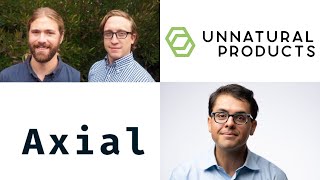
In this Axial podcast episode, host (Speaker A) interviews Cameron Pye and Joshua Schroescher, co‑founders of Anatra Products (also called Unnatural Products, UMP). The conversation traces their journey from graduate studies in Scott Lokey’s lab at UCSC—where they combined organic synthesis, chemi‑informatics, and structural biology—to founding a biotech that uses an automated, AI‑driven platform to design and synthesize macrocyclic and cyclic‑peptide therapeutics. They explain the scientific basis of macrocycles, how these large ring structures break traditional small‑molecule rules yet can be made cell‑permeable, and how they leveraged this to target historically “undruggable” proteins such as p53/MDM2/MDM4 and KRAS G12D. The founders describe building a high‑throughput workflow that couples parallel solid‑phase synthesis with machine‑learning models for permeability and other drug‑like properties, and they discuss the metrics they track (e.g., permeability fold‑change, number of compounds synthesized). They also cover business motivations—recognizing a market gap between pharma’s desire for macrocycle binders and the lack of scalable technology—along with the decision to stay in Santa Cruz, leveraging the local talent pool and UC Santa Cruz ecosystem. Throughout, they share lessons learned about negotiation, teamwork, remote work, and company culture, and they hint at upcoming milestones such as new partnerships, expanded target programs, and hiring needs.
Chapters
Welcome to the Axial podcast. Axial is an early-stage investment firm based in San Francisco. We partner with great founders and inventors investing in early-stage life science companies, often when they are no more than an idea. Axial is fanatical about helping the rare inventor who is compelled to build their own enduring business. For the first podcast, we have Cameron Pye and Joshua Schroescher, the founders of Anatra Products. Combining AI and medicinal chemistry, the company has built a platform to drug the undruggable. In our conversation, we cover the journey from the lab to building a company, the history of natural products, and the future of drug development. Hope you enjoy this great conversation with Cameron and Josh. Hey Cameron, hey Josh, how are you? Thanks for the podcast, this is the very first one. Thanks for taking the time.
Well, thanks for having us, Josh. I'm excited to be the first guest here.
Awesome. So we've known each other for, I think, around 3 to 4 years now, and I met you two when you were kind of raising the pre-seed round. And yeah, just really awesome to see all the progress you made over that time period, going from, you know, two scientists in the laboratory to, you know, a company of what, 10, 20 people and bunch of partnerships and programs and development. Yeah, maybe you can give us a quick overview on Natural Products, the company, how you guys got started, the vision of the company, stuff like that. Even the history of Natural Products would be interesting as well.
Yeah, absolutely. No, looking forward to it. Yeah, it's been a while. We've known each other since we were bright-eyed and bushy-tailed, fresh out of grad school. I think, you know, we look back at some of the old pitch decks recently and some pretty garish, overly scientific graphics, brutal PowerPoint slides that we used to think was a pitch deck. And compared to the polished and designed ones we have now, it's fun to look back over that time frame. So looking forward to telling the history here.
Yeah, but, you know, surprisingly, I think the vision's really the same now as it was back then, if you can interpret the bad grad student vision of what a good pitch deck looks looks like.
But yeah, maybe, um, yeah, we can just kind of start talking a little bit about kind of how it all began, uh, and then the transition to what we're building, uh, and, and yeah, maybe cut in with questions as, uh, as you see fit, Josh. But, um, yeah, basically Josh and I met each other in grad school, uh, going on— well, I guess we met each other on the grad school visit, um, going on probably 11 years ago at this point, which is crazy to say out loud, uh, and Both wound up in Scott Loki's lab at UCSC to do our PhDs in the chemistry department, biochemistry department there. And yeah, I came in really wanting to do like total organic synthesis. I thought that was going to be the coolest thing I could do because it was what I had done my undergrad research in. I think, Josh, what was your focus?
Yeah, you know, I, I was excited about UCSC because of their structural biology program in RNA. You know, looking back 10, 11 years ago, the spliceosome was kind of the final frontier, and this was before real cryo-EM. And UCSC has Harry Noller who did, you had a big part in the ribosome. And so I was like, oh, you know, I'm gonna come to UCSC and help crack the spliceosome. And, you know, the program we were in had a rotation system where you were kind of forced to work in multiple labs your first year. And kind of as an afterthought, just for fun, I tried Scott Loki's lab as my last rotation. And, you know, he kind of does this chemical biology trying to understand how to make molecules to modulate biology from a chemist's point of view, and that's really what I fell in love with, the idea that you could basically design compounds from the ground up to modulate biology in unique and interesting ways, and then use that as a tool both to understand how biology does what it does, but then ultimately create therapeutics.
Yeah, I think I, I came in, uh, in the organic chemistry track, still had the ritual hazing, uh, that was a part and parcel for that, that degree, some of which was these cumulative exams that the professors were these like bonus exams that you took on Saturday mornings. They were ruthlessly hard. You had to get a 60%, was a passing grade, on like 4 out of 12 of them. And Scott's questions that he asked were always like the most interesting. The papers he assigned, I really kind of fell in love with. And yeah, just this kind of general idea of, you know, we understand a lot of the kind of the general framework of biology, but how you actually start to pick and pull and see where you can push and prod that system into a place you want it to be, maybe from a place it isn't, is really through these chemical tool compounds that we can dose in cells and animals and hopefully eventually turn them into drugs. And Scott's lab is all about doing that and kind of pushing the next frontier of chemical biology from a chemistry-focused perspective. And so, yeah, I wound my way in that lab as well. I actually, yeah, like I said, came in to be a chemist and then I was, I think I was helping Scott like install Microsoft Office on his Apple computer and he was impressed with my IT acumen, and he was like, hey, do you want to be a computational chemist? Because we have a spot open and you can put your name on it. And, uh, and so he bought me a nice computer and whatever software licenses I wanted and, uh, kind of became a self-taught, uh, chemi-informatician, uh, and then luckily under the tutelage of some other great folks. And so yeah, that kind of became our two, two focuses in grad school. Josh a little bit more chemistry with a biology edge, um, and me a little bit more chemi-informatics, um, with the occasional, uh, dip into the chemistry lab, um, and And yeah, I think one of the other things that was kind of unique about our PhDs was really that Scott's lab was almost entirely funded through these pre-competitive pharma collaborations. So Josh's first program was solving a synthetic mystery with a bunch of crack team of a chemist over at Pfizer on a particular program that we had been collaborating with. I wound up working with Roche and Eli Lilly, and we had postdocs from Daiichi Sankyo and Lilly in the lab. And MedImmune did a project I was involved with as well. And so, we just had this really pleasantly industry-focused gaze throughout our every tower research. And I think that let us know that what we were studying was directly applicable to the market at large out there and gave us the confidence to start on natural products in the first place. But yeah, maybe we could discuss a little bit of science that we were working on in Scott's lab, or do you have any other—
Absolutely. That's, that's— I didn't know that part of the story, Cam, where that's how you got roped into the computational work. That makes total sense in terms of the number of papers you're on. That is really impressive. I think you're on like 12 papers from grad school over like a 4-year time span, and you know, that's kind of the hallmark of a comp bio person, right? Because they have their hands in everything.
Yeah, it's really interesting seeing the evolution in Scott's lab of people like Cam and then some grad students after starting to learn how to code and even just being able to manipulate data that's larger and more complex than what you can do in Excel. It really quickly changes the, even just the design of experiments, you know, you, you, when you're designing a new experiment in Scott's lab during our time, it was all about data. You know, how do we get larger data sets of compounds that we can start to pull apart these structure-property relationships. And, you know, if you're imagining the final step of the process is manually crunching through thousands and thousands of data points, you just don't even design that as a project. And unlike bioinformatics, where there's a really mature field, cheminformatics is kind of a little bit more on the fringes. And, you know, Cameron developing some of these computational tools really shifted our mindset into how we could design experiments. And I think that's really instrumental in the advances we made in Scott's lab and then now kind of in the DNA of UMP.
Absolutely, so maybe you can kind of give us a high-level overview in terms of what macrocycles are.
Yeah, absolutely, so yeah, maybe just, yeah, rewinding a little bit, the work we were doing in, in Scott's lab was, yeah, largely focused on this unique chemical structural class called macrocycles, and As that name might suggest, it's a large ring-like structure. In fact, I think the, like, classical definition is a compound which contains a ring of 11 atoms or greater, which isn't particularly exciting in its own right. But what's unique about these things is that they can kind of break the rules of traditional medicinal chemistry. And that, you know, over the past 100 years or so developing small molecules, you know, there's been some kind of rules of thumb that the medicinal chemists have learned to kind of create successful quote-unquote molecules. Some of these were retrospectively learned, some of them from the first principles. But in general, one of the central tenets is you got to keep them less than molecular weight 500 Daltons. And that means that these compounds are usually pretty small. And one of the reasons for doing that is so that they can slip across your cell membranes and access the inside of the cell. But nature kind of threw out that rule book or never had to learn it in the first place because she's a pretty good chemist. And one of the molecular classes that that kind of evolved out in the wild were these large ring-like structures that were able to do something unique. They could be quite a bit larger than your typical small molecule, up around molecular weight 1,000 or greater. So, you know, over twice the traditional kind of cutoffs for us mere mortals. And then they were still able to cross cell membranes and survive out in the wild. You know, these things, a lot of our antibiotics fit largely into this class, things like erythromycin, thancomycin. And then one kind of subclass of macrocycles that we're particularly, particularly interested in are these cyclic peptides. So these large rings that are composed of mostly amide bonds and kind of examples here are cyclosporin A is like the poster child in the space, this immunosuppressive drug that we've been using for decades. What makes those particularly interesting is that, you know, of things that are guaranteed to be the least drug-like and the least cell-permeable. Large peptides usually fit the bill, I think, if you asked a traditional medicinal chemist. But, once again, nature is not your traditional medicinal chemist. And so, the beautiful thing about peptides is that they're really modular and actually lend themselves to design and synthesizability quite well, that we're really good at forming endodons. And based on some great Nobel Prize-winning chemistry, actually by Merrifield, we have some synthetic tricks called solid phase synthesis that allow us to make a lot of these things really quickly. So, there's a huge, like, kind of attractive reason to be in the peptide space. The problem is, it's just they've never looked like drugs. But, it turns out, you know, we've had these examples from nature for a long time that showed it's possible. It was just a matter of balancing properties. So, you know, our research in Scott's lab was unpacking those cyclosporins of the world and and seeing what made them kind of tick from a biophysics perspective. So both, you know, Josh did some fantastic like spectroscopic work and really trying to understand them at a really fine-grained structural level. I did some kind of theory work and some broad brushstrokes, more like computational chemistry and modeling of those things. And kind of what the takeaway was, was that we had kind of at least learned to emulate nature's toolbox. To a well enough degree that we could translate this kind of rule-breaking behavior, cell permeability into the macrocycle space in purely synthetic contexts. That really kind of like opened the door for us. I think that was the aha moment was when we started making these large datasets of passively cell membrane permeable synthetic cyclic peptides that were, you know, crossing cell membranes. The only trick was they didn't do anything when they got inside the cell. These were just, you know, kind of contrived model systems, but But yeah, that was kind of the aha moment for saying, hey, we're going to be able to train some machine learning models on these datasets, use some of the same chemistry tricks that Josh had been developing to make these large libraries, and then apply that to this kind of iterative, you know, predict and synthesize and check cycle that we could use to hopefully design some really interesting drug-like properties into these large rings against really attractive intracellular targets.
That makes a ton of sense. And I know it's a longer story, but what was the premise to start a company? Like, what got you the courage to, you know, while in Scott Loki's lab at Santa Cruz, say, hey, maybe we should start a company? How did that conversation get started, and what was that kind of initial premise?
Yeah, I mean, I think, you know, at one level, the premise of Scott's work was if we could make truly synthetic cyclic peptides behave like natural products, we'd be able to address, you know, a huge number of these drug targets that had gone unaddressed simply because we couldn't get chemistry that balanced, you know, potent target engagement with drug-like properties. And, you know, when Cam and I joined Scott's lab, if you found a purely synthetic cyclic peptide or macrocycle that was cell-permeable, that was a paper in and of itself, just that single data point that, hey, hey, look, we could, whether it was by dumb luck or engineering, may make a compound from nature. And when we left Scott's lab, we were routinely making libraries of thousands of cyclic peptides with a variety of structures that had cell permeability, favorable water solubility, other drug-like properties. And so it really felt like by the end of our PhDs, we had seen kind of that inflection point from being able to simplistically mimic nature to creating large number of compounds that really had the property that we've been searching for. And so we felt that technologically we were at the right point in time to start, you know, using this in a therapeutic context.
And then I think from a kind of business and market perspective, kind of the courage or the hubris to forego some soft job offers and the traditional postdoc path and then go the lonely road of entrepreneurialism was that, you know, we would go to these conferences that were pretty dominated by pharma, you know, either pharma talks or biotech talks, and where some of these other macrocycle discovery platform technologies were getting kind of hawked. And we could see kind of that there was just this missing link between what pharma wanted and what the current technological offerings were. And really, it was Scott's research and a way to really reduce it to practice and make it scalable. So I think whether it was listening to the talks and throwing stones in glass houses as academics, asking questions afterwards, or grabbing beers with folks after hours at conferences and just kind of asking what was holding up the adoption of this molecular class, we realized that it was really the technologies we could build based on our current know-how and understanding that Josh said was really nascent. I mean, it happened during our PhD work., you know, to some extent was, was Josh and I's contribution to the field. So I think, I think that was kind of the, the impetus to do it was really just kind of getting the snapshot of where things were and seeing the hunger and desire for it, but just kind of the inability to execute. Um, and, and knowing that we had a technical solution to that problem. And, you know, in a lot of ways, I think, you know, Josh alluded to this, but it's like both halves of the coin were kind of proved out. It was just It was like, how do you put these two things together? One, we had these natural products examples, so we knew this was possible, right? Like nature had figured out a way to do this and we were using these things as therapeutics. So, we know that it can be safe and effective in humans. And, the other side of the equation was these undruggable targets that we've known about for decades, things like KRAS, which has been in the news lately with Amgen's compound, but MYC and p53, beta-catenin, and all these kind of core drivers of oncology that we've known about, but we just haven't had drugs to actually go after from a chemistry perspective. And so we saw, you know, macrocycles as being the kind of through line to connect both this biology that we wanted to drug, and we finally had a technical solution to translate kind of what nature had cooked up into the lab in a designable and repeatable fashion.
What's the natural products up to now? What are you excited about for the company? What are the kind of major highlights? What do you see on the roadmap for what you're building?
Yeah, absolutely. I mean, I think, you know, as we spun out, like we said, we kind of had this know-how and datasets and idea of how to leverage those into tools, both synthetic and in silico in the case of these machine learning models. I think, you know, what we did since then is really, you know, reduce that know-how to practice and really adopt this kind of, if it can be automated, should be automated kind of mantra inside the organization. So I think this notion that like Zymergen uses and industrializing the process, I think we've set out to do that really from the get-go of saying that, hey, this chemistry lends itself to parallelism, so let's make it parallel right from the get-go. Any data that we produce should be captured in a structured format that we can feed straight back into models. The front and back end of that process, both design and the data capture and interpretation, should be as automated as possible from a software perspective. And so we just set out, you know, building various tools to really allow that process to happen. Some of that was in the early days in the garage, me writing code, Joshua mapping out some of what those synthetic strategies were going to be. And then when we got underway in the lab, it was, it was really translating that into, into a set of tools and a platform that, that could do macrocycle med chem, which has really been that, that blockade I was talking about previously was really how do we, how do we engineer those properties into these macrocycles? Turns out they're really robust ways of identifying cyclic peptides that bind interesting targets. That, that hasn't been the hard part. Of the problem to date. So we could pick up some of these broken macrocycles from the public domain that bound a hard target but couldn't get there, and then start to, start to work on them. And what working on it means is, you know, improve changes to that chemical structure using these machine learning models that, that will improve permeability and other properties while hopefully maintaining or improving target engagement, and then synthesizing several hundred compounds based off that premise in the lab and then testing those in a variety of different systems and feeding that data back in the next round of design. So p53, we mentioned earlier, is one of these quote-unquote undruggable targets. We were going after that with one of our first programs through drugging the interaction with it and its negative regulators, MDM2 and MDM4, which has been traditionally an undruggable target to be able to hit both of those simultaneously.. And we did just that. We arrived at some, excuse me, bispecific compounds that were able to be cell permeable, ostensibly look like small molecules, except for the fact that they were hitting these undruggable targets. Yeah, and since then we've gone on to do it with partners as well. So I think, you know, like we'd said, those technologies for identifying potent cyclic peptide binders have found their ways into the hands of many pharmas, large and small. Small. Peptidream, a company out of Japan, really pioneered this mRNA display technology, and it's wound up at pretty much all major large pharmas, some of which did full tech transfer deals. So, you know, we're picking up where that platform leaves off internally with some partners there. Got a few others in the works, hopefully. So stay tuned on that. And then internally are tackling some of those other undruggable targets. So KRAS, G12D, we have a program that's so that's alive and well. Really excited by Amgen and I think soon to be Miratis and other progress against G12C, but that was kind of the quote unquote easy mutant of the KRAS mutant family. And unfortunately those covalent strategies won't work against some of these other more challenging mutants like DND, which we're currently cracking. So yeah, I think, you know, that's kind of the long and the short of it was really taking that know-how and, some of those datasets from our academics, building tools around those, continuing to add to them every day, of course, and then building a team that could leverage those to really do some best-in-class work against what are essentially the most valuable oncology targets.
Absolutely. Really inspiring. What do you see as your core metric or set of metrics for your platform you're building?
Yeah, I think it's not as crystal clear as just kind of like data points or a number of compounds synthesized. It's really One of the things that's been challenging about cyclic peptides and macrocycles in general is that we're actually pretty data poor. Unlike a lot of the quote-unquote AI and drug discovery companies going after typically small molecules where there are these publicly available and then private datasets that some get access to, just hundreds of thousands to millions of compounds characterized in a wide variety of assays. That doesn't exist for cyclic peptides. And macrocycles. So we've really had to build it ourselves. And so it's really about what data points you build and kind of which assays you ask questions in that we found is actually the most important rather than the sheer number of data points, just because we're kind of up against a disservice to time, I think, in the small molecule versus macrocycle landscape.
But, you know, one thing that was kind of one of the first technologies we built at UMP was, you know, these large cyclic peptides, macrocycles, aren't really treated well, like Cam was saying, because of a lack of data by the models people would use for small molecules. So there wasn't really a great model to predict cyclic peptide macrocycle permeability definitely not from a 2-dimensional structure. You know, there's all these— for a long time we've had QSAR and QSPr, where in the small molecule space you can put in a, a 2-dimensional structure and then out comes a whole bunch of predicted properties. Well, that really didn't exist for these larger compounds, these macrocycles. So based on those datasets we'd built in Scott's lab, we created some new models that let us predict macrocycle permeability, at least vaguely. And the great part about that is it lets us see how far off are the cyclic peptides that other platform technologies produce. And because the molecules are so much larger, they can be a lot worse, and it's hard to tell that just from visual inspection. So when we pick up a compound from another discovery technology that's out in the public domain, in a patent, in a partner, they're often off by log units, and I mean like 10, 15, 20 log units sometimes, away from values that are actually drug-like in the permeability sector, and this is because of a lot of polarity, excess molecular weight, excess charge, and so for our projects, the dynamic range of the actual assays is only a few log units, So when we're running a project like our KRAS project, we can see ourselves make jumps literally millionfold towards drug-like properties. And, you know, these models are really the compass that let us know that we're making headway outside of what you can observe. So those are really exciting metrics because, you know, we're kind of unique in our ability to understand peptide permeability across a really large chemical structure space.. And so that's one metric that gets us excited when we say, hey, we made these modifications. Look, that's 1,000-fold, 10,000, 100,000-fold progress towards our ultimate goal of these compounds being permeable like small molecules.
Yeah, funny anecdote. We were talking with one of our partners and we were really excited because, yeah, we're charting progress across this modeled space, which we have a lot of confidence in. Those partners, it was our first engagement with them. They're still kicking the tires on the technology. We were zooming out a little bit and we said, hey, look, you know, we've synthesized, you know, close to 1,500 compounds over the duration of this. You know, we've come from, you know, a predicted trillion-fold increase on cell permeability from the starting point that the partner had given us. And the senior scientists on the call leaned back and kind of gruffly said, well, you know, Cam, a trillion times zero is still zero. And it turns out, you know, it wasn't zero, it was 0.00000001 because the next week we got to observably permeable binders on that program series. So, it's like moments like that where we alone kind of have the metric where we can kind of understand the progress that we're making and then to see it bear out time and time again on these different programs, it's just super gratifying as a scientist and a founder.
Absolutely. I think kind of designing the right experiments and models for macrocycles you can create these kind of massive leaps in predictive power. You know, maybe one metric, kind of, it would be like if you could synthesize 1,000 compounds, you know, how many PhDs is that?
Maybe 10 million or something? Yeah, the, uh, no, that's funny because actually, you know, this, the synthesis platform we have internally, um, the first time we ran a synthesis on it, I think I made 80 compounds simultaneously and it took maybe a week just by myself. And I turned to Cam and I said, well, I've made about 60 compounds in 5 years as a PhD student, so I already, you know, made more compounds in a week than I had during my whole PhD.
So yeah, for a while we were tracking the number of PhDs we had made. That's awesome. Uh, maybe the last point, I think the part that I really like about what you're building beyond the technology is just where you're building it. You made a decision to locate in Santa Cruz and keep the company there. And very early on, there was some push for you to maybe move to Palo Alto or something, but you kept the company in Santa Cruz. What's been your experience in Santa Cruz, and what do you see as the opportunities and challenges, especially recruiting executives and whatnot? To build a biotech company in, say, quote unquote, a non-hub like San Francisco or Boston?
Yeah, no, I mean, I think we're not the only ones to do this. You know, I think you mentioned Recursion earlier, and I think they made a similar pitch. I remember being inspired when they did the release that they had bought an old Dick's Sporting Goods store and had a 3-story climbing wall in their headquarters. I think we're not quite there yet, but But what we do have is, yeah, about a 1,000-foot walk to Natural Bridges State Park, which is a beautiful coastal park right around the corner from us. And I think some of the same things that Recursion uses in their recruiting, we use in ours too, which is that I think science is ultimately a creative art and that there's a quest to reduce it to engineering, which again, I think we We're on that spectrum as well, but it's best when you can recharge the batteries and really find people that know how to do that. And I think, work hard, but also stay creative and passionate. That's like when good science happens. And it helps if you're in a beautiful place with like-minded people to do that. And I think Santa Cruz has that kind of ethos to it. The other thing it has is kind of the, the diamond in the rough UC, I would say, which is that UC Santa Cruz is kind of this Goldilocks institution where it's large enough that it has like best-in-class resources, fantastic faculty, you know, like bioinformatics is obviously legendary since we were the first to sequence the human genome, but also structural biology and chemistry legends have all gone through there, and because of that a bunch of, you know, great grad students and postdocs come to work at the university, fall in love with the town, and then there's not a lot of biotechs as of yet in Santa Cruz. And so we get to kind of skim the cream of the crop off of UCSC and get the yellowest banana slugs from that down at work. And it's really been fantastic for building the R&D team in-house. And I think just, you know, people come here, they want to be here. They're not looking like across the street in the Dogpatch or across the hallway at J Labs wondering if they should be at that other startup. They want to come to work and do their job in that creative and kind of laughter-filled environment that I think we have here at UMP. So I think it's actually been, I would say there are more advantages than challenges building here. You make a great point about executive recruiting. I think that the one silver lining also of the pandemic has shown us that we're actually all pretty capable of remote work, particularly for jobs where we don't need to be on premises. So I think there are more folks in the driving distance of Santa Cruz or in Santa Cruz that fit the bill for executives, biotech and otherwise. Actually, Ahmed Hamdi is a Santa Cruz local and he was the CMO at Asserta. And pharmaceuticals before that and just founded Vencera Therapeutics. So I think, you know, there's more in your backyard than you might think. And then it's actually really easy to build a team that isn't necessarily all on-prem these days for positions that don't necessarily need to be. So I think, you know, we're building kind of a modern biotech and some of that's distributed and some of that's consolidated here in Santa Cruz.
Yeah, if you're going to be one of the cool companies in an area, especially with world-class talent, you're going to monopolize talent. So it's like very, very advantageous. I think in drug development, the counter case study is Array BioPharma. Pfizer kind of got a deal with them. If Array wasn't based in Colorado but based in Boston, maybe Array would be much larger or maybe it would be acquired at a much higher price. And Array's issue historically was recruiting executives. So I think hopefully this remote work remains and getting executive talent which doesn't need to be on-premise, but it's easier. But, you know, to wrap up the podcast, you know, one thing we want to start doing is, is asking 2 questions for every guest, so then over time maybe comparisons can be made. Um, but the first question is, you know, out of this whole story, which is really awesome, what's been the kind of the single most valuable lesson you've learned while building, uh, UMP?
Yeah, one of my, uh, one of my takeaways is is everything's negotiable. And in the early days, it's tough to see that. There's a lot of things that seem like they're lines in the sand. I would say that's, that's true with like yourself and, and outside deals as well, that like a lot of times I think particularly as PhD founders, you draw these really firm lines around like what you're trying to build, um, or who you want to do it with and then some of these things. But you realize that that, yeah, much like science, it doesn't always work out the way you plan on paper, and some things are actually more advantageous. So I think that, you know, everything's negotiable. Don't ever take a deal at face value, whether you're making that deal with yourself or with someone else.
But Josh, you have something else. Yeah, yeah, I mean, I think, you know, academia is interesting, right, because you're, you're a single grad student or postdoc in a lab and It's not Lord of the Flies, but there is some element of you drive your own thing forward yourself. And, you know, we were very collaborative, but I think a lot of times the thought is kind of do as much as you can yourself because you want to have as much ownership. Less authors on the paper, the better. And, you know, here I think I've really learned the value of teamwork in science where we've built this great R&D team and having everyone together thinking about the same hard problem and just months of concerted effort by a bunch of smart folks on a problem, you can crack really hard problems that no amount of individuals doing their PhD would ever crack. So I think that's been really cool to see the transition from academia to industry where it's much more team-focused and you can, you know, you run into a wall and maybe you can't find a way around it, but enough hard effort and you just kind of blow your way through it.
Absolutely. I think You know, science has rules. You know, there's rules to science. You can't break them. And that's kind of makes it really hard. Business has no rules. There's only one rule in business. Just be ethical. And that's it. So as long as you're ethical, you can do whatever you want. It's just, you know, you just got to, you know, like you said, can be a good negotiator. What are you two looking forward to this year?
Oh, man, there's, there's so much. I mean, it's, it's, it's funny because, you know, some of our friends ask us how things are going and we're always just So excited. We got this great data rolling in. I mean, Josh, I kid you not, is scrolling through data on his laptop right now as we're doing this podcast. But, uh, and our friends are always like, man, it just always seems like there's good data coming in. We're like, well, I mean, it's, you know, good data that punctuates like the moments of, you know, falling flat or abject failure. But, uh, but with enough, like, that, like Josh said, the team that's coming together and the science, the general thesis working, it just seems like there's something exciting happening. Uh, every day someone's excited about something. And I think for us, there are a few things on the horizon that I think are really keeping me up at night in a good way. One is, yeah, some new partners coming online, I think, with some really exciting biology to work on and should be fun to work with that group. And then some technologies in-house, like I mentioned, that, you know, de novo discovery is quote unquote a solved art in this space through some fantastic technologies. Well, we're riffing on a few of those and got some really exciting early data that I think is just going to make us be able to really point the UMP cannon at any biology of interest and see it fall to this approach. So I think both just, and then really seeing the team continue to grow in both capability and number, I think it's just such a fantastic gift to be able to come to work every day and just work with this passionate group of scientists and operators and just kind of feel that excitement and buzz. And to have more of that just seems unfair, but I'm looking forward to it.
So, but yeah, I'm more looking forward to just the news that's already done that's yet to be announced. And so, look, I'm looking forward to announcing some big news for UMT over the next few months. I think it's going to— for me, that's probably the The biggest thing for the company, but maybe to last thing, do you have any plugs for UMP? You know, are you hiring for any positions?
Yeah, absolutely. I mean, we are hiring always, I would say, you know, both on the wet lab front. So I think chemists and biologists are always, always particularly peptide chemists. If you got some peptide experience, it never, never hurt. And if you've got a little high-throughput ilk to your biology, then that's appreciated as well. And then computational too. I mean, you know, give me informaticians and out-and-out developers for working on the tools. And yeah, if anyone's listening to this at pharma and is tired of decision committees and being stuck in the morass of, you know, Kenilworth, New Jersey, or some other place like that, then, you know, give us a line.
Maybe there's something to be done. Yeah, yeah, we really, I think, try and hire opportunistically where, of course, we hire to fill specific needs, but, you know, great passionate people who are interested in problem solving with, with a team of, you know, really, I think, interested and engaged folks. That's who we're looking for. So, you know, we'll find a place for you if you've got the UMP ethos in you already.
That's right. Awesome, guys. Well, thanks for doing this today. I learned a ton. Learned some tidbits about Unnatural Products I didn't know. And yeah, I'm always very excited to talk to you two. And so you're always welcome here.
Well, thanks for having us, Josh. It's, it's just been a pleasure having you partnered with Unnatural Products for so long. And congratulations on everything you're building here at Axial.
Looking forward to— I really, I really appreciate it. Yeah, it's kind of— I think you have to be a good investor, a good analyst, and then, you know, help your customers, which you you and other scientists and founders, and then another element, you got to become an influencer. And so I'm trying to— I've been about 2 years into social media, right? I've never used Facebook or anything, so it's kind of doing stuff that makes you feel uncomfortable a bit because it's important. But yeah, this is always really fun. I'm going to look forward to kind of doing a follow-up. Maybe in a year, uh, maybe do some recurring thing. That'd be really cool. But, uh, where are they now? Exactly, where are they now? We'll do like a follow-up study, uh, uh, but thanks guys, I really appreciate it.
Uh, yeah, thanks a lot, Josh.
All right, you have a good one.
More from Joshua







Scientist Stories: Hans Waterham, The value of phenotypic assays in peroxisomal disorders




Scientist Stories: Joel Zlotogora, Genetic carrier screening programs for reproductive purposes