Bill Walsh, The Score Takes Care of Itself
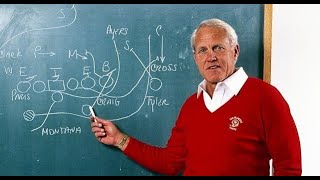
A former assistant recalls Bill Walsh's methods that built the 49ers dynasty: meticulous practice scripts, the West Coast offense, and psychological tactics like creating tension between quarterbacks Joe Montana and Steve Young. Walsh yelled at coaches instead of players and obsessed over preparation so thoroughly that the score took care of itself.
Chapters
I am familiar with the book. I've read it. This is an amazing book. This book is hard to find. If you try to buy it on eBay, it's— you're talking about $100 or more. This book is really about how to manage and get the best out of people. Every football coach should have it. I'd be surprised if they don't. What I learned from reading this book would be some of the things behind the scenes that, you know, I would have no way of knowing unless they were explained to me. As close to scripture as you can get for a coach, or It's the Bible of football coaching. It's a great book. It should be required reading for every football coach. You gonna be a football player when you grow up? Today is the best day of your life. Believe it. He might be the finest quarterback produced in the last 10 years. He can use some daylight. That's all I need. Fortunately for me, I didn't lose my life. I didn't lose my job. Football convinced me that life is a team game. The rest of your life, nobody can ever take It's been said that we are all authors of our own life story. Some are triumphs, some tragedies. Some collect dust, some become bestsellers. Like most, the book of Bill Walsh has its ups and downs, but in the end, his story is one of the NFL's greatest masterpieces. He was the author of a franchise's unlikely revival. We're just a group of young players that have excellent chemistry together. The creator of the West Coast Offense. As Paul Brown would say, we're a precision machine. A dramatist who scripted the greatest quarterback controversy in NFL history. We're going to have to select between Steve Young and Joe Montana. That's a critical area for us. A man nicknamed the Genius after 3 Super Bowl championships. Was this the final game on the sideline for a great coach, Bill Walsh? Yet page after page, he remained his own worst critic. I wish I'd have enjoyed it more because those were the Truly golden years. A lesser-known chapter of his career is a monumental book titled Finding the Winning Edge, written by Walsh 8 years after his retirement as head coach of the San Francisco 49ers. To know the book is to know the man. This is everything that this guy talked to me about. I can't read it cover to cover. It's— I'm not— I, I, you know There's places that I really am interested in and other places I just can't go to the detail that he was interested in. I have this sitting in my house. He left coaching too soon for me, and he left this world too soon, just as you start to get to know him. Well, he'd been asked many times by a number of different organizations what he had used to get to the point where the 49ers were winning Super Bowls. So he was giving talks and giving lectures, and one day he said, why don't I just write a book? He was infamous for having all of his lectures and team meetings videotaped, and it came in really pretty handy when it came to crafting the book because he could go back and see exactly what was his mindset. Walsh also looked to the past for a writing partner. He found one in a former 49ers public relations assistant turned NFL coach. I think how antiquated we used to be, but I had a little cassette tape recorder. Little mini cassettes that I would literally tape our conversations. What's tending to happen now to the head coach is he's becoming more press secretary and less coach. Yeah, it's fascinating to be able to look at the original manuscript, and I think you can get a sense of the way it was laid out. My writing abilities were only such that I knew we were going to have to bring in an editor to clean up the flow of the book because this was, this This was little more than an outline. Bill Walsh didn't pay me any money. Didn't bother me then, it doesn't bother me now. I wrote this book primarily because I wanted to get to know Bill Walsh better. I said, Coach Walsh, if we're going to do this, why don't we make this your legacy project? And he said, what's that? And I said, let's do a book that is so comprehensive that no one will ever try to write a similar kind of book. There's a rule. With a legacy as large as Walsh's, there was plenty to write about. 500, 550 pages. That was cut down from a svelte 800 pages. This thing just kept growing and growing. What this book reminds you of is how meticulous Bill was and how thought out everything was and how specific he was. The scheduling, you know, down to the minute of this is how the way the player's day is going to go. Utilization of formations, you know, personnel groups, how your plays should be in a minicamp practice when you only have helmets. Practice schedules, offseason programs, draft evaluation. Everything is in this book right here. So then Bill decides, well, no, we got to have— we got to have X's and O's in there. There's got to be a purpose for any information you give. You're giving them more information than they need. No, I think this is important here. But I said, Bill, the minute we put a football diagram in, this thing's going to be shoved on the sports section. And it's not going to sell anywhere near. And he says, I don't care. Finding the Winning Edge sold just 35,000 copies. Although it went on to become the definitive textbook for running an NFL franchise, its author was tortured by the imperfections he saw within it. It just wasn't good enough, you know. But that sort of seemed to be how a lot of things had been for him. Even if this was a success, he would still somehow find a way to not consider it one. Coming up, I'd be on the phone with him in half an hour, and I'm trying to convince him not to jump off the bridge, that he might win next Sunday. I spent the 5-hour flight home sitting by myself. I looked out the window so no one could see me break down. It was too much for anyone. I was emotionally, mentally, and physically exhausted. I decided I would resign as soon as the season ended. I believed I had done as much as I could do, and the job was just too much for me. Bill Walsh thought he was a failure. 27 games into his NFL head coaching career, he had just 5 wins. He inherited a team that won 2 games in 1978. Roll 1. Before he even coached a game in San Francisco— oh, let's start over again. All right. Walsh was asked to host a preview film of the 1979 season. Oh, that's not good. Start over. The hell was I saying? My mind wandered. And as he threw the ball, it was Got my mind on things going on downstairs. That's why I'm in trouble. Okay. And though he did his best to hype the coming attraction— in 1979, we expect to have a very competitive team— deep down, he might have known his show was going to bomb at the box office. That was just pathetic. I mean, that's pathetic. He had his work cut out for him tremendously. I mean, some of the Saturdays, even right before games, He would hold tryouts and there would be not like 20 or 30 people, but 200 or 300 people coming in. He was trying to find anyone that could help the team at that point. What the hell happened to the damn pickup? I can't believe it. In 1979, we inherited a team that didn't think they were going to win a game. I mean, they— that was the attitude of the team. They actually won 2 games, and after the second, a town and a team with the lowest of expectations celebrated as if they'd won the Super Bowl. In 1980, the losing continued. We've had this taste in our mouth one too many times. I don't have to suffer through this anymore than you do. I don't want that sick feeling of losing a game that you should have won or could have won. That sickening, lousy feeling. I can remember Bill after a loss to Miami, the 8th loss in a row, literally in tears. I looked out the window for 5 hours in the middle of the night because I broke down emotionally. I had conceded that I couldn't get the job done. Bill put everything on himself. He wasn't blaming the coaches. He wasn't pointing fingers at the players. It's my system good enough? Am I doing it the right way? Am I a failure or not? Walsh may have accepted the blame, But he shared his misery. I'm coaching now at Philadelphia, and I finally got my program going, and he would call on Monday. I'd be on the phone with him a half an hour, would hold up my entire offensive meeting. Now there's a 3-hour time zone difference, so it's midnight in Philadelphia, 9 o'clock in San Francisco, and I'm trying to convince him not to jump off the bridge, that he might win next Sunday. Bill, you're crazy, you know, you're crazy. At the start of my third year, I just wanted our team to have some respect in the National Football League because we didn't. We began to demonstrate offensively that we could be interesting. He would put plays in, in meetings sometimes, and say, you don't have to flinch when you catch this, there won't be anybody around. You'll be wide open. You know, we're all thinking, yeah, they get coached too. And, you know, you'd catch it, get ready to get hit, and turn around, and he would be right. Nobody would be there. No one was within 10 yards of him. We not only got respect, but we played more intensely and more fiercely than anyone in the game because the 49ers had been embarrassed and humiliated for a number of years by virtually everyone in football. So whenever we had a game, it was sort of a vendetta. It was like the last game we will ever play, and we played that way. Ronnie Lott intercepts, he's in for 6 points for San Francisco. And what happened that year was like Ali coming out his first year. A lot of confidence, a lot of, hey, no one can stop us. This time when they carried him off the field, it was because he had won a division title. But for the author to have a storybook ending and a trip to the Super Bowl. Walsh would have to beat Dallas. Fittingly, he had scripted a perfect play. We're gonna call a sprint option. When you think about the coaching point on my part of the play— Dwight is in here sliding back out. For him to say to Joe— Dwight will clear. He's gonna break up and break into the corner. Okay, you got it? Throw it to Dwight high enough to where it either goes out of bounds or he can jump up and catch it. You're ready to go to Dwight. Got it. You don't get what you want, you'll just throw— simply throw the ball away. No, not there. Away again. To think through that play all the way to that minor little detail, to me, you just really believe in every single thing he says. And he throws into the end zone. Touchdown! Touchdown! Touchdown, San Francisco! By Dwight Clark! Looking back on it, that was camouflage. That was Camelot. That was the origin of a dynasty. Many people erroneously think they have only one chance to succeed in their life's work, and if they miss that chance, they are doomed to failure. In fact, most people have several opportunities to succeed. Before Bill Walsh could write that passage, he had to experience it. As a young assistant with the Cincinnati Bengals in the late '60s and early '70s, Walsh thought his life's work was succeeding his mentor, the legendary Paul Brown. Bill Walsh loved him. He thought he was the example of how you do things. Bill, you see, after we get hit with a TD like we did there, that does something down here, and that's when you see what you just saw. Paul Brown thought Bill Walsh was a bright mind. He was a young, up-and-coming coach. Brown, the first coach to call plays from the sideline, even allowed his protégé to ghostwrite the Bengals' play calling. It was convoluted. A call would come from Walsh upstairs. 86 halfback curl. 86 halfback curl. And then Bill Johnson would repeat that call. 88 end delay. 88 end delay. Then it would go to the messenger guard and then on the field. Bill, we're not going to have much time probably when we get this. I don't want to try something that we're gambling a lot on. In the run-heavy NFL of the early '70s, the Bengals' high-percentage passing game was a sensation. Like WKRP's Dr. Johnny Fever, Bill Walsh was living on the air in Cincinnati. Paul Brown was ahead of his time, and Bill absorbed all this from him, but he wanted to take it to the next level. He wanted to include more of Bill Walsh's thinking. 86, double square out wide with— well, if we get 9, he wants to go down the middle, see if he can get up for a long one. Walsh believed he was Brown's heir apparent. Then on New Year's Day, 1976, the Bengals coach made a bombshell announcement. We were shocked when Paul Brown announced that he was retiring. The next announcement was Bill Johnson is the head coach. The next announcement was Bill Walsh is leaving. Bill Johnson is possibly my closest friend. I'd follow Bill to the end of the earth. There is no connection between my leaving and Bill becoming the head coach. The offensive players on the team, we all called Walsh, don't leave, don't leave, please don't leave. He said, I can't stay here anymore. I need my system to work somewhere where I get the credit. I've talked to Paul Brown about Bill Walsh. I asked him, I said, uh, why didn't you give Bill the head coaching job? He said, I didn't think he could handle the highs and lows, because Bill was— could be very high and he could be very low. Being passed over by the man he idolized plunged Walsh into a deep depression. His heart had been broken. He contemplated getting out of football. He was just absolutely devastated and didn't know if he could continue. He was in a state of shock. He came and lived in our basement after the Cincinnati thing for a while. He just was distraught. Do you feel a feeling of personal disappointment when you weren't given a head coaching job in Cincinnati? Shocker. But it did shake us. It shook us dramatically, and it took us a while to get over that. The only place Walsh could get a head coaching job was at Stanford University. In the NFL, he was approached and then passed over by the New York Jets, the expansion Seattle Seahawks, and the Los Angeles Rams. Speaking speculatively, would you possibly go down to LA? Well, I put it this way, I think the Rams are the finest organization in the National Football League, and if I were to return to the National Football I'd want to go with the finest organization. He learned later that Paul Brown had blocked him from a number of different coaching opportunities by giving him a bad review, by saying things that flat out weren't true. I think he was real close at the top of going to Green Bay. He thought he had the job, and Paul made a phone call and squashed it. It was, in a sense, a blackball of me. Had I not gone to Stanford University and been successful, I'd never been a head coach in the NFL. People had come to the conclusion nobody can have this kind of an intellectual approach to the game and be tough. Fasten your seatbelts. The outcome of a Super Bowl berth, everything hangs in the balance now. For Walsh, the catch was much more than the play that launched a dynasty. Dwight Clark's touchdown gave him a chance to settle a score. And how about Bill Walsh playing in the Super Bowl game against his old team, the Cincinnati Bengals? Should be a great Super Bowl. It's ironic that I would see Paul again. I just wish them the best. Publicly, it was all, oh no, it's just another game, it's not that important. Does it mean anything extra that in the Super Bowl you're going against Paul Brown's Bengals? Not really. This is the Super Bowl, and the Super Bowl in itself, the world's championship, there just isn't room for any revenge motive. I think Bill wanted to win that Super Bowl 6 '16, as mad as anybody could ever want anything. In the first drive, on the playlist was the triple pass. The reason we ran it is that Paul Brown always preached, if you got a trick, do it early before the other guy does it. But with the Paul Brown of today, innovation remains a way of life. Bill was thinking the same way in that game. Young, the tight end. What a play that was. That was a Paul Brown play. The message was, remember me, I was there when we used to do this. A beautifully deceptive play, and Bill Walsh goes to his trick bag for that one. He had his way of doing stuff like that. Here's Montana throwing toward the end zone, caught on the left by Cooper. He's got it, he's in the end zone, a 4-meter touchdown. Really meant something something to him. The only thing that would make it better is if Paul had been on the sideline instead of just the owner. Bill Walsh confounded pro football observers throughout the year, winning week after week, and now beating the AFC champions Cincinnati Bengals in the Super Bowl. In the 1980s, a philosophical war was being waged in the NFL. Some saw it as East Coast versus West, Others as smashmouth versus finesse. It was an era when many believed that might made right. Come on, run with power, run with some power. That the run was better than the pass and the sword mightier than the chalk. But this wasn't the first time Bill Walsh's offense was challenged by the old guard. When what is now known as the West Coast offense was being developed, It was summarily dismissed by many people as nothing more than nickel-and-dime football. History has shown that these individuals were glaringly mistaken. I agree with that. He always kind of laughed at the West Coast offense title. He says it really ought to be the Midwest offense because it's just the principles that we started in Cincinnati. 1969, they drafted this strong-arm kid Greg Cook from Chillicothe, Ohio. Greg Cook could do things that nobody could do. Greg Cook was, I believe, the greatest talent to play the position. He was Steve Young but bigger. Had he not gotten hurt, I believe could have been one of the all-time great quarterbacks ever. A shoulder injury suffered on this play eventually ended Greg Cook's career, and it forced Paul Brown and Bill Walsh to devise an offense for Virgil Carter, a quarterback who lacked the arm strength of Cook. Let me talk to him. Bill, what do you like next here? It was high percentage throwing. Lay the ball off short, let the receiver make the total yardage, the run after the catch. We began to control the ball through the short pass, always looking for the big play, but going then to the short pass. We won a division championship in Cincinnati with Virgil as our quarterback. So it was a little nickel and dime football in the beginning, but you had to do that. He goes, that's the only way we could do it. He took it to another level. The original stanzas of the West Coast offense that Walsh penned in Cincinnati grew into volumes of poetry in motion in San Francisco. Short passing game replicating the efficiency and the security of a running game, that's what changed things. And so defenses couldn't respond. Montana looking for the quick throw, throws, completes it to Wright. The ball was coming out so much faster than it happened in the past in the passing game. The defenses, it did take 15, 20 years to catch up. I think Bill Walsh was from another planet, to be honest with you. He was so far ahead. Simplified everything for the quarterback. They gave the quarterback options. He knows where his primary, his secondary, his third receiver— so it was very, very simple for the quarterback. It may have looked easy, but it was anything but for the men who had to execute Walsh's offense. We talked about my footwork, and he said, look, if you'll just follow the directions and the footwork that goes with each pass pattern, I can tell you the timing for when to deliver the football into who. "on your feet." I'm like, "What?" So every step counts, the timing of the play itself. Every step by receiver, certainly every step by the quarterback. And so I started to learn the footwork of the West Coast offense. Young down the middle. He makes the catch! Touchdown! Which told me, by timing, when to throw to a certain guy, drop back, hitch up. Back to throw. Stepping up, throwing for the end zone. Clark! Touchdown! And he's like, just follow the directions and you can play quarterback. Footwork, footwork, footwork. I'll tell you the problem with it right now. Look at the feet. I still hear it in my sleep. You just have to keep harping on the feet because they'll get lazy with it. Turn on the film and go, hey, footwork. You know, this is a 5-step drop. You took like 3 big and a hop, and that's why you feel like you're waiting on him because everything's not ready yet. We put steps in here for a reason. There's a 3-step drop, there's a 5-step drop. 5-step with a hitch, 7-step with a hitch. All this is all timed so that things can open up for you at a certain time. I remember Bill Walsh talking to me one day and he goes, Ronnie, look at Joe's feet. They're just beautiful. They're just beautiful. Pretty, pretty. I was like, really, Bill? He's the most graceful, quick-footed, nimble quarterback we've seen in many years. It's almost sensual, his movement. Graceful, nimble, sensual. No wonder much of the football world saw Walsh's team as less than intimidating. Coach, how would you describe your football team? Is it a finesse team? Finesse is not the word for our It bothered him. I think it bothered him a lot. For every person that said that we were finesse, he wanted to go punch him in the mouth. He always talked about delivering that first punch. One of the battle cries we used was beat him to the punch, beating people to the punch. I want to hear that in your coaching during the coaching sequence. I want that to be something they identify with. I want to hear it All here. When we take that field, that line field, it's just like Marvin Hagler. That's what it's going to be like. We're going to be unloaded on somebody. Bill created a poster that I helped him with that said, we will not be out-hit by anyone, and all the players signed it. He says, and we're going to pound them into submission and they won't even know it. He was busting people. He knocked a couple people down, knocked a couple of his own players out of the way. But we were, we were just tricking people. We were beating people by death of a thousand paper cuts. Death by paper cuts is a fitting way for an author to beat an opponent, and it was on paper with his scripting of plays that Walsh prepared for his weekly battle. We'll open the game with this right here. It was funny because the— it initially started as our— as the first 10 plays, and it ended up at 25, sometimes 26. Because in Bill's mind, I can script the whole game if I could get players that would do what I told them to do. Scripting plays can be even more effective when you claim your coach's headphones don't work at the start of a game. We knew they scripted plays. Well, we lost the toss in '85, and we knew they were going to get the ball, and then all of a sudden their phones went out. Now, you know, the league man said, you got to put your phones down. When the other team's phones go out. So it was just a coincidence that they got these plays scripted, they know what they're going to do, and then their phones go out. We were kind of— I don't want to say caught off guard by that, but we had to make some very quick adjustments. I kind of thought that that was a little bit calculated on their part. Getting ready to play them the next year in the playoffs, and I said to Bill, these phones go out again, to start the game, I said, I'm going to expose you, okay? He looked at me with a little wink and he says, just a little gamesmanship. And I said, I understand. Scripted plays or not, Walsh's West Coast offense managed just 3 points in each of those playoff losses in New York. As the Giants and Bill Parcells got the last laugh. The 49ers had won 2 Super Bowls in the early '80s, but the middle of the decade was being dominated by the Big Bad Bears and the Beasts of the East. But the author would have a say on how the history of his football philosophy would be written. Whether you're a general whether you're a CEO or a football coach, finding a middle ground between the well-being of the people who work for you and the achievement of a goal is one of the trickiest aspects of leadership. Bill understood that unless you get people to perform, you're not going to get very much done. And that's why he was such a great leader. He got the best out of people. He really had a special talent. He could take a player and stretch him right to the breaking point, and then with some humor and wit, he brings them all back together again. You gotta have everybody 100% fresh for this ballgame. Somehow you've got to be fresh. In some cases, it may mean a lot of sex. In others, none. I don't know. The players would refer to those same talents as manipulation. They saw Bill as someone who played with their minds. He was the puppeteer who was pulling the strings. When they started recognizing some strings that were attached, they resented it, even if a string was being pulled for their own benefit. Bill Walsh's true genius was not X's and O's, but handling people. Montana puts it up in the air, and it is caught, and this is going to be a touchdown! Psychology had as much to do with the 49ers becoming the team of the '80s as the West Coast offense. On the field in practice, players would make mistakes, and instead of the typical coach screaming at the player, he would turn and scream at the coach. Wait a minute, just wait a second. The halfback crosses that way on a double circle out. I can remember Bill Walsh explaining to the coaching staff why he yelled at coaches. If I yell at you, those players are gonna defend you. They're not gonna like the head coach getting mad at you. I put the fucking play in, Paul. Red rat! Fucking rat! You correct me on the fucking field. I put the fucking thing in upstairs. Now I'm being told by you what the fuck to do. Let's go. The dynamic was the coach is getting yelled at. The player feels bad. It's like, "Geez, I feel bad for my coach. He's getting yelled at for my mistake." And so what happened is a player, you think, I gotta make sure and protect my coach. Boy, if I ever get a chance to be a head coach, I'm not gonna do that. How do you think we started this game? Not very well. Okay, I mean, I'll be darned if when I became a head coach, if you were to talk to Steve Mariucci or Andy Reid or Jon Gruden, I did exactly the same thing. Why didn't he throw it? Why didn't he throw it? What happened on the Screen? Why'd we run that? That's me. Why? That's me. Why is it you? That's me. I said in the wrong thing, the formation. Right up short. I sent it in. Who gets to the first 15? Let's go. As I got older, I said, you know, I realize now why he did it. Pretty effective. I have not insulted the player. I've not demeaned him or embarrassed him in front of his colleagues. I mean, that's orchestra and that's part of the demeanor aspect of the head coach, to think of methods that he can get what he wants. Getting ready for the '83 season, sits down, looks at me and goes, I think you can probably play another 6, 8 years in this league. Only going to play maybe 3 or 4 here. I said, excuse me? He says, yeah, because you won't finish your career here. I just want to give you the heads up, he says, because I only want your good years. Bill had a philosophy: my players, I want them off my team a year before it's too late. Nobody left the 49ers through the '80s really, you know, like chipper. Nobody. You name the name. They left in their minds too early. Just the nature of Bill. It was difficult, but it was masterful. He pulled me in and said, I don't know if you can make the team this year, and if you do, I want you to take half salary because you won't be playing that much. When you hear the way he was thinking about you, it hurts you a little a little bit. For a couple years after I retired, I was mad at him. He would sort of sever relationship. I know that had to be really hard for him because I know he really cared about people, and it must have been really important to him to win. Being around and watching him, I realized that his His pursuit of greatness was bigger than me. You don't win that many championships unless you do that. It hurt, but at the end of his life, it hurt him too. The San Francisco 49ers, owners of the best record in the NFL at 13-2. Tops in both offense and defense, and the pick of most of the experts to win it all again. In the 1987 playoffs, the worst loss of Bill Walsh's career almost cost him his job. Joe Montana looking slower and slower as the age of the Viking pass rush began to catch up with him. During the game, we fell behind and were unable to move the ball. I sensed that Joe Montana was not at his best. Montana straight back, throws, sidelines, intercepted! It is picked off and in for the touchdown! In the middle of the third quarter, I knew what I had to do. A rare occurrence where you see Joe Montana lifted from the game. It was one of the toughest decisions I had ever had to make. That's a very frustrated quarterback right there. I didn't want to be pulled. I didn't like being pulled. I always felt that no matter what, we can come back from a deficit with our team. Joe Cool never got the chance. It was Steve Young who led the spirited comeback, but it came up short. Well, the 49ers, who had the best record in football, are not going to be going to the Super Bowl, not even going to be going to the championship game. That was the third straight playoff game that we had lost under Bill's coaching. And Eddie was convinced Bill was not doing the job, and Eddie had instructed me to relieve Bill of his responsibilities. It hit us all with like a ton of bricks. I was expecting to go to the Super Bowl. I strongly recommended that he not do that. Let's tell Bill you're still running everything. You're calling the shots. Just coach. We want him to coach because that's where his greatness lies. Bill was not happy with that, losing the title of president. This change was eventually good but initially tough. Almost immediately after his demotion, Walsh rocked a coaches meeting by proposing the unimaginable. He said, what do you think we could get if we traded Joe Montana? No one said anything. No one wanted to do it. We went around the room again, and of course it was, no, no, no, no, no, no, no, no. And then he passed out pieces of paper. He goes, write down what you would take in a trade for Joe Montana. There were several teams that we discussed the possibility of a trade. One of them, of course, was San Diego. There were also conversations with Denver. There were even conversations with Kansas City. When no trade was consummated, the embattled genius played Montana and Young against each other with an unprompted explosive announcement. Well, our strength is a quarterback, but our problem is we have two, and there's a quarterback controversy developing. We're going to have to select between Steve Young and Joe Montana. It wasn't accidental. Bill did nothing by accident. Zero. He was doing that for a specific purpose. When you talk about Bill, it's not an easy story. There's a quarterback controversy developing. Bill's come from so many different places, you're never quite sure what the motivation was. I call it creative tension. He loved creative tension. He would create creative tension amongst the players, a sense of insecurity around your job. Just as there will always be fleas on dogs, there will be a quarterback controversy somewhere in the NFL, and now there is one building here in San Francisco. I think everybody was caught off guard by the quarterback controversy. Took a lot of heat off of that situation for himself. Could have been a smokescreen. I was talking to Montana yesterday and he said he feels fine and he's disappointed that he's not starting today. Now Bill Walsh says that doesn't mean Joe Montana's out of this game. He's not going to start. Steve Young is going to start. We want to see how he can do. For the first 10 weeks of the 1988 season. Walsh played both Montana and Young, ratcheting up the creative tension. Throws long out in front, it's Taylor, he has it, he will go all the way! They're both very competitive. Neither wishes to be pulled from a game, neither wishes to be on the sideline during the game. Montana throws long down the middle for Rice, but he's got it! Touchdown 49ers! There were moments Bill would say, I'm not really sure who's going to be the quarterback. Joe can throw the ball, or Steve can throw the ball on time to Jerry without a problem. He was calling Joe and I in, and Bill was like, Joe, I'm playing Steve today. Now this is Joe Montana, right? Steve's got a set of plays, and I'm going to put him in, so just know that's coming. Joe and Dwight got together a big play on this a few years ago. Joe's in going right, Steve's in, we're going back. And you could see Joe just— Joe had a knife, it was, you know, been a problem, you know. Before Steve got there, I don't think Joe felt that kind of pressure at all. He's angry. If Bill Walsh were to say to you, Joe, it's time to hang it would you play somewhere else? Yes, I would. Wouldn't hesitate. By mid-November, the experiment seemed to be backfiring. Walsh was losing his players. It got to a point in the locker room, guys were going, what is he talking about? He was also losing games. Phoenix comes back for a dramatic 24-23 win after trailing 23-0. 49ers offense just failed miserably. San Francisco's record was just 6-5. All of a sudden, the genius didn't look so smart. Coaches have a shelf life. In just a few cases have coaches been successful when they've been on the same job over 10 years. Just a few cases, and you'd question those. The pressure is so intense that you're only able to do it for so many years in a given role. In '88, we weren't playing well. We were 6-5 and going nowhere, and I saw that the, the wear and tear on Bill was pretty dramatic. It's, uh, I have to blame us for the penalties. That's what's killing this football team right now. Kill him. That was the stress that was getting him. What he was— what he had built from an expectation standpoint was part of what wore him down. Every loss hurts deeply. There's no question about it. Every time somebody robs your grocery store, you wonder why you don't move it or sell it to somebody else. That's the kind of feeling you have. We had another one of those meetings. He said, "What's wrong with this team?" I said, "I think the team's off balance 'cause we haven't set on the quarterback, and the quarterbacks feel that. You gotta pick one." He got up and left. He was angry. I don't know if he wanted to hear that. And he came back in the room, he goes, "Okay. Joe Montana will be our quarterback." And from that moment on, you didn't mess with him anymore. Joe was the guy. Back to throw, Montana. Out in front is Rice. He is there, he's got it! He's at the 40. It'll be a touchdown for the 49ers! From my perspective, it was difficult, no question. But what happened is, who was the beneficiaries of this experiment with Bill? Was the 49ers. Because you got the best of Joe Montana. I mean, that was as good a football as you ever find. What a play by Montana! Behind Montana, the 49ers won 4 of their last 5 games and raced to a division title. We've opened the door. We're gonna go through it next week, and we're gonna kick ass and take no prisoners the week after. When we did We did finally get to the playoffs. It's almost like Bill snapped out of it. He was driven by this sense of, I've got to prove something to myself and to everyone else. Looks, looks, looks, throws! Touchdown, Rice! And especially the NFC Championship game in Chicago, where the world had written us off and we dominated. In back-to-back playoff games against the best of the NFC Central, the so-called Black and Blue Division, Walsh's 49ers shed their finesse label once and for all. You can say finesse if you want to, but when they were sticking the ball down your throat, it wasn't finesse. They were really pounding you. Rathman drives for the end zone. Touchdown, 49ers! Who ever would have thought it? On the coldest day of January, The finesse-ass 49ers will come in the backyard of the Bears and kick ass. The 49ers had come a long way from 6-5 to the Super Bowl. For the head coach, his career had come full circle. Once again, the Super Bowl opponent was the Cincinnati Bengals, now coached by Sam Wyche, Walsh's former assistant. I coached Sam as a player for a number of years, and I developed him right up to the upper reaches of mediocrity. I'm so nervous I just wet myself, and I'm— don't do the other. He had won every way imaginable with brawn and precision, bold experiments and creative scheme. Against the With 3:10 remaining, the 49ers will have to go from their 8-yard line. We always practice that 2-minute drill after practice when everybody's tired. Being able to execute when everything is on the line, you know, has to be a Walsh. Montana back to throw on first down. Throws over the middle, completes it to Craig. Craig is at the 6-yard line. Joe back to throw, steps up, throws out here for Rice. He has it. We went straight back to basic plays that we ran forever, plays that we can close our eyes and run. Montana to throw, complete it up the middle to Craig. Montana trying to drive them the length of the field here with the game in the balance. Throws over the middle, a spike hit by Rice. He's down to the 19 for a first down. My all-time favorite clip of tape was Sam Weiss walking down the sideline going, "How many times have I seen this?" Déjà vu. At the 10-yard line, 39 seconds remaining. Back to throw, Montana. Steps up, throws. Touchdown, 49ers! Fire! Fire! Out the corner, touchdown! The 49ers have scored! They win it on a brilliant drive. 3 Super Bowl victories in the 1980s. I love you. I love you. Congratulations. I am happy for you like I've never been, believe me. Congratulations. This is yours. You deserve it. I remember holding on to each other and And Bill at one point kind of gave way on me. I mean, I held on to him to kind of hold him up a little bit. He was emotionally spent. This is a tough moment in a way because was this the final game on the sideline for a great coach, Bill Walsh? Emotional moment right now with the coach down here inside the locker room, Jack. For 10 years, Bill Walsh had alienated his players by releasing teammates who were still in their prime. After retiring in 1989, Walsh got a dose of his own medicine. The regret I have is not coaching longer because I left the best team in football and the youngest team in football, so I could have coached a couple more years. He found little sympathy inside the 49ers locker room when he quit. There were a lot of guys that wanted to win the Super Bowl so bad the following year because we wanted to prove that we could win it without him. And that became the battle cry that year. And the celebrating begins. The San Francisco 49ers are going to their second consecutive Super Bowl. We would see him that year, and you could tell that he missed it. You can tell that that was tough for him. In one sense, you're very proud of your team doing very, very well. Then you feel sort of unfortunate that they can go on so well without you. So after building something like this, you wish them well, but darn it, I wish they missed me just a little bit more than they do. He sat with me at the game, and no knock to George Seifert, but he knew that team that was on the field was his team, and it was. About 5 minutes into the game, he looked at me and he said, "This game's over." I said, "What are you talking about?" He said, "Everybody's open." Launches it for the end zone! Jerry Rice! Touchdown, 49ers! He said, "This game is going to be a blowout." San Francisco, 55, and the Denver Broncos, 0. Camelot was having a coronation. The only thing missing was its king. There is a certain relief when you step away, but then there's a grieving process that occurs with any of us when they step away from their life's work. You miss the craft itself. Walsh eventually returned to the sideline, first as head coach at Stanford. Then as 49ers general manager, where he made amends with former players. I thought I was really well-liked when I coached. Later I found out I wasn't quite that well-liked. There were players who wouldn't speak to me for a period of time who are now very close to me, and the relationships are great. There's much love, and that's the way it should be. Someday I'd love to get all the men I've worked with together. Yeah, it'd be great. It'd be great. It will never happen, but I can give them the word, I love you. Walsh expressed those feelings after being diagnosed with leukemia in 2006. He had to spend a lot of time in the hospital. Getting transfusions and things, and he would be on the phone, and, you know, he would be talking, and then he would end the phone conversation with, you know, "I love you," and then hang up. And I'd always be like, "Who is that?" And he'd say, "Oh yeah, that was so-and-so." It'd usually be a player. Watching a champion die, watching somebody that you admired, somebody that you fought with, somebody that you cared about, somebody that you love, you only have moments like that. You get that very rare in your life where you can thank somebody and you can truly love them for that moment. Ronnie had said goodbye and walked out, and I was saying goodbye, and he stopped me and he said, "Hey, you owe me any money?" I said, "I don't think so, Coach, but I'll check." that sense of humor to the last minute that I saw him. And in the face of what he was up against, I think that says, you know, everything about him. He was just a great, great coach and a great man and great person. I wish I had a lot more time with him. I'm honored to be standing here today. Excuse me. People look for words to say, and if I had to say one about Bill, I would say life, because life is what he brought wherever wherever he was. The life story of Bill Walsh is about much more than a football coach leading his franchise to multiple championships. His story is a masterpiece that still resonates across the NFL today, not just by way of books or statues, but through the very makeup of a sport that he elevated to an art form. I look for the roots of Bill in places that I'm, that I'm visiting, and they're always there. The game was coached, played, managed, owned in a very archaic way for a long time, and Bill changed that fundamentally at every level, forever. To get to greatness in life, one has to overcome their weaknesses. In his case, he was up to the task. I've never been completely pleased with myself and my own performance, and in a sense, that's been what's driven me to be relentless toward winning and toward improving. Thank God for football.
More from Joshua







Scientist Stories: Hans Waterham, The value of phenotypic assays in peroxisomal disorders




Scientist Stories: Joel Zlotogora, Genetic carrier screening programs for reproductive purposes