Chemistry to Control Biology & Building a World-Class Lab with Bryan Dickinson
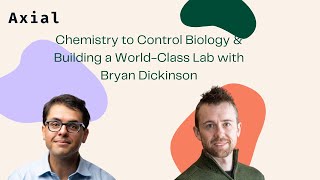
In this Axial Podcast episode, host Joshua Elkington interviews Dr. Bryan Dickinson, a chemical biologist at the University of Chicago. Dickinson recounts his scientific journey—from an undergraduate fascination with controlling molecules at the University of Maryland, through graduate work in Christopher Chang’s lab at UC Berkeley, to a post‑doc with David Liu where he learned to use evolutionary approaches for molecular discovery. He explains why he chose Chicago to start his own lab, emphasizing the importance of people, mentorship, and a collaborative, interdisciplinary environment that brings together synthetic chemists, protein engineers, RNA biologists, and computational scientists. Dickinson describes his lab’s philosophy of selecting important, problem‑driven projects rather than mastering a single technique, highlighting a current focus on RNA‑targeting tools—bifunctional molecules, guide‑dependent regulators (SIRTs), and strategies to hijack RNA modification pathways for therapeutic applications, especially in neurological disease. He discusses how the lab cultivates a culture of creativity, risk‑taking, and teamwork, and how recruitment prioritizes motivation, teamwork mindset, and willingness to tackle unknown challenges over specific technical expertise. Finally, Dickinson reflects on the modern biotech ecosystem, the rapid translation of academic discoveries into companies, and how his lab encourages students to think about impact, IP, and entrepreneurship while maintaining a supportive, autonomous research environment.
Chapters
Welcome to the Axial Podcast. Axial is an early-stage investment firm based in San Francisco. We partner with great founders and inventors investing in early-stage life science companies, often when they are no more than an idea. Axial is fanatical about helping the rare inventor who is compelled to build their own enduring business. Okay, Brian, uh, nice talking. Last, like, you know, 12 minutes, so we have maybe like 40 minutes to have a conversation about your whole story, so hopefully we can be as efficient as possible. But thanks for doing this. I'm a huge fan of your work, um, and just excited to hear about your journey and hear about the work, the research you're doing right now, and then, you know, kind of stuff you're kind of cooking up, uh, for the future. So, uh, maybe you start off and just talk about your background and how you got into science and you can go from there.
Yeah, for sure. No, thanks for having me. It's really, uh, Great to get to chat about my journey and how I got here. I think like everyone, it feels like a random series of, you know, chance events that lead you to where you are. But I guess I'll start at my undergraduate training, which was at the University of Maryland, and I worked for a biophysicist, David Fushman, there doing kind of structural studies of proteins. And in his lab, my first project was to use protein chemistry to kind of modulate the dynamics of a protein to study how that impacted its binding to partners. But what I got really excited by was this idea of controlling molecules, right? Using chemistry to control molecules with potentially biological applications, but really just this idea of controlling molecules I thought was really cool. And I think inherently I'm kind of a builder. That's my kind of philosophy in life. I like to tinker. I like to, you know, I do woodworking, that sort of thing. I really like the idea of like just building things. So kind of maybe an engineer in that way, and that's what attracted me to chemistry, and that research inspired me to think about building molecules and controlling molecules. So when I was looking for graduate school opportunities, I really wanted to move into chemical biology, and I figured, you know, after that undergraduate experience, I wanted to learn how to make small molecules and do kind of synthetic organic chemistry, but in the context of, you know, an application, a biological application. So I ended up going to UC Berkeley and worked with Christopher Chang, who was an assistant professor at that point. And, you know, he had really, even at that early time, established himself as kind of a leader in just designing molecules, right? Having this really cool ability to, you know, identify a biological problem and then, you know, go to the dry erase board and sketch out a molecule that has never existed in the universe that could potentially solve that problem. And then, you know, it's up to us as the grad students to then go in the lab and figure out how to make it and see if it actually works or not, and then use it in various applications. And that whole approach to science really inspired me, right? This idea that you can have an idea of a molecule, make that molecule, and have it do something in a biological system, still to this day, I think is one of the coolest things we can do as chemists. So I worked with Chris for my PhD and really just loved that experience. He's just a fantastic mentor and just has this incredible ability to just, you know, invent molecules really. But, you know, after that I kind of decided that for my postdoc I wanted to take a different approach to molecular design that wasn't so kind of prescriptive and defined like maybe Chris's approach. And I went to work for David Liu at Harvard And it's because I, you know, I was reading David's papers and ended up getting to see him give a seminar, host him for a student-invited seminar at Berkeley. And I got really inspired by this idea of using evolution as a design philosophy. You know, it's almost the opposite of the Chris Chang approach, right? Chris really has this incredible ability to think up molecules and build them from kind of chemical design principles. David was using evolution and still is. As really a way to discover molecules that have a function, and kind of a mechanistic agnostic approach to molecular design. And that got me really excited because I thought that if I had this ability to kind of make molecules with my hands and also use evolutionary principles to discover molecules, that would be a way to bring new molecules into the world that hadn't existed before. So I went to work for David and again, had a fantastic experience as a postdoc. He is just one of the most creative scientists I think, of our time. His ability to just not only tackle important problems, but do so with this really creative kind of visionary approach was just inspiring to be around. So I really enjoyed my time with him. And then, you know, eventually I started my own lab here at the University of Chicago in 2014. So I guess it's about 8 years ago now. And, you know, my lab really was founded on this idea of You know, we're— I'm in a chemistry department, and my passion is making molecules, right? So we founded the lab on this idea that we want to make molecules as tools to study and control biology, but the molecules we make are kind of agnostic in what they're built out of. So we have synthetic organic chemists synthesizing molecules, we have protein engineers designing biomolecules and RNA molecules, we use evolutionary principles, we use rational design principles, We use selection and computation and we kind of just do everything right in service of making molecules that solve problems we think are important within biological systems.
Awesome. Yeah, that's a great— like, that's a great, like, start. Maybe to back it all up, Chris Chang is one of my favorite scientists. You know, he's just like an exceptional person, but really nice and just like you have a great conversation with him. And Michelle's awesome, too. You know, when you were making that transition from like undergrad to grad school and joining, why Chris Chang's lab essentially, right? Was it more of a passion for trying to learn the kind of the tools to synthesize molecules? Was it Chris as a mentor? Was it maybe his research on metals? Or maybe all of the above? But what made Chris Chang, you know, what made you want to like work with Chris? Of all the great chemists in Berkeley. Yeah.
Well, actually, yeah. So I went to Berkeley because I didn't know Chris when I was an undergraduate. I actually went to Berkeley to work for Carolyn Bertozzi. Oh, okay. And I worked in her lab and had a wonderful experience. And she is one of my all-time favorite scientists. And I worked for— my rotation mentor in her lab was Jeremy Baskin, who's a professor at Cornell now, who's really good, an amazing chemical biologist himself. So I had a great experience in Carolyn's lab and had always planned to join her lab, and I think it would have been fantastic. But then, you know, I ended up rotating in Chris's lab just because he was a, you know, at the time an assistant professor and, you know, someone who was up and coming, I guess. But, you know, at the end of the day, I've always made every decision for myself, for my own career choices, and the way I run my lab really based off of the people. You know, I think at the end of the day, most people like me who are interdisciplinary scientists, let's say, I can get excited about a lot of different areas of science. I didn't really have some sort of specific plan for myself in terms of what I really needed to learn or what skills I needed. It's really picking the people, and that's why I chose to work with Chris. You know, he, he even then was clearly a very special mentor at the time because I was, you know, a a young graduate student, I was pretty self-reflective. I thought being in a smaller lab environment with a little bit more attention and specific motivation from the mentor would probably have benefited me. And I think that was true. I think being in an assistant professor's lab was great for me at that point in my career. So it was really a combination of what I identified in myself as my own weaknesses that I thought, you know, Chris specifically at that point in his life could help fill. And then really just being inspired by him and thinking that this is someone that I trusted with my own future basically. And I think that was, it definitely ended up being true that he is one of the great mentors of our time, has produced so many wonderful academics. He's incredibly supportive. So yeah, so it was really about the people way more than specific science.
That's awesome. I didn't know that. Yeah, I think it's like this tension when you're a young scientist, you're like, do I join the famous lab? And get all the money and the resources, and I don't have to worry about like, you know, how much I have to spend for reagents, or do I join the up-and-coming lab and, you know, make a larger impact? But, you know, like you said, you definitely have to have a good taste in people, and Chris is definitely up there. So I didn't know that. That's awesome. And then during the postdoc in David Liu's lab, That kind of seems more well thought out than kind of the grad school plan.
Sort of, but honestly, even then it was really about the person way more than the science. You know, like I was definitely inspired by the science, but I was also just really inspired by David. I was just like, I just want to be near people that are incredibly successful. And you know, both David and Chris are both incredibly smart and successful scientists, but they're also very different. And I like that also about David. I was like, here's someone that just runs their lab differently, approaches science differently, you know, both specifically with the techniques, but also just the kind of scientific philosophies are a bit different. And just to, just to see someone else who's successful. I mean, I think sometimes when people are kind of navigating their career, they think too hard about all these little details that don't matter. At the end of the day, right, you just need to learn how to be a good scientist. And, and that's just from seeing people who are really good at it running the lab, choosing problems, managing the group. So that was really more so than anything else the rationale for going to David. It's just like attach yourself to someone who views the world differently than you, has a successful approach, and just try to see how they do that, how they work.
Cool, yeah. And then Harvard is definitely different than Berkeley, right? Yeah, whole different environment in terms of day to day, you feel the pressure at Harvard, I think, a little bit more because there's so many different departments and conferences. Berkeley seems more of like a little safe haven for scientists where you can kind of maybe get out of the bubble. You stay in a bubble almost. But in David's lab, you're trying to join pre-CRISPR. Yeah.
I mean, there were CRISPR projects when I joined. Pre-BASE editing for sure. So BASE editing took off right after I left David's lab and really, really took over.
And so was your, a lot of your work around PACE?
Yeah, I was, I joined the PACE project pretty early on. That was most of my postdoc work with David is, you know, I had never done really kind of synthetic biology. So learning everything from, you know, cloning and construct design and, obviously PACE and evolution and all those sorts of things was really all my postdoc work.
Cool. Okay, let's go and sit in your lab. I think what makes you really unique is you already said this, is you have all these different kind of characters in your lab. You have organic chemists, different forms of biology, synthetic biologists, cell biologists. You attract like a whole diverse set of scientists who then, you know, kind of solve the problems you're working on. But when you set up your lab in 2014 at Chicago, maybe you can talk about why you chose Chicago of all places. Definitely, it's very different from Berkeley and Harvard. Chicago is— I was thinking about going to college there, and the motto for Chicago is, it's where fun goes to die. Why Chicago? That's one question. But And then how did you define the problem set? That's often a lot of scientists have their own groups. How do you define what problems to go after? Maybe Chris and David really influenced you there.
Yeah, I know I could start with, you know, why Chicago? I mean, you know, at the time there was one really strong chemical biologist here, probably Xuan He, who was, was kind of leading the charge for building up chemical biology here. There were some other really good structural biologists and biochemists, but he was really the sole chemical biologist. And, you know, maybe that was also another decision that from the outside world could have been viewed as a bit risky. But, you know, from visiting, I got the sense that it was an area of focus that they wanted to build up here. And then, you know, the advice I was given, again, picking, again, getting back to this idea that every decision I made was based off of the people. Getting back to the idea that like the people are what matters most in science. I was given the advice that when you're starting out as an assistant professor, you know, that having a good, not faculty mentor, I mean, it's partly a faculty mentor, but even just someone who you can kind of bounce ideas off of, who can challenge your assumptions, and who can be someone again that you can just try to emulate and learn from was really important. And, you know, ideally that person is probably someone who's kind of mid-career successful but still kind of remembers what it was like to start their lab. That's kind of, I think, the perfect phenotype of someone who can really serve that role for an assistant professor. And to me, Chuan was just like that perfect person because, you know, he had recently gotten his Howard Hughes and he was, you know, really, you know, doing incredibly well, running a very vibrant research program, but again, was still young enough to kind of recognize that, you know, what the world looks like for you know, an upcoming assistant professor. So I was really excited about getting to work with him. He was always someone, he was always one of my favorite scientists from my time, really all the way back into graduate school. So I was excited by that. And then, you know, the University of Chicago was hiring a lot of chemical biologists at the time, so they hired myself and Ray Muller in that same year, who also came in as assistant professor. He was kind of a Ben Cravatt, Greg Berdine person doing proteomics and other sorts of cool science. Then also Yamuna Krishnan, who is a senior hire from India, started also that same time. So the three of us all came in together, and Yamuna is just a complete rock star with imaging and lysosomal biology and DNA nanotechnology. So there's just kind of all this growth, and that was exciting, and I, you know, got really interested in trying to build something new. And then, you know, since then, now, you know, our chemical biology group here is just, you know, really thriving. We have, we've built be built on top of that. So Wei Shen Tang, who's another David Liu person, started her lab a few years ago and she's doing great. And then Jack Shostak just moved here.
Jack moved from Chicago?
Yeah.
What? I didn't know that. Wow.
We have like a very— I would, you know, arguably we have one of the strongest chemical biology groups in the country now. I mean, we— our group is just— we have all bases covered. So it went from, you know, and it was fun to be part of that building process. So now we, you know, we do Fantastic, I think. And I'm right in the middle of that. It's great to have— I really think you want to be in a department, in an environment where there are people doing things better than you. And having, you know, Shuan and Yamuna and Jack around, it keeps you on your toes. It's good.
I think it's the theme of you're a builder. So go somewhere with growth, go build something, there's meaning there.
And just being around people that I like. Like, we're all friends. Like, I really like having colleagues that that inspire me and that I want to spend time with and hear about their science. It's just a really open place. I mean, there are other logistical reasons that UChicago is special. We have our medical school right on campus. It's a highly interdisciplinary university. It's private, but it's also in the Midwest, so it has this nice balance of resource, lots of resources and opportunities, but at the same time, I think being a little bit disconnected from let's say Boston, if you're doing what we do, can be useful because it can allow you to not necessarily chase every trend as quickly as possible. You can kind of be a little bit more free. People can kind of, you know, let you do what you want to do. And, you know, and I guess the other thing I should say about myself being self-reflective, I really hate being told what to do. That's why I'm an academic. I want to do what I want to do. I could never have a boss. I would be the worst. That's why I want to be an academic scientist is I just want to do what I want to do, right? And I feel like here I get that more so probably than just about anyone else. Like, no one has ever questioned what I want to do. I have resources to do what I want to do. I just like do my thing and it's lovely.
I think that's the dream for everyone, including myself, right? And we all have different ways of going after it. I didn't know Jack. I used to work at undergrad. I used to work at MGH. Jack had his lab there, and I would see Jack wandering around. He had really long hair. It was always, it was a, it's kind of a freaky, it was my first Nobel Prize person I ever met. And I was like, kind of, kind of always starstruck. And he, I'm assuming he's still doing the origins of life research.
Mm-hmm, yeah.
That's awesome. Good for Chicago. Jack is just this wonderful person.
Amazing, yeah. He's a special, very special scientist.
We were talking about David Lu before recording, and like, you know what, you know, David's one of these people you can't replicate. Jack's one of these people you can't even replicate in any way. Just admire him. That's awesome. Okay, so then he said to lab, go Chicago. I mean, the second kind of question would be, I think every, every person has this problem. How do you define your problem set? How do you define your interests? And I think Maybe you can talk about how maybe Chris, David informed you with their styles and maybe how you create your own style. I think definitely your lab is really one of a kind in terms of chemical biology, in terms of your ability to develop new tools, make new discoveries, and then kind of, it's, I talk to a lot of scientists all over the world and you're one of the few labs that can bring like 5 different skill sets to the table pretty in a world-class way. So how do you even recruit those people to come join your lab is a whole second issue. But yeah, how do you, how do you define your problem set?
Yeah, that's a great question. I mean, so, so like that, I guess, you know, it's interesting to think back. I think that, you know, the lab philosophy was really built around this idea that, that, that we, you know, what, what we would do is pick problems that we think are important and then just try to tackle those problems. And that's Not to say that that's always the right approach. I mean, I think another more classic model is maybe you build a lab that's really good at a specific technique, right? You build this infrastructure and experience and knowledge base with the technique, and then you kind of point that technique or model or whatever in a positive direction that could have an impact on the world. For us, I mean, for better or worse, what I tell prospective graduate students is like, we're not especially good at anything, right? There's no special skill set that we have that no one else has, right? We do a lot of everything. But I think what ideally would make us special is that we pick problems that are important, right? Or at least we think are interesting. Getting this back, back to this idea that we're not told what to do, right? We pick problems that we think are inherently interesting or important, and then we go after those problems. So yeah, a student that's attracted to my lab is really the sort of student phenotype that is really interested in the big picture, right? And it could be basic science. It could be, I really want to understand this process of evolution, or it could be really applied. Like, here's a disease area that I think is really important and I want to do something that could potentially have an impact in this disease area. And then they come and they just do whatever they need to do to make that happen. It could be chemistry or bioengineering or animal studies. I mean, who knows? And they just kind of go after that problem. And again, it's not to say that that's the right approach to science. I think an equally valid approach is to say, I want to go to graduate school and join a lab that's really world expert in this thing, and I'm just going to learn that thing from them. And that's fine, right? But it's just not the way— it's not the way I get excited about science. I really get excited about these big picture ideas and moving methodically towards something that could really have an impact in the world. And then changing our research depending on how the world changes around us. And we've done that several times. So yeah, so I actually think it makes it in some ways easier to build a lab culture and to recruit people because it just means that the kind of alignment with overall motivation structure is the most important thing. Specific skill sets or experiences are not so relevant to our lab because people are going to have to learn many things while they're here. They're going to have to troubleshoot lots of aspects of their project. So it's much more about bringing people in to kind of have that mindset of problem-oriented science and are willing to kind of take a risk and sort things out as, as they kind of navigate their project. So that's how I built the lab. And then in terms of like specific project areas we focused on, right, it's been a combination of things that we identified as interesting inherently, some from me, some from the lab, just kind of organically building up over time, and then some from just our environment and collaborations. So, you know, an example of that is we're obsessed now with targeting RNA, both for basic science purposes and for therapeutic purposes. And that really emerged from collaborations again with my colleague Xuan He, who who's really an expert in RNA regulation. And initially we were just kind of working with them toward developing some new tools for things they were interested in, and then that really spun out into all sorts of new projects in our lab, thinking about RNA as a therapeutic target and just an area of biology that really needed new tools. So, you know, at the end of the day, everyone in my lab is trying to make a molecule do something new, right? That can be synthesizing or protein engineering or evolving or all sorts of different things, but You know, again, it gets back to this idea that we're all building molecules to solve a problem. That problem can be applied or basic science or therapeutic, but it's all about kind of building molecules.
Well, that makes sense. I think one thing to pull a thread on is something I observed with scientists early on in their careers. They're the ones defining the problems because they often come from a postdoc or they come from prior experiences. And they kind of know what they're good at. They kind of rack up papers, so to speak, or rack up discoveries that way. But over time, as the lab grows bigger, they become more of a filter. That's something I've observed. They become more of like a filtering tool in the lab where it's like ideas come to them and then they have the taste and experience to say, you know, don't do that, do that. And then they let their team execute. And so maybe in the— at least what's your role now in the lab? Are you more, Are you still kind of maybe, you kind of said this word organic, right? A lot of this work has organically emerged, but your role in the lab now, do you see yourself more as a filtering mechanism or are you still kind of like telling people, hey, here's like the 4 tasks in RNA we need to solve, let's go solve them?
Yeah, it's a great question. I mean, I think it's a mix of all of that, right? I think that, you know, I think a lot about, in terms of managing a group and running a group, you know, how do you set up the environment to kind of maximize and foster creativity? And, you know, and that entails many different things, but, you know, trying to build an environment where people feel safe to fail, right? Feel safe to take on risky ideas and try things. And then, yeah, sometimes I filter and I'll say, well, that's not such a great idea, you shouldn't do that. And then someone will prove me wrong and make something work that I didn't think was possible. And that's like, the dream, right? I love when that happens. You know, even this idea of being a filter, it's not, it's not a filter so much as, you know, saying you can't do this or you have to do that. I don't, I don't run the group like that. It's more just building an environment where people feel free to explore, take on risk, build up their own kind of research portfolio in a way that like maximizes their impact or mitigates risk for their particular career goals. I think a lot about, you know, individual group members like that. And then my job is really, you know, if you view your job like that as a manager, it actually becomes really fun because then it's really about figuring out like what is the most impactful thing we can do. You know, how do we steer the ship in a big picture? But I think individual team members in my group feel a lot of autonomy to kind of make their project their own, or if they're working in a team environment, like let that team kind of figure out the solutions to those problems. So Yeah, so right now I think the lab is, it's a combination of me helping steer projects and being really active and then the projects kind of taking on a life of their own and then students kind of bringing in their own or trainees in general bringing in their own interests and ideas to the projects to kind of make them their own projects. So yeah, I think a lot about though, like how do you set up any sort of team-based environment to be creative, risk-taking and supportive for that sort of science? 'Cause I think for what we do, That's really, we have to have that. Like the fuel of our research program is creativity. So we need to make sure that that is constantly an influx into the group, right? And that requires a very specific type of environment, I think.
Yep, I agree. I think that's kind of like the, it's always this tension I've observed in every lab is like how to define problems and then, but leave it open-ended where new things happen unexpectedly. It's a— I think you kind of distilled it right, right? Having a grad student or postdoc or somebody pull off an experiment that you didn't expect to work, and that's always where it's like really magical. And that's what I love about science is that there's that— you kind of know something no one else knows just for a little bit. It's like a magical feeling, and it's even more magical when no one expected it to work. And so, you know, history of science is always riddled with those examples. Maybe we can also talk about then how you recruit talent. You kind of said something really interesting, alignment of motivations, which is maybe, you know, it's not so much saying, hey, we want these chemists who are really good at synthesizing molecules or these really good protein engineers. See, you all are welcome as long as we're aligned on motivations. And so how do you, like, when you interview new people, you recruit new talent, and how do you think of, how do you, how do you determine somebody is aligned with the motivations of the group? Is it more based on their past experiences? Or is it more based on maybe more intangible things like passion or veracity or something?
Yeah, no, it's not so much that. So there's a couple ideas there. One is, you know, we have a, I would say, thinking about building a lab culture, we have a very positive lab culture. And that's really important to me, not only because it's good for being a good mentor and helping trainees and having people be happy is important. Even if you ignore all of that, it's actually important because again, that's what you need for a creative environment, right? You need people that feel comfortable working together, spitballing crazy ideas, being wrong. Like you need a positive environment to be the fuel of that creativity. So that's one of the most important things to me is that you have to have an environment that allows for that to happen. Again, ignoring all the other good reasons to have a good lab environment, just for the sole reason that we need that in order to let our lab run, it's really important. So that's part of it is having people that get inspired by working in teams, by being in a team environment. And again, I think you could make a case that like going to graduate school or your postdoc and just like getting in your hood, doing your thing, getting the work done as quickly as you can, That's logical. There's nothing wrong with that per se, but it just wouldn't be aligned with what I need in my group in order to be successful. So that's part of it is just the kind of lab culture and making sure people get inspired by team-based science and are willing to work through the struggles that inevitably come along with doing team-based science, because that's what we need to make our projects work. And then other things are just, you know, people who, you know, view adversity that's going to emerge in a problem. You know, when I pitch a project and I say, here's something we want to do, we know how to do half of it, but the other half we literally have no idea. You're gonna have to either figure it out or talk to people or just run around campus and start knocking on doors. I think for some people that sounds terrifying. That sounds like that— why would I join a group that doesn't know how to do what I need to do? For other people, that's really exciting. They're like, wow, I get to be the one to build this in the lab. That sounds really exciting. I'll be the one that gets to teach the next person, and I'll become the, the lab person that does this new thing. That sounds really exciting. So that's another area where Is that energizing or terrifying for someone, I think would be another indicator of whether this sort of approach to science is a good fit.
Yeah, I think that no one in the Dickinson lab is gonna do a project alone. That's what it seems like.
That's right. And again, and it's not to say that it's not autonomous, right? But the idea that there's a collaborative spirit, right? That you'll be the primary on a project and there'll be a secondary person who has some experience that will help you with that. And you're gonna be the secondary on someone else's, right? This idea that like it's a supportive environment and sometimes it's very active collaboration, like, which means like, okay, you're gonna be a co-author on a paper or whatever. But in a lot of times it's just like supportive environment. Like you're gonna help someone with an experiment they don't know how to do because that's the environment that we've built. And you know that in the long run that's gonna benefit you as well. So it's a mix of both of those practical and also just kind of, And Brian, at least in academia, that type of culture is very rare.
You know, you walk in most labs and, you know, if not most, maybe like a good part, maybe a third or something, most scientists are like kind of in their desks and no one's talking. And it kind of feels like, it's like that sometimes you watch sports teams and the best sports teams are always talking to each other, whereas sometimes the worst sports teams are just locked into their position. And they're not really working together. And sometimes you walk in labs, you kind of feel that there's no vibrancy to it. Or some labs you kind of, oh, you see people collaborating, like kind of at the high level.
So yeah, very, very cross-lab, even across labs. I mean, that's, I mean, that's the other, that's the other real strength we have here is, like I said, all of us chemical biologists faculty, we're all friends, we really like each other. And I think that trickles down to the labs. Our labs are all friends, they collaborate. They interact, they get lunches together. I mean, it is a very open environment where people, you know, it's a very tenuous thing to maintain, right? Like, it's hard to maintain that sort of environment. But again, like, for me, it's like, okay, what's the role of academic science? We train people. Hopefully we do a few things that matter, but at the end of the day, most of academic science doesn't matter, right? So the reason I'm doing this is because it's enjoyable and you want to build a culture that makes it fun. And it's not fun That sort of siloed approach to science, I think, just takes a lot of the fun out of it for me. So yeah. I agree.
I think we're aligned in terms of we wanna do things and have no one tell us, I don't want anybody to tell me what to do. And that's always, if you can, I think to do that though, you have to be the best at something. So I think—
Probably, maybe, I don't know. Yeah, it's true.
I think that's fine. One thing too, you're the best at what you do. You have to kind of acknowledge that too, where it's like you have to be really good at one thing to be able to get to the point where you have a lot of autonomy. I think same thing probably if your people in your lab, where you have to train them to be really world-class on something that's really what makes your lab truly unique in the midst of all these other labs. I'm assuming it's inspired by David's lab, where David has kind of a— I know people in his lab, very similar culture. Um, although a little, a little more, a little bigger because, you know, it's David. Uh, maybe we can transition towards your research. And you know how I'd like to segment it is like you have evolutionary tools and then you have RNA epigenetics, kind of various modifications. Um, and then you use the binding things, chemistry, developing molecules to like probe and explore, uh, both areas. I don't know, you have a lot of papers. Over the last 8 years in your group. I don't know, there's some papers we could discuss if you want, or maybe we can talk about particular anecdotes in each, in kind of various scientific projects you, your labs going after. I don't know, I'll let you take the lead on that. I don't really— I can talk, we can talk about specific papers I think are exciting, but I don't want to, uh, I can talk maybe general.
I mean, I think, yeah, I mean, so, you know, our lab is— we have a couple subgroups right now, and maybe I'll talk about 2 of them. Maybe so Picking problems that have maybe a more medium-term impact is what got us really excited about RNA regulation. We were studying it for basic science purposes and then got really interested in targeting RNA for therapeutic applications. And the motivation there is really practical, that there are a lot of diseases, especially within neurological disorders, that they seem intractable. Think of things like neurodegeneration and autism. These are things that we're kind of obsessed with in the lab right now that seem so complicated, and there's not a lot of hope right now, I think, for therapeutics in these areas. So to me, that's the starting point. Okay, that's where academia can come in. A lot of industry is not even touching these in various ways because it is so risky. So let's start building up ideas and concepts around targeting, you know, neurological disorders that seem really challenging. And then that fits in with RNA regulation because RNA regulation is the way that cells kind of fine-tune gene expression. And a lot of these complex disorders really emerge from dysregulation of gene expression. I mean, actually, really all disease is due to dysregulation of gene expression in one way or another. Now, if you want to knock something out or, you know, overexpress something, we have tools to do that. And if you think about drugs, right, in the clinic, basically every drug we have either, you know, inhibits or destroys or removes or sequesters. It just basically blocks information within the central dogma in one way or another, whether it's at the protein level, like most things, or at the DNA level. So RNA provides opportunities to just do more, to subtly repress gene expression, to activate gene expression, to cause changes in the proteogenic products of gene expression. So there's a lot of engineering opportunities within RNA to kind of control gene expression in lots of different ways. So a couple years ago, we built a program kind of starting to, you know, just thinking about these ideas of targeting RNA with engineered molecules. We think about these usually as bifunctional molecules that can, you know, one component that binds an RNA of interest in a sequence-specific manner or structure-specific manner, and then another component that either itself as an enzyme or delivers regulatory pathways to the RNA as a way to kind of just retune the regulation of gene expression at that RNA level. So that was the kind of framing of how we started this. And then, you know, specifically along those lines, we have a lot of different projects. We have a protein-based system that we use to do this that's kind of similar to CRISPR systems. It's a guide-dependent RNA regulatory system called SIRTs. We have some nucleic acid-based systems that do this that are engineered nucleic acids, and now we're working on various strategies to move into kind of small molecule or peptide-like systems as well. So, you know, again, it's molecule agnostic. It's really the problem, how do we discover and engineer bifunctional molecules that target RNA regulation with an eye toward therapeutic opportunities? And then, you know, let's throw lots of different ideas at that, protein-based systems, nucleic acids, small molecule, other genetic systems as well. And then try to address those kind of, you know, high clinical unmet needs. So that's kind of one example of a project that's now spun off in many different directions and kind of captures that idea of having lots of different people thinking about a problem and then figuring out ways to tackle it in hopefully creative ways. Interesting.
And so then when you think about like, okay, so, you know, a high level that makes sense where RNA controls is like the in the middle of central dogma. So that's where the action's at. And if you can figure out ways how to modulate RNA expression activity, you can begin to like, you know, you have a stranglehold over protein production and have an impact on a bunch of diseases, not only ones that are from RNA dysfunction, but also just protein dysfunction in general. How did you think about like specific modifications to go after? That's kind of where it gets a little challenging in terms of You've done a lot of research in terms of you have to selectively add modifications, maybe remove them. Were there certain kind of certain nucleotide modifications that were harder than others? You know, is there some sort of limit right now in terms of RNA editing that maybe isn't apparent to me that is apparent to you? Things like that. Like what, what are the, what's the upper limit right now in the field? What are the kind of the big problems that are like kind of still a little unsolved in controlling or editing RNA?
Yeah, so I mean, so when— and we even— just to, for definition's sake, you know, RNA editing to me is one very specific thing, which is making a base change to an RNA. So when people say RNA editing, kind of definitionally, that would mean usually you use ADAR or some other specific editing enzyme to cause a single base edit in RNA, which is really cool. We've done some of that. There are lots of both academic labs and startups doing ADAR-based RNA editing right now, which is really cool. So, you know, one idea that we've been playing with is we don't necessarily want to chemically modify the RNA. So the way RNA regulation works in many cases in mammalian systems is the mRNAs themselves are chemically modified in a variety of different ways— methylation and other base modifications, for example. But the way that those modifications function is usually the chemistry itself doesn't do a lot, like a methylation, m6A, that chemical perturbation to the mRNA doesn't really do a lot by itself. What it does do is it serves as an adapter, right, as a kind of a recognition motif for other regulatory proteins to bind to. So really what we've been doing in the academic lab is really thinking about designing— and these are called reader proteins, RNA proteins that bind maybe in a modification or structure or regulatory-specific manner— so we've been more thinking about how do we hijack those pathways and make them no longer modification-dependent but make them dependent on engineered systems that we can control. So we don't have to necessarily think about changing the chemistry of the RNA within a cell. Instead, we can take these pathways that are oftentimes chemical modification dependent and then make them no longer modification dependent, make them dependent on the factors that we engineer into the system and kind of redirect them in the way we want to redirect them. So we're still annotating the different functions we can do there. I have a graduate student who's going through a big screen of different RNA regulatory pathways to figure out which ones are amenable to kind of hijacking in this way with an engineered kind of system. But we're kind of trying to build up the repertoire of different functions we can control RNA with when delivered with these sorts of bifunctional molecules.
Cool. And you're totally right. I mean, targeting RNA is this umbrella, and then maybe base editing is one small component. —of what we can do to target RNA, maybe beyond, you know, editing is the sexy part of, you know, maybe the field because it involves, you know, it's maybe kind of somewhat related to CRISPR, right? So it gets kind of the, it gets some of the, I don't know what the word is, gets some of the, like, the after, the after effect, the, I don't know, the sprinkles or something, I have no clue. But when you think about targeting RNA in general, what do you see as kind of the most productive strategies? You know, there are some— there's a lot of work around ribotax and kind of using, I think, those bifunctional molecules to help degrade RNA or selectively degrade RNA. Yeah. What do you think— when you think about targeting RNA in general to have an impact on disease, from your perspective, what do you think would the most productive paths of research will be over the next couple years?
Yeah, that's a great question. I mean, I think, yeah, so Matt Disney's work Rabbitox is a huge inspiration for us. He's like amazing. So it's, he's obviously one of the leaders in that kind of small molecule targeting space. You know, I think, you know, I guess I would challenge the question a little bit in the sense that if one were to ask what are the most promising strategies to target proteins, right? I think, you know, the obvious answer is, well, who knows? It's disease and context dependent, right? Antibodies can do great things, but they are limited and protacs are super jazzed up for it. We're all excited, but they're not going to solve all problems. So the idea with RNA, I think, is really, it's much more about, well, if you think about any sort of therapeutic, right, within biotechnology at least, the therapeutic is going to emerge from a combination of a technology that you have, a therapeutic indication you're going after, and then probably a delivery strategy. And it's the marrying of those three things, right, which are equally weighted probably, that actually is what will drive success. So then it's about, you know, what technologies with indications align and then what delivery strategies align with those. There's not going to, in my opinion, be a one-size-fits-all. In some cases, let's use examples, AAV is going to be a really good strategy for certain diseases, and maybe CRISPR systems really make a lot of sense. And in other cases, there's going to be limitations to those factors. In some cases, probably having a small molecule would be really advantageous. In other cases, because you can redose and retune. In other cases, having a permanent alteration would be advantageous because it's kind of a one-and-done approach. So it's really about the disease target. That's why we usually start projects not from the technology per se, but from the disease targets. Here are some clinical applications that are important. Let's use those as the kind of foundation for the project. Not that we necessarily, right, not that we necessarily have to cure those diseases, but the idea is that those serve as like real-world examples of an actual need that exists. And then let's back-calculate what would we want to do to try to target those. And then ideally you then expand that out and see if it actually solves problems in a more diverse set of indications. So that's a, that's a big picture kind of view of the RNA targeting. But then in terms of specifics, like, I really think like really, you know, seeing what sorts of affinity small molecules can get to RNA structures, how good can they be in a general sense, I think is really open-ended question. Thinking about delivery challenges with all genetic therapeutics, but especially those that target RNA, that's a real challenge that I think needs to be addressed in the next couple of years. And then, you know, obviously things about selectivity and toxicity and all these issues around, you know, how do we do these safe and effectively in clinical context, I think is another area that really needs to be addressed. Awesome.
Maybe use that as a segue into, okay, you do research and it'll create something potentially useful. And your Dickinson lab is like a golden goose, so to speak, creates all these great little tools with a lot of potential. And how do you think about essentially translating those technologies one day? And maybe David will lose inspiration there, definitely. I'm trying to get Chris, he needs to step up his game a little bit. I'm trying to help Chris. But how do you think about the Dickinson Lab and you create all these cool tools? How do you think about structuring them to bring them out to the world? How do you think as a laboratory and as a PI, how to shepherd something you invent and publish and then take it to the real world, which is kind of a big challenge, I think, for every lab?
Yeah. It's a challenge, but I feel like it's also an opportunity, right? I mean, the ecosystem of biotech, which includes academia and industry and VCs and government and everything, like, that's really changing a lot in some, I think, really positive ways. You know, when I was in graduate school, which wasn't that long ago, like, it was almost like the default that everyone had to at least pretend that they wanted to be an academic for most of grad school, right? That was just kind of the mindset that was peer pressured into, you know, you're getting your PhD, of course you must be thinking about being a professor one day. And I, I'm very inspired nowadays that students don't have that constraint. I mean, obviously a lot of them want to be academics, but certainly not all of them. And I get students now that come in from day one and they're like, I want to join your lab, I want to try to invent something, and I want to try to start a company around that when I graduate, right? I think that's really exciting. It really changes the way we think about mentorship. It really changes the motivations around the PhD. So I think, you know, like, like all things in the world, right, the future is in the youth, right? So, you know, PhD students that are trained in this environment today where there's resources, there's opportunity, there's an— I think that there's a growing kind of acknowledgement that young founders and young people who built ideas taking a leading role in trying to move them to the next stage, at least early on. There's a lot of exciting possibilities now. So again, in my lab, we try to foster that, right? Just try to get people thinking about, you know, whether they're trying to go into academia or trying to go into biotech in one way or another, what can they do to maximize the impact of their projects? How do you, you know, fill in the IP around it? How do you network and get connected to people? So, but like I said, I think this is a changing environment. I think that as academia changes and as the biotech landscape changes, there's going to be more opportunities to figure out how to do this better. And I think it's just going to make a more rich experience within academia as we do these things better. Cool.
I think it's kind of like the 4-minute mile. Once you see somebody else do it, they realize you can do it. So like, you know, like anecdotally, the fact that David Owens, 25% of Prime, you know, that, that's pretty exciting. And so that kind of shows other scientists, hey, you Maybe I can't own 25% of the company, but maybe 5%, 10% of the company at the end. So I think it definitely shows. I think there's one— I see one arc, at least in biology, is inventors are getting rewarded more and more for their work and they're playing a bigger— whether it's not David Luís, Craig Cruz, or even Carolyn has various companies she's kind of helped get started over the last decade or so.
So I think, yeah, I mean, part of it is the money, but, but, you know, the other thing I would say about that is that, you know, it used to be not that long ago that if you were an academic, you would spend your, you know, 30, 40-year career working on some idea. And maybe if you were really lucky, by the end of that, it would maybe try to get translated and it would either fail or not. And I just think that what's really special about today's world is everything moves so quickly, right? You can have an idea, you can vet it in your lab, develop some IP around it, push it out into the world and see if it actually works and get feedback on that idea and kind of the gratification or not that it made an impact. And using David as an example, I mean, there are people being dosed right now with base editors. Base editors weren't invented, they weren't around 10 years ago and it's already in people. I mean, that's like the speed at which you can test ideas is really, it's amazing, right? And I think it just changes the way you view academia, right? It really is this idea of like, get ideas pushed out into the world and see if they have an impact. And I think that's what gets me really excited. And then how do you set up the environment to test as many good ideas as possible and see which ones actually, you know, have an impact in the broader world? Cool.
I think that's a great ending. And I think, uh, we'll do a follow-up like a few years from now, and then we'll see the Dickinson Lab has spun out 4 companies, bunch of papers, really, you know, some of the grad students are involved in the companies. And that'd be kind of using David as a template almost. I think—
Oh my goodness. Like I said before, David is not a template. David is someone to admire and be inspired by, but do not— my advice to anyone young, don't try to replicate David. David is David. He is a special, special human being.
Okay, maybe try to replicate Brian. Try to do that.
Yeah, anyone could be me. Yeah, exactly. Or replicate Brian. I think—
as a template. Okay, I had a great time, Brian. Thanks for doing this, uh, and I'm looking forward to doing it, you know, a few years from now and the update.
Cool, sounds good.
Thanks for taking the time. Absolutely.
More from Joshua







Scientist Stories: Hans Waterham, The value of phenotypic assays in peroxisomal disorders




Scientist Stories: Joel Zlotogora, Genetic carrier screening programs for reproductive purposes