Founder Stories: A Conversation with Uğur Şahin and Özlem Türeci, Founders of BioNTech
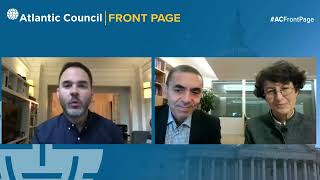
BioNTech co-founders Uğur Şahin and Özlem Türeci designed eight vaccine candidates over a weekend when COVID-19 emerged in early 2020. Their partnership with Pfizer produced 1.8 billion doses that reached 150 countries and vaccinated over 750 million people. They discuss how mRNA technology, originally developed for cancer immunotherapy, became a versatile platform for infectious diseases and beyond.
Chapters
Hello, I'm Fred Kemp, President and CEO of the Atlantic Council, and it's my pleasure to welcome you to Atlantic Council Front Page, our premier ideas platform for global leaders. We're honored today to host Professor Ugur Sahin and Dr. Özlem Türeci, co-founders of BioNTech. The Atlantic Council will honor them on Wednesday evening this week in Washington, DC, with our highest honor for business leaders, this year's Distinguished Business Leadership Award, for their cutting-edge work to address the COVID-19 pandemic. We'll at the same time honor their partner in this venture, Pfizer Chairman and CEO Albert Bourla. Together, they have overseen the development of the fastest approved vaccine in history using messenger RNA technology, mRNA technology, that BioNTech pioneered to rapidly produce a life-saving vaccine that is being used around the world. The BioNTech co-founder story and that of the creation of their vaccine is a transatlantic success story of historic dimensions. The BioNTech founders are Germans of Turkish descent, and they partnered with an American company, Pfizer, run by Dr. Albert Bourla, an American CEO of Greek-Jewish descent, to develop the vaccine. Their journey shows what can be accomplished when we work with partners around the world to address the greatest challenges of our day, and that is the Atlantic Council's mission. This interview will highlight not just the story of the vaccine, but how the technology behind it can be used to fight everything from the flu to cancer. And as both Professor Shaheen and Dr. Tureci have said, this isn't just an issue of developing the technology to fight diseases, but about equitably distributing those advancements for the benefit of all. We are fortunate today to have David Gelles, a business reporter with The New York Times, to lead the discussion. David, thank you for being with us today. And thank you again to Professor Shaheen and Dr. Tureci for sharing your story with us. And congratulations on the honor you'll receive this week. And please do tune in tomorrow for another special edition of Atlantic Council Front Page with Dr. Bourla, Chairman and CEO of Pfizer. With that, I turn it over to you, David.
Well, thank you, Fred. And it's such a pleasure to be here and to be a part of this conversation. I've had the distinct pleasure of chatting with the doctors for more than a year now, as I chronicled the development of the COVID-19 vaccine developed by BioNTech and Pfizer over the last more than year and a half. And it has been remarkable as I and my family have been the recipients of the vaccines, and we've seen the transformative effect it's had across the world. Today, we'd like to cover, of course, the story of the vaccine, but also get to know the doctors a bit better, understanding how their personal journey led them to this extraordinary moment, and also taking a moment to look ahead and understand what might be coming next. So, Uğur, perhaps we could start with you. And as you think back to some of your early work earlier in your career when you were studying immunotherapy and oncology. Those were fundamental experiences you had, but did you ever expect that the work you were doing then 20 and 30 years ago would now lead you to a moment where you were addressing such a severe and immediate concern like the COVID-19 pandemic?
Definitely not, David. Our work started— my research started as as a young immunologist asking the question, how can we use the mechanisms of our immune system to fight cancer? So we wanted to develop cancer immunotherapies, and infectious disease was not on our focus when we started our work. So I imagined that we could develop cancer immunotherapies that would be useful to treat cancer in a personalized, personalized fashion.
Right. And Özlem, you had very similar interests at the start of your scientific and research career as well, also studying immunology. What drew you to the study of immunology and specifically cancer, which was also a focus of yours from an early age?
Cancer is a very complex disease, which makes it very interesting for a scientist. So that was one of the reasons. I was curious and wanted to learn more about this disease. And the second was that in medical school, I, when I made my first experiences with treating cancer patients, I could not believe that this cut, poison, burn type of approach would be the only one we could offer to these patients. And that was sort of on the medical clinical side, the reason which drew me to this disease.
Yeah.
Well, I know it, of course, also led you to your first company, Ganymede. But before we get there, I think it's important to note that in addition to being colleagues and business partners, you also are a couple. You know one another as well as anyone. And one thing I've always wondered and never had the opportunity to ask you is what it's like to work together. How do you divide the labor, if you will? Talk to us a bit about the collaborative process with someone who I imagine is not only your your greatest collaborator, but probably also your best friend?
You have to answer that.
So, David, it's a symbiosis, and I think that that is the secret why it works so nicely. We have complementary skills so that we complement each other in the process. I pick up where Ugo leaves things and vice versa, and we have the same values and standards to what we want to deliver with our work. And this is a reason why, even though we are married, we can work very functionally together.
Terrific. Uğur, I'd love to hear your perspective as well.
Just to add on this, we don't see what we do as work. It's really part of our life, David, and therefore it's a wonderful, wonderful chance to share this passion with my partner, yeah, and to really every moment decide whether we continue to discuss a scientific topic. And sometimes we even have private topics, yeah, but we don't discriminate between life-work balance. It's one thing.
And this all is not rehearsed. It's true, David.
I know.
I'm remembering a detail I included in an early article I had the good fortune of writing, where if I have this right, it was a detail you shared with me, where on the day of your wedding, after the ceremony was concluded, you went back to the office together and got back to work. Is that true?
That's true, yes.
That's terrific. That's terrific. Well, it's also worth mentioning your values, and I think, Uğur, you may have just alluded to them, but you, of course, in addition to sharing values, share a certain amount of heritage. Uğur, you were born in Turkey, and your father, if I remember, immigrated to Germany when you were 4 years old to take a job at a Ford factory. Özlem, you were born in Germany to parents who were Turkish immigrants. How did that experience shape your individual and scientific careers and also your partnership perhaps?
I would not say that it shaped my career too much, because our family was integrated and I grew up in a way where I was never— I never faced any discrimination, at least this was what the way I felt. It probably impacted the way we interact with each other because there are sort of mentality aspects which we share, which probably come from this nationality, which we also share, and that makes it easier to agree on values, on standards, on general principles of doing things.
And clearly a shared work ethic as well. Let's fast forward now to 2008. By this point, your academic careers were both thriving. You had opportunities to teach, to do research. You had also found success with your first company, Ganymede Pharmaceuticals, which was focused, if I have it right, on monoclonal antibodies and their potential to help cancer patients. But then you decided to do something relatively radical. You decided to put that aside and create this new company, BioNTech. What was behind that decision? What gave you the conviction to walk away from what was obviously a, a, a fair amount of success in the realm you were already enjoying and go for this even more ambitious target?
Yeah, it is, it is. At the end of the day, it was very consistent with our, with our vision. From the very beginning, our vision was was to enable the development of what we call individualized immunotherapies. And the idea behind that is that every cancer is different and every patient has a different cancer. And the way how we are treating cancer patients today is we are trying to find an existing drug and hope that this existing drug will be able to help this patient with a unique cancer. We believe that the fundamental scientific challenge behind the failure of cancer treatments is that we disregard this complexity, and therefore we were interested in developing technologies that allow us to make tailored immunotherapies. We accomplished that in the academic setting, so that means we found a potential solution to solve this challenge. But it was very clear to us that we could not continue our work in the academic setting because we have to translate it. We have to bring it into clinical testing. You have to connect that to pharmaceutical development, which of course means millions and many, many millions of investment. And therefore it was just a consequence, yeah, to move ahead and start a second company which is dedicated for the development of, of, of individually tailored treatment.
So when it came time to start this company, you mentioned the need to also identify the appropriate technology, and of course you landed on mRNA as one of the tools that could potentially deliver this radical new vision of truly tailored, customized medicine. What was it about the mRNA technology that you saw even then, even though we didn't have an mRNA vaccine that was in the wild yet and that was proven effective, that gave you the conviction that it might be the right tool for you?
This, this conviction actually came very early in the late 1990s. So many years before we even founded BioNTech. And what we did at that time was to compare those existing technologies, which at that time were tried for as cancer vaccines, and we also tried them and experimented with them, including mRNA. And what we saw in these comparisons was the huge potential of mRNA beyond those of other technologies, in particular with regard to its versatility. So the many things you could do with it if you would optimize it, and that was then the work of many years which followed. And what we also saw was the manufacturing or production aspect, that it could be feasible to be very fast with the production, and that's a very— and at low cost of goods if optimized. And that's a very important aspect for making personalized approaches, which is customized on-demand production of an innovative treatment, viable. And these are the reasons why we first invested many years into this which only was a vision at that time, namely optimizing for all this potential. And it worked out.
In addition to the work you were already pursuing at BioNTech, Uğur, in 2018, you made remarks at a conference that I was able to find where you thought beyond the potential for mRNA technology and what it might do for cancer. And you also addressed what it might one day do in the event of a truly global pandemic. What gave you the confidence and the vision to think even back then that this technology could potentially be used for something, although we didn't have a name for it then, like COVID?
Yeah, at that time point in 2018, we had already a lot of progress in the cancer field, in our personalized cancer vaccines. We had treated hundreds of patients at that time point with our personalized cancer vaccine approach and accomplished published to make vaccines within a few weeks and have seen in cancer patients that we can— that the tailored vaccines induce strong immune responses. So the question was, what could be the utility of such a technology for the infectious disease field? And we believe that the utility would be to respond quickly to newly emerging virus, for example, in the case of an epidemic. And that was just a theoretical case that I was referring to, but at that moment, of course, I didn't know that this is— this could become reality 2 years later.
Yeah, so then let's pick up at that moment. I think it was early January of 2020 you read this famous article in The Lancet. Will you tell us what you had been thinking in the previous weeks when I suspect you may have been hearing about what was happening in China and the emergence, the early cases of COVID-19, and then what both of you experienced when you saw that journal article?
Yeah, so in mid-January, I heard that that there is a new outbreak in China with a SARS-type virus. And I was not concerned at that time point because we knew from the past that every year there is a new outbreak with a new virus strain. And I was not concerned. I just thought that this is going to happen and then it will be controlled in the coming weeks or months.. But on this Friday, on January 24th, there was an article. It was the first scientific article describing the cases of this outbreak. The article was very informative, and one piece of information in the article was very disturbing, that this virus, that there was evidence that the virus could spread from asymptomatic people, right? And the combination, the whole pattern that was described in this paper showed the pattern of an outbreak that is extremely difficult to control. And we got concerned that this is an outbreak which will not stay local but could become a global pandemic very, very quickly.
Right. Özlem, was the same thought process essentially going through your mind as, as you realized the properties that this virus contained and thought about in the interconnected global world we live in, just how difficult it might be to contain if it truly was as contagious as these early reports made it out to be?
Yes, when Ugo presented his thoughts, it was very easy for me to follow what he was suspecting. In fact, the numbers and the mechanisms we discussed made very clear that we probably were already in the midst of a smoldering pandemic, and Ugo came up with two potential scenarios. Either this would be a process in which within basically a few months only the world population would be quickly decimated, or the other scenario that it would take one year or so, a slower ramp-up, which at the end of the day was what really happened. And so it did not take too much discussions to make clear that we had the obligation to try to contribute to a response and that this response had to be fast because we did not know which of these scenarios would then come true.
Right.
And then of course, things did start moving very quickly. Can you talk about those initial few days between when you received what was, I believe, the genetic sequence, or help us get the terminology right here, from where you were able to have essentially the data you needed to start developing what might be an effective COVID-19 vaccine using mRNA technology?
So we— indeed, the genetic sequence of this virus was already available. So already on the weekend, we downloaded the sequence and asked the questions, which part of this sequence could be useful for development of a vaccine? And based on prior publications of related members of this virus family, we could rapidly identify the spike protein as a candidate. And we also selected domains of the spike protein as potential candidates. And already on Sunday, we had designed sequences for our vaccines, 8 candidates. And that we sent to our collaborators, to our team to start designing and producing this vaccine candidate. And on the next Monday, we just met our team and started to discuss how to execute this project.
And I remember some details I picked up from speaking with you and other members of the company. I recall that this was a moment where I think I think many people in Germany were preparing to go on ski vacations and it was holiday time. And I think there was a pretty serious moment when you made it clear, no, no, no, everyone, we're putting our heads down, we got to do this work. And things started to get very, very serious very quickly at the offices of BioNTech. What you just described, though, it seems to me technologically just absolutely astonishing. How recently, in the matter of years or decades, is the rapid development of 8 potential candidates— would that have even been possible? I mean, had COVID come around just a decade ago, could you have done the work you did that quickly to identify candidates? Or are we really at this inflection point moment where the technology is finally allowing us to do these rapid responses in a way that just wasn't possible even a few years ago.
Yes, but as you, as you said, science and our technology also specifically was right just now mature enough to show this type of rapid response. And also this opening this design space of several candidates, which was necessary because we had so many unknowns. We had to put a couple of horses into this race, and even 12 months ago, we might not have been in the position to respond this fast. So it's indeed an inflection point.
And what is really interesting is, as Özlem said, it was just in time, but it was like we have built a plane to fly, but never used the plane to fly an infectious disease vaccine. So that means we had never done an infectious disease clinical trial. So we had a number of unknowns, We knew that the technology could work, but we did not have the definitive proof that this is going to work. And that was, of course, dealing with unknowns. And if you deal with unknowns, you need to use multiple candidates. So we not only generated 8, but more than 20 candidates for testing.
Amazing. Well, we've all benefited from the, the opportune timing that you just described. At the same time, you were then whittling it down from 20 candidates to 8 candidates to, I believe there were 3 sort of finalists. You also, around this same time, we're now in the February, March, April timeframe of last year, establishing your relationship with Pfizer. You had already been working with Pfizer on an influenza vaccine. Talk to us briefly about the foundations of that partnership and what it meant that you already had inroads with a global company like Pfizer at this critical moment.
As, as you pointed out, we were already working with Pfizer. Our flu partnership started in 2018. It was still in the, at the preclinical stage. But even though it was just 1.5 years working together, we already had a very good understanding of the capabilities of our partner. We knew everyone in the different teams, and we— and this was very important— knew that the values were in sync. We had the same values, and in particular, this being driven by scientific data. And that was a very good a foundation for us. After we very quickly understood that this project, Project Lightspeed, would very fast come to a point where we would need a global partner, it was very clear that Pfizer would be definitely the preferred one. And we approached them, and they were open to work.
And I recall, if I have this right, that even months into the clinical trials, the paperwork, I think, still was not officially signed, that it was— you all were operating on something of a handshake deal for many months there, which I think, again, speaks to what you just alluded to, was this trust, this alignment of values, which was quite extraordinary. That summer, though, there was still no guarantee that this would work. I know you had some confidence. I know the data was potentially promising, but you still, of course, had to go through the clinical trials. What was the most difficult part of that summer and fall of 2020 as the clinical trials proceeded with haste, of course, but still at a judicious pace, as I think Albert told me, the speed of science, and you still had to get to that place where the data told you what we all hoped we would find. What was the most difficult part of the clinical trials and the waiting?
Yeah, so one, one really difficult, difficult aspect was the selection of the phase 3 clinical candidate. You can start with 20 candidates, but at the end of the day, you have to decide and select the one which will go into the phase 3 clinical trial. And, and even until almost end of July, we had two candidates which were in the race, and we had to make a decision. Yeah, and actually, and the data supporting the decision-making came in just on July 24th and we had a meeting with the colleagues from Pfizer on the same day discussing all data and made a decision to select BNT162b2 as a candidate. And a few days ago, the candidate, preferred candidate was another one. So it was a surprise to the whole team and to the world that we had just selected a candidate, yeah, for the phase 3 clinical trial, which came in with even better data. And then we had, of course, when the phase 3 clinical trial started, we had to wait to get the data. This is a double-blind clinical trial, so that means half of the trial participants get vaccine, got the vaccine, and the other half got placebo. And we didn't know, we didn't, of course, until the day of evaluation, we didn't know which, whether the vaccine would be effective, yeah, whether it would be able to prevent infections in a in a reasonable manner.
Yeah. And vaccines, as we now know, I think the world has become much more familiar with vaccines over the last 20 months. Some would consider a vaccine with 60% efficacy a success, 70% efficacy a real success. What was your reaction when, I think it was almost exactly a year ago, this week if I have the timing right, that you saw the data that it was well over 90% effective.
Yes, it was an unbelievable moment when we got this data, and you have to imagine it was on a Sunday and we knew that in the afternoon we would get the data, and up to that point there was no no way of knowing whether we would see any, any efficacy at all, or whether placebo and vaccine would show the same results. So it was, it was a scary day. And then we heard from Albert that, yes, there is efficacy, the vaccine works, and it's 95%, which was first unbelievable. And, and thereafter just, just wonderful to hear. Yeah, we felt blessed.
And, and a lot of people would go out and hit the town and, and be drinking champagne. How did you two celebrate?
So we were in a lockdown, so, uh, that, that was not on the table, this option. Uh, we, we, uh, uh, treated us with a cup of tea.
Very good. Very, very in character, given all that we've generously gotten to know about you. So I want to briefly talk about what has happened in the year since. You talked about the potential for mRNA to be rapidly produced and scaled up. And we know that millions of people have now acquired doses of the BioNTech-Pfizer vaccine. But we also know, and my reporting bore this out, that the production was, was not entirely without its hiccups. What were the major challenges of scaling up the production of the BioNTech-Pfizer vaccine, especially in those critical first months?
So usually, if you develop a vaccine, you start preparing the manufacturing of the vaccine about 2 to 3 years before, before the vaccine reaches the market. So that means the team has a lot of time to improve the manufacturing process, to adapt the details, to scale up the production capacities. And when we started our project in January 2020, we knew that we don't have this time of 3 years. So we really wanted not only to get an effective and safe vaccine, but enable manufacturing and supply of the vaccine worldwide worldwide. So that was the reason why we already started in January, February in planning how to scale up our manufacturing. You have to imagine that in 2019, that means a year before this pandemic, our scale for manufacturing was in the range of 10,000 to 50,000 doses per year. And in the pandemic, for pandemic supply, of course, We had the aim to deliver at least 100 million doses. So that means both companies, our company and Pfizer, the Pfizer team were working and scaling up the manufacturing and we had accomplished to produce, to scale up the production of the mRNA, which was fully in our hands, but we were also dependent on the scale-up up of the second step, which is the lipid nanoparticle, which depends on materials, raw materials from third parties. And during the last step of the scale-up process, we realized that one of the components, that one of the lipids, does not have the quality required to manufacture for supply. So, that means the team were working day and night for several weeks to identify the root cause and find a solution for that. And in this time, in this few weeks, we lost the opportunity to produce 50 million doses. So our plan was in 2020 to make 100 million doses. But we had to— yeah, we could only produce 50 million doses, which was a setback. But later on, we were able to manage that and to even further increase our manufacturing capacity.
And today, how many people around the world have now benefited from the BioNTech/Pfizer vaccine?
We produced in the meantime 1.8 billion doses that were already delivered. And so we managed to supply about 150 countries and regions worldwide. We have more than 750 million people who already received our vaccine, which is incredible because such a ramp-up up has never happened in the history of pharmaceutics, and it just shows how incredible, incredible an accomplishment of our teams, but also with support of collaboration partners is.
Extraordinary, extraordinary, and we've all benefited from it. With our last few minutes together, I wonder if we can look forward. Clearly, the pandemic is not over. I know the teams at BioNTech and Pfizer are still working extraordinarily hard to increase the supply and make sure everyone who wants and is eligible for a vaccine has easy access to it. And yet I also know that you all are thinking about where else the mRNA technology might be effective. If we all remember from our earlier part of the conversation, it was not infectious diseases that initially intrigued you and was the rationale for even the founding of this company, but it was the potential for mRNA technology to address the emperor of maladies, cancer. Are you still at work on vaccines that could potentially treat cancer? And beyond that, where else Do you now see the potential application of mRNA?
We have never stopped, David. Also during Project Lightspeed, our cancer vaccine programs and treating patients in our clinical trials with our cancer vaccines has continued. It was slowed down by the pandemic as the entire sort of industry has been slowed down with regard to clinical trial conduct. Production, but we have continued and now we are accelerating even those programs, both for our fully personalized vaccines as well as for our off-the-shelf cancer vaccines. And not only vaccines, mRNA can, for example, be used to deliver cancer-targeting monoclonal antibodies. So what we had done with Gunni made before with conventional technologies, recombinant protein technologies, we are now doing using mRNA and ditching the middleman, meaning the protein production plants. And the same, for example, for cytokines, which are an important part for immune therapy in cancer. And we are going beyond cancer into other infectious diseases, which might be much higher fruits, hanging fruits, as compared to COVID. These are diseases which are with humans for many millions of years. For example, malaria or TB, tuberculosis, and HIV. And this is the sort of first wave. We also want to bring mRNA into indications such as autoimmune diseases, because mRNA not only can help to communicate to the immune system to attack, for example, cancers or viruses, it can also communicate to not attack and to calm down, which is needed for autoimmunity or allergy indications, for example.
Extraordinary. And perhaps lastly, given everything that's transpired over the last year and a half, both in terms of the production and the collaboration, but also just in terms of your raw scientific understanding of the potential for mRNA technology, what do you now see as you look into the future? And think about the potential for we as a civilization to treat some of these diseases, what, Uğur, seems possible perhaps that didn't seem possible even just 2 years ago?
The biggest, biggest change is that we have been transformed as a company. So we had, of course, broad vision to develop personalized cancer immunotherapies. But the innovation of mRNA goes beyond cancer. It is actually what we believe the most important medical progress or medical technology progress in the last 40 years. So this technology, if combined with the rapidly growing knowledge about diseases, yeah, about better understanding of the mechanisms could help us to design treatments for diseases with a high medical need which have not been solved. So malaria and tuberculosis and HIV are examples, but there are other examples. We have, for example, neurodegenerative diseases, we have autoimmunity, we have diseases, rare diseases,. And what we can also do is to combine this technology with other types of tools, for example, with CRISPR-Cas. CRISPR-Cas could be delivered with messenger RNA. When we combine that with, for example, gene therapy, we could use the technology also for modifying, modifying related diseases. So the number of opportunities is endless. And the challenge is, of course, to mobilize the scientific community in a meaningful fashion and engage into collaborations to address all these opportunities in a diligent fashion. Because drug development, of course, requires diligence and requires several years of development, and it requires also financing. And so we, we have a lot of opportunities, but there are also a number of challenges ahead to increase productivity of research in the field.
Well, that's an extraordinary vision for what might be coming in the years ahead, and I know on behalf of the Atlantic Council myself, and so many more. We're extraordinarily grateful for all the work both of you have done, that your colleagues have done, and we're excited that you're committed to continuing this work in the years ahead.
Thank you very much. Thank you, David.
Thank you, David. And stay tuned, if you will, for Fred's interview with Albert Bourla, the CEO of Pfizer, which I believe will happen tomorrow at the very same time. Thank you again all, and congratulations again.
Thank you.
More from Joshua







Scientist Stories: Hans Waterham, The value of phenotypic assays in peroxisomal disorders




Scientist Stories: Joel Zlotogora, Genetic carrier screening programs for reproductive purposes