Founder Stories: Alexis Borisy, Third Rock Ventures, EQRx, Relay Therapeutics, and more
Alexis Borisy traces personalized medicine from a 2000 McKinsey report predicting it would fail, to today's targeted therapies achieving 60-90% response rates in specific patient subsets. Precision approaches now reshape drug development timelines and costs, with applications expanding beyond oncology.
Chapters
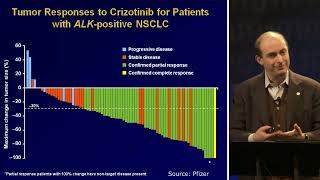
Good morning, everyone, and thank you for that kind introduction. And it's an honor to follow Dr. Drucker's inspiring talk this morning and the inspiring example that his research on imatinib has been for all of us. It's a pleasure for me to kick off this session on emerging technologies. I am both an entrepreneur and venture capitalist dedicating my focus into the area of personalized medicine. So I've titled the talk here "Personalized Medicine Here and Now." So if I'm dedicating my efforts on there, obviously I have a lot of reason to believe in this. And I do want to just put my conflicts out to say that I am a founder and chairman of Foundation Medicine, which is providing Comprehensive Cancer Genome Diagnostics, and along with Dr. Drucker, a founder of and investor in Blueprint Medicines, which is trying to come up with sort of the next generations of very, very specifically targeted molecules to cancer that has been then focused into that molecular understanding of can we understand the disease and then create the molecules to that specific subset of patients. But I believe the opportunities in personalized medicine, although cancer is on the leading front,— and is an incredibly important effort, I think the here and now actually applies broadly across the board. And as Dr. Drucker said, fundamentally this is about having the right intervention, be that a pharmaceutical agent, be it a therapy, be it any course of action, to the right patient at the right time. But of course this is something that we have been talking about for a while. So I like to pull out some slides out of the file. This is a slide from Inside Millennium Pharmaceuticals that was used in 1999 that was talking about a lot of the same themes of what we're continuing to talk about today. Where on the slide it talks about the advances that were happening in personal imaging, in genomic analysis, in the data sets that could be assembled, and how those could all be put together to go after that central problem of how can we define disease where we have not been able to really break it down to a functional category before. That an intervention could work the vast majority of the time. So this is something we've been talking about, but skeptics at the time— again, looking back in history a little bit, this is a page from what was a McKinsey and Lehman Brothers— if you remember Lehman Brothers report— that had said, OK, all this wonderful new information that was coming forth, right? Then the vast majority of it from the genomics revolution. They argued at the time— so this was a report back in 2000— that this was going to actually increase costs in developing new therapies and decrease probabilities of success, because they said all this new information, we're not going to know what it means. That it's extremely exciting, but getting there to that level of insight that Dr. Durek showed in that nice Hollywood clip was going to take time, and so we would not immediately have the understanding of how this molecular information comes together to specifically identify those narrow definitions of disease where you could have the right intervention to the right patient at the right time. And so they argued— and on this, on the left column, you had what was then the success rates in developing drugs. On the right column, they argued that all this new potential targets we were looking at, but not really understanding how they would go together, They put a couple assumptions in where odds would decrease, and the net result was to say, whereas drug discovery was a profitable enterprise with a positive net present value at the time, they argued that this would effectively come close to zero. And of course, you hate to look back and recognize when somebody was very prescient when they had sort of a negative conclusion, but that is exactly what happened for a period of time. However, Although this certainly gave lots of room for lots of cynics, skeptics, critics to say this was all an area of substantially overblown hype, in point of fact, revolutions take time, and they take time to build, and where there's a phase where a lot of information is being collected, and that information is being digested, and we're learning how to cope with this new world, and that is, in fact, what has been happening, and the argument that I would put forward is that time is now translating here and now. Right? Things in the past decade moved at increasing speed. This is a graph that everyone is well familiar with, sort of the cost per base pair of genomic information. And I don't want to particularly bring a focus on only genomic information, because what we're talking about are advances not only in DNA, in RNA, in imaging, in proteomic analysis techniques, in metabolomic analysis techniques. But that we're getting a much greater degree of resolution to be able to have the molecular portrait of a disease, where in the past we had sort of the physical outlines of the disease. Now we can characterize it with this much, much greater degree of resolution, which is enabling us, for some diseases at this point now, to take what had been massive amounts or piles of information and to understand certain subsets of those diseases as a coherent whole, and then to know how to interact, how to make an intervention for that subset. And I just use as an example— I think Dr. Drucker showed an example from colorectal cancer in the mutation distribution. Here's a similar one in lung cancer, from how it used to be defined on the upper left-hand side, how it is now becoming to be defined. And this pie chart is rapidly, extremely rapidly now, being worked out to higher degrees of resolution. For example, there will be a publication actually coming in just a few days that will take another slice and add on to this pie chart, and there will be many more that are coming after that. And the reason that it's very relevant is because we're beginning to get more and more drugs where we then know the understanding of that disease, that subset of the disease, that we can have substantial activity. So here's another one we were talking about. I mentioned imatinib before. This is another drug that was approved last year, which was crizotinib, which is focused on a very specific slice of non-small cell lung cancer. And again, in the past, in developing cancer drugs, we were looking at having activities 20%, 30% of patients. Now we start talking about having activities in 60%, 80%, 90% of the patients. It is both incredibly important for for the patients, for our oncology system overall, but it is also really the tip of the iceberg of what we are going to be able to do. And I think when it comes back down to talking about personalized medicine here and now, so of course last year we had crizotinib approved, we had vemurafenib approved, we're having now Jakafi, so this is not just one drug, it's beginning to come many, many more, and you're going to see that continue. And it's not going to be only in oncology. As I continue to look at new opportunities, we're seeing things where this ability to understand slices of disease are increasing substantially in multiple other disease categories as well. And whether we're talking about therapeutics, whether we're talking about diagnostic opportunities, whether we're talking about whatever the mode of intervention, if you have that understanding of what the disease that you're treating, even if it's just a subset of what we had previously called a larger category, It changes the fundamental business model in terms of how those innovations can be brought forward to actually make a meaningful difference to the lives of patients and to do that rapidly. Because if you have the definition of disease and you've tailored your intervention for that specific cause of disease, then your level of effect goes up. So instead of having a 30% effect, you have an 80% effect or a 90% effect. If your level of effect goes up, your probabilities in any trial design of seeing that effect go up. The amount of time that it takes to develop that drug goes down. The amount of cost that it takes to develop that drug or intervention goes down. And so all of a sudden, you have something that can be extraordinarily productive, both for industry as well as for patients and our overall health system together. Now, to get all the way there— right now I think we're going at some of the, perhaps, ones that are the easiest to understand or the less heterogeneous? How are we going to tackle those that are the most heterogeneous? And here we need to be able to take not only the molecular information, which I have on this slide by genotype, but the molecular information, again, whether it's proteomic information, that full set of molecular information, we need to match it with the clinical phenotype, with the in-depth clinical parameters about who that patient is, what their experience in depth has been. We need to assemble these large datasets to be able to have the wealth and richness of information to really be able to tease out these diseases, to understand what is a coherent group of disease that we can make that intervention for. And so we need to think about, as an overall ecosystem, how do we assemble these massive datasets? How do we make sure that they contain the full this full richness of information, which an EMR itself does not have, and is going to require a lot of innovative thinking. And we need this full richness of information because it's always important to keep in mind that the genes alone are not the story, right? The environment alone is not the story, and there's this level of stochastic chance. But as we get this richness of information, we will be able to have some diseases that we can categorize into these groups, that will be highly actionable. And although it will not be a cure for all, it will be very meaningful for many. And so with that, I kick off this session this morning, which I think is a very exciting session, as we have a lot of leaders in the new technologies that will help continue to push forward on this front, both in the raw technologies and in the clinic. Thank you very much.
More from Joshua







Scientist Stories: Hans Waterham, The value of phenotypic assays in peroxisomal disorders




Scientist Stories: Joel Zlotogora, Genetic carrier screening programs for reproductive purposes