Founder Stories: Arie Belldegrun, Founder of Kite Pharma
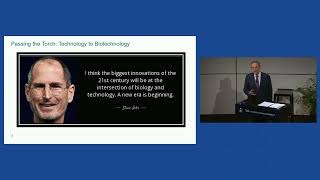
The recording captures a Yale Innovation Day session in which Jim Boyle introduces the Technology Commercialization Program (TCP) that paired graduate students with faculty to launch biotech ventures. Sean McKay, a former TCP participant, recounts his early licensing of Rong Fan’s single‑cell analysis platform and how that led to collaborations with Kite Pharma, highlighting the importance of passion, long‑term commitment, and mentorship in biotech entrepreneurship. Arie Belldegrun, a UCLA surgeon‑scientist, then delivers a keynote describing his three‑decade journey from academic research to founding multiple biotech companies (Agensys, Kura, Kite Pharma, Allogene Therapeutics, Cronos Bio, EuroGen, Vita Ventures). He details the scientific foundations (gene editing, engineered T‑cell therapy, CAR‑T), the rapid IND‑to‑approval timeline for Kite’s Yescarta (34 months), the role of strategic partnerships (Gilead, Pfizer, TPG, Selectis, Servier), and the evolution toward next‑generation synthetic‑biology cell therapies and off‑the‑shelf allogeneic products. Belldegrun emphasizes the “seed‑soil‑success‑factor” model: groundbreaking science (seed), supportive mentorship, financing, and team building (soil), plus an unnamed “secret sauce” that integrates them. He shares patient impact stories, the importance of competition (e.g., Juno, Celgene), and his perspective on the future of immunotherapy as combination regimens. The session ends with a brief Q&A on time‑management for academic entrepreneurs, where Belldegrun advises surrounding oneself with the right people and working 24/7 when passion drives you. The talk weaves together personal anecdotes, company formation narratives, regulatory milestones, and strategic insights into building a thriving biotech ecosystem.
Chapters
As you're settling in, I'll share with you why they asked me to come to the podium. I am not your next keynote speaker. I'm actually— I've been asked to come up here to introduce the person who will introduce the keynote speaker. I'm honored. My name is Jim Boyle. I'm with the Office of Cooperative Research. In an earlier era, Here at Yale, OCR operated an entity called the Yale Entrepreneurial Institute, and in the 10 years that it was running, we tried lots of different experiments. And before this explosion of the innovation ecosystem gave rise to 1,000-person conferences such as what you are all part of today, congratulations, we tried some experiments to get bright people together to do things that other— who otherwise might not come together. And as would often happen, the chair of a department would call us up and say, hey, listen, I think you need to pay attention to someone. And we had that conversation with biomedical engineering some years ago about a young faculty member named Rong Fan. And we realized that people who are working on platform technologies need a lot of help with pulling those things together. But they weren't yet mature enough to go out and find someone who was a mature, mid-career serial CEO to take it on. So with the blessing of John Soderstrom, who ran OCR then and runs OCR today, we said, permission to try something a little different. And he said, what's that? And we said, we're gonna ask some faculty if they're willing to work with graduate students as very early-stage CEOs. And for 8 or 10 different experiments that we tried in the 2013 to 2015 time period, we did that. And the fellow who I'm gonna ask to come out and talk to you in a minute is, definitely one of the bright lights that came from this program that we called the Technology Commercialization Program. I didn't call it that, I called it TCP, which drove Soderstrom absolutely crazy because we had 3-letter acronyms for everything. I said, that's TCP. The fellow who we recruited to work with Rongfan was, it was no slam dunk that he was the right guy for this, Rong was working— he had come from Caltech and was working with a very complex single-cell analysis technology where he was looking at secreted proteins. And here's this guy in the MBA program who'd been doing investment banking on the life sciences side, but investment banking. And is this really the right person to put in with a very, very Hewlett-Packard fellow working on something that's going to be like next-generation technology? Is he really the right person? Over the course— that was the summer of 2013. Over the course of the next 2 years, 2 to 3 years, he demonstrated to us not only the fortitude and the ability to take coaching and the ability to network and the ability to learn single-cell analysis and immunology and immuno-oncology and actually become skilled in all the things he needed to to do to master that field, he actually became the archetype of what I think what we're going to be doing in larger scale with the help of the folks from Blavatnik, which is to launch the Blavatnik Fellows up. And in a very large way, I think Sean McKay, who I'm going to ask to come to the podium now, is sort of the shining example of what happens when we turn around and ask young people who we have access to, whether they're graduate students in business or life sciences or law or medicine, what happens when we bring them into projects that Yale innovators have given rise to as well. So anyway, with that, I'd like to ask Sean McKay to come to the podium.
That was a nice introduction. So yeah, I guess for 2 seconds, I didn't know I'd be talking about ourselves, myself, but that's good too. We founded the company with the Office of Cooperative Research and Dr. Rong Fan. In licensed technologies, saw the sort of challenges that laid ahead as far as the commercialization process in the life sciences tools and diagnostics business. I think the exciting, the really exciting part for us, I mean, it was, you can sort of connect the dots backwards. That's the famous saying. You can't do it looking forward, but you can connect the dots backwards. A lot of the companies that I'd worked with in the sort of mid, whatever it was, mid-2000s when I was at Lazard, some of these cancer immunotherapy companies that at that point hadn't really reached the stage in which you could get durable responses. And sort of eliminate the cancers, but we're still at the sort of potential stage. I think it just so happened that the technology that we in-licensed, brought in from Dr. Rong Fan, and later we brought on Dr. Jim Heath from Caltech and Tony Ribas, UCLA. Those technologies had their predominant use case in cancer immunotherapy in helping analyze these highly functional immune cells to predict responses and non-responses in patients, which now, as so many of these immunotherapies have shown at least initial impact in creating these amazing response rates in patients, has become very important to establish some of these biomarkers, not necessarily just through tumor sequencing, but through evaluating the actual immune profiles of these patients. So it's sort of this connecting the dots backwards, but it's so— I mean, we were looking, we just generated a lot of data in this GVAX cancer vaccine with some of the leading people over at Johns Hopkins. And I had participated in a transaction back in 2006 or '07 in which we had helped sell the company that was basically working on GVAX at the time. So, again, things have a funny way of working out that way. And I think one of the, probably the major success story in the past a few years in the space of immunotherapy has been Kite Pharma's ascendance and now, of course, their acquisition by Gilead. And in being able to introduce Dr. Ari Baldegren, who I hadn't met in person, but I'd collaborated with a lot of his colleagues over the past 3 years, and then I just met in that little alcove over there. There are two things that stuck out to me through the stories I've heard from other people. And this sort of idea that there's a phenotype of a good entrepreneur, and then there's like great or legendary entrepreneurs. Of course, the latter I'm aspiring to. But it's this combination of sort of ridiculous levels of passion and commitment. And so a couple of the stories that I had heard. On the passion side, I was meeting with one of the chairs of oncology at the National Cancer Institute, chairs of one of the branches. He was telling me this story about how in like 1988 or '89, Ari was one of the first people to be pushing forward the idea of tumor-infiltrating lymphocytes, these cell therapies against cancer. And think about the time frame. So this is 1988, right? So at the time, you're not getting a really good understanding of exactly what's happening from a tumor sequencing perspective, of course. You're just establishing that these immune cells have certain functional profiles. So, this is sort of the odds are long, difficulty is high, and it takes a lot of passion to sort of stay up in long nights and push forward in the dark a little bit. But I think Ari was doing that back then and coupling that with a commitment, right? A quite long-term commitment. But sort of after that, Dr. Beldergan took that passion from the lab and started establishing companies that could continue the fight against cancer and maybe scale that up. So, starting with a Genesis in Los Angeles and going to, again, an oncology company, going to Cougar Biotechnology, again, in Los Angeles. And finally, again, a couple successful exits, but growing towards Kite Pharma in which a lot of people— this is a well-known story. You're getting these durable cell therapy, a complex product. Again, not the exact same therapy, but as far as the life cycle goes, a cellular therapy that is delivering durable responses in refractory leukemia and lymphoma patients, patients that didn't really have any alternatives. So it's not only something that graces the covers of the New York Times because of the level of impact on the patient, but it's also something that has sort of created a lot of stakeholder value, one through the number of people employed at Kite Pharma and these broader other cell therapy companies that have come off as Kite has built up their success in the space, but also creating shareholder value. Kite was acquired for $11.9 billion by Gilead and really achieving outstanding returns for investors. Employees and patients. So it's just something that, again, you see this sort of mix of passion and that 30-year commitment that sort of has come to fruition in the cell therapy space. So something to aspire to. And the sort of why me, why I'm presenting Dr. Beldigran is the company I founded, as Jim gave that eloquent introduction, We started working with Kite as one of our early collaborators. We presented at AACR and SITC and things last year. You know, showed that you could predict some of these durable responses in patients by evaluating the cell therapy drugs prior to going into the patient. Very exciting data, but I think it was only made possible that they could be our, really our first major public collaborator in the CAR-T space because of the company-wide focus on Following the science in a very concerted fashion and sort of committing you to the most cutting-edge technologies, albeit maybe not, let's say, proven in 2014 when we started working together, but taking a little bit of risk to get that reward that I think is proven beyond a reasonable doubt to be worth it over the course of Dr. Beldingman's career. So yeah, that's the sort of couple stories, that idea of passion and commitment that I think describes in this day, this Yale Innovation Day, what we're all aspiring to. And not only that, I think we've seen just as, it doesn't, there's no, the Yale innovation and immunotherapy don't necessarily track each other. But you've seen the, if you could track the number of people that come to the events, these events over the years, I think you see Yale focusing on the fact that they're pushing forward the field of innovation by recognizing that in the biomedical field, and not only therapeutics but tools and diagnostics, this is sort of where everyone's headed. And I think everyone's— I think getting everyone here is a big deal to show the commitment of of Yale to continue to move the field forward. So without further ado, I'll introduce Dr. Bellegren.
Thank you. Thank you, Sean, and thanks for shortening my talk by about half. So I will try not to repeat anything you have said. Well, I'm a professor at UCLA., and that's where I started my academic career for the past 3 decades. And I think it's right time here at Yale and in the summit to bring the story here that an entrepreneurial spirit of a university can dictate and allow a group of us to be successful in other areas beyond just in the laboratory or treating patients or even in the operating room. So as a professor in the university, clearly my interest was always in biotechnology and where biotechnology fits. And if you see, look today, we are very fortunate to live in a unique era where we can deliver in biotechnology what the field has promised for many years. It's very little doubt that when we say something, most likely it's the right direction, but obviously not every idea will come to a product. But as you can see in the cycle, the gene editing, the engineered cell therapy, the gene therapy, all of these Technologies are increasing the kind of imagination of what can be done as opposed to, I think, technology when you're already starting adopting it and getting used to what it is. A better way of putting it together obviously was put by Steve Jobs when he say that the biggest innovation of the 21st century, it will be at the intersection between biology and technology, and this is really a beginning of a new era. If you look just in the last couple of years what happened on Wall Street, how the non-scientists are accepting what we are doing here as clinical developers, you would see that the technology biopharma They outperformed technology on a year-to-date basis. If you take the 2016 and look at what happened up to now, by 4 to 1, 419% return versus 119% for the technology. And if you look on the right-hand side on 2017 till today, it's about 3 to 4 times as well, which means that while technology and investment in technology is strong, biotech IPOs outperform and probably will continue to outperform because the, you know, imagination is unbelievable in what is about to come from this technology. When in my mind when we are looking at biotech and startups, there's a lot of S's there. I usually say this is about the seed and clearly the seed is the science. Without good science, without good innovations, there is no really future in biotechnology. But that's the good science is just one component and it's not enough. You need the soil, and the soil clearly is the environment of the mentorship, the financial, building a team. It's about the people. Both of these are crucial. One cannot live without the other. However, that is not completely enough and what I call the success factor. Is something, a secret sauce that I don't have time to talk today, but there is something there that I'm not going to release to all of you today, but it is something that is very important in the success in bringing the people and the good science to an acceptable outcome. When you look at what is the foundation for any success in our biotech. And at the same time, what are the entry points one can get into our industry? It's clearly you can come from the venture capital, you can come from the biotech entrepreneurs, pharma industry, you leave the pharma and then you go out to start your own company. Personally, I came from— I don't know if it's the back door, but it's the research and the academic world directly into the entrepreneurial world. When I was a chief resident at the Brigham in surgery, we all felt that we are on the top of the world as chief resident there. And I went to the MIT asking for a job as a scientist in my postdoc after completing my residency. Well, Bob Weinberg looked at me and said, "What are you going to do after my fellowship?" I said, "You know, I'll be a surgeon scientist. I'll do clinical, I'll do it in the operating room, and then I'll also do science." He says, "You know, I have a small laboratory. I think it's quite a waste of time for me to teach somebody like you. You know, we don't have too much space in our lab, so why won't you look at something more clinical rather than scientist? Well, thank you, Bob, for not accepting me because I ended up going to the NIH where Steve Rosenberg was a— years before was a resident at Brigham and a surgical resident and he knew all my professors and they all which obviously helped me getting the job. My fellowship was a basis for my success as an academician with hundreds of papers and publications in immunotherapy and cell therapy, as you heard. But more importantly, two decades later, when Rosenberg presented to me some idea that was beyond what what we have been used to see with Interleukin-2 and others, and we realized that there is something different there with very few patients, 2 or 3. I made a decision at the time that it was 2009 that we would start a company of engineered T-cell therapy. Immediately upon completing my fellowship, we a group of us at UCLA decided to start our first company in Los Angeles called Agensis. And that company was founded in 1996 of genomics, bioinformatics, gene discovery, and monoclonal antibodies. This was the early days of the antibodies before many technologies that we have today. But this was something that was quite a challenge for us. With 114 employees, over 50 PhDs. And this was a long and protracted process. I see here sitting Fred Frank, who at that time, you know, obviously is one of the giants of our industry. So when I wrote the first business plan with the help of the business school at UCLA, at the Anderson School, I went to Fred Frank and asked if he would be a consultant to help me to maybe know how to be successful in biotech. And that was what happened for till 2007 when the company was acquired by Astellas. And today, actually just about a few months ago, one of the genes and antibodies that were discovered at that time, you can see AG-22, just got a breakthrough therapy and probably has some great promise in urothelial cancer. We then moved to develop a different group of a company because it's not a gene discovery or hardcore science, but we identified opportunities that other companies did not show an interest.. We found in the Institute of Cancer Research in the UK a molecule that was sitting there after being developed by a chemist, was sitting there for about 7 years. Luckily enough, this product was returned from a big pharma after it has been there for a year. We looked at it, we read all the JBC papers, were about 8 or 10 papers, and we decided that this is a great molecule to develop for prostate cancer. Well, at that time in 2004, there were very few new drugs in prostate cancer, almost none, and therefore we took it all the way to developing it in hormone-refractory prostate cancer, and that's today Zytiga or abiraterone, which is kind of a master switch for testosterone in the body, which blocks a 17-hydroxy-20-lyase, and that's kind of an important enzyme. In the formation of testosterone. This company eventually was sold to Johnson Johnson, and today $3.5 billion per year of revenues for the company. I think they are quite happy with the progress that we have done initially in Los Angeles. I then moved to start other companies, and Two Rivers is a New York-based venture capital incubator that allowed me to build other companies. And you can see a list of companies. One of them was started in New York and then moved to Los Angeles, Kite Pharma, Allogene Therapeutics, which we just announced several weeks ago. I'll talk about it in a minute. Cronos Bio, EuroGen, and others that are making their way right now for in the approval process. Few words on Kite because it got a lot of attention and there are a few lessons there. Kite Pharma was founded in 2009. At that time, there were no other engineered cell therapy companies anywhere. We decided to focus on engineering the T cells and no other technology, although we considered others as well. The company in 2014, in January, when we contemplated taking it public, had less than 20 employees. By June, we— by May, we took it public, and then the company was sold about more than half a year ago. We had over 800 employees. So essentially we were recruiting in Los Angeles, and Los Angeles is not the hub that was discussed today as the biotech hub. It's not San Francisco, it's not Boston, it's LA, but it's Santa Monica next to the beach. So we were able to recruit over 200, sometimes 250 people to Los Angeles per year. Many of them are out of town. And the drug, obviously the product was developed, and today this is Yescarta, or the drug that was approved for— first drug for non-Hodgkin's lymphoma. Just to show you, when you combine what I said before, the right people, the right leadership, and the right experience of the team, you can achieve something that I'm not sure that in the big pharma you can do it because the bureaucracy is cut by manyfold. We started here, just a point in time, we started by December of 2014. We filed for an IND. 2 years. Took us to run all the clinical trials needed for the product. And by March 2017, we submitted the filing to the FDA, and by October, the Yescarta was approved. This is 34 months from IND to approval, which makes it one of the fastest and the shortest path to to register any drug in oncology to our knowledge. What are we— what am I most proud about the story of Kite? Twofold. Number one, the New England Journal of Medicine paper that appeared at the end of December. Well, I have published over 500 papers. I was very pleased not to be included in that paper, but I know that I have enabled all of these scientists and clinical developers to bring this product to the market and seeing how proud they were and how many of them were waiting till the New England Journal of Medicine is coming out, that tells you about the commitment and passion of the people. Just to show you, there is a tracking system they call Altmetric, it's the company and looks how many in the world are reading your paper. Well, over 9 million research papers that were tracked by this company, that is on the 99th percentile, the highest ever that they have tracked. So when you think today on engineered T-cell therapy, what is the upside? And how fast the field is moving, that's quite astonishing. Finally, I mean, the other thing that I'm most proud is obviously the patients and the story of the patient. This is a picture that was taken with the, in the center, a lady which is a 36-year-old, Emily, And she's mother of 3. She was told she had 2 to 3 months to live, less than 6 months to live. She was debilitated and received an experimental therapy, one of the first ones from us with the CAR-T. You can see her telling the story at the Forbes Healthcare Summit in 2017. By now, she's over 3 years. She's running her normal life. Many of these patients don't want even to come to follow-up, and we had quite a lot of them, but she's going around and telling the whole story, which is quite dramatic. We then understood that this is just the lowest-hanging fruit of the technology. This is like a beginning of engineering T cells, but by no means this is the end. This just opened the door to the FDA to understand how to approve an engineered T-cell therapy. And we had to do it safely and in the right way, working with the FDA. But once the door is open, the FDA understands better the technology and what it takes to bring a a product that is not in a vial, it's not in an inhaler, and it's not in anybody. That is something very unique, which I thought that working with the FDA through the breakthrough mechanism was very helpful. The next generation, I was involved in a company called Cell Design Lab. We have here Fred Cohen, who was the chairman of the company, is one of the founders of the company. I think that we have had a great run with that because that was clear that this is kind of the synthetic biology next-generation technology which will allow safety, essentially a remote control to the T cell in the body wherever it goes. Well, we didn't finish the work because first on the left Gilead bought Kite, and 4 or 5 months later, they showed interest to buying Cell Design as well. And clearly what they have done is took the two companies, merged them together, and now at Kite in Los Angeles, the two companies are working under one roof, which is making a lot of sense because it's a continuation of where the technology is moving. Well, this is the landscape of CAR-T in 2018. In the center, you have two companies. One is Yescarta and Kite. The other one is Novartis with Cambria, and that's where we started. And it shows you if you have good technology, good idea, good science, look at the proliferation. Of these companies, and I don't think that there is a week, or at least every week, that we see one new company, an idea for a new company in that field. So, you know that this is something that's not going away, but it will bring some great results, not only in oncology, but not less than that in autoimmune, inflammatory, and as such worth pursuing. A few weeks ago, we announced that we partnered with Pfizer and we started a company called Allogene, which is, we believe, the next generation technology. Obviously, a drug is quite expensive, it's cumbersome, but the technology is about 15 years old. It's not developed just in the last few years. The new technology, which will be allogeneic, off-the-shelf, much cheaper production, less sophisticated, and using gene editing, and we believe that that, with the help of some of our partners, we will make strides in bringing an off-the-shelf product to patients with advanced cancer in hematologic and as well as in solid tumors. We acquired from Pfizer 17 molecules, which one is already in the clinic and 16 are in the preclinical testing at the moment. In order to do that, we understood that this is one of the most demanding projects for engineered cell therapy. So we try to get as many partners as we could. Pfizer came in as an investor, Gilead and TPG and Two Rivers, but also Selectis and Servier are our partners. So we together will hopefully develop the field and bring this product soon. Well, it was talked a lot about the role of mentorship. This company, Allogene, will be run by David Chang. David is an MD-PhD from MIT and Harvard who has been the head of R&D and Chief Medical Officer of Kite. He has been one of the— he is one of the brightest drug developers that I have met, and it's kind of my honor to just be the executive chairman, and David is running the company as the CEO. Company is located in San Francisco. Well, we moved to other companies, and I don't have time to go to all of these, But this is kind of just a list of activities that we have based on really good science. CronosBio, which has a component of— very strong component of chemistry and science in transcriptional gene regulation, and EuroGen, and more recently early-stage companies investment. Since we see so many companies now, we have the kind of the luxury to select which companies we would like to invest. Starting with Cronos Bio, this technology was developed by the laboratory of Angela Kohler at the Koch Institute and MIT. Our laboratories are located across the street there from LabCentral, and we are focusing on several transcriptional genes and in the products that are high value but hard to drug. So essentially undruggable product. So this is the challenge we are going, and there will be some new announcement in the next, some interesting announcement in the next several weeks about this company. Eurogene is a company that we took public last week, last year, sorry. This is a company that that the lead product Mitogel is in Phase 3 clinical development and the data should be read in the next— by year-end. And the breakthrough, the late breaker news as we disclose will be presented in a few weeks. This is just a platform to technology which has a reverse gelation polymer that has opportunities. We started with bladder cancer, but it can be going in, in overactive bladder together with Allergan. But this can go to the same technologies, a platform technology to go to gastroenterology, women's health, and others as well. Finally, as I said, with all the technology that we had last year, we decided to put together our own resources and that of a few others in order to create Vita Ventures, which invests in good science, good technology, and here we are leveraging a lot of the talent that you can see the team that is shown here in the pictures. And again, Fred Cohen is a senior partner with me and additional people, some of them are here in the room. So I'm very pleased to be partnering with them. So kind of to summarize, I came directly from UCLA, from the operating room, from doing a lot of work I was thinking initially as a young surgeon that we can, with our knife, cure all of the issues of cancer. Well, it doesn't work like that, and we had to go some way, take another approach and maybe combination with other therapies. And we started with Agensis, moved to Kura, and you can see the proliferation of the companies that I've personally been kind of intimately involved with their development. And this is a fun journey that again started from the academia, but it's interesting that all of the professors who started with me 20 years ago, some of these companies are all still at UCLA running their laboratories, teaching students, None of them left the university. So I think that model should tell the story that it's not about— there's nothing bad about making some money and feel comfortable with the family, but at the same time continuing the same passion to be, you know, Owen Wheatley, a chairman, a member of the National Academy of Sciences, one of the smartest guys that I have worked and is chairman of any SAB of my companies, he runs his laboratories in the same passion he did it 20 years ago when he joined me for the first time. So I hope that at Yale, this is kind of a take-home message that is more important than really remembering which company is what. Finally, just to bring it— so I came from the back door in research and academia. Learning of what is venture capital, what is biotech, and making my way into familiarize myself with the pharma. And as kind of the journey continues, I find myself there in the red dot in the center of all the activity of the biotech, of the venture, of the side of the pharma and research and activities. Which makes it a really great journey. Thank you for your attention. Any questions? I know it's late. Great. Oh, sorry. There's a volunteer. Good. I'm an assistant professor here at Yale, and I'm curious how you find time to live in the red dot, or if you have advice to wait until you get tenure. I didn't get— What was the— I'm asking for time management tips for young professors who want to also be entrepreneurs. Unlimited time. 24/7. If you are passionate in whatever you do, I never found it kind of a problem. And time management is how you surround— how you build your life. Essentially, you have to put the best people around you. If you select it well, a lot of them will do the work for you under obviously your leadership, but it's a process and it's time management, yeah. But I don't have a secret sauce for that.
In those long years before Kite became what we know it to be, were there any points where you personally said, you know what, I'm going to go back to surgery because this is a cloudy path, the money is hard to come by?
Like, listening to you, I'm speechless. So I'd love to know there's parts of you that are a mere mortal that somewhere along the line you thought, oh God, how can we do this?
I've never— that somehow You know, these are kind of a Legoland that you build as you go, and there is no place that I was not challenged by the next and the next and the next. But at the same time, till about 2, 3 years ago, I was still operating, spending some time in the operating room, less and less, but at some point, I must tell you, I got advice not to operate, not because I cannot, because I shouldn't. So I stopped, but I'm still seeing patients when I'm in town, and, and that's kind of a lot of fun for me.
Dr. Arya, that was a wonderful talk. Can you just give us an idea what this company Juno, the beautiful history that you outlined, how that intersects with the flow kites, especially specifically? And then my follow-up question is, what do you see in terms of the ultimate objective of where you want to see where CAR-T would go?
CAR-T cells. What was the first company, Juno? I've never heard about it. Is that in our space? No. Look, I always say competition breeds excellence, and without competition, you feel too comfortable in doing something, or you think, I'm the only one in the space, probably I'm not in the right place. So the fact that we came and then Juno started and we all started a race of who gets what and who is doing it in one way or the other was positive for the field. Obviously today it's Celgene, versus Gilead. So it's the giants are running the battle, which is a great outcome for all of us. But I continue to be involved with Gilead. I'm there. I'm still very much involved in Kite as their consultant for special purposes, and I know that some of the Juno guys are with Celgene. So, it will continue. I see it just as a positive. And the second question was about where the field is going. I think synthetic biology and engineering of the T cells is the future. T cells are long-lived. They are traveling everywhere in the body. They are getting into the brain. They are in— if you take tumors that I have taken, size that size, out of a patient and you dissect and you look at the center of this tumor that you think hypoxia, they would not get there, the T cells are getting there. So you have a CAR that brings them straight to where they need to be. However, obviously the milieu of the cancer and the immunosuppressive elements there creating an environment that they cannot work effectively. So if you load this car in the right ingredients to overcome the local host immune suppression, that will be done. And that's, you know, and this is what cell design was all about, and there are multiple companies that are working on engineering the T cells to overcome this hurdle. But in addition, there is new drugs today. So I think everybody understands that immunotherapy is not going to be a one drug. It will be a combination of treatments, much as 50 years ago chemotherapy was not a one drug. There was the cocktails of chemotherapy. That is where things are going now in immunotherapy. So you will see the lead, kind of the war will start with the cell therapy, and then there will be some additional checkpoint inhibitors or others that will continue to maintain that status quo in the tumor.
Thank you very much. At this time,
More from Joshua







Scientist Stories: Hans Waterham, The value of phenotypic assays in peroxisomal disorders




Scientist Stories: Joel Zlotogora, Genetic carrier screening programs for reproductive purposes