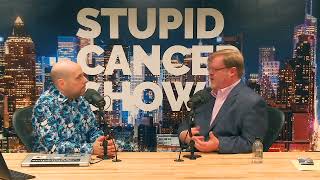
In this episode of the Stupid Cancer Show’s “Pharma Humans” series, host Matthew Zachary interviews Bruce Cozadd, co‑founder and CEO of Jazz Pharmaceuticals. Cozadd recounts his early love of music, how a piano was the first asset he bought for his biotech startup, and how that musical heritage shapes the company’s culture— from a break‑room piano to conference rooms named after jazz legends and a visit from Wynton Marsalis. He explains how creativity and improvisation, hallmarks of jazz, inform the company’s approach to R&D, risk‑taking, and learning from failure in a high‑cost, high‑failure industry. Cozadd emphasizes patient centricity, describing long‑term relationships with patients, a multi‑story mural of real patients in the headquarters, and deep collaboration with advocacy organizations that inform product development and support. He highlights the overlap between patients and employees, noting that many staff members live with the diseases Jazz treats, such as narcolepsy, and that hiring people affected by the disease reinforces the mission. Cozadd shares his leadership philosophy: the primary purpose of a pharma company is to improve patients’ lives, not merely to serve shareholders; sales teams should target the right patients and be quick to advise against use when inappropriate. He also discusses the broader impact of CEOs on employee health, referencing the book “Dying for a Paycheck,” and stresses the need to create low‑stress, health‑supportive workplaces. Finally, he offers advice to peers— stay mission‑driven, treat employees well, and remember that caring for yourself and your team is prerequisite to helping the world. The conversation ends with light‑hearted personal anecdotes about family, improv with his kids, and a love of Wegmans.
Chapters
We hope you don't have cancer, but if you do, this show's for you.
The Stupid Cancer Show. Welcome back to another exciting episode of the Stupid Cancer Show right here in New York City. I am Matthew Zachary, the founder and CEO of Stupid Cancer. Joining me here today today is Bruce Kozad, the CEO of Jazz Pharmaceuticals. Welcome, welcome, welcome, my friend.
Glad to be here.
So this is one of our shows called Pharma Humans, which is here to show you that humans work at pharma. They are real people, flesh and blood. They have passions and art and creativity, and they do real things every day. And we were bonding before the show on how much we actually ironically have in common.
A lot.
Way too much.
Way Way too much.
Possibly uncomfortably too much.
But we'll leave that out.
Well, I want to start with the commonalities here. We're both artists.
Mm-hmm.
And it is interesting to see how art and creativity wind up becoming part of your ethos and your being and how that gets infused into your careers. Talk about how you got started.
Yeah, so as I was telling you, Matt, you know, I've played piano since I was a kid. I sang. And music was really sort of where I found joy, you know, creativity. Uh, and then I realized I was not good enough, uh, to make a career out of it, uh, that I'd have to find something else to do.
Okay. Uh, without being a high school marching band director— no offense, we love them. I had a great time marching band. Love you, Mr. Duda.
Uh, and in 10th grade, I decided I wanted to run a biopharma company, which was an unusual thing to decide.
10th grade, not architect, not doctor, an astronaut.
I wanted to run a biopharma company. This was back in the dark ages. This was in the 1970s, right? If you can go back that far. And there weren't a lot of biotech companies there, but there were a couple. So I pursued that as my career. Right. And here I am doing that years later. But I never lost the passion for music. And when it came time to start my own company, you know, I gave it a musical name, Jazz Pharmaceuticals. So that's, that's where that comes from. The first asset I bought for the company was a used piano.
Clearly.
Which we still have.
I would be disappointed if it wasn't the first asset you purchased.
So 16 years later, we still have that. It's in the employee break room. I go down and play it sometimes at lunch, have employees come down and sing with me. Right. And it's great, you know, it's great community building.
I heard that every conference room in your office is named after a famous jazz musician.
True.
And I also heard that Wynton Marsalis recently made a cameo and saw his own room.
He did.
Talk to me about that.
He did. So I got a call from one of the women that works in the Lincoln Center Jazz Orchestra organization, saying that they'd love to get me tickets to one of their performances on the West Coast. Would I be interested? And I said, I'm not available.
Okay.
And she said, I haven't given you the dates yet. Oh, she said, this is kind of embarrassing. And I said, no, I know I'm not available because if I were available, I'd have tickets already, right? I go see Wynton Marsalis every time.
You can't not go see him.
Exactly. And, uh, so she said, well, I'll just come by your office if you can't make the concerts. And, uh, so I sent my, uh, assistant Emily a little email saying, you know, please set this up. And I copied the woman, and then I sent my assistant another email that said low priority. Meaning don't mess with my calendar. If it happens to fit, great. And then she said, the woman says Wynton Marsalis might come with her. And I said, high priority, right?
And that's like the cloud goes over your head with a giant explosion.
But I didn't think he was really going to come. I thought she'd walk into my office, say, you know, he's really busy. He's got the show tonight. He came. He came. We spent an hour and a half together. I was tongue-tied. I'm rarely tongue-tied. He walked into my office and I— Couldn't believe he was standing there. I've been a fan of his, uh, about 30 years.
One of my colleagues—
he was playing classical trumpet.
No, one of my college buddies was the— ran PR for Jazz at Lincoln Center before they opened in— reopened in, um, in Columbus Circle.
Yeah.
So I got to meet Wynton. Yeah. And Branford at the same time because they were both speccing out the place. I mean, my God, that's crazy. Total geek out.
So I, uh, I, at the end of our meeting, I said, would you like to see your conference room? And he said, what are you talking about? And I said, all the conference rooms in my building are named for jazz musicians. My only rule to my team was half of them had to be women, which is interesting because most people can name more male jazz musicians than female. So I take him downstairs and as my employees know, Marsalis is our biggest room, right? It is the employee cafeteria break room.
Sounds legit.
There are murals on the wall. I've got pictures of his family outside.
You must be a fan.
I'm a huge fan. So he, he came, he sat down and played the piano. Wow.
Oh my God.
Asset 0001. Yes. Uh, has now been played by Wynton Marsalis. Um, it was, uh, it was amazing.
What do you find most intriguing about balancing this creative, um, innards, like what drives your passion creatively, with running an industry company like Jazz? How do they blend together?
Yeah, so it's, you know, we are in a wonderful industry, right? We do something amazing for people, for patients. You know, we change their lives for the better. But it's an enormously complex industry, right? The fact that it costs hundreds of millions or $1 billion to bring one product to market.
Right.
And that most of them don't make it. Means you're, you're risking a lot of capital, you're taking a lot of time, you're putting a lot of resources to bear against long odds. And creativity plays an incredible role in not only what people think of in, in R&D as being an innovative, or you'd say in music, an improvisational process. But it's not just R&D, it's, it's a lot of what we do. Requires innovation to make it successful, to really have the impact you want to have on patients. And so I think, you know, we're privileged to do something that does good but also requires that creativity and that innovation.
I was going to say the practice makes perfect euphemism, or that— what is it? A success is a failure, a success in training. I've heard that too.
Yeah, yeah, yeah. We make a lot of mistakes and, and Our company is on a path to be more innovation-based. In other words, to invest more of what we do back into R&D. Right. One of the things we're working with our employees on is being comfortable taking more risk than we've taken before and understanding that you learn through failure.
Let's talk about the role of the advocacy organizations within the lens of how Jazz interoperates. As a partner of yours for many, many years now, It's been interesting to see how you are really putting your money where your mouth is on innovation. And, you know, we say patient centricity, which is a nice buzzword these days, but what's your take on how you see interoperations with patient groups?
Yeah, well, let me start with the patient centricity and just say, you know, I'm, I'm one of three founders of Jazz Pharmaceuticals back in 2003, and the reason the company exists is I wanted to work for a mission-driven company that treated its employees well.
So how novel.
Yeah, nothing about this is novel. It's, it's just doing it, not saying it.
Right.
And so, you know, I had this idea to start this company with a focus on patients and with a certain corporate culture that got built in from day one. And, you know, here we are 16 years later, and I still tell employees success is are we mission driven? Do we live our values? That's success. It's not a revenue target. It's not an income target. And so, so how do we stay close to patients, right? I love the opportunity to meet patients, to talk to patients, to follow patients longitudinally, right? It's not just that moment when we offered a treatment. How did that impact their life? How did it impact their family? You know, what happened afterwards? What's the next chapter? And so I stay close to a lot of our patients. You see, if you walk into our building in Northern California, a big mural, sort of a multi-story mural that's all real patients, our patients with their name, their disease, most of whom I've met and stay in touch with. So advocacy groups, to go back to your question, Matt, advocacy groups to us are one of the ways we best understand how patients feel, not just about a treatment, but the disease they have, the challenges they face, what they really need in the way of support. We can't provide all that support. We're not, we're not the best organization to do that. We can explore new treatments. We can make those treatments more available, but we rely on advocacy organizations to inform our work. And then we support advocacy organizations because they do things well that we can't do.
And I can attest that they really do that. It's been a wonderful partnership for so many years now working with with you and your incredible team. And again, like, the whole point is, like, you're a person, you're passionate, you're driven. I don't really see a lot of that humanity in the way some of the bigger groups are run these days. And as much as I've written articles called, "There's nothing very centric about patient-centricity out there," but when you truly do focus on— I would say the end user could possibly be, you know, we talk about end users now, but patients really are the end result. Of your efforts at the end of the day. And I just look back at how dignity matters these days, and you were a pioneer in recognizing that dignity matters. Yeah.
And the other thing I'll say is sometimes these worlds collide and our patients and our employees are one, right? Sometimes that's an employee is diagnosed with one of the diseases we treat, or a family member, a child is, is diagnosed with one of the diseases we treat. Sometimes we have people who are survivors of a particular disease choose to come work for our company, right? Because they're so committed to how can I do something for people who are similarly situated. And if they believe our company does good work and really cares about patients, they're, they're driven to come work for us. So one of the diseases we treat that's not in the cancer field is narcolepsy. And I know we have a lot of narcolepsy patients, people with narcolepsy, working at Jazz Pharmaceuticals. It's a rare disease. You wouldn't expect to find many, right? But there are a lot, and they've chosen to come to our organization because they realize what we can do for people like them.
So the ear of industry is watching. Okay. If you had to offer, I would say, a really high-level pearl of wisdom to your peers in the industry, what, what would that message be?
Well, I'm not sure my industry needs pearls of wisdom from me.
Play piano more.
You know, I would say a couple of things. I would say there's a reason our organizations exist, which is to improve patients' lives. And if that's not what you're focused on, you're making a mistake. It's not just about shareholders. It's really, it's a mission-driven industry. And let me, that sounds like, yeah, sure, you can say that. What does that really mean? So, you know, if you have a sales force in a pharmaceutical company, that's whose job it is to go out and sell a product, you know, what instructions do you give them? What is their goal? Is it to sell as much product as possible? Well, if they're promoting your product for patients who will benefit from your product, will uniquely benefit from your product, the right patients, yes, sell as much as you can, right? Do it in a legit way, but that's— you are, you are advancing our mission. But there are patients who won't benefit from our products, right? Or might even be uniquely harmed by our products. Selling to, to those patients is not mission consistent, right? So do you or don't you believe you want to improve patients' lives? If you do, you're going to do the right thing, right? Which is find the right patients and be as quick to tell doctors when not to use your product as when to use it, right? That's consistent with your mission.
It's the emissaries of humanity in a sense.
Yeah. Yeah. So making sure everyone in the organization connects to that. Why are we doing what we're doing? There's a reason, right? There are ways we need to do it. But, but stay consistent with that mission. You know, the other thing I would say is, you know, you have an impact as a leader of an organization, you have an impact on your own employees and their health. So there's a book that recently came out by an author who's a friend of mine, called Dying for a Paycheck that talks about the impact that CEOs, leaders of organizations, have on their employees' health because of decisions they make about the kind of work they do, how they're treated. So a lot of diseases are chronic ailments. A lot of them are stress-related. What's the biggest source of stress in life? For most people, it's work. And so how do you treat employees in a way that's consistent with, you know, you're out there saying, I want to help the health of patients. Do you care about the health of your own employees? Right. Are you treating them well?
It's the, you can't help the world until you help yourself.
Yeah.
Yeah.
Yeah. The people who are part of your organization itself. Yeah.
Bruce Kozet is the founder, co-founder, and CEO of Jazz Pharmaceuticals. I mean, the, the sub-list though, Singer?
Yep.
Pianist?
Yep.
Do you compose?
I can't.
Do you write?
I can't.
Do you—
I sight read.
Do you act?
Uh, I've been in shows.
Have you done improv?
As an amateur.
Okay, okay.
And I improv only with my kids.
And family man, we should mention. Absolutely. Newly married.
Yeah.
And Wegmans lover.
Yeah.
Of upstate New York. Anyone listening that is aware of Wegmans is nodding their head on the video right now.
Of course.
We will not put a link to Wegmans. You're going to have to find them on Google. But this has been astonishing. Thank you so much for joining us, stopping by, lending your voice, your story. It's important that these conversations get out there.
Yeah, I agree. And a real pleasure to meet you. Always love running into musicians who have found other interesting things to do with their life as well.
Exactly, exactly. Wonderful parallels.
Yeah.
All right, folks, thanks for joining us on this episode of the Stupid Cancer Show. We'll be back very soon. Take care.
Bye-bye.
Bye-bye. Hey everyone, thank you for watching our show. Please subscribe to our channel and click the notification bell so you are alerted whenever we post new content. Follow us online at stupidcancer.org, Facebook, Twitter, Instagram, you know the deal. Stupid Cancer, we make young adult cancer suck less.