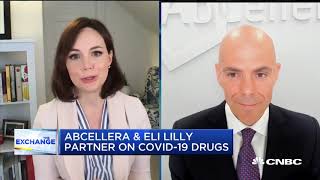
In this interview, Carl Hansen, co‑founder and CEO of AbCellera, explains how his company’s high‑throughput immune‑cell screening platform—described as a "search engine" for the billions of antibodies present in a human immune system—enabled the rapid discovery of potent COVID‑19 antibodies. After receiving a patient sample on February 25, 2020, AbCellera began a program on March 1 and screened over 5.5 million immune cells within three days, isolating multiple lead candidates. The company then partnered with Eli Lilly, leveraging Lilly’s manufacturing and clinical development capabilities to aim for a first‑in‑human trial by July 2020, far faster than the typical 2.5‑5‑year timeline for antibody therapeutics. Hansen discusses the strategic choice between a single ultra‑potent antibody versus a cocktail, noting that while a cocktail may guard against viral mutation, a single antibody simplifies manufacturing and could treat more patients. He outlines the uncertain regulatory and clinical pathway, from treating severely ill patients to potential prophylactic use, emphasizing that timelines will be driven by data. Finally, Hansen addresses pricing and profit motives, clarifying that AbCellera’s role is early‑stage discovery, while Lilly will handle commercialization, and that profit is not the primary driver for delivering the therapy during the pandemic.
Chapters
I wonder if you could just start out by explaining what these drugs are, how you develop them and discover them from people who've recovered from this disease.
Thanks, Meg. Great to be on the show today. So AbCellera has developed a technology that allows us to scan, decode, and analyze natural immune systems. At any given time, a human has a billion different immune cells, each which makes a different antibody. And we've created the search engine that lets us go through that massive diversity and find the molecules that are most likely to be advanced successfully towards a clinic.
And I understand that you had access to one of the first North American patients with COVID-19, and you said in a release that you had gotten access to that sample on February 25th, and now you've spelled out a timeline to getting into human testing by July. That's incredibly fast. I mean, just tell us how this is possible.
Yeah, it has been a remarkable few months. So to put it in perspective, normally A project like this would take anywhere from 2.5 years to 5 years quite easily. Clearly with COVID-19, no one has the time for that. So we received the first sample at the very end of February. We started a program on March 1st, and over 3 days we were able to screen over 5.5 million immune cells from that patient. That resulted in the isolation of many lead candidate antibodies. Shortly thereafter, we partnered with Eli Lilly, and together with them and the innovation and massive effort that they have put behind this program, We are on track to meet the very ambitious goal of getting the first antibody therapeutic into the clinic originally in July, and we are hopeful that we'll hit that, if not beat that deadline.
Well, I know that Regeneron's approach is to use a cocktail of antibodies, so more than one in the same drug. How are you and Lilly approaching this?
Well, I think we're going to let the data lead here. So we're going to have to get antibodies into the clinic and see how it works. There are good motivations for having a cocktail. One of the big ones is that if the virus were to mutate, it's more difficult to get away from a cocktail of antibodies. That's something that we're keeping an eye on right now. Our number one priority is to get a safe, effective, and developable, manufacturable drug to the clinic as quickly as possible. If we can do that with a single antibody that's ultra-potent, that's the very best scenario because it means that we can apply more manufacturing capacity to that one antibody. Ultimately, that means we can help more patients.
And what does the pathway look like from getting into human trials to actually getting a drug that could treat COVID-19 or even prevent it, as this approach might be able to do? How long would that take, do you think?
You know, normally, again, that process would take several years. So we're in uncharted territory. There's been tremendous effort in our partners, Eli Lilly, working with regulatory agencies to figure out what is the fastest path to get a therapy to patients and then through a variety of different clinical development steps. The first application is likely to be for patients that are very sick, but then there will be other groups of patients, patients earlier in the disease or perhaps even prophylaxis. Those will be a series of different trials, and I think it's too early to speculate when exactly those will, will read out and when we'll have the results, because again, we're going to be led by the science in this.
Absolutely. And I know it's very early days, but one thing we've been trying to glean from the leaders of companies working in this space is their approach to profiting from the medicines or vaccines they develop during this pandemic. Acceleron is a private company, but you obviously do have investors. You just announced some more of them today. What is your approach to if you are successful pricing this drug and potentially profiting during a pandemic?
It's a great question. I think it's natural, given the attention that's on COVID-19 right now, to bring these two events together, the financing that we just announced and COVID-19. But the reality is we've been working on this financing since last fall, and the syndicate and investors and plan for the use of proceeds were put in long before COVID-19 was on the table. With respect to pricing, we are a drug discovery company. We work on the front end and on the preclinical development. We have partnered with Lilly, who's taking on the manufacturing, clinical development, and ultimately the commercial development of this drug. I believe it's the case that Lilly, as well as other groups in this, are doing it primarily to bring something out to the world that we need right now. And I don't believe there's a strong profit motive in this for Eli Lilly or for others in this space.
All right, Dr. Hanson, thanks for joining us today. And we look forward to hearing more about your progress as this continues.