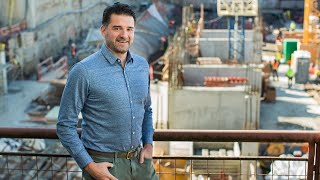
In this interview at the Life Sciences Innovation Northwest conference, Alexis Holzer speaks with Chad Robbins, CEO and President of Adaptive Biotechnologies. Robbins explains Adaptive’s core technology—high‑throughput immunosequencing (Immunoseek) used for research and now commercial diagnostics, focusing on oncology applications such as minimal residual disease (MRD) monitoring and tumor‑infiltrating lymphocyte (TIL) analysis for cancer staging and immunotherapy response prediction. He describes Adaptive’s origins as a spin‑out from the Fred Hutchinson Cancer Research Center, highlighting deep collaborative ties with local institutions (UW, Seattle Cancer Care Alliance, Seattle Children’s, etc.) and the broader Seattle‑Washington biotech network. Robbins discusses rapid company growth (doubling staff from 55 to 120) and the difficulty of finding commercial talent locally, leading to flexible hiring strategies and remote work. He reflects on regional economic development, noting the role of the Washington Biotechnology & Biomedical Association (WBBA), recent legislative tax incentives, and the need for more policy support to sustain a world‑class biotech hub. Looking ahead, he envisions public‑market opportunities, continued capital attraction, and a stronger ecosystem driven by successful local companies. Robbins also outlines Adaptive’s contributions to the ecosystem: hiring locally, partnering with 10‑15 regional firms, providing platform technology that enables others’ discoveries, and personal mentorship through speaking engagements and STEM programs. The conversation ends with a forward‑looking view of the conference’s role in fostering collaboration and talent growth in Washington’s life‑science sector.
Chapters
Good morning, everyone. Welcome to day 2 of Life Sciences Innovation Northwest. My name is Alexis Holzer. I'm the Assistant Director for Economic Development at Washington State University. And now I'm interviewing Chad Robbins, who is the CEO and President of Adaptive Biotechnologies Corporation. Good morning.
Morning.
How are you?
Fine. How are you, Alexis?
Good. So you just gave a presentation about your company. Can you sort of recap that for us here? Tell us a little bit more about Adaptive.
Yeah, I can. You know, Adaptive Biotechnologies is the global leader in immunosequencing, which is high-throughput sequencing of cells of the adaptive immune system, which are T and B cells. And so we developed a, first, a research platform called Immunoseek that's used, being used by principal investigators in academia and biopharmaceutical companies in clinical trials to characterize the adaptive immune system. And now we're on the step where we're we're commercializing products that are clinical diagnostics that can inform patient care. And we've started primarily in the area of oncology. Our first application is for monitoring minimal residual disease in blood-based cancers. And now we're doing a significant amount of research into your host response within the tumor microenvironment for solid tumors to characterize tumor-infiltrating lymphocytes, or TILs., and that has two applications. Um, you know, one in kind of better staging of cancer patients, and the other in potentially predicting a response to cancer immunotherapy or a specific immunotherapeutic agent.
Great. So you're a spin-out of the Fred Hutch. Can you tell us about, uh, what that was like, your experience as a startup in Seattle?
Uh, sure, I can. I mean, we spun out from the Fred Hutch, um, 5 years ago now, but, um, it was a wonderful experience. Um, the, the The center has been extremely supportive of what we've done. We have a great working relationship. I would say that we probably have 20 current collaborators at the Fred Hutch, including Stan Riddell and Fred Applebaum and Larry Corey and Brent Wood and everyone that works there that is looking at the adaptive immune system in a variety of contexts really collaborates with Adaptive, including one of the founders of our technology, Hootie Warren, still sends us samples. Almost on a weekly basis.
So why Seattle and why is Washington so great for collaboration? It's a big theme at the conference this year, partnerships. Washington is one of the best places in the U.S. to do research and education and healthcare. So can you tell us a little bit about why that is here?
Yeah, I mean, I can say I would put Seattle's science and collaborative community really at the top of the heap. I mean, we're We're on par or better than Boston, San Francisco, and there's an infrastructure and a network within on the science side from the University of Washington, the Seattle Cancer Care Alliance, the Fred Hutchinson Cancer Research Center, Swedish and Harborview, and all the different networks that have come together, and it's really about lifting up together and kind of looking at different areas of the science to collaborate to come up with a greater goal. I mean, for example, we've been working with Mike Jensen at Seattle Children's on his kind of adoptive T-cell therapy approach to childhood hematologic malignancies. And it's just been kind of a wonderful experience where we, in some cases, we will do pilot projects for free just to just to help the community. But also, if you look at the infrastructure of new, new companies that are coming out of Seattle between, you know, Juno and Immune Design, Integrated Diagnostics, obviously Adaptive Biotechnologies, a lot of us are working together as well in a collaborative sense that, you know, in some cases kind of one and one can make three. So it's been, it's been a wonderful experience. On the, on the commercial side, I do think we are, we're trailing it. We are adaptive, is massively expanding our operations, both our physical footprint and our, and our human capital. We're looking to double in size, going from 55 to 120 people over the next 9 to 12 months, which is, which is, which is a lot. It's a lot. And what we found is that a lot of the commercial talent doesn't reside here. And I think one of the reasons is one of our last big anchor tenants, Immunex, sold to Amgen years ago. And so that crop of kind of managers and product people and marketing people hasn't really grown up in the ecosystem. And so what we found is we're, in some cases, we're having to look at flexible working arrangements such as commuting and/or using technologies, you know, Skype and whatnot, and We're— the first objective is to hire the best people. Obviously, you prefer them to be in Seattle, but you're going to hire the best people first and then figure out a way to make it work. At least that's my philosophy. And so we've been doing that and we are— we're, we're looking, we're looking for commercial talent right now. How do you take a technological advance in a platform and technological innovation and convert that into products? That's the stage we're on in terms of commercialization. And we can use talent in that area.
Great. So there's a problem. Do you see from your perspective, what are some possible solutions? Is it something that the WBBA can do? Is it the state issue? Is it mentorship that we need more of? What will help us grow that talent here in Washington?
Success. There's a couple different areas. One is you look at Seattle Genetics is, is, you know, growing and successful. And some of the companies that I just mentioned are really coming up, you know, strongly and the, the region is attracting capital. I mean, I think between Adaptive Biotechnologies and Juno, we're the two largest fundraising, private fundraising rounds in the country, at least in our space over the last year. And so we, we've attracted capital and so now we're attracting people as, as more science paired with kind of that commercial success happens, you'll start to see the you're really starting to see kind of the, the kind of regional hub start to take shape again. Chris has done an excellent job from the WBBA. And if you look at from a legislative, legislative perspective, some of, some of the tax initiatives that have been put in place that we could use, we could, we could, we could use extension of some of the policies that has been, that has been helpful to an extent, but We clearly need more incentive within the region from a legislative perspective, from an economic development perspective that could continue to really grow us as kind of a world-class kind of national hub for, or global hub for biotechnology.
So Life Science Innovation Northwest is a great place to talk about those needs that we have in the region. Next year, let's think a year out at Life Science Innovation Northwest 2015, what does that look like or what would you like to see at that conference to really help move the needle forward on some of these things?
I think there's potentially some public market opportunities for some of the companies that I've mentioned. I think that's going to attract further attention to the region. I think there's some legislative initiatives that are on the docket now that could potentially— and economic development incentives that could attract, you know, further investment into the region. But the ecosystem and the infrastructure, you are starting to see that to really grow. And in a year out, I think again is all predicated on success, right? The more successful companies we have that come out of the region, the more companies are going to be incentivized to start, start and grow up within and stay within the region. And I think that's, I think that's starting to happen because if you look at the last few years as opposed to the few years before that, there's been a huge growth in opportunity. Some of that correlates with the industry in general, of course, but some of that correlates kind of with, with the region and the infrastructure of the region.
So what are you doing to help that ecosystem? What can companies do to help each other grow? Are you helping mentor other companies, help them navigate the system? What can— what advice can you give?
Well, the first thing we're doing to help that ecosystem is hiring. I mean, we're hiring people in the region. I mean, that— I mean, I don't think there's anything that can be done more. I mean, you can do more things, but in terms of the most impact, it is actually bringing in talent to the region and hiring people into the region. The second— yeah, we— in terms of collaborating, we collaborate with probably 10 to 15 kind of local companies. You know, think of us as kind of the pickaxe for the gold rush or the routers for the internet. I mean, we have a technological platform, at least on the research side, that makes their discovery possible or validates their, their, their technology or potentially their biopharmaceutical kind of innovation, if you will. So a lot of that collaboration helps. And then from a mentorship perspective, you know, I personally have spoken at the Foster School. I'm involved with the STEM program at Bellevue College. I've tried, not as much as I'd like to be, but I've tried to do things throughout the region to give time to help kind of grow up the ecosystem.
Great. Well, thank you so much for everything that you do and all the success on your company. So this has been Chad Robbins with Adaptive Biotechnologies at Life Science Innovation Northwest. Thank you so much.