Founder Stories: Christoph Lengauer, Thrive Earlier Detection and Blueprint Medicines
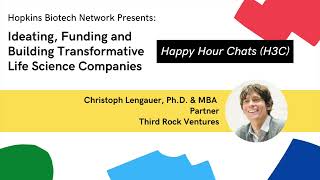
Christoph Lengauer, a venture partner who co-founded Thrive Earlier Detection, talks about building biotech companies from scratch. Third Rock took Thrive from concept to a $2 billion acquisition. He discusses moving between science and business, assembling teams, and why digital health and antimicrobial resistance remain under-invested.
Chapters
So hello all and welcome. It's a pleasure as always to have you with us for this latest installment of the Hopkins Biotech Network Happy Hour Chat Series. My name is Farai and I currently serve as Vice President of the organization. Before we begin, I would like to extend a massive thank you to attendees and our members as a whole on behalf of everyone at HPN. We launched H3C earlier this year and have really been blown away by the level of support and engagement that we've seen so far. For those joining us for the first time, the Hopkins Biotech Network is an association focused on the transition of academic careers to non-academic careers, from biotech to pharma to med devices. We're happy to have 5 branches centered on different parts of that transition experience to meet the needs of our members. This initiative has been put together by our industry relations team, which works to bridge the gap between industry professionals in the Hopkins community. Through H3C, we're hoping to build out community through which we can network and have interesting discussions about a variety of topics within the industry. Today we'll be talking about ideating, funding, and building transformative life science companies through venture capital. No one embodies the fearless, innovative, and bold spirit of Johns Hopkins University more than our esteemed and special guest, Christoph Langauer. Christoph, who holds a PhD and MBA, has been described as a science superhero. Hopkins is proud to count him as an alumni given his far-reaching and significant contributions to science, medicine, and business. Christoph has contributed to the discovery and development of 4 FDA-approved medicines and several drugs currently in clinical trials. And he continues to push the boundaries of science and technology. Christoph, it's a great privilege to have you join us. And I must tell you that there's been an incredible amount of excitement, not only amongst HPN members, but also people outside of our network who have learned about this event. So thank you for your time and, and please know how much this means to all of us. We're going to be doing this much like a fireside chat. Christophe is going to spend about 30 to 35 minutes answering questions that have already been prepared, and then we'll open up the floor for questions from members of the audience. So without further ado, let's get started. You've contributed so much, Christophe, to the worlds of academia, biotech, and pharma over the last 3.5 decades. You've worked in the lab, as a professor, in operations, in C-suites, as a founder, advisor, consultant, and now serve as a partner at the leading life science VC firm in Third Rock Ventures. Yours is an incredibly rich and diverse background that spans across different areas, areas in which members of our audience are currently working in or aspire to. Can you tell us a bit more about your journey in some depth and how you've worked your way to where you are now?
First, thanks for conversation. Glad always to share a little bit of what I learned over the years. To your question, none of what I have been doing has been planned. I mean, that's always a question. How do you become a partner at Third Rock? I don't think there is a plan, but that has been true for my career in general. I was driven by curiosity and having— wanting to have an impact on cancer, and that's why I chose cancer research and was at Hopkins. And then at one point I wanted to make medicines, and that's why I was in big pharma, and then felt like the most effective way of doing this is in biotech after all, and was in management leadership roles there, and then sort of wanted to more switching to ideating companies driven by medical need definition. And then from there, just like, how can you help and like, you know, build that out? Never, most of it just happened, I guess.
Wow, that's incredibly fascinating. And, you know, the perspective I imagine you've gained through all of those experiences is incredibly expansive and unique. I'm curious about one of the major decisions that you made quite early on in your career. You know, you complete your PhD in Heidelberg, eventually you move to the US to work with Dr. Bert Vogelsky here at Hopkins in what you described before as the best molecular oncology lab in the world. While you're a principal investigator in that lab, you decide to simultaneously pursue an MBA at Carey Business School. What are some of the key factors that led to that choice? And, you know, based on whatever those may be and also what you got out of the program, Would you encourage graduate students and postdocs and early career professionals with a science background to consider business or management degrees, say, if they're looking to build their own companies, pursue leadership roles, or get into VC?
Yeah, I mean, there are at least 3 decisions in what you sort of described, and then I'm glad to answer your question. I mean, the first decision was to go to the US. I'm from Austria originally, got my PhD in Germany, was in a very elite organization doing my, my, my postdoc. It's called IMP in Vienna, and that's where I got very frustrated about doing science and was engaged in many other things on this side. Did a lot on the human rights side, refugee work, asylum, Supreme Court decision against the Republic of Austria, worked a lot as victim of torture, and that was somewhat more gratifying to me because it had immediate impact. If we couldn't stop that plane with the person to be deported to— that was who was scheduled to be shot at the airport in Ankara in Turkey, then we had failed. And if we stopped that plane because the pilot refused, with that information in hand, to start that plane, then we had achieved something. We have a very direct impact, which was very different to my postdoc work, which didn't work well, and I didn't know where that should lead to, and I was ready to give up. And I said, like, before I stop doing science, I want to go to what I considered, as you said, sort of the best molecular oncology lab in the world. And I applied in Bert's lab and that's how I ended up there and I loved it and stayed there for 13 years. That's the first decision. The second decision I think might be even a bigger one, which was after my postdoc and some nice papers in Science and Nature, that the clear career path was to start my own lab as a principal investigator, as everybody else. And that's not what I did. Bert asked me if I wanted to stay and I said, wow, that's an honor, but how should that work? And he said, I have no idea, we'll figure it out. And that decision to go into this unknown, like not the common path towards like what is expected from you as a career, I think was career changing. And as I said, I stayed there for another 9 years and it was super productive and enjoyable. For the second decision. The third decision maybe is like what you refer to is like that I decided to have, you know, sort of to go for an additional education and get my MBA at Hopkins. And it was a tough decision because I wanted to do the full program. And, you know, if you working day and night in the lab and then some of the young kids say like, hey, you know, this group project, we'll meet over lunch, you know, like in whatever restaurant. I'm like, no way on earth I can do this. Okay. I could do 10:00 PM, you know, till midnight or 4:00 in the morning. And therefore it was tough to go through this. To your question, would I encourage others to do that? I know that's not a satisfying answer, but we might come to that back later. I think it totally depends. I think it's a very individual decision, and there are situations where it makes sense, a lot of sense, and I think there are many, many situations where it wouldn't make any sense at all. But I'm sure we'll come back to that later.
Absolutely. And, you know, you talked a little bit about the frustration you felt as a scientist. What about the reverse route? So, you know, that is navigating from sort of a business-oriented background into operational and VC roles that require a solid understanding of science? What are some of the pathways, in your opinion, that one might consider following? I know specifically for VC, it's often said that master's degrees or doctorates, in some cases, are absolutely essential. Would you say that's accurate?
No, it's, it's a tricky career path. We see this often also at Third Rock. 'Cause you need to know your stuff. And where do you get that knowledge from? After having read a book, you know, you're not an expert. I would argue having an MD doesn't make you necessarily like somebody understands medicine, okay? A PhD doesn't mean you're an expert in like drug discovery or getting an MBA, you know, doesn't make you necessarily somebody who has practical experience and can apply that. Therefore, I think for me, the trick is, and it's also when I look at people and we want to hire and stuff, it's experience, it's practical experience. And people need to gain that. They just need to know their stuff, right? I mean, if you come from Wharton School or from Hopkins, it doesn't really matter. If all you know is an MBA and microeconomics and macroeconomics, and you know shit about drug discovery, why do you even ask to want to be part of this? Okay? Therefore, I think that's an issue. Where do you get it from? You start somewhere. You sneak in, you help out, you wash dishes, you get an understanding, you talk to people, and, you know, at one point you know more, you might participate in conversation, and with that you sort of, one day you're an expert, and then we are talking. Therefore, I think it's all about that practical experience.
Yeah, and I think that's one thing that you and Christy Weiskel had actually spoken about in one of the discussions that you had earlier on a few months ago with Carey Business School is that getting in, in whatever capacity is critical. And from there, it's really up to you to learn as much as possible and really seek out opportunities from whatever it is that you're experiencing. Finally, you know, as far as career paths go, what is some advice you might give to someone who has an interest in or is pursuing a science degree but hasn't yet quite figured out what it is they'd like to do? And before you answer, I do want to note and encourage audience members to, to ask questions via the Q&A function that we have here at the bottom of your screen in the Zoom webinar. We will do our best to get to as many of them as possible later on in the discussion. So, Christoph, over to you.
Yeah, my, my answer is a little bit nuanced. If somebody is not certain whether they should do science, my recommendation is get out of it. There's no way you can do a good job in that business if, if you're not obsessed with it. It's totally impossible. Now, if you don't know what you want to do or how to have an impact, I would say it's exactly the opposite. Don't worry about that. It's like, you know, there's so many ways of helping and it'll come to you. Like, a few weeks ago we sat down and that was like this career advice kind of thing and like they invited like 4 people. I was one of those on the panel. At one point we started chatting about like what got us where we are. And in everybody's case, it was a total random path. It was not that you find in a book. It's not something that anybody would have planned of being a straightforward path. And we all ended up having huge impact and a successful career. Therefore, if you ask me what I want to do eventually, I don't know. I'll figure it out. There will be the next opportunity. Very nuanced answer. If you are not sure about it, drop it. If you don't know how to apply it, don't get discouraged, just like keep going. Yeah.
Okay, no, that's incredibly helpful. So let's take a step back and let's reset the clock to 2019. You were a seasoned operator and now a partner at Third Rock, which then in its 12th or 13th year established a strong reputation as a venture firm that both ideates and builds life sciences businesses from the ground up. You co-founded Thrive Early Detection, which is a Hopkins spinoff that develops a multi-cancer detection blood test. And the test itself is groundbreaking as it enables sort of proactive cancer management and significantly prolongs and improves patient quality of life, potentially saving hundreds of thousands of of lives. What's both significant and intriguing about all of this is that the underlying technology was developed by Dr. Bert Vogelstein and his colleagues, with whom you used to work with for over a decade, as you mentioned earlier on. Third Rock provided significant funding, and you joined the executive team. And fast forward to late 2020, early 2021, less than 2 years after launching, Thrive was acquired by Exact Sciences for over $2 billion. In the conversation that I referenced earlier that you had with Christy Weiskold describing your involvement in Thrive, she said, quote, "None of this would've happened without you." Can you talk to us in detail about taking the company from concept to exit? I mean, this was a runaway success. What did you see in terms of the science at the early stages and how did that translate into a palatable business for investors over time?
That's a good question. I mean, maybe it's a lucky case, but like, you know, if you do it repeatedly, maybe it's like, you know, it's a concept in it. I mean, first of all, companies are not sold, companies are bought. Okay, therefore you never, you should never work towards like selling your company. I think that would be really bad. You always work towards like your North Star, and then like take it from there. I think that's, that's important. Now what's also important is if you have the best product with the best science, but your team is not good, you have no chance. Therefore, it's a lot about sort of putting that team together, and that can be inexperienced or experienced. That experience is invaluable as it comes to us building companies. That's why we at Third Rock, when we launch companies, you know, we as partners go into management leadership roles in the company for like a year, 2, 3 years till we can take off the training wheels and leave that company alone and then go back and like be board members. We think that's really, really important. And that means you have to have a clear valuation plan. You have to have a, a north star that you believe in, and you need to build just a robust company. I think it's— sometimes we think there's like a discovery and making a product that's hard, but then like, well, medicine is hard, but then in medicine, like, in making actually a product is like maybe even harder. Therefore, same is true for diagnostics. It's So many steps, and I think you cannot just rely on science or whatever. It's, it's that interplay between science, medicine, and business that one needs to get right in order to have a successful company.
Yeah, that, that makes a lot of sense. And you touched slightly on, um, sort of the pathways and responsibilities, um, of a VC partner. And that can really vary across fund size, industry, and even within a given firm. Can you shed some light around your specific scope of responsibilities at Third Rock? You know, what level of involvement do you have with companies across the portfolio? Do you meet often with entrepreneurs and find founders at what stage? And for the firm, are there specific geographic areas or even universities, let's say, that you tend to sort of gravitate towards?
Vertrocq is a little bit special in that regard. Now more firms are trying to do this, but we were the first ones about like 12 years ago that started the concept of investing only, almost exclusively, in companies that we ideate ourselves. And that's sort of relatively unique. That means even if Founders approach us, academic founders, for example, with their ideas. We take those on together with them and incubate that idea and for like 2, 3 years on average. We spend about $2 million and about 2 years before we launch a company. Definitely call that sort of that ideation process and then launched companies. And as I said before, go down into those companies in a management leadership role, in my case, usually as chief scientific officer. And, but that's somewhat unique. And given that uniqueness, it's kind of obvious that we do this only in Boston and in the San Francisco area because those are the two places where we have our offices. Thrive is a little bit of an exception because it's originated in Baltimore, but we built our headquarters out in Cambridge. And therefore, in that regard, it's very similar also. To my specific role, I mean, We are about 10 partners at Third Rock, everybody with different responsibilities. I co-lead the discovery part, which is maybe the best way to describe that is the ideation process, which means the portfolios are leading the portfolio of company ideas till we actually decide to launch that.. And then I go deep into like one or two companies at a time.
I see. And you know, Third Rock has a very vast and really just unbelievably impressive portfolio. Are there one, two, or three businesses people here may not know about, maybe recent investments that you're particularly energized by? And are you able to share any information about what they're working on and what excites you about them?
Yeah, I mean, of course there are companies that I helped ideate and build, and those companies live on forever, hopefully, right? There are two examples. Blueprint Medicines, a kinase company, now two drugs approved. I think a $5 billion company at this point that continues to, like, deliver on new medicines in the personalized medicine oncology space. And then similarly Relay Therapeutics, also now a public company, a little bit over $3 billion value that I helped build. And that does the same thing. From the new projects in the drug discovery space, I liked one in particular. It's, it's all has also a cool name. It's called MoMA Therapeutics, which stands for Molecular Machines. We started it about a year ago. With an $85 million investment with Third Rock and a couple of syndicate partners. And it works on making drugs for what we call the blue-collar workers of the cell. Those are the molecular machines that are very essential for many different types of diseases. And people just didn't touch them much because it's so hard to make drug against those. And it fascinates me, like, you know, and it's super difficult, and if you need to be very innovative of how to approach that, in this case from a chemistry perspective, I think that's, that's really cool.
Very cool, very cool. You know, throughout your career, you've shown sort of this innate desire and commitment to make the world a better place, and there's There are numerous examples of this, not only evident via your professional and industry recognitions, but also at a more humanist level. You were actually written about in a book called The Immortal Life of Henrietta Lacks, which details the work you did to develop a technique used to detect and identify DNA sequences and your interactions with the Lacks family, to which you sort of freely offered your time, your knowledge, and empathy. While sort of accounting for the institutional racism that they endured. What are some of the core principles and values that have driven you over the years, and how do they shape the decisions that you make?
It's a good question, which I never know the answer for, because like, I don't know, I think it's very much dependent on what a person believes in or considers important. I mean, people always ask me, why did you show the cells to the Lacks family when Hopkins actually took a very different position? Um, and thought about it, I just thought that's the right thing to do, right? I mean, it's like, it's not much to talk about. Um, I understand why people maybe do not follow necessarily what they think is right because there's a lot of barriers. And I think Hopkins in that regard is a good example, right? You know, when I heard first time about the Lacks family not having insurance, living close to the Hopkins campus, having been instrumental with those cells, you know, for so many advancements in sciences, and nobody ever said thank you. I wrote a letter to like, you know, the president of Hopkins at the time and just like thank them somehow, you know, that would be good. And I did get a response, which was they won't do that. And the reason was the legal team of Hopkins advised the president not to do that because it could have been perceived as, acknowledging that one owes something to their family. And therefore the advice was not to do. And I just like, don't give a shit about those things, okay? I just like think what's right, and I think that's a very good guiding principle and not very complicated, I think. It has nothing to do, I think, with grand values or beliefs. I think it's just like, people were just to do all the time what they think is right, I think the world would be a better place. And I think that, applies to everything we do.
Great, great. Thank you, Christophe. I want to shift gears and now maybe focus a little bit on Third Rock's approach and the work that you all do as a firm, which is sort of broken out into 4 pillars, which are discovery, you know, so looking for emerging fields of science and medicine with an unmet need, launch, so providing companies with the necessary financial, technical, and human resources to get off the ground, building, so executing on strategy and really bringing whatever resources are required to, to cultivate partnerships and really drive value-creating transactions. And then, you know, transformation, so delivering on that promise to, to make a difference in the lives of patients and their families. Can you elaborate on exactly how that takes shape? Who's involved in the various phases? And is the process relatively consistent and uniform, or does it really depend on the company and their specific needs.
I think it depends on the company needs and like our philosophy is, I think there are two core principles that we apply. First off, we let people vote with their feet and with their heart and with their brain. Okay, therefore there's no regimenting in terms of how many people should be on what project. If there's an interesting project and people like join it, that's how it goes. Therefore, it's very, very much driven by the motivation of people and by people feeling like they can have an impact or be champions. That's the first principle. The second principle is group genius. We just totally believe that the more people are involved in the decision-making, the more diverse that group is, the better is decision and The genius comes out by the group rather than by an individual. With that, every company is different and there's no clear plans. There's like a concept to it, but otherwise it's totally individualized. And I mean, that made us the most successful venture capital firm in life sciences and the second most successful venture capital firm in any discipline in the world. And there's principles that actually are like pretty obvious, right? You know, like people vote with whatever is important to them and like apply group genius and the diversity that's so important for good decision-making.
That's very helpful. And for those of you unfamiliar, Third Rock was actually ranked by Private Equity Insights in 2020 as the second highest performing performing venture firm in the world across all industries, as Christoph mentioned. Based on your experience, Christoph, what are some common sources of ideas for new companies? And, you know, as you evaluate new concepts, how does Third Rock's model facilitate and measure the progress and challenges associated with translational science?
It's a good question, right? We had to where does creativity start and how do you foster it. Max Perdue, like one of the Nobel Prize winners, like once said that you cannot really sort of force, cannot really like create creativity. It pops up at random places. But there are definitely ways how to stifle creativity. And there you can remove the barriers. Therefore, also for Third Rock, it's actually a lot about removing those barriers that actually don't allow, like, you know, something to come to fruition or ideas to blossom. And ideas are like babies or plants or like a small animal. You need to, like, protect it in order so that it can grow. It's so easy to just like, you know, like damage it and destroy it and say that's like, you know, useless. Therefore, we do a lot around removing those barriers, and one of them is that people like believe in uniformity or like, you know, as I mentioned, diversity works against that, and I think that's super important to us, or that free flow of ideas where there are no bad ideas. Okay, I mean, just like maybe immature ideas or like things that don't have legs eventually, but in the beginning you don't know. And therefore we'll do a lot of creative processing and like different approaches towards that. And it's a lot about networking and talking to people. I mean, there might be a technician who says like, look, you know, this really is in my way of things. And I thought about a better way of doing this. And like, here we go. Maybe that's a company idea and comes from a patient maybe who explains to you that if you just were to have less side effects and you study those and like, you know, come up with that. I mean, there's so many different ways and just being observant. I just started a company a year and a half ago that's very different. It's called EQRX, and that's a company that will— is remaking medicine and sells them for a fraction of the price because we think that access for medicine is becoming one of the biggest challenges. That's not a third company, but it's like the company that really is very important because access is becoming one of the biggest limitations in our industry because pricing is too high. Somebody needs to do something. It's a very simple solution. You sell them for a fraction of the price. How do you do this? Okay, you need to make them in a cheap way so that you can afford it and you need to take out the middleman. Okay. Good. Take out the middleman, make it more affordable with machine learning, artificial intelligence, whatever, in a robust way. And then, as we show now, two drugs after a year in phase 3, both of them positive results. And now we'll show the world that we'll sell them for a fraction of the price. We'll disrupt the total industry, hopefully. And in 10 years, we'll look at it in a different way, we hope.
That's exciting, and congratulations on that company, and look forward to sort of learning more about what you're doing through it. You touched on, you know, the need for networking, and I want to drill down on that a little bit deeper. We have some members of the audience and other, you know, others who are part of our network not here today who are either startup founders or sort of intimately involved in the process of building early-stage companies. What advice would you give to them with respect to approaching VC firms, building relationships, and overall just trying to raise capital?
Yeah, good question. I'm a firm believer in building robust companies and not being greedy. I'm not a believer in bootstrapping companies. Companies. I'm convinced that a small size of a pie, be it a founder, be it like even an investor, is absolutely appropriate if the pie is big. I would always worry about the size of the pie rather than the fraction you get. Because I tell you, it's very simple math. If you own 70% of a company that's worth nothing, that's zero value. It's very simple math. If you ask, if you own 10% of a $10 billion company, you have $1 billion. Okay, therefore I would always worry about the size of the pie and get there in the most robust way. And financing is one of them. I would encourage people to not be greedy, to really like build the best possible product and company and everything else. So like, it's great to share. Yeah.
Well then, you know, how do you navigate that? Because, you know, in your opinion, what are your views on sort of founder equity for inventors for initial key team members and for the firm, for Third Rock in its capacity as a very hands-on investor and partner for companies.
Yeah, again, I mean, take Blueprint Medicine as an example. Let's say you have found them, Blueprint, you have 1%. Okay, now it's a $5 billion company, you have $50 million. It's very simple. Now you can go to an investor with dumb money all you get is money and a headache and complications as you grow the company. You have 50% in this company and you never get it to anywhere. So why would you do this? Therefore, I think it's extremely important, like building companies, being successful, bringing medicines to the market, diagnostic tests, whatever you have it. It's like, it's all about like, you know, being successful and you can't do it alone. You need so many people who help you with that. And just don't take the money. It's like, you know, just like try to be like, is there smart money? Is there something that— especially in a situation like today where money is not limiting. We're not here in 2009 or whatever, where it was hard to get money. Okay. We're in a situation where you get money, like, you know, raising money is like, you know, it's not a big deal in my opinion, if you have a good idea and a great team. And you have a great story. I would focus on the story and like, they are just like anybody who can enrich the company with some form of knowledge. The rest is, I think, details.
Great, thanks Christophe. I'm curious to hear your thoughts about sort of trends and patterns that you're seeing in venture in 2020 and beyond. But before we get to that, What are some of the areas in biotech and pharma that companies are not focusing on enough right now? And, you know, how do you see this as being a problem?
Yeah, I think we used to say rare genetic diseases are not covered because they don't make money. Okay, not true. Genzyme, Alexion, you know, Bluebird, you have it. Very, very successful companies with patient populations that are very, very small. And for that, that of course was wrong. We said that you can't invest in diagnostics because it takes so much money to build them and then the return is small. Now we built Foundation Medicine, sold it to Roche for more than $2 billion. We built Thrive, we just talked about it, within 18 months we turned over $2.5 billion. There are other companies out there, Exact, more than $20 billion value, like, you know, this is no longer true. Therefore also here we were wrong, it was a good idea. Therefore I think there's more and more willingness to take the risk where we are not yet investing as much as I would say in digital health. There's a lot of angel investing, like whatever, $3 million here, $2 million here, but the field has not yet shown how impactful actually and how successful it can be besides measuring things faster or in a more convenient way. But that's a space where I think we need to just convince the investment community that actually it can be successful. Partially it's a problem because of expertise. I always say I invest in every digital health company that has two requirements. One is a leadership person who knows data sciences and a leadership person who understands the medical problem that they're trying to solve. There's almost no digital health company that has like a data scientist and an MD. Okay, therefore, why is that? Okay, because they are mature. Okay, therefore I think that's a field we need to do more. And then as I mentioned, that's why I mentioned eQRX, you know, in the space of access to care, in the space of delivering care, in like making an antibody or vaccines that don't need to be refrigerated so that we can also sell them in poor countries or in Africa or South Latin America. Like those kind of project concepts, I think, are still very, very small developed. And then there are what I call bad neighborhoods where people just had made bad experiences over time, and there's no willingness to invest, even if the space is very important. One is antimicrobial resistance, right? You know, bacterial resistance, infectious diseases, space where we have not done anything as a community over the last 10 years. Now with COVID that's changing a little bit, but still there's very little in that space, and it's so important. It's one of the biggest healthcare problems. There's a lot of space. There's so much medical needs still, you know, and therefore I would say the universe of possibilities is enormous still.
And, you know, can you maybe— you mentioned digital health and a couple of others. Can you talk to us about in terms of trends, what you're seeing as an investor and entrepreneur? Specifically where you think jobs will be in life sciences in the next 5 to 10 to 15 years. What are you most excited about with respect to that element and overall where the industry is headed?
Yeah, I mean, we see this already now in the context of artificial intelligence, machine learning. I think there will be more in making more efficient processes, shortening the timelines, especially in drug discovery. I think we'll see a lot. I think in therapeutic areas that we consider untouchable because they are so difficult, we'll see more. And my favorite topic is personalized medicine. Personalized medicine, targeted therapy, like, is totally super important in oncology. You couldn't even think oncology anymore without targeted therapy, but actually it doesn't exist in other therapeutic areas. There's no personalized medicine in autoimmune diseases, one of the biggest problems. There's none in cardiovascular, and there's nothing in metabolic diseases. We need to find ways of personalized medicine outside oncology.
Great. One thing we talked about earlier was sort of this idea of having a north star and something that you're really committed to if you are really going to dedicate yourself to any pathway within the industry. What do future sort of life sciences leaders look like? And any final words of advice for audience members with an interest not only in science but also in commercialization and VC?
Yeah, I mean, For me, of a basic principle that is, I think an average scientist compared to a good scientist, the difference lies most likely in articulating tough decisions, I think. And the difference between a great— a good scientist and a great scientist is actually to act them out. And I think that applies for most disciplines in the space that we're working, maybe for everything in life. That courage to act upon it, not only to intellectualize it, I think is a key characteristic for successful entrepreneur scientists and clinicians. I think it's also a very emotional process that should be driven by like what our responsibility is. You know, I think, you know, the grandmother of Spider-Man said it, but what Jesus said is in the Bible too, I believe, you know, it's like with great talent comes great responsibility. And like, we are all privileged to be part of this. Most likely everybody on this call, we are a very privileged group, okay? Very privileged. Like, what do we do with it? I think, you know, if we take that seriously and becomes our drive, good things will happen. Great.
And I think that we're gonna move on to audience questions. Kai Arash, I see that you asked, what are some qualities that you think differentiate scientists who succeeded at ideation? And I think Christoph touched on that a little bit. I don't know if there's anything you want to add, but really I think the answer to the question was, was acting, right? So being proactive about whatever, whatever it is that you're working on, whatever it is that you're passionate about. Christoph, is there anything that you would add? So the question is, you know, what differentiates—
Yeah, I mean, we have a lot of, like, I see a lot of, like, what I call screwdriver companies, which is you have like a tool and then you go from house to house and ask if you can fix something with your screwdriver. Okay, and I think it's a very common theme, you know, very often PIs in academia, they choose their area to work on because they have developed the technologies and now they say like, hey, what can I solve with this technology? I think that's fundamentally a bad approach. Okay. I think we should define a problem that we will solve and then make the tools for it. Okay. Therefore, and I think that also is the recipe to successful ideation. I mean, not every idea will be good. Most of them will be like, have no legs, you know, but that obsession with trying to solve a problem, right? I mean, that's like, you know, where a lot of, you know, wars have been very good ideators. Unfortunately, but like, because like there's a need, okay, there's this urgency. I mean, take COVID as an example. I mean, if we would have just set out as a scientific community and said like, from now on we make vaccines that by the second we hear about them, you know, 14 months later we vaccinate like, you know, like most of people on earth. Like people said, it's totally silly. Then there was COVID, here we have it. And not by one company, but by, I don't know, 20 companies. Very interesting, most of them are partnerships between biotechs and big pharma, or biotechs and academia, academia and big pharma. Be it Oxford, like, you know, like, you know, it's AstraZeneca, be it like, you know, BioNTech with Pfizer, be it like, you know, whatever you have it. Okay, therefore all of a sudden collaboration and like creativity and new technologies and now the established old technologies lead to the same purpose and just because it's need-driven for that obsession to solve a problem, I think those that makes you a good ideator.
That's great, thank you so much, very, very, very insightful. Anson, who's asked, you know, can you talk about the process of taking an idea to actually forming a company. How do you judge whether the idea is feasible and profitable, and what are some of the categories you consider during the incubation process?
Yeah, it's a good question. And like, you know, I think we need to be careful. Um, there is a reason why Amnesty International and Greenpeace are not like, you know, um companies on the stock market that like, you know, create those business models because that's not what they do. Are they solving an important problem? Yes. We need to be very careful, as I mentioned before, there's a synergy between science, medicine, and business, and we cannot do it with only two elements of that because that's the intrinsic element of an entrepreneur.. And it's not just like, you know, whatever, like digging a well in like South Sahara, okay? That might be a business model, but not necessarily. But it's always a good cause to kind of work on it. Therefore, we need to look at any direction. I think that's really, really important. Now, to the question, the follow-up question by Anson about like, how is our process and what's the attrition around that? Around that. We have 3 phases at Third Rock in this discovery process, and very creatively we call them C, B, and A. And we lose about 2/3 of the ideas in that first phase. And then in that second phase, we lose again about a third. Therefore, there is like, you know, from whatever is left over. Okay, therefore we lose a third from the third. Okay, in the A phase we don't lose projects. Okay, therefore that is a pretty high attrition. Okay, that means we lose about what, 75% or so of our ideas, and they are already kind of a little bit filtered. Okay, therefore that's just how it is for us as we go through this process.
Thank you. Thank you, Christophe. Esther has just asked, how do you know when to pull the plug or judge when it's time to change directions and pivot when the obsession doesn't match the progress?
Yeah, there's a lot of power in pivoting, right? A lot of companies reinvented themselves, and I think that's that just shows how good the team is. If that's a good team, they can make a bad idea into something good, okay? Therefore, I think I totally believe in this. Not always true, however, and there you just need to be very prudent. Super tough to say you were wrong, that you bet on something that you were obsessed with and it's just not working out for whatever the reason is. And I think that just happens and I mean, I think it's totally cool. It's part of the process, right? You know, to kind of screw things up or to be wrong. And as long as you're not like making the same mistake 3 times, you know, it's totally— it's just part of the process. Drug discovery is like that. 1 out of 100 ideas goes into a clinic, okay? And from the ideas that are in clinic, only 1 out of 100 gets a reg, becomes a registered drug. Most drug discoverers have never worked on a drug that eventually went on the market. Actually, about 99% of our drug discoverers never worked on something. It's like selling, trying to sell shoes your whole life. And when you retire, you can say you have, you know, put that window up and like, you know, try to do whatever, but you've never sold a pair of shoes. That's the life and fate of a drug discoverer. Okay, now there are some that are a little bit like more blessed and lucky in that, but that's, that's tough. Therefore, it's just totally normal to fail, and I think our culture can live with this as long as we— I think we ourselves in the way of this, okay, like we just don't want to be wrong. But I think in ideation, and that's also the question here, what makes a good ideator, just not be afraid of that's like silly or like impossible or, you know, that's right.
So, you know, I want to go back actually based off of your answer there to something you mentioned earlier, which is the idea of bootstrapping. And I think you had mentioned that you would sort of advise against bootstrapping. Are there times when we feel it actually makes sense for an entrepreneur or team to bootstrap their business. Let's say they're not able to actually raise funds from a VC firm and really they're not able to really sort of communicate and translate their product into something that's tangible and palatable again for investors at a given point in time. Does it ever make sense to actually just raise it?
Yeah, it does. I also like, worked on a company concept that we bootstrapped, and that's now 7 or 8 years ago, and the company still exists and does a lot of good. It's sort of in matching patients with, uh, with clinical trials, for example. Um, company called Sagelee Health. Um, I think sometimes if you are ahead of your curve, right, you know, and really you might have to bootstrap. If nobody believes in you, you might have to generate data. You might have to create reasons to believe, right? Now, at the same time, timing is one of the key factors for a successful company. Just because you are ahead of your curve and nobody is willing to go for it will not make you successful. Therefore, there are, you know, it's a fine line between silly and like, you know, sort of convincing people. If I think that needs to be, that balance has to be found. I think bootstrapping is appropriate, like if one starts out small and like, you know, really in those pilot projects, I think that's good. Like, you know, maybe I don't know if I should give a quantitative guidance, but like I would say up to $3 million or something. I think, you know, I, I, I think that's very appropriate to bootstrap. I think when it comes to $10 million, I, I, I just don't see that this is the most responsible way of doing that. Okay, but it depends on the situation. It depends on your motivation also, you know. But I think for early ideas, if As long as it's like in that range, I think that's appropriate, sometimes necessary.
I see. And then how much of that depends on the team? And sort of a step further, what are sort of some of the key elements to assembling an ideal management team as you're building out a business?
It has to be very strong. Very strong. It's the most important part. Elements to it, I think diversity, I mentioned it several times, that you're not like too narrow in your thinking. Experience, I think is enormously important. Because like, look, this is tough what we are doing. Why do we want to have just people in there who have never done it before? I mean, it's heroic, I respect it. It's just like, why would you do this if you have a choice? Okay? If you have a good idea and no experience with it, just surround yourself with people with experience. Why do you surround yourself with people who have no experience either? Like, explain that to me. I see a lot of company concepts and then there are 6 people in there, super smart, you know, people, none of them have any experience. Like, why do you do this? Why don't you add people to it? That I actually experienced. And then I think it's about storytelling, and I don't mean it like, you know, telling stories. I mean it in that context, can you, do you have a capability to actually simplify and synthesize and communicate clearly? Because it usually indicates that you own and control the idea and concept. I think it's very, very important. Many companies don't have those storytellers, and it might indicate that something is maybe too convoluted. I always say if it's complicated, it might be wrong. Okay, I think usually, you know, the right things are simple, and doesn't mean like not difficult, but like less complex.
Thank you, Christophe. I have one final question, and it relates to The final question you actually had in the chat that you had done a few months ago with Hopkins. I know that you're a big soccer fan. I know that you're a big Chelsea fan. So massive congratulations on last week's Champions League triumph. Are there any sort of lessons from that journey that might be applicable to the world of business or biotech and pharma?
Yeah, soccer is very important. Important, I think. Actually, I was assistant coach at the women's soccer team at Hopkins for, I think, 4 or 5 years at some point. I coached a team in Baltimore, was director of coaching in Baltimore, and my club team was third place in North America. I was on the national staff for selecting the Olympic national team on the women's side. I love soccer. Yeah, Chelsea. Yeah, thanks. Big win, you know, like champions of the world, right? Anything that maybe relates to what we are doing? I think so. I mean, take like, you know, for those who don't care about soccer, Chelsea, like, you know, a few months ago got a new coach and manager, as it's called in England, and it's a German dude. And like, you know, what happened.
Okay.
And I think that's very, very important. It's like he understood that the team needs to sort of unify around common goals and principles. And as everybody in the interviews afterwards said, is we are one unity because we need each other. And I think sometimes that needs a leader to help a group to understand that. And I think, you know, instilling that understanding of interdependencies and that difficult tasks, you know, require people to work together and acknowledging this and putting your ego a bit like in the back seat I think that's maybe something that we can learn from that.
Yeah, very, very wise words. I'm a bitter United fan, so not quite as much happiness. Okay. But thank you for that. And really, Christophe, thank you so much for today. This has been incredibly insightful, I think, for everyone here in the audience. And, you know, as you mentioned, as I mentioned earlier, we really just appreciate the time that you've taken today to share your insights and knowledge with us. So thank you so much. And we hope to stay in touch with you and maybe host you again at some point in the future. So thanks a lot.
Of course. And like, you know, and thanks for the time and everything. And if people like on this sort of video call like need something, that's the other thing. Always reach out to people. Like don't be afraid of things. Like we're always looking to meet with people who are ambitious and like have bold plans and like want to achieve something. And then even us who are like super busy, you know, like we make the time for it because that makes us busy. Busy people can be recognized by the fact that they have always time, I think. And, We are willing to do that. That's also my offer, like, to anybody, of course, like, that to help with anything.
Great, thank you for that. And, um, I think a good place to sign off— Sean has just said that this is the best webinar that he's watched all year, 11 out of 10.
Maybe it's the only one, you know.
Um, and please host him again. So, so thanks again, Christoph, and thank you everyone for attending, um, and we'll see you again soon.
Of course, thank you.
Take care.
More from Joshua







Scientist Stories: Hans Waterham, The value of phenotypic assays in peroxisomal disorders




Scientist Stories: Joel Zlotogora, Genetic carrier screening programs for reproductive purposes