In this sponsor presentation, Emily Leproust, co‑founder and CEO of Twist Bioscience, outlines the company’s silicon‑chip oligo synthesis platform and its disruptive advantages over traditional 96‑well plate synthesis, emphasizing higher throughput, lower cost, and superior quality for targeted sequencing. She structures the talk around three themes: fast optimization (delivering first‑run data within weeks), sequencing efficiency (achieving balanced 30× coverage with minimal sequencing to reduce costs and avoid over‑ or under‑sequencing, demonstrated across designs ranging from 139 to 135,000 probes with >95% of bases reaching 30× at 150× raw sequencing), and workflow flexibility (introducing UDI adapters that add barcodes via PCR for higher yield and scalability, universal barcodes that simplify blocking, fast hybridization buffers that cut hybridization from 16 hours to 15 minutes, and mechanical fragmentation kits for FFPE samples). Leproust also highlights Twist’s broader product portfolio—including rapid gene synthesis, oligo pools for CRISPR guide RNAs, protein and antibody libraries, and long‑term DNA data storage—inviting the audience to leverage these services. The presentation concludes with a call to action for researchers to adopt Twist’s solutions to save sequencing dollars and streamline laboratory workflows.
Chapters
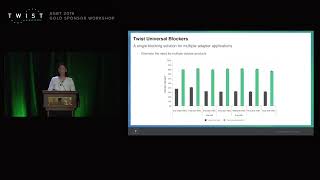
So thank you. First up, we will have Emily. Thank you very much. It's my pleasure to be here for our second in a row gold sponsor presentation. So if I can move the next slide. For those of you who don't know Twist, we were founded in 2013, and we recently did an IPO. And we have a global presence, so we are building a team that's able to support you throughout the world. And Twist is founded on a foundation of a silicon chip where we can synthesize millions of oligos. And that is in contrast of to the classical synthesis of DNA on a 96-well plate. And so the silicon chip gives us a very disruptive throughput and cost advantage, as well as a quality advantage to support your targeted sequencing workflow. And what I'll talk about today is around 3 themes. The first theme is the theme of fast optimization. Which means that once you have an idea, you can get your first data in a few weeks so that you know if it's the right direction for your science. I'll talk a little bit about sequencing efficiency. And our goal is to enable you to get the data you need with the least amount of sequencing possible so that you can have the lowest cost per sample possible. And finally, we want to give you as great flexibility as possible to really enable any workflow that you want. So first, sequencing efficiency. This is what we are trying to do. You can see that there is a target region you want to capture. And the goal is to get to 300— sorry, to 30x coverage with as little sequencing as possible, meaning that we don't want to over-sequence any target because that's just waste of your sequencing dollars. At the same time, We don't want to undersequence anything, and we definitely don't want to have any off-target. So, the— what we have achieved with our solution is balancing the coverage such that you don't have undersequenced regions, you don't have oversequenced regions, which is important for 30x coverage. But now if you think of going to 400x coverage for cancer samples, or thousands of x coverage for circulating DNA, it's even more important. And we've built the technology and it's working. And last year we said that it will work, and now this year hundreds of you have tried it. And so just to give you a quick summary, I have a table with almost 10 designs. At the top is a very small design with just 139 probes, and at the bottom is a bigger design with 135,000 probes. And they all work well on the first time. And for us, working well means that if you have 150x of raw sequencing that you filter at Q20, more than 95% of your bases have 30x coverage. So with as little sequencing as possible, you get coverage on all the bases that you want. And that's what you can get on the first try. Next, I'd like to speak a little bit about the flexibility. So what was available so far is an enzymatic fragmentation kit, combinatorial adapters, enrichment reagents for high buffers and so on, and then any contents you want, either catalog content or custom content, as well as some beads. And we are adding to that workflow. The first thing that we are adding are UDIS adapters. And we have a, you know, classic way of adding adapter, sharing the DNA, ligating the adapters, but the UDIs are actually added at the last step through PCR, which brings a few advantages. The first advantage is that it maximizes the yield and it removes the primer dimer. You can see on the left with the Y-shaped adapters, there's always some primer dimer. With our adapters, that demo is gone and you get much more yield, so you need less PCR cycles to go to your next step. And because the dual adapters are added through PCR, it's much easier to have a much larger number of barcodes. We're starting with 384 barcodes, but we have the foundations to go to thousands of barcodes, as you can think of high throughput. So the idea is is to create the foundation for adding more and more samples on Nova6. And the next thing that we are adding is universal barcodes. And as you know, in the workflow, the adapters can daisy chain to each other, so you have to block them. And depending on the size of your barcode, you may have to get blockers for 8 barcodes or 10 barcodes. 10 base pair barcode, and we've eliminated that by having one blocking solution. So, and I'm showing here data of 6 base pair barcode on the left all the way to 14 base pair barcodes on the right. With or without UMI, it's one tube, it works for all your samples. So, if you're thinking of putting together on one lane samples that come from different collaborators different library preps, you only need one blocker. The next thing that we are adding is the fast HIB experiments, so the fast HIB reagents. In the past, we used to have a 16-hour HIB to get the maximum efficiency, and now we are changing the buffers for hybridization, and you can achieve the same results in 15 minutes so that you can go from a sample to the sequencer in the same day. So just to show you some data, on the left we have the Exome data. In gray, you can see that 16 hours high previously is as good as 15 minutes high with the new buffer. If you wait 30 minutes, 1 hour, it gets even better. But you get the same performance at 15 minutes than you used to get at 16L. And so on the left is a big panel, on the right is a very small panel. It works both ways. You get very high on target, very high percentage of bases covered. And last, we are adding a mechanical fermentation. If you guys are interested in using the Covaris maybe for FFPE samples, we have that kit as well. So the idea is we used to have great sequencing efficiency. And now we are adding to the workflow to enable you to get that efficiency with the least effort possible. So saving you sequencing dollars thanks to efficiency and saving you effort for the work. Last but not least, I've shown you our NGS portfolio, and you'll hear from our customers how great it works in their hands. But we do other things. We especially do a lot of gene synthesis. So if you know people that are spending their time cloning, you should tell them to go to the Twist website. It's twistbioscience.com/shop. And remember, friends don't let friends clone. So if any of your friends are cloning, they should go on the website. In 5 minutes, you You can order your gene and you get it shipped to you in 2 weeks. Your gene in your vector, delivered perfect. We do oligo pools as guide RNA for CRISPR experiments. We can build protein and antibody libraries. And we also do quite a bit of data storage. So coming to a data center near you soon, any data that's very important, we'll be able to store it in DNA. For the very long term. So with that, I'll stop. Thank you very much for your attention, and I think you're going to have a very, really great time hearing from our customers and the great work that they have been doing. Thank you.