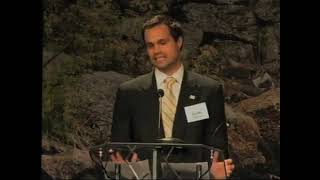
In a brief keynote, Errik Anderson – COO of the biotech firm Adimab – outlines a predicted transformation in nonprofit fundraising. He argues that the next decade will move away from reliance on a few large donors (“whale” strategy) toward a mass‑micro‑donation model (“krill” strategy) powered by social networking, gaming dynamics, and internet‑scale economies. Anderson cites research that 90% of charitable giving stems from personal connections, and points to the massive amount of idle time people spend watching TV and browsing online as a resource to be redirected toward meaningful micro‑donations. He highlights the stability of current donation rates (≈2% of personal income) and draws a parallel to the disruptive impact of microfinance, suggesting a similar breakthrough is imminent for charitable finance. Using analogies of blue whales feeding on krill, he challenges nonprofits to rethink how they “feed” their fundraising engines, emphasizing that technology should be used to deepen human connections rather than merely automate transactions. The talk concludes with a provocative question: would you rather secure a single $10 million gift or $10 from a million donors?
Chapters
Good afternoon. See, I knew it was a room full of smart people. Nicely done. Boy, I'll tell you, when we're talking about our future looking bright, it certainly is looking bright for Shaka Pella. Nicely done. So as you saw in your program today, we have 6 ideas we want to share with you. So let me first introduce our our first speaker, who is the Chief Operating Officer of Adimab, a Lebanon-based biotech firm. In 2010, Adimab received the Entrepreneur of the Year Award from the New Hampshire High Tech Council and was selected as a 2011 Technology Pioneer by the World Economic Forum. He was named the 2010 Young Professional of the Year by Business New Hampshire magazine, Let's welcome, please, Eric Anderson to the stage.
Thank you. Thanks so much for having me here today. I don't know that I'm qualified to give you even 3 minutes on this, but I'm going to try. As my wife always makes fun of me, often wrong but never in doubt. So you're going to get it with enthusiasm, at least. Here's what I see next. What I see is a fundamental shift in how we do fundraising using social networking, gaming dynamics, and how we leverage the economies of the internet. So, said another way, more in layman's terms, is you gotta find a way to make something meaningful, you've gotta make it engaging, and then we're gonna leverage it, which means we're gonna find a way to turn that into donations. So you rinse and repeat, uh, that's gonna be a real recipe for success. So to start on the first part, uh, social networking, people estimate that upwards of 90% or more of the reason why people donate is because of some personal connection with a cause. Think about your own. That— I think that probably rings true. So now we consider a world where we have 500+ Facebook connections that we're constantly being inundated with information of everything from what somebody had for lunch, but also to the health status of their family. And so when you think about that social network, when there's a call to action through your social network, there's a direct personal connection. And so if 90% of donations are given through a personal connection or because of a personal connection, you have an immediate personal connection. Okay, so people are going to figure that out. People are going to figure out how to turn that into donations, and we're going to do a better job of that in the future. So let's talk about those tools people are using. I could go on this for hours, but one thing that we all know, Wikipedia, I just want to highlight that as a tool and how people have used that. People estimate that we've collectively spent 100 million hours building Wikipedia today. 100 million hours. Seems like a huge number. For a second, think in your head, guess, how many hours do we spend in America watching TV in a year? Get a number. 200 billion is the answer. 200 billion hours. Okay, Wikipedia 100 million, 200 billion watching TV. That means we spend 100 million hours in a weekend watching commercials. Okay, crazy. Do the math, it's true. It's— somebody out there is going to figure out how to convert that free time into something that's really useful. And there are people working on this problem, I work with a lot of them. We're going to find a way to move that time from 100 million hours in a weekend watching commercials to doing something that's going to be really meaningful for organizations. Okay, so let's talk about fundraising. A quick thought there: Americans spend 2% of their money donating to charity. You guys all know these statistics. 3% is saved and 95% is spent on stuff. Okay? These percentages have been stable for 50 years. Nothing moves the needle on this. One year they go up and down, but it stays about the same. So in 2006, Muhammad Yunus and Grameen Bank, they won the Nobel Prize for inventing microfinance. Somebody's going to do the same thing in the next decade. To build better tools, to do the same thing for finance that microfinance did, we're going to do the same thing in the donation space. We're going to create a micro-donation space that's much more effective. So— and I'm not talking about trivial donations. When I talk to a lot of people who run nonprofits, they think of this in trivial terms. I'm talking about a fundamental shift in how people view the value of what they're doing with nonprofits so that they will shift money from the 95% into the 2% that people donate today. We're going to move the needle on that. Um, so I'll close with a quick question for you to consider. I ask this of a lot of people. So you've got two options, you have to pick one of them. So for a second, imagine you're solely responsible for fundraising for your nonprofit, and, uh, would you rather do option one, raise $10 million from a single high-net-worth individual, just one check, or would you rather raise $10 from each of a million donors? Okay, over the last few years I've asked hundreds of people this question, and I'm shocked to say that close to half of people still take the single network, high net worth individual, the single $10 million donor. And I understand it, you think about all the work that goes into it, yeah, but that's not the future. Some people call this their whale strategy, which I find deeply ironic because when you think about a blue whale, I don't know if you're aware of this, but the blue whale is the largest organism that has ever lived on the face of the earth, even including dinosaurs. It's crazy, okay? So how does a blue whale get to be the size of a blue whale? What does it eat? A blue whale eats krill. It's a 1-centimeter organism. It eats 40 million krill a day. So the question I ask nonprofits, "What's your nonprofit going to eat? You going to eat whales? You going to eat krill?" So here's my prediction: that we're going to see a fundamental shift in how we do fundraising using social networking, gaming elements, and the economies of the internet. Okay, but my prediction is not a technological prediction, so I don't want to leave you with that. My prediction is that we're going to leverage technology to do a better job of developing and improving human connections. Because as we all know in the nonprofits that we run and we're involved with, it's all about that human connection. And so, we're going to use the internet to catch krill, is what I think is going to happen. Thanks.