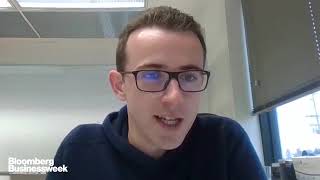
In this interview, host Speaker A talks with Fred Turner, the 25‑year‑old co‑founder and CEO of Curative, about how the Silicon Valley startup rapidly pivoted from a sepsis‑diagnostics company to a leading COVID‑19 testing operation. Turner explains the decision to move the team to Los Angeles, secure a licensed lab, and develop an oral‑fluid, self‑collected test that can be administered at drive‑through sites without a healthcare worker. The conversation covers the test’s scientific rationale, clinical sensitivity, and the logistical system that enables up to 25,000 tests per day—about a quarter of California’s testing volume—with a goal of scaling to one million tests per week across multiple states. Turner describes how Curative convinced Governor Newsom and other officials of its capacity, leveraging the startup’s agility compared to larger labs. He also shares his personal background in agricultural genomics in the UK, his decision to leave Oxford, and his mission‑driven ethos of “putting the company out of business” by ending the pandemic, including plans to support clinical trials and vaccine development.
Chapters
Here in California, one of the biggest stories through the whole pandemic has been this startup called Curative. It was a tiny company based in Silicon Valley, and they decided they were going to become this kind of testing powerhouse, and they are now doing this enormous percentage of all the coronavirus tests in California, hoping to get up to about a million tests per week. The company is run by a 25-year-old named Fred Turner. So with that, we will head down to LA and talk to Fred. For people who don't know, I mean, just tell us a little bit about your company.
Yeah, so we are a pretty new company, just Started in January. Originally, we were a sepsis diagnostics company. And then in late February, we sort of started to realize that we were not going to have enough diagnostics as a country to do COVID testing. So we moved the entire team from the Bay Area down to LA. We found a lab down here that had all the license and everything else that's needed to do testing. And they were willing to let us come in and build out a whole COVID lab there. We've also built out a pretty large team helping people set up drive-throughs. So we have all the software for drive-throughs, we have all the training, we have a team that will go out to a city and help them set up drive-through sites and show them how to run them. And we've scaled up to about 25,000 tests per day now.
I mean, you do some enormous percentage of the, the tests in California.
Yeah, it's about a quarter of the tests in California.
Okay, so I remember, you know, as the virus was picking up steam and the whole United States was in a testing crisis. I just kept hearing about this startup that was able to process, at that time, this much higher volume of tests than it seemed like anyone else was doing. I mean, part of this is a function of the kind of test you do, right?
Yeah, it's what we call an oral fluid test. So you're swabbing the inside of your mouth after coughing. So coughing releases virus from deep in the lungs that gets caught in the saliva. There's also already virus in the saliva. And so when you swab your mouth, you pick up virus from these two locations at once. And the key to this is it can be self-collected. So it doesn't require a healthcare worker to shove a swab 3 inches up someone's nose, which obviously no one enjoys.
Yeah, so you guys, as far as I understand it, I mean, you kind of have the person sit in the car and cough for a little bit.
Yeah, so they drive up to the drive-through, They are checked in by someone in the computer system against their appointment. They hand them a kit through the car window. In LA, they're now doing this with like a grabber stick so they can do it from 6 feet away. They self-collect in the car and then they drop the kit into a bin, which at the end of the day comes to us.
Okay, people have questioned whether your test is as accurate as doing the more invasive test.
Yes, we've done clinical studies. And we found that when you have a fairly low viral load, maybe you only have it in the nose, maybe you only have it in the throat, getting 2 samples effectively in 1, because you're getting the respiratory sample as well as the saliva, produces a good sensitivity. And we've seen that particularly in picking up early cases before they become symptomatic. And then from a distribution standpoint, I think what we've seen is that the oral fluid collection is just the easiest thing for people to do. And it's one thing to have a lot of lab capacity, but if you want to be doing millions of tests per day as a country, you have to have a distribution method of getting millions of tests to people. And the only way to do that is going to be self-collected samples. The goal at the end of this month is to get to 25,000 tests and then to grow exponentially from there.
How did you convince Governor Newsom and other officials to not only take you seriously, but believe that you guys could scale this thing up to have a meaningful impact on what was going Yeah, the, the team behind it is very experienced in the infectious disease world.
And then I think the second part of it is just delivering. A lot of other labs are sort of saying, no, we can't do that many tests, whereas as a startup we can move a lot faster than a big company can.
Okay, tell us a little bit about your background. So you're from the UK and, and you went to Oxford and you, you dropped out, and I mean, you're a young guy, you're 25.
So I started off in the UK doing agricultural genomics at a startup testing dairy and beef cows to predict how good they would be for breeding. Did that out in the UK for a few years, then moved it out to California.
Why did you drop out of school? Was it because you wanted to run a startup, become an entrepreneur, or was it—
Yeah, I'd already been running the cattle genomics startup for about 2 years at that point. Okay. Yeah, it just felt like I was learning an awful lot more during the startup than in school.
What's the path forward for you? Is it just sort of deal with the coronavirus for some time?
Yeah, we're kind of a weird company because our, you know, our mission is to put ourselves out of business, right? We're working 7-day weeks to end COVID. I mean, I have yet to take a day off since we started doing this. And we will continue scaling testing as long as people need more testing. We have drive-through sites, I think, in 10 or more states now across the country. And our current goal is to scale to about 1 million tests per week. I think the other focus for us is we have a pretty great population now of COVID-positive patients that we have been trying to utilize for clinical trial enrollment. So can we help with drug development? Can we help with vaccine development and end the pandemic faster?
What do you see the next 6 months looking like here in the US?
Yeah, we need a lot more testing. Testing to bridge to a vaccine is basically the, the strategy. Every other path is going to lead to a large number of deaths. So we either stay completely locked down and wait for a vaccine, but as a country, like, we can't do that. So we have to be able to reopen at least some things. And to enable that, we need large-scale testing. We need to be doing millions of tests line.