Founder Stories: Gaurab Chakrabarti & Sean Hunt, Founders of Solugen
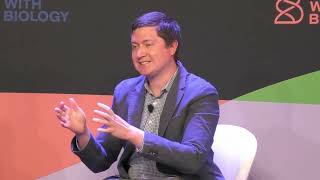
The video records a fireside chat at the Built with Biology conference featuring Solugen co‑founders Gaurav (Gaurab) Chakrabarti and Sean Hunt, moderated by science writer Julianna Lemire, followed by a panel on strategic and impact investment in synthetic biology. In the Solugen segment, the founders recount the accidental origin of the company— a medical‑research discovery of an efficient enzymatic hydrogen‑peroxide pathway, a chance meeting at a poker game, and a $10,000 MIT grant that led to a DIY PVC‑reactor in a Home‑Depot‑sourced warehouse. They describe how they combined engineered enzymes with heterogeneous metal catalysis to create a cell‑free manufacturing platform that now runs a commercial plant in Houston producing 10,000 t/yr of specialty chemicals with no air or wastewater emissions. Scaling was driven by Y Combinator, a niche float‑spa market, and a consumer‑wipes brand (Ode to Clean) that secured a rapid acquisition and large industrial contracts. They explain their engineering approach: simultaneous R&D and front‑end loading (FEL2) after techno‑economic analysis, physics‑aware enzyme engineering, and the importance of early‑scale feedback to avoid lab‑scale‑only optimization. They discuss the broader synthetic‑biology landscape, noting dramatic improvements in enzyme productivity (from 100 t/ton to 50,000 t/ton in a year), the need for multidisciplinary integration of chemistry, physics, and biology, and the still‑pending inflection point when scaling becomes routine. They also touch on geopolitical supply‑chain shifts, on‑shoring opportunities, and collaborations with the U.S. Department of Defense. The second part introduces a panel moderated by Massimo Portincaso, with investors Negin Mokhtari (General Ventures), Jürgen Eckhardt (LEAP/Bayer), Omri Drori (NFX), and Anna Fokina (DCVC Bio). The discussion centers on strategic and ethical investment in synthetic biology, the alignment (or tension) between impact and financial returns, the role of corporate venture units like LEAP in de‑risking early‑stage technologies, the importance of platform technologies versus single‑product IP, and investment heuristics (size of market, defensible “magic” technology, and execution team). Panelists share perspectives on how to evaluate early‑stage companies, the value of mission‑driven culture, diversity, and ethical considerations (ESG, pricing, accessibility). The conversation ends with reflections on entrepreneurship as a transformative technology and a vision of a future powered by synthetic biology. Overall, the content provides a detailed narrative of Solugen’s technical and business journey, insights into scaling cell‑free biomanufacturing, and a broader view of how investors are shaping the synthetic‑biology ecosystem.
Chapters
Gorab, have you seen Sean?
I have not seen Sean.
Sean, is he coming?
Are you here? Oh, there he is. Okay.
What's up, Built with Biology?
Thanks, Sean.
Thanks, Sean. Thanks for kicking us off like that. So I'm Julianna Lemire, science writer at Genetic Engineering and Biotechnology News, or GEN, and I'm thrilled to be kicking off the conference today with this first fireside chat with Sean Hunt and Gurub Chakrabarty from Solugen. So we're going to spend the next 20 minutes talking about where SynBio is today and where it's going. But before we get started, started. Can you tell us a little bit about yourselves and what Solugen is up to today? Gaurav, I'll start with you.
Yeah, Gaurav, co-founder, CEO.
I'm Sean, I'm the co-founder and CTO. And where Solugen is today, we're excited to announce that we built our first commercial plant that came online September of last year. And so what we're— thank you. What we're very excited about is what this plant represents. I think it represents a milestone in synthetic biology because it's actually a cell-free manufacturing asset. So it produces 10,000 tons per year of a couple different molecules. And what's exciting is we use engineered enzymes that cascade together and then we couple it with what's called a heterogeneous metal catalyst, which is my background, gold chemistry. And what's really exciting is this enables us to produce molecules at a very low cost. So we're able to wholesale delete a large portion of downstream separations. This enables us to build smaller plants that scale more quickly. And it's the first asset built in Houston without any air or wastewater emissions.
And the knock-on effects of that are pretty remarkable because it allows us to do what the steel industry did. So if you look at how that industry was set up, it used to be these giant integrated steel manufacturing plants that were supplanted by mini mills, steel mini mills, from a company called Nucor. And now every single piece of steel that we all interact with is coming from a mini mill, a steel mini mill. In a sense, that's largely what we're doing with the chemicals industry is because we can miniaturize some of these plants and use Chemi-Enzymatic technology in a more distributed way, we can have chemical mini mills that aren't tied to petrochemistry feedstock. Stocks anymore.
Okay, terrific. And I think that one thing we just learned is that telling a story is really important. And I know that the story of how Solugen started is a really good one. I think there's a trip to Home Depot involved and maybe a poker game. So could you guys tell us a little bit about how the company got started?
Yeah, it was, it was by accident, I would say. I think I'm actually a physician scientist by training, and I was studying pancreatic cancer, of all things, and discovered this reaction in pancreatic cancer cells that makes a molecule called hydrogen peroxide, which I'm sure everyone's seen. What was interesting was this cell, using this enzymatic process to make peroxide, it was far more efficient than even the industrial way to make it. And my best friend in medical school happened to be Sean's wife. And one day, we, we had like a weekly poker game. And we went to this poker game and I got seated next to Sean. And obviously, as one does at a poker game, you start talking about your research, right? Sean was at MIT doing his chemical engineering PhD on the production of hydrogen peroxide at massive industrial scales using heterogeneous metal catalysts.
So we started talking and I would say I'm a, I'm a recovering biotech skeptic. So I used to work in the pharma industry and we paid $100,000 a kilogram for our enzymes. And, you know, Gordon and I were talking and Gordon was like, oh, wouldn't it be so cool if we could use these enzymes in industrial process? And I was like, you're out of your mind. I was like, techno-economically, it just won't work. But we started talking and it was eye-opening to me because I, my background is very traditional chemical engineering, heat, pressure, heterogeneous catalysis. As I started learning more about where biology was, I realized that my 2012 knowledge of biology was not sufficient in 2016 when we started the company and how dramatically the ecosystem has shifted.
So we realized at that point was if we married our two worlds, we can actually eke out efficiencies that neither of our catalysts could get. So MIT believed in us. They gave us a whole $10,000 to start a chemical empire. And so what we ended up doing was we went to Home Depot and we bought some PVC pipes and we got some enzyme made abroad and we started producing product in a little dinky warehouse.
We were super lucky that two owners of what are called float spas, they saw our MIT pitch and they shared it on their Facebook group. And all of a sudden we had all this inbound from these little water treatment hot tub enthusiasts. They were like, oh, if you can make Hey, you know, peroxide, we'll buy it from you. And that's really what incepted the business and kicked off the Home Depot trip. How do we put this $10,000 to work?
So that little PVC reactor started cash flowing us $10,000 a month, which is actually a lot of money for two guys whose parents are very—
It's more than my grad school stipend.
Oh yeah. Our parents were very disappointed in us overall. But I would say that that was enough to say, hey, maybe there's something There's something bigger here. Maybe there's this idea that we can scale this up even more and actually make the mini mills of the chemicals industry. And then we started raising venture money.
Got it.
Yeah.
Okay, terrific.
What a story.
So go to the poker game is the bottom line.
Yes, go to poker games.
Okay. So it's no secret that scale is a major challenge in synthetic biology. Um, but Solugen has successfully cleared that hurdle. So how did you scale the business so quickly?
Yeah, it, for us, it, we're, we, so we went through Y Combinator in 2017, and the thing that really spoke to us was this idea of customer-centric tech development. And the, the example that Sean gave with the float spas was a great example of, hey, these aren't huge markets, but they are niche markets that can prove out the technology in the early days. So we started with the float spa market. Then what happened was the float spa owners said, hey, can you turn this into a wipe of some kind? We said, maybe, I guess. And so we said that we decided, hey, let's figure out a way to make wipes out of, out of our product. And yeah, yeah, well, and, and I think, um, well, we launched a consumer brand, uh, which is kind of a detour for everyone, but it's called Ode to Clean.
Yeah, so, so essentially the, the Solugen strategy, I guess, I guess you could call it, it really started at Y Combinator. So once, once we built this first reactor, went through Y Combinator, Gorb and I are not business people, but Y Combinator really made us think differently about business and how to do it. And one of the things that they recommended is that we talked to a lot of clean tech 1.0 founders. And so at Solugen, what we embarked on was, okay, how do we create a go-to-market strategy that enables us to scale the technology and build a commercial business, essentially pursue scale-up in a way that's orthogonal to clean tech 1.0. And one thing that we recognize is the importance of distribution. And so if you're thinking about building a chemical plant and going to a really large scale, there's sort of this thing where it's like, okay, we built this chemical plant, suddenly we're going to push button, get chemical, and we're going to be amazing at supply chain and distribution. And that doesn't really happen. It takes— supply chain distribution is actually quite difficult. But what's exciting is That's really valuable to customers, especially in this day and age. It's a very apt statement in this day and age, supply chain distribution. And so we, we had our flow spot business. We started a consumer wipes brand, we did blending. And so we could essentially build this capability, this organizational capability that we knew we were going to need when we scaled up the plant and scaled up the plant at the same time.
And the wipes story turned out to be very fortuitous for us because no one would take a take us seriously in the industrial sector. No one. We were two guys with a PVC plant. Like, who's going to take you seriously? But the wipes business, what that did was within 3 months, that business got acquired by one of the biggest wipes manufacturers in the world. That ended up translating into a large contract for real volumes of product. And so it was kind of like this weird hack that got us to where we wanted to go that, like, it would have probably taken 3 years to get that contract. 2 to 3 years to get to scale, but we got it in the span of a few months precisely because we were able to show value immediately and then use that to then fund the next level of scale-up for the business.
Okay, terrific. It seems appropriate to talk about timing, not only the timing of how exciting it is to be here right now and that we're not on a Zoom call and we don't have to say that you're on mute, But also the timing of the field as a whole. And so let me ask you, where is synthetic biology? Where's the field right now?
Go ahead.
So I would say it's come a long way since I was in the pharma industry in 2012 when we were paying so much for our enzymes. I think what's exciting is the rate at which we can both engineer enzymes, engineer strains, and scale to scale them up because we still toll out the fermentation aspect of Solugen. So we do toll fermentation to manufacture our enzymes and then the enzymes go into this chemical plant. I would say there's still a ways to go and I think it's been interesting sort of designing an asset while our enzymes have been exponentially improving on the backend. It's made it quite challenging. But what's really exciting, I can give you a number from Solugen that we're very, very proud of. So an enzyme that we started engineering in 2020, it made 100 tons of product per ton of this enzyme and virtually nothing, right?
So very embarrassing.
Very embarrassing. I think the cost contribution of the enzyme would be like $20 a pound or something. And in the span of 12 months, it now makes 50,000 tons of product per ton of this enzyme. And this was done with this really cool combination of engineering, both directed evolution, but then also computationally. And I think it's hats off to our enzymes team headed by Dr. Tony Lee.
I would add one thing that we learned is kind of this, the physical world part of biology, where we learned a lot at scale. When we started bringing things to scale, the chemistry of the enzyme actually, the physical chemistry of the enzyme was different. The way that the active group was actually looking started to change based on the pressure, the oxygen profile, the actual shear, the flow. Flow, and we started using that to inform how we think about enzyme engineering. So like, your question is where is the field heading? I think the field is heading towards a more multidisciplinary state where we start thinking about the physics, the chemical engineering part of it, while we start thinking about the biology part of it. There shouldn't be two separate entities at any point.
Yeah, I think there's this old school notion that you will sort of do everything at lab scale and then after a couple of years you'll think about going to scale. Scale. And one of the things we found is that that's, that is actually a detriment to our enzyme engineering program. So if you, if you only stay at the 400 microliter well plate, you'll make an enzyme that's amazing in a 400 microliter well plate. And then if you go and put it in our reactor, our reactor is not a nice environment for cells. It has a lot of shear. We're really putting these enzymes to work. And so if you don't take your, your enzyme engineering program and you don't expose it to scale early on, you can actually start to diverge and you'll optimize an enzyme that only works at small scales.
So that's where like the physics of the system, which sounds like super nebulous, actually matters a lot because there's something called— I won't go too technical, but like there's this science paper that just came out kind of describing what we're seeing. It's called flyby reactions, where basically cyclization or ring opening of certain chemistries can change based on the shear of the system. And when you think about an enzyme, it's fundamentally just a bunch of amino acids which have either ring structures or non-ring structures. Structures. And in a shared environment, that equilibrium shifts dramatically. And we didn't know that a priori, but now we can have some level of predictability on what that's going to look like at scale.
Yeah, that's so interesting. So I mean, as a lot of companies are thinking about when to scale, what's the best time to scale, what's your advice to companies that are wrestling with that question?
Scale today. Yeah, yeah, I think, I think you want to be pursuing R&D and scale up simultaneously because there's a feedback loop. And especially too, once you kick off the engineering process, you, you actually want feedback from what does it look like to go procure this vessel or procure this downstream unit? What's the true cost today in the lead time and how does that implement your R&D program or how does it influence your R&D program?
Like one example, we were looking at this enzyme that we thought, you know, we'd have to make thermostable. But then when we looked at the cost of cooling water to actually install a cooling water tower, the footprint, all of the LCA associated with that. We said, hey, we actually don't need to make this thermostable. We can just use processed water to keep it at least slightly below ambient temperature and it'll be fine. So that we wouldn't have known that unless we had spent a lot of time in FEL2. So FEL2, a lot of companies, they kind of try to, they try to like run through FEL2.
Sorry. Oh yeah.
So front-end loading.
Front-end loading.
Yeah.
So there's engineering terms, you've got these dates. Front-end loading tells you where you are in the phase space of your scale-up plan. A lot of companies spend a lot of time on the FEL3 and FEL4 phases. Solugen does things a little bit differently. We spend a lot of time in FEL2 because that's where you start thinking about sizing your equipment, and that relates directly to your R&D program.
And we usually start FEL2 right after a techno-economic analysis. So I have a very cheesy line internally that math is free. It's one of the few things in life that is free. And so once we have a process where that looks technologically viable, we jump straight to FEL too. So we're, we're, we have active R&D programs, we're running our pilot plant, but we're also jumping to front-end loading too in engineering so that we can get that feedback loop with the real world on how viable is this process.
So it looks slow because a lot of people are like, well, why are you still in a field too? It's a go slow to go fast type situation. Mm-hmm.
Yeah.
Okay, terrific. So, um, jumping back to how we started that question, which was like, where is the field today? A lot of people use the word inflection point, right? In, um, but you can't be at an inflection point every year, right?
Yeah.
So, um, what would, I mean, are we at an inflection point and what would an inflection point look like in this field?
So I think the inflection point is still in front of us. And I say that because it is still difficult to scale up new synthetic biology technologies. And I think, you know, well, it's sort of like a question of when do you know, how do you know what the inflection point looks like? And I think it'll be when anyone can start a synbio company and not just, you know, engineer an organism or a new process, but actually get it to scale quickly and predictably. And I think, frankly, I think government has a big role to play in the bioeconomy and essentially catalyzing that inflection point.
And said differently, I think another way to look at it is the inflection point comes when people realize before they even raise a Series A or seed, they have a chemical engineer as either a founder or one of their first hires. I think once you know that, that is when the inflection point is real. Because it implies that you can actually get this thing to scale as quickly as possible.
Okay. All right. And I want to spend our last few minutes putting all of this into context a bit. So I'm talking about manufacturing now and how the decline in globalization or decentralization is going to have an effect on industries like synthetic biology. So how are the events going on in the world going to play into the success or failure of Symbio in the future?
I, I'm of the conviction that it's going to be very good for business, particularly around the products that are going to be supply chain limited because of conflict regions and/or because of just pure supply chain problems. I'll give you an example of this that we're seeing right now. The United States spends $28 billion a year on corrosion chemicals, so corrosion coatings for weapons, tanks, infrastructure, vehicles, things of that nature. All of that chemistry was coming from China until July of last year. China said, we are no longer shipping this to the United States precisely because of the DOD's need for this chemistry. So we got a call that said, hey, can you guys use— one of our products is glucaric acid that is used on metal coatings. Can we use a glucaric acid from corn sugar, for instance, as a replacement. And that's precisely what kicked off a lot of the work that we now do with the Department of Defense, the contracts that we have. We don't talk openly about it for security purposes, but the rationale is that if it's true for this chemistry, imagine how many other things are true within the supply chain and in the value chain of the government. Just as one example.
I think we're going to see a lot more push for the onshoring of manufacturing. I think for the past couple of decades, the US has transitioned too far into a service economy, and it's time to bring back manufacturing to the US. And I think synthetic biology has a very important role to play in that. I don't think it's a silver bullet, but I think it's a tool in the toolbox that can be used to make not just really great, highly efficient processes, but also assist with decarbonization.
Okay. And as the first fireside chat of the meeting, what are you looking most forward to for the next week? At the meeting?
It's meeting people.
I think it's seeing everybody. It's like not being on a Zoom call, seeing everybody. There's more to us than the torso above, you know, and being continuously surprised by how tall or short people are versus how I thought they were going to be. All right.
Well, with that, terrific. And we'll move on to the next fireside chat. Thank you so much.
Thanks, everybody. Oh no.
Hello, hello everyone. We are back to the future. At least that's how I feel because it's so wonderful to be back with this incredible community who are building the future with biology, now called Built with Biology. My name is Christine Gould. I am the founder and CEO of Thought for Food, and it's an absolute pleasure to be here today to be one of the co-MCs for the sessions. And I am here now to introduce a very important panel called If You Fund It, They Will Come. We all know, of course, from Field of Dreams that if you build it, they will come. And as mentioned, We are building the innovations that are creating a better world and solving some of the most important challenges facing our world. How do we now attract strategic and ethical investment to the sector of biology? It is my absolute honor to welcome our distinguished panel that is moderated by Massimo Portincasso of Officine— oh, I have to say this right. It's Italian pronunciation. Officine Bio and Deep Wave, Jürgen Eckhardt, SVP and head of LEAPS by Bayer, Omri Drori, general partner of NFX Fund, and Najin Mokhtari, senior associate of Genoa Ventures, and Anna Fokina of DCVC Bio. Please welcome them to the stage. Thank you.
Hi everybody, I'm Massimo Portincaso. I'm the co-founder and executive chairman of Avicene Bio and the founding partner of Deepwave. And I'm joined on this panel by 4 incredible panelists that are going to introduce introduce them, Sam, briefly.
Hi everyone, I'm Negin Mokhtari. I'm an investor at General Ventures, scientist by training, and I've served in scientific roles in academia as well as operating roles as co-founder, late-stage commercial operator, and advisor to multiple startups. General Ventures is an early-stage venture capital firm. We invest at the convergence of biology and technology. We're all scientists by training. In operators and builders, and we're early-stage investors, so we invest in seed and Series A companies.
Jürgen?
Hi everyone, my name is Jürgen Eckhardt. I lead Leap by Bayer, Bayer's impact investment unit. We are focusing on investments in the areas of healthcare and agriculture, which is Bayer's heritage, where we feel we can contribute a lot of know-how and networks and sometimes even IP to startups in those areas. Yeah, we focus on breakthrough technologies that have the potential to change the way we do agriculture or healthcare. In healthcare, it's, you know, technologies with the potential to go from therapy to cure. And in agriculture, it's really all about sustainability. Producing food to feed an ever-growing world population, but doing so in a way that protects the health of the planet. Nice to meet you all.
Hello, everyone. My name is Omri. I'm a general partner at NFX. NFX has around $1 billion under management. We're currently investing from Fund 3. It's a $450 million fund doing pre-seed and seed investment at the intersection of biology and technology. I started as a scientist. It took me took me 4 years at Stanford to realize that starting a company is a thing that you can do. I started one of the first synthetic biology companies back in 2011 doing software for bioengineers, ran it for 5 and a half years. That's how I lost my hair and gained around 40 pounds because starting companies, it's pretty hard. Got acquired by Twist back in 2016, was head of corporate for Twist working with Emily Leproust, Then started a small fund called TechBio, $10 million fund, and now part of NFX. Pleasure to be here.
Hi everybody, my name is Anna Fakhina. I'm an investment director at DCVC Bio. Omri, you must have lost all the 40 pounds since then. Yeah, so DCVC Bio, we invest in early-stage companies on the intersection of computational biology, computational platforms and biology. We do human health as well as agriculture. And we also have a DCVC deep tech fund that invests in deep technologies.
Wonderful. So if you find it, they will come. Our strategic and ethical investment can build a better world with biology. And it's clear if we want to build a more sustainable— a different world. It requires long-term capital and orientation. It requires also a certain size of investment. And it's quite interesting because if we look at climate without staying with biology right now, and the IPCC just produced a report where they analyzed all the mitigation opportunities, and then a team at Climate Tech VC compared it with where the investments of the VC community was going, and there was a complete mismatch between what really would bring the most and where we were investing, investing most of it in EVs. And then after that, the second after that was mobility in terms of e-scooters and e-bikes. That is not really going to move the needle when it comes to climate. So if we look at the synthetic biology space, the good news is there, as John was mentioning earlier on, we went from $3.6 billion in 2019 invested to $17.6 billion in 2021. So an incredible increase. But the question that one asks himself is, is this increase being allocated into the right things? Or are we investing in the equivalent of synthetic biology of the e-scooters of this world? And I wanted to discuss with you and hear from each of you as we go through this is, do you think that these investments are being directed already in the right place? And also, do you think that the changing economical climate that is happening right now and also the geopolitical situation is going to have an impact on the allocation of the investment and being strategic about what we do? It could bring it up and increase it or even decrease it. So how do you see it in the months and years to come?
Yeah, I think that's a good question. I think that there is something to be said about, you know, venture investors and the difference that it has with impact investing, right? I think we're quite fortunate in this specific field that there is quite a big overlap between the two, right? So we can think about how we go about investing that kind of overlaps with intervention, with, with good innovations and with financial returns, as well as with positive impact on humanity and our planet, right? And that's something that we can actually be strategic about specifically in the field of synthetic biology. At JANA, we're very interested in this field, of course, as we do invest in the convergence of biology and technology. And thinking about, for example, biology beyond healthcare, right? And biology as technology and technology driving biology are the themes that I think will be quite impactful in this field.
And Jürgen, how do you see it at Bayer? Yeah.
So as I mentioned, you know, we invest in areas where we, where we can contribute knowledge and expertise. And for us, this is healthcare and agriculture. Those areas happen to be areas where, you know, impact investing and sustainability are big, big topics. Just to give you an example, you know, livestock farming is the second biggest contributor to climate change after fossil fuel and energy, right? So while we were successful in feeding an ever-growing world population, I think we now need to find new ways how we can feed an even more, even a bigger world population, but do so in a way that, that is more sustainable, right? So this is why, for example, we are investing in alternative proteins, right, that hopefully will be able in the future to feed to feed the world and to provide the protein needs to humans which they need to be healthy, right? About 1 in 5 people on this planet are sick because of food, because of wrong nutrition, right, not having the right nutritional values, etc. So I think this is a big impact lever that we can pull, and that's why we are focusing on those areas?
It's a good question. There is a joke about how you make a small fortune in biotech, which is you start with a big fortune. And we need to change that, right? You know, because the more we show scale, the more we show successful companies, the more money will be in the space and the more we can do as a community. And again, I believe biology is the most advanced technology on Earth. It's the first exponential technology because a cell turns into 2 to 4 4 to 8. And you know, when you think about it, biology can work at scale. The air we breathe came from biology. So biology can really change, you know, and, and make huge impact. And we can, can use it to solve the biggest problem we have in the world. And none of us would be here if we didn't want to make a difference, right? You know, we could invest in crypto, we can invest in, you know, SaaS, whatever, not interesting things. We decided to spend our time here because it matters.
Anna? Yeah, um, I think there are many different ways you can look into the space, right? And it's important that we understand that, first of all, from investor perspective, we need to make return on certain— on all of the investments. And we're always looking for the opportunities where we can do that yet bring value to the world. And if we think about climate generally, it's a pretty challenging topic for investments. And I think just because we have a lot more tools today that allow to build better technologies or products, that also allows us investors to invest in this company. So I think we're in a great period of time right now when we see just a lot of innovation, and that allows to really make a breakthrough, whether it's in agriculture or it's in biotech. You know, we invested in a company, for example, that reduces enteric emission from cows. That's, you know, potentially you can reduce CO2 by 90% from burps of cows. That's pretty amazing, right? But we also have companies where they focus on really helping cure disease for people, and I think both create substantial impact for societies, right? And I think I'm very excited to be an investor in this generation because I think the— there are a lot of opportunities right now for amazing investments and also just to build great companies.
And to stay with you, Anna, the CBC has an incredible reputation and a great roster of companies in their portfolio. And you have been one of the first to be able to do exits in deep tech in general, in synthetic biology specifically. And I think one of the, you know, when you talk about impact investing, there is this discussion. Yeah, it's impact investing, but Actually, you are showing, and also the other members on the panel, that you can do impact investing and make good returns. It's not an end, actually, if you do it properly. So can you talk a little bit about what's the journey for you at the CTC to be able to conjugate the two?
Yeah, yeah. I think we, first of all, we still think about investments as a great investment, and of course we're looking for for investments that make an impact. But I think you still have to keep that in mind because we also raise money. Some people don't think about it, but funds also raise money, and they also need to show progress. And, you know, a lot of the KPIs that startups show our investors are our LPs. And it's very important to invest in companies that have the potential venture returns. So for example, if we look into the material space, and we looked into a lot of companies in that space, a lot of companies have amazing, interesting technologies where, you know, you can change the color of the material based on pH levels, or you can change the shape of the material. But then there's always this question, what is the product market fit? What are the unit economics? Who are your customers? And you really need to be able to think about this. And when you have a technology, it's not just a cool science, which is always amazing, right? But you're not in a lab anymore. You're actually building a business. So you really have to think about all aspects of the business to make it attractive for investors, but also really to build a business that will finally eventually reach consumers that will use your product. And I think that's very important to have that mindset when you start building a company.
What, Omri, your view on this?
Yeah, you know, it's funny. I was a scientist, I started a company, now I'm an investor. When I look back at my company, I had 148 different versions of my pitch deck and they all look stupid. After 5 minutes of being an investor, you know how investors think. And again, when you invest somebody else's money, the model is usually 2/20. So you get 2% out. If you have a $100 million fund, you get $2 million each year to support the fund. And then the main money you make is once you return the fund, you make 20% out of every dollar you make. So you only start making money after you return the fund. And you'd think you invest in companies, you get this nice distribution of some companies are doing well, some worse, and some in the middle. But the truth is it's a very sharp parabola, which Most companies will not return anything to your fund, and only a few companies will return the fund. And the entire game is to find those companies. So what we ask usually is, is it big enough? So if we super optimistic, listen to what you say, we believe in everything, can it be big enough? Second, do you have defensible magic? And this is where the technology comes. Like, is your technology magical technology that only you can do and nobody can compete with you? Because competition is for losers. If you want to make money, you want to be a monopoly, at least as a founder and as an investor. And third, are you the right people to execute on that? That is the thing we are looking for.
Yeah. And Omri, to stay with you, NFX is also famous for the philosophy leveraging network effects and working on platform. And I know that you speak about moving from biotech to tech bio. Platform. And of course, when we talk about building a better world, platforms are much better leverage points in the system to accelerate the change. So can you speak a little bit more about this view, this NFX view on platform and your view on that?
Sure.
So NFX stands for network effects. That's how the fund started. And actually, no, I hate the word synthetic biology. I just— and John, please forgive me, but I like You know, I think what we're doing is biotech. It's biotech. I just call it tech-bio because I think it's tech first in bio, and it's driven because of many technologies that are coming together at the same time. If it's biology getting digitized with DNA synthesis, sequencing, and sensors, because it's digitized, now we can use accelerating computation, machine learning, AI to make sense of the data, and then moving from people pipetting in the lab to high-throughput automation at scale. And all those things together just accelerate the design-build-test cycle so you can create product faster. And that just unlocks a lot of value. And like, we will not invest in one small molecule against one indication. We will not invest in usually one medical device against one thing because it's very binary. It's either work or it doesn't work. We like to invest in platform technologies that can generate huge amount of products where you can collaborate with some companies on some of them. And there are a lot of opportunities. One example is Mammoth Biosciences, where they have huge amount of IP around CRISPR system for diagnostic and for therapeutics. So they can do so many things. So, you know, when we talk about platform technologies, we're talking about those kind of things.
But the question that I would have is the whole IP issues in synthetic biology is a big one. So there is not an open source culture in, in biology, it's quite the opposite. So how do you overcome this problem and can really get to a true network effect to really get the impact?
Yeah, again, I think the power of a platform is that it's getting easier along the way because all of our companies, most of them, have core platform technologies. And then they can do many indication or many collaboration on many different products. And the more collaboration they have, the easier it becomes because the platform is getting better. Everything goes back to the platform. And then the next program is easier than the first program. And the more customers you have, the easier it is. So it's a flywheel that makes the business more defensible and better.
Yeah.
OK. And Jürgen, coming to Leapz, I have to say I've been following the journey that you have taken. And it's quite impressive. Changed, set a new standard when it comes to corporate venture capital. Actually, what you're doing, I wouldn't even define it as corporate venture capital, but you have really set the bar very high, and you are in an ideal position to do impact investing. You have one LP ultimately, which is long-term oriented, even better. You are operating out of 10 problems that you're trying to solve, so it is the ideal setup. And I think that I'm sure that despite being in this incredible position, it has not been everything easy and a piece of cake. So are there any particular learning, hard-won learning that you gathered during this journey that you want to share with the audience and with us?
Sure. So when we started Leap roughly 6 years ago, the idea was not to just create another corporate venture activity, right? It's, as I mentioned, very strategic for, for Bayer. It's almost like a corporate development tool. The idea was that we create this unit that would make these really investments into early-stage potential breakthrough technology platform at a time when they're probably too early stage for our operating divisions to consider, you know, a partnering or a license or an acquisition, but where we felt it's important that we contribute not only our cash, but really also our know-how when we can to help develop those technologies and bring them to a stage where some of those will hopefully then become relevant for our divisions and will help them later on with a second transaction to license or collaborate or acquire these companies. And through that, basically, we should to help renew Bayer's technology portfolio over time and help Bayer stay at the forefront of innovation. So that was sort of, in a nutshell, the idea when we created this. And it has worked really great for Bayer. Just to give you one example, one of the— actually, the first deal I did when I joined Bayer was a deal around the induced pluripotent stem cell. Was in 2016. The technology was really still very early, and we co-created a company there called BlueRock, which then developed that technology over 3 years. By that time, then, our pharma colleagues started to become interested, and they basically decided to fully acquire BlueRock and make it the nucleus of their own cell and gene therapy strategy and platform.
Platform.
And this was quite a big leap for pharma because when we started BlueRock, you know, we had no internal know-how in cell therapy and we had no footprint in neurodegenerative disease. And the lead product of BlueRock is actually in Parkinson's. So it really allowed Bayer Pharma to change its course somewhat. And now work in neurodegenerative disease and work in cell therapy. And then they have, with subsequent transactions, further bolstered this cell and gene therapy unit. So that's just to illustrate the role that we are trying to have. Learnings, you asked. I think for a unit like LEAPS to be successful, it's important that it's sort of outside of the operating divisions, which is the case in the case of leaps. So we have sort of short decision-making processes. We don't have to go through divisional approval layers to get an investment done. And I think that is one of the key ingredients of success that has worked really well for us.
And I think that we would need more of leaps with other big corporates because we have an urgency to scale. And of course we want to scale kill a lot of company. But if we manage to get this collaboration between the startup and the big corporate, bringing the best of both worlds, where you have the innovation of the startup and the power of the corporate, is great. Unfortunately, very often what we see is we get the weaknesses of the startup coming together with the bureaucracy of the corporate, and everything then collapse. So how you overcome these, uh, matchmaking that is not working?
I mean, you said it right. You know, that's exactly what we try to do, to combine sort of the strengths of, of a large organization with 100,000 employees. You know, we have lots of expertise that we try to leverage for the benefit of this startup, but not strangulate the startup, of course, with, with, with any of our sort of processes, etc. So, you know, in day-to-day life, These are independent third companies that are managed by their management teams and their boards, and we just try to be supportive if and when we can without bogging them down with any, any sort of red tape.
Wonderful. And then General Ventures has a reputation for really being good at spotting early technologies with great potential, and I would be really keen If you look at it with, with an impact angle, do you have a different way of looking at the companies that we're looking at, the teams when you do the investment? Are the same metrics that you look at for all other investment, or has it changed over time in the early stage? Because when things are a little bit more shaped, it's easier to assess. But when things are a little bit fuzzier, then do you have other heuristics that that you use to do that? Is there anything specific that you do in this space?
Yeah, of course. I think that's generally, as most of my panelists here have mentioned today, right? I think we're very privileged to do the work that we do because again, impact and returns have quite a nice overlap, right? I think the impact is so tangible. You don't have to really have a long conversation with someone to convince them why cancer diagnostics or treatments are important, right? I think a general, All of us having been scientists, we've done wet lab work, we've failed in a variety of ways, right? So when it comes to working with early-stage companies, you can see that with that lens, right? And then we pair that with, of course, having operating experience and investment experience and also being able to think about what our companies, what their commercial readiness looks like, R&D journey looks like, and what are other types of funding that they can perhaps add to their portfolio that can bring, you know, with itself capital and credibility and other aspects of that. So I think that there is really a combination of different things that also includes, you know, financial metrics, as everybody else here has mentioned. Another piece of it that I find quite interesting for myself is not thinking just about what kind of products the companies are making, making, but also what types of companies the companies are making, right? What are the company's values? What is its culture? And what is the mission? And I think when you also think about the timing of investments, right, you know, as somebody who's been an operator, I can tell you, like, on a day-to-day basis in an operation, we don't think about LPs and VCs and their ROIs, right? You really have a mission. And, you know, if you're, for example, developing, again, a diagnostic test for cancer, let's say, The mission there, of course, with all the proper checks and balances in place, there is a sense of urgency to that too. So that kind of pairs pretty nicely within the user needs and adoption and all of those things that you can hear a lot of VCs talk about a lot of times. And then the company piece of it also, I think the people that are hired are important. The diversity there is important because of thought of people, because it impacts how the product is created. Created and how it's marketed and eventually, you know, who has access to it.
So I'd like to end with just a final comment for the audience. Like I told you that I believe that biology is the most advanced technology on Earth, but I believe there is one technology that is very human that it's even more advanced than biology, and that's entrepreneurship. Because I see the power, the magic of founders where they see the world as it can be and they see the world today and they're just pissed off that the world today is not as great as it world that can be. And then just using the sheer power of grit and never giving up, they can rip a hole in the universe and drag all of us kicking and screaming to this new universe they imagine. It's the most magical technology. So I like to encourage the best people in the world to use the most advanced technologies with biology entrepreneurship to solve the biggest problems in the world. And all of you can do it. And one last comment is I don't know if people know, but I saw— When I walk down here, there is a company here that makes glow-in-the-dark plants. I went to the room and it was like freaking Avatar. So that's what we want, like exciting future, beautiful future with the technology all of you are creating.
Thank you. And to close with one question for Anna, one of the titles was about ethical investment. And when I saw the question, I thought, who would unethically invest? But then I realized that with science, we are really moving in in a space where it's— there are a lot of ethical questions embedded in the science and the product that you do. And is it something that you look at when you do your investment, also the ethical component of the science that you're working on? And I'm not, I'm not talking about, you know, drugs or oil or whatever, but really more, really the more fundamental pieces. There is a new dimension to investing that we have never considered before.
Yes, absolutely. I mean, I think we're not trying to make gene editing babies, but are you one? We never know. But yes, absolutely. I think we have ESG forms that we follow, but also, you know, I think we want to create a better future and we think about implications. And even if it's It's not always just a simple drug. There is a huge question about pricing of drugs, and drugs are very expensive, especially if you go into cell therapies. And some of the platforms we've invested have the ability to actually potentially approve the entire platform and make drugs much more affordable, make the whole regulatory process simpler, but also really bring the personalized medicine at affordable cost, maybe $100,000 instead of $500 million. Some of these technologies are very expensive. So yes, we do think about that. And of course, if we see the right teams who have the capability to do that, we're very happy to invest.
So thank you, Megan, Jürgen. Ombri and Anna, thank you very much.
Thank you.
Thank you.
More from Joshua







Scientist Stories: Hans Waterham, The value of phenotypic assays in peroxisomal disorders




Scientist Stories: Joel Zlotogora, Genetic carrier screening programs for reproductive purposes