Founder Stories: Ivan Dimov, Co-Founder and CEO of Orca Bio
Ivan Dimov, CEO of Orca Bio, describes a manufacturing platform that assembles designer immune systems from donor cells in 48-72 hours for bone-marrow transplants. Early data shows 12-month survival doubled from 30% to 75%, with major reductions in transplant-related mortality and chronic GVHD. The company has raised $300M and is running a Phase 3 trial for AML, ALL, and MDS.
Chapters
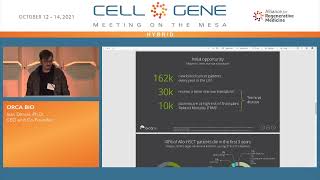
Thank you, everyone. I really appreciate the opportunity to tell you a little bit about what we're doing at Orca. Hopefully this actually works. This is a PDF. I'm not sure if the clicker actually works. OK, there we go. So I'd like to start with just a high-level overview of the company. One of the things that distinguishes us compared to some of the other cell and gene therapy companies out there is that we have a high-precision cell therapy manufacturing technology, specifically allowing us to build mixtures of cells with single-cell precision. We have started to apply this in the realm of bone marrow transplantation, trying to address some of the issues. Bone marrow transplants have been around for many decades. It's sort of a proven way to cure many of the terminal blood cancers and some of the hematological and even some of the immunological disorders. But it has been plagued by a poor safety record, and efficacy could also be improved quite a lot. And we believe by bringing better precision, we can really impact that realm. We spun out of Stanford in 2016, so relatively young company. We're somewhere around 80 people right now at the company. We have been in stealth mode for most of our existence, really focusing on really delivering some of these promises to patients. We came out of stealth mode sometime last year. We've raised about $300 million to date. We have several Phase 1 and Phase 2 clinical trials ongoing. We think it's a really exciting opportunity, somewhat similar to the previous speaker. Really being able to reset somebody's entire blood and immune system can really address many, many needs out there, more than 100 different diseases. So we're very excited about the upcoming opportunities. And we have a lot of IP that we've brought in from Stanford and and built ourselves. At a high level, the team, just kind of a highlight, is quite diverse. We've been able to bring a lot of the pioneers in this space together. On the left side, you see the founding team that came together initially at Stanford, and just, this is a little sample of the diversity of folks, trying to show some of the extremes here. For example, Irv Weissman is one of the co-founders of the company, and he's pretty well known for discovering or identifying the markers to, that really pinpoint the long-term blood-forming stem cells. And then a lot of the biology of how that develops the entire blood and immune system. On the other extreme of the spectrum, they work pretty closely with the National Marrow Donor Program. And specifically Steve Devine has been a very close friend of the company and really bringing that perspective of how you deliver many, many products of a cell therapy to patients. And if you think of the National Marrow Donor Program as, an organization that delivers cell therapy products. I could argue that they're probably the largest cell therapy product delivery organization in the world, and by far. So, a lot of experience there to be learned from. And then maybe on the more business side, two extremes are the folks on sort of the advisory folks is Ted Love and Joe Jimenez. Ted Love helped pioneer originally at Genentech the biologics revolution. And I think there's lots of lessons to be brought on board as we built out the cell and gene therapy revolution right now. And of course, he's since then gone on to build some very successful companies. On the other side of the extreme, kind of the large pharma perspective, Joe Jiménez is also a very close friend. He was the former CEO of Novartis and helped with that first CAR-T launch. All right. At a high level, what we do is build a designer immune system. We take the raw mobilized blood from a healthy donor. We select specific subsets of T cells and we combine them with stem cells. We make an unnatural mixture of these cells and really leverage and harness the naturally occurring T cells that are already present in the body without any need of modification. And by just being very smart about the science of how these cells work and combining them in the right way, you can really enhance their efficacy. And more importantly, you can also control their safety in patients. I think a nice summary slide of that is, is shown here, where we essentially build upon the decades of research behind hematopoietic toxic stem cell transplants. That's the fundamental platform. We add a layer of precision that's unprecedented with that single-cell sorting capability, which means that when we deliver our products in patients that have terminal blood cancers, we do not have to rely on antigens to really seek out and destroy the cancer. It's a full system reset. It's basically HLA-driven. So you're a lot more resistant to antigen escape, as we've seen in some of the other cases, unfortunately.. In addition, we do not do any ex vivo manipulation or gene editing or activation or expansion of the cells, which really lets us deliver products very quickly. In general, we deliver our products within 48 hours. This is vein-to-vein time. Our specs say usually below 72, but the vast majority we've been able to achieve within 48 hours. In order to have this be more easily adopted by folks, we've also been really focused on really fitting into existing medical workflows. And I think this slide is a good example of that. On the left side, you see sort of the standard bone marrow transplant workflow. We try to really, you know, a lot of the infrastructure to achieve this has already been built out for many decades. One thing I really learned when I first got into the space, interestingly enough, about a third of all sort of hematopoietic stem cell products that are used in the U.S. actually come from come from Europe. And so the logistics of how do you get cells from essentially across another continent and deliver them into a patient within 72 hours have been worked out over several decades. So we really try to build on top of that. And so the way we deliver our products is we intercept that shipment. So instead of having the, the product, you know, being collected at the donor site be shipped directly to the patient site, we ask that that product be shipped to a centralized manufacturing facility where we use our novel manufacturing approach That's one of the big pieces of IP that we have at the company. With that, we built out the proprietary recipe of cells, and that's the other big family of IP that we have. And we achieve all this in a matter of hours, and then we forward that onto the hospital center where the patient receives it. So from the perspective of the donor centers and the hospitals that receive these products, everything is transparent, and everything works as if it were a conventional bone marrow transplant. The hope, of course, is that with this we can achieve much better results. With this infrastructure, we're building out an ever-expanding portfolio of products. OrcaT is our first product. It's our first-generation product. We've had some really exciting data that I'm going to show in the next couple slides from that product. That has allowed us really to propel this into a pivotal Phase 3. We're about to launch our pivotal Phase 3 on this product, focusing on AML, ALL, and MDS. Patients. We are also continuing to do some of the Phase 1/2 studies on some of the other more rare types of cancers like myelofibrosis, some of the other mixed lymph— mixed phenotype acute leukemias, et cetera. We have a second-generation product, ORCA-Q, that's also in the clinic. I think between ORCA-Q and ORCA-T, we've treated about 160 patients to date. On ORCA-Q, we have about 50-ish patients. And OrcaQ is a second-gen product in the sense that the recipe of the T cells is even better controlled and better engineered than OrcaT. It still tries to address the same issues and the same indications as OrcaT, but the big difference is that with OrcaQ, you don't need to have a matching donor. So you can actually work with mismatched donors, and that really opens up the ability to deliver more products to patients. On top of that, we're working quite extensively on some of our other products, OrcaH, O, and Z, and some of the others, where we'd like to expand beyond the malignant use for this kind of a platform, specifically in the hematological and immunological disease arenas. Just to give you some of the numbers here on the initial opportunity around allogeneic bone marrow transplants, it's sort of the de facto tool used for terminal blood cancer patients today. And just to give you some of the patient numbers there, about 160,000 patients every year in the U.S. get diagnosed with blood cancer. Of those, 30,000 or so will proceed to being in sort of a pretty advanced stage requiring a bone marrow transplant. And about 10,000 of these patients would be of high risk of mortality just by the transplant itself. So it's a pretty— it's a curative, but at the same time pretty toxic process going through a conventional allo transplant. Some more details there. Within about 3 years, close to half, over 40% of patients do pass away, unfortunately. And if you look more deeply into those who do pass away, what were the reasons that they died from? The biggest reason, about half of those patients die from just relapse of the primary cancer. But another 40% or so die from the toxicity of the treatment, mainly driven by GVHD infections and organ failures. So what we're trying to do with our first product, OrcaT, is really fix all these issues and really minimize the death, hopefully dramatically improve that and eliminate the death of patients. Now, if you're lucky enough to survive and not die, unfortunately prospects aren't that great either. Chronic GVHD is a form of sort of long long entire life burden on patients. And in many cases, it's described as worse than the cancer itself. Just to give you a sense, people with chronic GVHD usually suffer from many issues that really destroys their quality of life. Things like, for example, in some patients, half of their lung is incapacitated by the GVHD. They're sclerotic in their joints. They can't really, really move much. They have dry eyes. They can't constantly use artificial tears, and they can't really read or can't really do anything very substantial. So, it's a huge drain on life. So, sure, you've saved them, but you've given them a disease that's pretty horrible instead. So, we're going to try to eliminate this as well, as much as possible. So, here's some data that we published earlier this year. And this talks about sort of the ideal survival of patients that, in other words, people who survive free of GVHD and free of relapse in the first 12 months. You can see in sort of the dark line there, the standard of care, about 30% of people have this sort of ideal course in the first 12 months. We've been fortunately able to more than double that to about 75% surviving ideally. And hopefully we can continue that and improve on that even further. When it comes to toxicities outside of relapse, sort of transplant-related mortalities, we've seen a dramatic effect there as well. In the first 12 months, you'd expect somewhere between 10 to 15% of your patients to die from infections, GVHD, and organ failure, and some of the other issues. We've been able to dramatically reduce that. And just to give you a sense, this is out of a 50-patient study that, that we published in earlier this year. We have updated data that will be coming up at ASH where we have significantly more patients But generally, these results seem to be holding. When it comes to GVHD specifically, and on the right side you can see the chronic GVHD effects, this is moderate to severe chronic GVHD. About close to half of patients generally have some form of moderate or severe chronic GVHD. We've been able to dramatically reduce that. You know, just a couple patients in this I think one patient really in this 50-patient cohort has really had major issues. And so we're very, very excited about this as well because this is a huge quality of life boost and also a huge positive effect on the medical system as well. We've been able to start meeting some of our patients recently. They've been reaching out and it's been extremely humbling and, and really puts a face to everything that we're doing.. And I just wanted to show you one example of Robin. She was one of our early patients. She's been about 2 years now post-treatment, still cancer-free, and has had no issues around toxicities and no GVHD, thankfully. So Robin had myelofibrosis, a pretty aggressive version of myelofibrosis. Generally, it's a more rare version of a disease that gets transplanted. However, the relapse-free survival for myelofibrosis patients in the first year is very dismal. So it was really impressive to see her outcomes. And we've generally been really surprised with all of our patients, but especially with the myelofibrosis ones, because it seems like a lot of the fibrotic issues that you normally see with conventional transplants are significantly reduced with, with our approach. So that really talks about a new biology of what's going on in the patients. By better regulating that immune system that you're putting into those patients versus dumping all the raw materials as you normally do in a conventional hematopoietic transplant. I think that brings me to the end. So I'd like to open up for any questions, and happy to share more. All right, thank you.
More from Joshua







Scientist Stories: Hans Waterham, The value of phenotypic assays in peroxisomal disorders




Scientist Stories: Joel Zlotogora, Genetic carrier screening programs for reproductive purposes