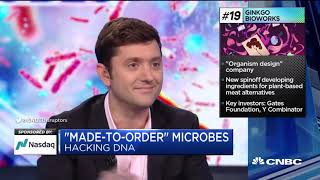
In this CNBC Disruptor 50 interview, Ginkgo Bioworks CEO Jason Kelly explains how his company engineers microbes to produce high‑value molecules for emerging markets. He describes programming brewer’s yeast to synthesize heme, the iron‑rich protein that gives plant‑based burgers a bleeding appearance, and how the same cell‑programming approach enables the production of cannabidiol (CBD) by transferring the cannabis plant’s DNA into yeast, eliminating the need for cultivation. Kelly highlights partnerships with food giants such as ADM and Cargill, as well as a collaboration with cannabis firm Cronos, illustrating the breadth of Ginkgo’s commercial ecosystem. He frames biology as a universal manufacturing technology—capable, in his view, of eventually producing anything from flavors to microchips—drawing an analogy to the exponential progress seen in computing. The conversation also touches on Ginkgo’s decade‑long growth, fundraising history, and the prospect of an eventual IPO once key milestones are achieved. Throughout, Kelly conveys an optimistic, visionary stance on the future of synthetic biology as a scalable, programmable platform.
Chapters
Lab-grown CBD, plant-based meat, and bringing back the perfume of an extinct flower. One CNBC Disruptor 50 company is making all that a reality with what they call made-to-order microbes. With me now is Jason Kelly. He's the CEO of Ginkgo Bioworks, number 19 on our list this year. Welcome and congrats.
Yeah, thanks, Kelly. Thanks for having me.
So first of all, because Beyond Meat and Impossible Burger are so in the news today—
a little bit in the news, yeah.
I know they're not, they're not direct customers, correct?
No.
But you are creating what exactly for this nascent industry?
Right. So if you take a bite out of that Impossible Whopper at Burger King, It's going to bleed. Right. And what's going on there is they put hemoglobin, which is what makes blood red, which you don't really find at high levels in plants, into the burger. So where does it come from? Well, they took brewer's yeast like they used to make beer, and they program it like you'd program a computer.
You can program yeast.
You can. Yeah, you can actually program any cell. Right. So if you look out in nature and you look inside any plant, animal or insect, in the cell will be code. In the form of DNA.
Wow.
And it's ATCG, not zeros and ones, but it's a lot like programming a computer.
So basically you're programming yeast to make heme. Wow.
And you're also protein or whatever.
Or CBD, is that right?
Exactly.
That's a partnership with Cronos.
Yeah, Cronos, the Canadian cannabis company. And so the way you get CBD for CBD oil today is you extract it from a cannabis plant. So you grow this whole plant with a flower and all this, and you take out this little teeny bit of CBD oil or THC or these other cannabinoids. So what we'll do is we'll read the DNA of that plant, find the code for the CBD, move it into a yeast or bacteria, and then you brew it up and you get CBD oil. No plant.
There's some controversy now about cell-based meat. People who create actual meat not from farms but in a lab. Is what you're doing similar in the sense that you're reproducing things found in nature, but you're not actually doing it in nature, if that makes any sense?
Yeah, I mean, so I'm like a biological engineer, right? So one of the things you learn quickly about biology is there's enormous reuse of that DNA code across biology. So it's kind of surprising you could take like the code from a cannabis plant and put it in yeast and it works. And the reason is we all share the same stuff. So I look at it and it's sort of just moving things around nature.
You have a lot of companies we're familiar with around here that you partner with— ADM, Cargill. Explain some of the opportunities that you see out there.
Yeah. I mean, the way I look at it is you could program cells to make things, right? And biology is, if you look at it, is a plant can kind of grow itself out of air, water, and sunlight. That's amazing manufacturing, right? And so if we could program it to make what we wanted, other things, microchips in the future, whatever, really, we would. Yeah. Yeah. Why not?
Well, so what is possible with this technology?
I think if you play out the tape, biological engineering, programming cells, is going to be like what you saw in computers in the last 50 years. It's getting exponentially better at places like Ginkgo. And we know that like in an apple or a banana is a level of complexity at a cellular level that exceeds what Intel has in a chip. So you will use it to make everything.
So you can grow an apple for me out of yeast at some point in the future?
Grow you an Apple computer?
Yeah, maybe. Even better. Your business has been around for 10 years now. You've done some fundraising. Is an IPO in the cards?
Yeah, IPO is in the cards. Yeah, eventually.
Eventually, because are there certain milestones you want to hit?
We just don't make— like, the way to think about it is we're a cell programming company. We already work with, you know, we have a $100 million deal with Bayer in agriculture. We announced yesterday a $160 million deal with Roche for antibiotics. We work in cannabis, we work in food. Cell programming is like electronics. It's below everything. And so we don't make sense to be acquired. We make sense to stand alone.