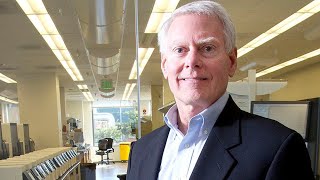
In this interview segment, Jay Flatley recounts joining Illumina in 1999 when the company was a fledgling team of about 25 employees with core microarray IP licensed from Tufts. He explains the competitive landscape dominated by Affymetrix’s gene chip technology and how his prior experience at Molecular Dynamics—where he helped build the first scanners for Affymetrix and launched a capillary DNA sequencer—shaped his perspective. Flatley describes Illumina’s early mission to develop a next‑generation microarray platform that could surpass Affymetrix and serve multiple applications such as expression profiling, genotyping, and proteomics, noting that the proteomics effort never reached market. He also hints at a long‑term ambition to enter high‑speed DNA sequencing, though no sequencing technology existed at Illumina at that time. The dialogue touches on the broader context of the Human Genome Project and the massive sequencing effort undertaken by Venter and Collins, prompting Flatley to reflect on Illumina’s future direction.
arrays and how many microarray plates can you fit on a dish and SNP sequencing and protein expression and some of the early-stage things that you did. But when you came, what were you thinking about? What was your vision for what Illumina could become way back in 1999?
Well, I got there, there were about 25 people in the company, so the company had really about about a year old, had secured some of the core intellectual property from Tufts to build a new generation of microarrays. And as any of you who sort of follow that field, at that time Affymetrix was the 800-pound gorilla in the microarray business. They had the technology called the gene chip, and they used semiconductor processing to make those gene chips. And so when I came out of molecular dynamics, I had sold that company in 1998. Molecular dynamics had been involved in the microarray business and the DNA sequencing business. In fact, we built the first 50 scanners for Affymetrix because they didn't have a scanner technology. So that happened about 1995 or so. So we kind of enabled the start of Affymetrix, and then we launched the first capillary DNA sequencer. So I had arrays and sequencing in my background when I got to Illumina. And after I sold Molecular Dynamics, I was looking for the next great startup, and Illumina was my wife and I agreed to come to San Diego on a 5-year plan, and here we are 15 years later, 17 years later, whatever it is. Speaks to the greatness of San Diego. But the mission of the company really then was to understand how we could take that microarray technology and really develop a new generation that could eclipse Affymetrix and go into multiple applications: expression, genotyping, and potentially proteomics. Worked hard in proteomics and actually never launched a product in proteomics. So there's a story to be told there if anybody cares about that story. But we had ambitions in the long run to get into sequencing, but we didn't have a sequencing technology in those early days.
So what, what led to that? I mean, was your— back then, 1999, 2000, Craig Venter, Francis Collins sequenced the human genome. I remember they had literally hundreds and hundreds of sequencers in two different locations that they used over, what, 7 or 8 years to be able to accomplish that. Did you have any inkling of a vision at that time about high-speed sequencing and Illumina moving into that arena?
Yeah, I did and we did, because I was involved in that in a different way than Craig was. Craig was actually doing the sequencing, and at Molecular Dynamics I was in the same kind of role that I am now. So Molecular Dynamics built the first capillary sequencer. They wound up sequencing about a third of the human genome program. Celera, where Craig was, because they were tied directly to ABI, they used the Perus 700, which was ABI's competitive product. They launched about a year later than we did, but they had a much bigger market footprint and much better control over reagents, so they eclipsed what we had launched in the market. So about two-thirds of it was done on their technology, about a third on molecular dynamics technology. And then after I sold it to Amersham, they never never invested in that, so it kind of disappeared. But I always had an affection for sequencing and had an intent to try to drive Illumina in that direction. But as I said, we didn't have a way to do that at that point in time. So we explored all kinds of things over the years and wound up via acquisition getting into sequencing.