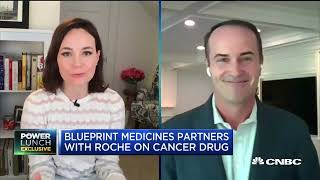
In this interview, Blueprint Medicines’ former CEO Jeff Albers discusses the company’s global collaboration with Roche/Genentech to develop and commercialize the RET‑targeted drug pralsetinib. He outlines the deal’s financial structure—$775 million upfront (including a $100 million equity investment) and up to $927 million in milestones and royalties—and explains how the partnership will accelerate patient access worldwide, leverage Roche’s diagnostic capabilities to identify the small patient population with RET‑driven cancers, and provide Blueprint with the financial independence to fund its broader precision‑medicine platform. Albers addresses competition from Eli Lilly/Loxo’s already‑approved RET inhibitor, emphasizing Blueprint’s differentiated approach and the partnership’s role in scaling reach. He also reflects on the COVID‑19 pandemic’s impact on clinical trials, noting the company’s resilience and continued progress despite challenges. Finally, when pressed about analyst speculation regarding a potential take‑private, Albers reaffirms Blueprint’s intention to remain an independent, financially self‑sufficient company, positioning itself as a long‑term leader in precision oncology.
Chapters
Well, this is a deal to develop and commercialize this drug called pralsetinib, which is currently pending regulatory approval in the United States for certain genetically defined cancers, including non-small cell lung cancer and certain kinds of thyroid cancers, a mutation or a fusion that's known as RET. Now, this is a very specific and personalized way of going after cancer. Now, the deal with Roche includes $775 million in upfront payments, including $100 million equity investment from Roche into Blueprint, as well as $927 million in potential milestones, plus potential royalties if they are successful down the road. Joining us to discuss this is Blueprint Medicine CEO Jeff Albers. Jeff, it's great to see you. Tell us about what this deal does for your company. You're expecting potential approval by the FDA of this drug by November, is that right?
Meg, thanks for having me on the show this afternoon. And the announcement today of The global collaboration between Blueprint Medicines and Genentech Roche is important news for individuals with certain forms of cancer that, as you mentioned, are driven by what is known as a RET mutation. And those mutations occur most commonly in small percentages of patients with non-small lung cancer or advanced thyroid cancer. And in both those settings, patients are in need of additional therapeutic options. The collaboration is centered around Blueprint Medicines Investigational Medicine pralsetinib. And as you mentioned, we're in the process of, of waiting for regulatory feedback on what could be our first approval.
How does this set you up in sort of competition with Eli Lilly and Loxo Oncology? They already have this RET-targeted cancer drug on the market, which got approval in May.
I think there's 3 critical components of this collaboration. First off, it's going to allow us to bring pralsetinib to more patients globally more quickly. Secondly, one of the challenges with targeted therapies is finding the patients. It can often feel like looking for a needle in a haystack. And by partnering with Roche and their expertise using data and diagnostics on patient identification, It's like being handed the world's most effective medical, metal, metal detector to help us to find the patients most likely to benefit. And then ultimately, for Blueprint Medicines, this now sets us on a trajectory to be a financially independent company over the long term so we can continue to invest in our platform. And Meg, as you know, that's a, that's a unique challenge within the biotech community. And it's something that for a company of our size really could set us apart.
Well, I know you also have drugs earlier in the pipeline. And, you know, it's been nice to think for just 5 minutes about something other than COVID. But I have to ask you about the impact of COVID because we know for many companies they've had to put new clinical trials on hold or somehow alter the way they're running clinical trials because of the pandemic. How has that affected your pipeline? And will we see any potential delays because of that?
Certainly, we feel the impact of the pandemic like everyone else, and it's been a challenge. And one of the things that I find incredibly gratifying is that our employees have shown resiliency and adaptability because ultimately we know that cancer doesn't wait for a pandemic. And in fact, patients probably need us more now than ever. And so we've been working with, with investigators and with patients to ensure that we can make, make therapies available. And at this point, I've really been thrilled with the progress we've been making in recent months.
Jeff, in talking about the deal, analysts came away with the perception that, that there was strong commentary surrounding this deal regarding remaining independent. And there had been a perception that there is a takeout premium in your stock, the assumption that a bigger company would come in. And be interested. What can you tell investors about your plans? I mean, does this mean— do those comments mean that you plan on remaining independent for the foreseeable future, that there are no deals that you're thinking of down the line?
Any collaboration, in my experience, has to be grounded in strong science and shared values and shared goals. And ultimately, why this collaboration was right for Blueprint Medicines now and for pralsetinib was that we and Roche were aligned in that we're just getting started in terms of maximizing the value of pralsetinib, in terms of meeting more— meeting the needs of more patients over time. And so I actually think that this transaction now doubles down on the notion that we are set up to be the premier precision medicine company over the long term, both from the pipeline that's driven by our great science and now with the financial wherewithal to continue to invest in multiple broad programs simultaneously.
So the bottom line here is you're saying you're going to go it alone.