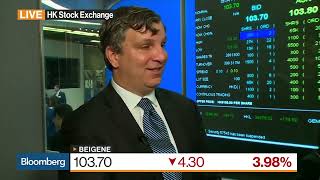
In this interview, John Oyler, Co‑Founder and CEO of BeiGene, explains why the company chose a secondary listing in Hong Kong—to embed itself in the Chinese biotech ecosystem and give local investors visibility. He describes BeiGene’s ambition to be a "homegrown champion" that combines Chinese scientific talent with global resources, aiming to capture a larger share of China’s rapidly growing pharmaceutical market. Oyler discusses the massive market opportunity for BeiGene’s PD‑1 cancer therapy, citing Morgan Stanley’s $2.3 billion 2030 sales estimate, and highlights the primary risk: delivering high‑quality drug to 2–3.5 million eligible patients. He outlines how BeiGene navigates China’s evolving regulatory landscape through long‑term partnerships with Boehringer Ingelheim (manufacturing), Celgene (clinical development), and other global players, emphasizing the need for a "village" of collaborators. The conversation turns to cash‑burn management, noting a cost‑conscious culture instilled by the founders to keep drugs affordable while maintaining rigorous quality standards. Finally, Oyler touches on future financing plans, referencing prior share sales and the company’s ongoing focus on sustainable funding to support its growth trajectory.
Chapters
Congratulations, first and foremost, on today's listing. Firstly, why did you choose Hong Kong for your secondary listing when the US market perhaps might be more liquid?
Thank you. It's a pleasure to be here. And the reason that we wanted to be part of the Hong Kong market is BeiJin's a company that was really born in Beijing, as you said, 8, 9 years ago. And we're doing cancer research and trying to help people with cancer globally, but also people here in this region. And, you know, the vast majority of people in our company, I think, you know, are here in China, and we wanted to, you know, be part of the community as it evolves here and a positive, you know, force and, you know, partner for the other organizations that are, you know, growing up here too alongside of us. I think trying to fight cancer is hard, and we need a big ecosystem with investors and many companies and academicians, and being part of the China community is really, really critical to us. And we want to enable investors and people around to know who we are and have the opportunity to help us in what we're trying to do.
So, John, this puts a spotlight then on your efforts in China, which is the second biggest pharmaceutical market after the US. How do you intend to get a larger share of that market, especially with Chinese authorities' attempts to develop homegrown champions?
Well, I think, you know, we're definitely a homegrown champion. I think we're a company that the molecules we're talking about and antibodies that are in the clinic today and that, you know, are in trials and showing data that's extremely promising globally and in China, you know, they were invented by some of the scientists that are here today in Beijing. I don't know, maybe 6, 7 years ago in our laboratories there. And I think that, you know, we believe to build the strongest company, you know, you can't only be Chinese. You have to be global. And you want to bring together the best capabilities and the best resources from the whole world. And we're trying to do that in an organization. But at the same time, you know, the vast majority of what we're doing is here. And, you know, You know, we think that fits exactly with what China and the industry is trying to do.
When it comes to tapping the potential of the Chinese market, now Morgan Stanley has an estimate for your PD-1 cancer therapy. If approved by China, that could hit annual sales of up to $2.3 billion in 2030. Those are lofty numbers, but what could be the biggest risk to attaining those types of goals for yourself as well as to the wider industry? In China?
Sure. I think that in general, you know, you have a lot of people in China that have cancer that could respond to a PD-1. There's probably, you know, 2 to 3.5 million people that could really have a long, meaningful, lifelong benefit from that. And I think the real challenge for us, for China, for the other companies that are trying to help us do this is how we can possibly get that much drug to that many people in a high-quality fashion. And I think from our perspective, you know, we think we can play an important role in that area. Whether those numbers are big or small, I think the critical thing is we get the drug that can really help 2 million people to them as quickly as we can in a high-quality fashion.
And how is Beijing navigating the regulatory environment in China when it comes to healthcare and pharma, it has been going through some changes of late?
Well, I think that our view has always been there's only one way to do things, and it's with the highest science and the highest quality. It's why, you know, with our PD-1, for example, we've partnered over 5 years ago with Boehringer Ingelheim, who's a German company that has as much experience as anyone in monoclonal antibody manufacturing. And together with them, we're manufacturing our PD-1, and we've developed it. And we think that really helps us ensure the quality that is extremely helpful to patients. And on the clinical side, we're partnered with Celgene, one of the largest oncology companies in the world, also known for its great drugs, Revlimid and Abraxane in particular. And from that perspective, we have their help in the clinical development of that drug, and we're pursuing it across the globe with a dozen-plus regulatory agencies. So really, you know, it takes a It takes a huge group of people, a village, to raise a child. And I think that it takes a lot of help for a company, any company, to really get drug in a high-quality fashion to that many patients. And we're trying.
So any plans, John, to expand that village, to tie up with more partners other than Merck, Celgene, and others?
I think we believe partnership is a critical task to being successful. And if you want to help as many people as you can, You know, we should focus on how to do that enough, and it requires finding a smart way to work with other people. So I think, yes, we're always open to that.
Now, cash burn is a hurdle for most biotech firms. How are you hoping to alleviate that?
You know, I think that, you know, one thing from the early days in our company, Wang Xiaodong and myself have had a cost-conscious mentality, and I think that If you set as a goal for your company to get, you know, drugs to people that can be humanely priced, you have to build a culture of cost consciousness. And if you don't do that, it's going to be a challenge at the end of the day to make sure that you can get drugs to people. And people can't afford drugs that are really expensive. So I think we're focused on that. And that's one way that we try to manage what we're doing from an expense perspective. But certainly, you know, if you want to understand if a drug is working and if you want to manufacture it in a high-quality fashion, you can't take risks. And that means you will spend money to make sure that everything you're doing is completely robust.
So it takes money. Are there any future funding plans? Before this IPO, you already had 3 share sales following the NASDAQ listing in 2016. So what's the prospect here?
I don't think that there's anything necessarily on our horizon at the moment, but I think from the other perspective, you know, we understand and acknowledge this is a building process, and our aspiration is not, you know, to be a small, you know, niche biotech company. It's to be a lasting major global player. You know, at Beijing, I think we've said, you know, you hear a lot because you're in China of you know, things are made for China, and you've heard things are made in China, and then you've heard, well, in our industry, me-tos, where people, you know, are making a duplicate around IP of something else. You know, I think at this time, you know, we believe it's time that we can lead from China in this industry, and we really are committed and trying to build ourselves into a global leader from China. That has, you know, reach and is helping people throughout the globe and becomes a major biopharmaceutical company. And that's what we're striving and aspire to do.