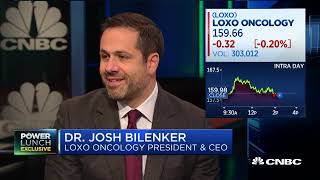
Josh Bilenker, former CEO of Loxo Oncology, discusses larotrectinib, a cancer drug with a 75% response rate across tumor types. The FDA decision was expected in November. Finding the roughly 2,500 to 3,000 eligible U.S. patients annually required comprehensive genomic testing.
Chapters
A huge flood of news was released over the weekend from a cancer research conference in Europe, and most stocks are moving to the downside. Bristol-Myers is selling off on concerns it'll further lose ground to competitor Merck in immunotherapy. Those are, of course, new drugs that unleash the immune system to fight cancer. And smaller biotechs are seeing even bigger negative swings. Check out Clovis. Despite what some saw as an encouraging update in prostate cancer, it's also facing increased competition from AstraZeneca in ovarian cancer. Mirati Therapeutics is selling off after an update for its lung cancer immunotherapy, and Adaptimmune is down on data for its immunotherapy in various types of cancer. Summed up by one biotech watcher today, it's been pretty underwhelming. Now, one stock that was bucking the trend earlier today is Loxo Oncology. Let's bring in CEO and President Dr. Joshua Elkington. Loxo stock is up more than 90% year to date. And though you're kind of just holding on to flat territory, that's pretty good compared to the rest of biotechs who were presenting at ESMO over the weekend. Analysts really glowing about the data you had presented there. What, what can you tell us about it?
We provided an update to the data we had provided in 2017, and we showed that in another cohort of patients treated with our drug called larotrectinib, the response rate was generally the same. About 3 out of every 4 patients have significant reduction in their tumor size. And more importantly, perhaps, is the fact that once patients do respond, they are staying on the drug for an encouraging amount of time.
So you're expecting a decision from the FDA on this drug by November 26th. I understand you've got a partner in Bayer on the drug. And one of the interesting challenges about this space is it's a very rare cancer, just a few thousand patients in the United States. How are you expecting to be able to find all of those? How is it going with awareness and testing for this kind of cancer?
Right. We are in this very delicate moment for the program in that FDA is doing a review of the safety and efficacy of the drug to ensure that it, that it's worthy of approval and can be labeled appropriately. You alert to the right question though. How do we find patients who have the opportunity perhaps to benefit from the drug? And it's all about testing. It's all about having their tumors comprehensively assayed for the presence of a DNA abnormality called the TRK fusion.
In terms of the glowing analyst reports, a lot of them have said that the competition is basically knocked out the competition from Roche. Stiefel said this removes any lingering speculation about potential competition. How do you view this in terms of strengthening your positioning going into a potential FDA approval in November?
It wouldn't be appropriate to comment on someone else's data, but we're very encouraged.
Less effective, bottom line, coming out of this conference. That's, that was the takeaway.
It's really important that, you know, FDA review the data in, in in the absence of, of press releases and such, and they'll have that opportunity perhaps for both datasets, and we'll all await that review. But we're really encouraged about that, and the options for patients are what matter. And for us, anticipating the day when perhaps larotrectinib stops working, we launched a program called LOXA-195, which is a different drug that we hope will pick up the pieces should larotrectinib stop working for a given patient. We don't have all the answers yet, it's only in phase 1, but That's something that we do, is try to focus on what's next for the patient.
So, so Meg was a little elliptical in describing the cancer that this treats. Tell me what the cancer is that it treats, how many patients, let's say in the United States, you expect to maybe be able to reach, and then how do you make money if it is a small cohort?
So there's as many as 24 different cancer types where this biomarker has been described, but it's rare in any given cancer. And in the United States, there are approximately 2,500, maybe as many as 3,000 patients diagnosed every year, or I should say who have this cancer. The question is, will they be diagnosed?
Who have that biomarker in their cancer, which could be of any sort or lots of different sorts.
So it could be lung cancers, colon cancers, sarcomas, pediatric cancers, but it's there at a very rare percentage in each given category. And so that's where these tests come in to be important. So everybody needs the same comprehensive test to know whether or not this drug could be there for them. But it very much follows the precision oncology or precision medicine model where we're trying to build very well-prescribed selective medicines for selective alterations so that we can have a bespoke solution for every patient in the long run. We're not nearly there yet, but this hopefully is an encouraging sign of where we can get.
And as you prepare to enter the market with your first drug. I'm not going to ask you about pricing. I know you can't tell us how you think about pricing or how Bayer, your partner, may think about pricing. But more broadly, as you look at what the administration has said about drug pricing recently, some of the actions they've been taking, wanting to include the drug price in the ad for, for the drugs on TV, how are you feeling about that environment? Does it make you nervous?
Well, thanks for acknowledging our commercial partner Bayer, who has final say in matters of pricing., and we don't think mass advertising is the right way to talk about this drug, given how unique and rare the population is, but to the larger question of drug pricing, we think it's really important to protect two ideas. One idea is to make sure that novel medicines that provide benefits to patients are reimbursed, and therefore provide incentives for that next generation of medicines that we don't know about today, but biopharma companies all over the world are thinking about, committing and risking dollars against. It's really important that we have a system that rewards that. The second idea is, can there be relief for patients who today are paying unbelievable out-of-pocket expenses just to have their medicines, no matter how they're priced? Oncology pricing will always be to a premium of an antibiotic or a hypertension drug. And so there needs to be a mechanism to protect patients from this so-called financial toxicity that they face.