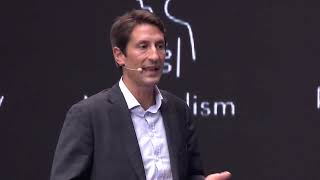
In this keynote, Jurgi Camblong, co‑founder and CEO of SOPHiA GENETICS, frames the global cancer burden as both a crisis and an opportunity. He argues that the convergence of two rapidly advancing technologies—high‑throughput DNA sequencing and artificial‑intelligence‑driven pattern recognition—has created a revolution that can turn cancer from a fatal disease into a chronic, manageable condition. Camblong outlines three pivotal questions about the future of data‑driven medicine: its scalability beyond research, its ability to reach thousands of patients worldwide, and its capacity to not only diagnose but also personalize treatment. He positions SOPHiA GENETICS as a pioneer in democratizing this vision by building a global community of more than 180 university hospitals across 30 countries that pool genomic data into a single, secure, GDPR‑compliant SaaS platform called Sophia DDM. The platform’s proprietary AI engine, “Sophia,” continuously learns from the aggregated data, delivering faster, more accurate variant interpretation, drug‑matching, and clinical‑trial recommendations. Camblong shares concrete impact metrics—launch in 2014, daily analysis of ~200 patients, a four‑fold annual increase in diagnoses, and expansion into cardiology, metabolic, and pediatric disorders. He emphasizes the company’s Swiss‑engineered focus on data quality, trust, and privacy, noting that patient data remain under hospital control and are never monetized. Finally, he looks beyond genomics, describing a future where molecular signatures are combined with clinical variables (tumor type, stage, treatment outcomes) to enable real‑time epidemiology and treatment personalization at scale.
Chapters
Ladies and gentlemen, nice seeing you today. I'm here actually to give you two news: the bad news and the good news. And I'm going to start with the bad news. The bad news is that unfortunately, according to Marie Curie Institute, 1 out of the 2 people sitting in this room are going to suffer from cancer. And cancer will remain the first cause of mortality in developed countries. Now, the good news is that there is a revolution that is ongoing, and that thanks to this revolution, we're going to be able to make cancer a chronic disorder, a disorder with which people will live, rather than die. This revolution is being possible thanks to different technologies. And with those different technologies, we're going to be able to understand the molecular evidences of diseases such as cancer, but as well diseases such as diabetes, obesity, and make actionable insights so that we're going to beat these diseases. There is a tech guy that you all know that strongly believed in this revolution of data-driven medicine. This was Steve Jobs. In 2007, Steve Jobs was diagnosed pancreatic cancer, and he had the DNA of his pancreatic cancer that was sequenced. And at that time, he said, I'm either going to be one of the first to be able to outrun cancer like this, or I'm going to be one of the last to die from it. Well, in 2007, we knew little about the molecular evidences that are driving cancer, and one couldn't save Steve Jobs. Since then, we've seen two technologies that have dramatically progressed and that are making the revolution of data-driven medicine a reality. The first technology is DNA sequencing. Most of you may remember that the first human genome was sequenced in 2003, that this took 13 years and cost $3 billion. Today, hospitals are able to produce the same information in a day for $1,000. The second technology that has dramatically progressed over the last years is artificial intelligence, with techniques such as machine learning, pattern recognition, techniques that do come from the big data industry. By combining these two technologies, we will be able to master cancer, to master diseases that are devastating life every day. Now, this brings us to three questions. Important questions. Is data-driven medicine going to remain a research thing? Is data-driven medicine going to help thousands of patients every day, everywhere in the world? Is data-driven medicine going to help not only better diagnose, but definitely better treat as well patients, adapting treatments? In other words, how are we going to be able to democratize data-driven medicine? And that's the challenge Sophia Genetics has taken from inception. Our ambition as founders of Sophia Genetics was to leverage on DNA information to better diagnose and treat patients across the globe. We actually are not the only one having that vision and having that dream. This year, in February, Barack Obama made a fantastic speech in the White House, and this is what he said: This is an exciting time for medithing, thanks to the work done in mapping of the human genome. The key to all this is for us to be able to build up databases, because all of us potentially could have electronic medical records with privacy protection, We will voluntarily pool them together, allowing researchers, practitioners, and scientists to accelerate the process of discovering cures in ways we've never seen before. What is Barack Obama talking about? He's talking about things that are quite basic, in fact. He's talking about connecting healthcare institutions, connecting hospitals, about pooling patient molecular information in a single community, about motivating healthcare professionals to share their knowledge in this single community, and then to do what? To leverage on big data technologies to find actionable insights, better diagnose patients, better treat them. Actually, that's something Sophia Genetics as partly already done. With our technology that I'm going to present you later on, we've already been able to connect over 180 leading university hospitals across 30 countries, which are all part of a single community where they pool in single data centers the genome profile of patients, that is then computed by some artificial intelligence to better diagnose and treat patients. They don't only pool information, but they share as well the information about how they treated the patient cases. And there are 500 of them using that daily across these 180 leading university hospitals. Now, the reason why we've been able to do that is that we've been able to build a breakthrough technology, a technology that has become the world's largest and most advanced artificial technology in data-driven medicine, a technology that was built by our bioinformaticians with training sets and is now able to operate things faster and better than an individual can do. This technology is called Sophia, for wisdom. You may know that in Greek, Sophia means wisdom. We want to make data-driven medicine wise. We want to make data-driven medicine sustainable. This artificial intelligence is progressing thanks to network effects, things that are very well characterized in social media, right? This artificial intelligence is not only providing accurate response to better diagnose patients, but as well is matching the molecular profiles of the patients against most advanced drugs, and eventually as well matching for clinical trials that are developing innovative drugs. The key here were two things when we started developing this technology from scratch. We built everything on quality. We're a Swiss company, exactly like Swiss watchmakers are doing Swiss watches, we work on the mechanics of the analytics. And we work on these mechanics to make any data accurate independently of how the data would be produced by the hospitals. Independently of the sequencing technologies they would have available. In parallel, as we had to build this ecosystem, this community, we had to build trust. And to build trust, we've invested as well in privacy and security to ensure that employers and insurers cannot get access to the data of the patients. And this is what has made our success so far. This collective artificial intelligence, Sophia, is available to the community into a software-as-a-service platform called Sophia DDM. The hospitals remain the controller of the data of the patients. They themselves, with their equipment, produce the information of the patients. They load the information into our infrastructure through a software-as-a-service mode, and then Sophia automatically computes the data trench them, and find the variants that are unique and specific to a given patient. This system, as I explained to you, is learning every day and is becoming every day more and more powerful. Today, we're not only helping patients in cancer, we're helping as well patients suffering from cardiology disorders, from metabolic disorders, for pediatric disorders. And the more applications clinicians will develop, the more our system will be able to help patients. What you can see here is the usage that these 180 hospitals have made, submitting patient data into the system month after month since we launched the platform. The platform was launched in April 2014. Prior to that, we had a beta version. And year after year, we've seen that every day we would help 4 times more patients to be better diagnosed. And today, we're helping about 200 patients to be better diagnosed. In France, which is the country that is hosting us today, we have actually 30 leading university hospitals and cancer centers that are using the technology every day. And with the new mission that the Minister of Health launched recently, setting up reference genome centers, we hope that every day we're going to be able to help even more patients. Importantly, the system we have is compliant with European regulation for data protection. And that's something very important, because if we want to make data-driven medicine happen, We need trust, and to have trust, we need clear guidance. So the American friends here around may think, "What do you do with the data? Do you monetize the data?" We don't monetize the data. We are only paid to help better diagnose patients. We are not paid to exploit the data or sell the data. As you can see from the numbers, every day, the number of patients that we do help to better diagnose is increasing. And as you understand, this is what is driving the collective artificial intelligence we've built. Now, I'm one of the 3 co-founders of Sophia Genetics. I'm obviously very proud about the impact we're having today in better helping hospitals to diagnose more and more patients. But actually, that's not data-driven medicine. What I've been showing to you is genomic medicine. And our ambition goes further than that. We need to be able to capture other types of data together with the molecular signature of the patients to be able to empower this information. And when it comes to cancer, we need to specifically be able to capture things such as the tumor type of the patient, the tumor stage of the patient, the treatment that was given to the patient, and the success rate of that treatment. Why is that important? If we are able to capture this information on the top of the molecular signature of the patient, then we will be able to cluster patients and reach our ultimate vision, which is to say that The cancer of one patient looks like the one of 10,000 other patients that did receive treatment plan A and survived. This change of paradigm, this new era of medicine, data-driven medicine, is in fact what other people call as well real-time epidemiology. It's about adapting the treatments one will be given based on the efficacy of the treatments of patients that had same molecular characteristics and did benefit from that drug. And this is our dream. Thank you very much for your attention.