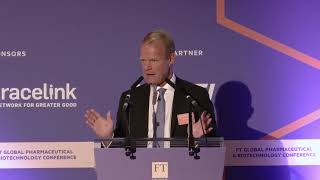
In this keynote‑style presentation, Kåre Schultz, CEO of Teva, delivers a macro‑level overview of the global pharmaceutical ecosystem. He begins by highlighting the steady rise in worldwide life expectancy and attributes a substantial share of that improvement to pharmaceutical innovation. Schultz quantifies the scale of private‑sector R&D (≈ $188 billion annually) and explains how new molecules, predominantly developed by private firms, have driven health gains over the past five decades. He then contrasts the high‑price, patented “branded” drug market with the subsequent generic wave, showing how generics now dominate volume (≈ 90 % in the US) while representing a modest share of value, and quantifies the savings generated by generic competition ($300 billion in the US and €100 billion in Europe in 2018). Teva’s own contribution to those savings ($42 billion in the US, $8.5 billion in Europe) is highlighted as a concrete example. Schultz identifies four political threats to the value chain: exorbitant pricing, patent‑gaming, lack of global access/price differentiation, and poor quality/compliance. In the Q&A, he discusses the need for stricter patent‑system enforcement, the economic roots of generic drug shortages, the importance of regulator‑driven quality assurance (citing concerns raised in “Bottle of Lies”), and defends Teva against DOJ‑initiated price‑collusion allegations, presenting evidence that generic prices have actually fallen 50 % over three years. Throughout, he urges industry and regulators to maintain a balanced, transparent system that preserves innovation while ensuring affordable, high‑quality medicines for all.
Questions this video answers
Regulators should enforce stricter thresholds in the patent system to ensure only primary drug innovations receive patents, preventing strategic extensions via process patents or minor variations.
Maintain a price point that provides economic stability for suppliers, work with trusted partners for sustainable supply, and have regulators enforce rigorous quality and compliance inspections.
Prioritizing volume of approvals over quality can lead to compliance failures; regulators must keep quality and compliance as the top priority.
Teva provided over a million documents to the DOJ and found no evidence of organized price collusion; generic prices have actually fallen 50 % over three years, and the specific products cited either were not manufactured by Teva or saw price reductions.
Chapters
Ladies and gentlemen, it's a great pleasure and honor to address you all. I've chosen to give a perspective on what's really in the name of the conference, which is the situation for global pharmaceuticals. So what you'll hear from me is like a macro view on what's really the track record, the performance of global pharmaceuticals. How does it work? Does it make sense? But then the most interesting part comes at the end. What are the key challenges and how can we all address them in a way that will benefit society and will keep us being relevant? Now I'll need to find out how to move the slides along. So if you can take the next slide, please. So this is a very simple graph. It just shows global life expectancy and it just gives you a story that you probably all know, the story that worldwide, not just in the rich part of the world but all over the world, life expectancy has been increasing dramatically. Actually, on average, for every year that passes, life expectancy has been going up something around 1/3 of a year, basically meaning that all of us in this room, but also people in Bangladesh or in Peru or wherever you think about in the world, they are today living significantly longer and have expectancy for living significantly longer than they had 10 years ago, 30 years ago, and so on, as you can see from the curve. Now, there's a lot of good reasons for that, but one part of it is the pharmaceutical industry. So, if we go to the next slide. Then this is just to give you a sort of kind of quantitative view on what has been happening in pharmaceuticals. And this is just one way of thinking of it, how many new molecules have actually been developed. All of them, of course, have had varying degrees of effect on people's lives, varying sizes of patient groups, but on average they have all in this graph been addressing huge segments Millions of people being treated, leading to better quality of life, leading to longer lives and better health worldwide. Now, all these new molecules have basically come from the private sector, 99+ percent of them from private pharmaceutical companies. And if we take a look at the next slide, then this is something I won't go into in detail because you all know this.. But there's of course been an evolution of the technologies, of the understanding of the human body and the physiology, and therefore the types of medications that we're seeing. 50 years ago, we didn't talk about orphan drugs. 50 years ago, we didn't talk about sort of breaking the code of cancer and combating cancer. But we're talking about that now, and we're moving into even more sophisticated things.. But the point here is really not the exact technology or the exact disease category we're going after. The point is just that it's been possible to achieve very tangible benefits for the whole human race during the last 50 years through research, launch, manufacturing, commercialization of new innovative therapies. Now, if we take a look at how this comes about, then it only comes about from a lot of work. A lot of work, a lot of people working hard in laboratories, in clinical testing, in research, spending a lot of money. And you can see here how the current run rate for R&D is expected to be around $188 billion per year, which is much more than it was 10 years ago or 30 years ago. And that's, of course, also why the industry is still at a stage where the investments going in are so substantial that the return is never secured. And that's only fair. If you do very well, you create a huge return because you deliver fantastic value in the form of very efficacious and safe drugs. If you have bad luck and you don't really hit the right drug candidates and your portfolio fails, then of course you don't make the return because of the size of the investment going into the industry. On the other hand, the rewards are also going up. These are the revenues that you see in branded pharmaceuticals. You see US versus Europe. So you have to admit that given the population sizes, there's some truth to the fact that on average branded products do carry a higher price tag in the US than they do in Europe. This is pretty obvious from this graph. But it also shows that on average the market keeps growing, so there's a logic to the fact that more and more money gets invested in R&D because the potential payout is also going up. So there's a kind of balance there, and you also saw that there's no slowdown in the number of new innovative products that comes to the market. Now, how does it then benefit broadly? How does it benefit everybody around the world? Well, that's basically because, as you all know, any branded product normally gets launched at a relatively high price. Higher in the US than in Europe, but eventually the patent expires and you have generic competition. And with generic competition comes a significantly lower price, more access, both more access in individual countries but also more access in more countries. So eventually through generic medicine, you get broader access all around the world. And if you just look at the development here over the last years, then there's been a dramatic change in the volume in the sense that generics now, in this case, this is the US, you can see how it's now more than doubled over a 20-year period. And you can also see how the sort of volume share is getting sort of close to approaching 90 and the value share is around 14. So that gives, of course, you an idea about the fact that the money being spent is being spent on the branded products that are an ever decreasing share of the total volume. Now, this is for a good reason because the $188 billion R&D dollars primarily goes into the new branded drugs. So of course, in order for the whole system to work, the pricing of the new branded drugs has to be significantly higher. Now, in Europe, you have the same development The penetration is slightly slower on generics. It has also doubled in the period we're looking at here. And it's the same phenomenon that it's significantly higher volume share than value share for generics, and that branded drugs, of course, make up a much higher part of the value. You can see it's not quite as extreme. That's just because in the US where you have free pricing, you get higher pricing for the new branded products and lower generic pricing eventually, whereas in Europe you get a lower initial price but also a higher generic price. Now, how much are we talking about? And it's actually quite big numbers. If we just take 2018, then the saving to the US healthcare system from products going off patent, going generic, is around $300 billion. And in Europe, because the market is somewhat smaller, it's around €100 billion. And of course, I wouldn't be giving this speech without making a little bit of a commercial for TEVA. So I brought you the TEVA numbers just so you know. In Europe, the annual saving in '18 was $8.5 billion. A big chunk of it actually here from the UK, which is interesting. And of course, all countries are saving, and this is only this share of generics that Teva actually manufactures and ships in Europe. And in the US, the products we shipped in '18, they constituted a saving of some $42 billion. So it's a lot of money we're talking about, and it's a big saving, but it's also a necessary part of the whole system because the whole patent system is predicated upon eventually providing cheap medication to everybody. Now, here comes the last and most interesting slide because I'm assuming you knew most of what I said already. But from my point of view, there are 4 big political threats to the value chain. And you have to remember that seen at least from my point of view, the value chain works extremely well. The R&D works well, we get good output from R&D, we have Good improvements of public health worldwide or private health, health overall is improving everywhere. So we can only be happy about the overall global pharmaceutical value chain. However, there are some challenges we need to be aware of. One is exorbitant pricing. It's fair to take a high price for a new innovative drug, but you need to make sure you take a price that is reasonable somehow.. It should be much higher than other therapeutics that are old or generic. It should signify the value you're creating for people, but don't make it exorbitant because if you made it exorbitant due to the fact you have a patent, you are sort of provoking the public and political sector and don't do that. Now also patent gaming, that doesn't work because what I mean with patent gaming is when You have a basic patent for 10, 12 years, and then you make 15 other patents to extend it for another 10 years. Now, that's not the deal with society. The deal with society is you get a natural monopoly in terms of patents because you give it back to society at the end, and then we have generics and everybody gets the benefit. Lack of access. What do I mean by that? You can't make a product and then only make it available, for instance, in the US. You've got to make sure you make a product and you try to make it available worldwide because there's a natural perception, again, in the global political landscape that we need to secure access. And with that goes price differentiation. We need to understand that in Bangladesh, the product has to be cheaper than it can be probably in North America or in the UK. And then the last point here, which is very much, I think, centered for consumers, patients, families, but also it should be for regulators and everybody, watch out for poor quality and compliance. You can't just approve 10 engine manufacturers and hope you get a steady compliance situation and steady supplies for the US generic business. You have to have very rigorous regulators watching over all value elements here in the pharmaceutical supply chain and making sure that quality is always top and paramount because the trust in the system is part of what maintains the system. And that is really up to the regulators to secure that we can maintain trust in all the medical products that we get every day and that all of us are using in one form or another. So on this actually positive note that the overall pharmaceutical value chain is ticking along, working well, And with this, sort of begging you all to think about this in your business, let's make sure that we continue having a strong and healthy pharmaceutical value chain in the future.
Thank you. Well, thank you very much for that. There's so much to talk about and really not very much time, so you'll have to stick around for lunch just so everyone can talk to you. So, you know, you laid out just there at the end some of these threats. I wanted to dig in on this patent gaming issue. What do you think regulators should be doing about that?
I think it's really not the fundamental patent legislation, that's fine, but it's really up to, you know, the legal systems and the patent part of the legal system to make sure that there's a certain threshold for what you can actually get a patent on. And make sure that it's the primary innovation of new drugs that you patent and you protect it vigorously, but all the details about things that are not really important, and that's where we see the patent gaming on, you know, process patents or, you know, different versions and so on, that there they should ensure, but it's really something you can only ensure through the patent system.
So you need much more enforcement?
I think it's not bad the way it is, no. I'm not saying that it doesn't work the way it works now, I'm just saying that everybody should watch that the public does not appreciate patent gaming. They appreciate new drugs with a patent period and then cheaper generics.
And you also spoke about lack of access and talking about global access, but obviously one of the things we've also seen, particularly in the US at the moment, is that these plummeting prices of generics has actually led to significant shortages. How do you think we should be dealing with that?
Well, it's kind of a basic economic phenomenon that if you want stable supplies, you need to have suppliers and a price point that creates that stability. If you go for, you know, the cheapest deal of the day all the time, then nobody will have the commitment to supply to you and then you get instability. So I think it's also a commercial element here that you need to deal with people you can trust to keep on supplying you on a sustainable basis. And the regulators, again, have to be very tough on how they also inspect foreign factories and not just approve products because they think it's nice to approve more and have more competition, but also look for compliance and ensuring that compliance and quality is always high because that's what the patients expect.
So do you think that the rush— I mean, obviously we've seen the FDA approve thousands of generic products, you know, in the last year or so. You think that that may have fed into some of the issues that we've seen discussed this year, for example in that book Bottle of Lies, about lack of quality in some of the Indian factories, for example?
I think there is a risk if you go out with a purpose just to approve as many products as possible and not with the purpose to secure quality and compliance, that you take a risk as a regulator if you do that. I think it should always be quality and compliance should be number one in the mind of the regulators.
Okay, I'm going to throw it open. Is there anyone who has any questions?
Oh, we've got one here. Thanks, thank you very much, Melanie Senior. I just have to ask about the accusation of collusion over pricing in the US, and, you know, you— and I totally get the case for generics and all the points you make,. And I also take your point that the public doesn't like patent gaming. And it may not like that other sort of price collusion either. So I just wondered if you say a few words about that chapter.
Yeah, I'd love to answer that. It's a little— it takes a few minutes because it's a complicated story. It goes back to 2014-15 where a company called Heritage, their two executives were charged with embezzlement., and they explained to the DOJ that they would like to talk about the fact that there was a price collusion going on in the US generic industry. And the DOJ went along with that theory and raided 10 pharma companies because they thought there was some kind of price collusion going on. Now, we were also raided and we handed over, in collaboration with DOJ, more than a million documents which were reviewed by us and our external legal counsel. And we've seen absolutely no evidence of any organized price collusion or cartel or price fixing on our part. And the interesting thing here is that there's been a settlement with DOJ and Heritage and they named two specific generic products in this and those two products, one product we don't manufacture, the other product in the period we reduced the price. There's also been a congressional hearing with Bernie Saunders and Cummings, and they also were looking at two generic products where they thought there was something wrong going on, and we've shared all the data with them as well. It's a product costing 55 cents a day, and also those two products, one we didn't manufacture, the other one the price went down. So I just have to say that the hard facts are against the accusations and rumors on price collusion. And we don't see any evidence of us having done anything in terms of structured collusion or price fixing. The good thing about this case is that it's pretty factual. I mean, did you all take the prices up or did you take them down? And for those of you who have followed U.S. generics, you will see that the value actually dropped 50% in 3 years of the total U.S. generics, so pricing dropped dramatically. Actually, the only reason I'm sitting here being the head of Teva was that Teva got into a lot of trouble because the whole value of the generics dropped because the prices dropped. So it is ironic that I'm sitting here defending myself against price collusion when I only got the job because the prices collapsed, but that's just the irony of it.
Oh, well, thank you very much for that answer, and I'm afraid we're all done and we have to go