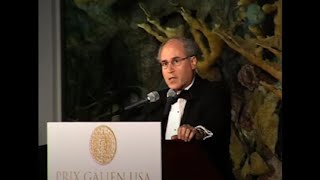
Leonard Bell, CEO of Alexion, accepts an award for Soliris, the first complement inhibitor for PNH, a rare blood disease. One patient went from housebound to active; another returned to work. Alexion provides the drug free through the Complement Foundation and plans to expand the treatment to kidney, transplant, and neurologic disorders.
Chapters
Dr. Leonard Bell. Richard, thank you very much. I'm really very, very, very honored. I guess to add to that, there probably aren't two things that are as old as a panamizing compliment, as it turns out, and certainly this hall with Terry Weissman, who represents much of the compound discovery over the last 40 years, I'm very, very honored. On behalf of the entire Alexion organization, which currently now spans the United States, Europe, and Asia, as a small biotech company headquartered here in Connecticut, I'd like to thank the Green Gallium USA committee and also the very distinguished award panel, of course, for noting both the scientific and, very importantly, the clinical accomplishments that are represented by Solaris. Solaris really is our first-in-class competitor and the first competitor developed through recombinant technology ever. It's also especially a very great honor today in light of the substantial accomplishments of the other final candidates in the burgeoning field of biotechnology. In addition to the leaders of Lexicon's operational teams, I also note that Lexicon is only 16 years old, and fortuitously we're actually at table 16. David, I'm joined by tonight by two of the scientists really who led our 16-year years ago and played a tremendous role in developing SLURP. Steve Swindell, the Executive Vice President and Head of R&D, and Russell Rothery, Chief Science Officer. Like much of science, as Dr. Miller described, Dr. Lerner described, and Dr. Weissman described, our work stands on the shoulders of the groundbreaking science of those that have come before us and are still with us. I point out particularly the innovation and dedication of Dr. Wendell Ross, who's here with us tonight, and also the enormous scientific insight and clinical initiative of Dr. Pete Hellman, who's unfortunately on call today and he's able to join us this evening. Together though, we developed VELVS LURIS as the first ever treatment for patients suffering from paroxysmal nocturnal hypoglycemia, or canage., which is a debilitating, ultra-rare, life-threatening complement-mediated blood disease. Blood cells from patients with PNH are deficient in naturally occurring complement inhibitors that normally exist on the surface of these cells to protect them from terminal complement and their destruction. Soliris, in a pinpoint, selective, highly potent way, addresses this deficiency by binding and blocking the generation of terminal complement before it can affect these unprotected cells. It's clearly the right answer for these patients with this rare life-threatening blood disease. The impact of Soliris on patient lives is striking, including the transformation of a young English woman from a spiraling downward clinical course of progressive blood clots, organ ischemia, and organ damage, and severe disability being housebound, to, with Soliris, a life filled with vigor, a new outlook, and actually able to go to the gym 3 times a week. Post approval, we've taken our path forward even more aggressively. We've stated very clearly our objective is that every patient who can benefit from SLURRS around the world will have access to SLURRS. This aggressively leaning forward commitment includes Alexion's Complement Foundation, of course, which provides SLURRS free of charge to patients in need. Recently, in the last few months actually, one such patient in the United States was unable to work and she did not have any access to health insurance. She was able to resume work once she commenced treatment with Solyris, and now she holds a full-time job with benefits, medical benefits and other health benefits for herself and for her family. Importantly, we believe that our work transforming patients' lives one at a time has only just begun. Each day scientists at Alexion seek to use our expanded scientific and clinical understanding to evaluate the promise of complement inhibition, a new class of drugs, with Soliris at the forefront, to treat patients with other ultra-rare and life-threatening diseases, including now kidney, blood transplant, and neurologic disorders. That is to treat other patients who are severely ill or suffering from other complement inhibitor deficiencies or from excessive complement activation. We stand on the shoulders of the scientists who preceded us and are with us today, and we are eternally grateful to all of our patients and the physicians who participated in advancing this science. And once again, on behalf of all the team at Alexion, all several hundred of us, I wish to thank you very much for this great honor.