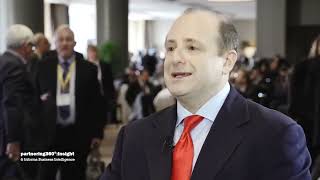
In this interview recorded at the Biotech Showcase in San Francisco, Mike Ward speaks with Marc Cohen, executive chairman and co‑founder of C4 Therapeutics. Cohen explains that C4 is a newly formed spin‑out from Dana‑Farber Cancer Institute and Harvard Medical School that has raised a $73 million Series A and simultaneously secured a strategic, multi‑target partnership with Roche valued at up to $750 million. The company’s core scientific innovation is a chemistry‑driven method to hijack the body’s ubiquitin‑proteasome system (UPS) to label and degrade disease‑causing proteins, moving beyond inhibition to removal of “undruggable” targets. Cohen describes in‑vitro and in‑vivo proof‑of‑concept data showing rapid degradation of cancer proteins in mouse models. Funding comes from an angel syndicate led by Cohen’s own Cobro Ventures and a crossover fund, Cormorant Asset Management. C4’s business model features two revenue streams: proprietary target programs and partner‑licensed programs, with Roche acting as the first flagship partner under a joint‑development, target‑selection framework. Cohen outlines hiring plans, a move to a new Cambridge facility, and a two‑year timeline to bring the first compounds into the clinic—significantly faster than typical Series A timelines. He anticipates working with three to four additional partners on parallel programs, leveraging the $73 million raise and upfront partner payments to achieve cash‑flow positivity.
Chapters
Hi, my name is Mike Ward. I'm the Global Director of Content in PharmaPharma Insights. I'm here at the Biotech Showcase in San Francisco. It's a meeting which runs alongside the JPMorgan meeting where all the great and good, all the movers and shakers of pharma and biotech meet on an annual basis and look at, do deals, etc. I'm actually, I've been joined by Mark Cohen, who's the executive chairman and co-founder of C4 Therapeutics. This company is so new, so freshly baked, that Mark doesn't even have a business card as yet. But you've managed to do a big financing and a deal. So, yeah, who, who, who is C4 Therapeutics?
Great. Well, first, it's a pleasure to be here. So C4 Therapeutics is a brand new company we announced last Thursday, and we raised $73 million in our Series A. And right out of the gate, we also announced a strategic partnership with our first flagship partner, Roche Pharmaceuticals, in a deal that's worth potentially over $750 million. So we're a spin-out of the Dana-Farber Cancer Institute, which is part of Harvard, and our co-founders come from Harvard Medical School. And we are bringing to market what we think is a paradigm shift in how to make drugs.
Okay, so could you— yeah, what is it that you guys think you've got a solution to? What was the problem that you guys think you've got a solution to?
Sure, so the approach that we are taking, and which we think is really very different in terms of how drugs have been made today, is that we have our team, our scientific team, has come up with a way to degrade proteins by tricking the body's natural mechanism, which is a professional machinery that has evolved over millions of years called the ubiquitin proteasome system, or UPS. And we have figured out, in fact, Jay Bradner, one of our co-founders, figured this out. It was the first in 2010 to come up with an all-chemical strategy on how to take advantage of the system and target it towards any disease-causing protein of our choice. So that's extremely powerful because, as you know, proteins are involved in almost every disease. And so if we can degrade, that is destroy as opposed to inhibit, we can get to the root cause and cure many diseases that today aren't even touchable.
So it searches out and destroys rogue proteins?
Exactly. Let me explain how it works. So the ubiquitin proteasome system today has two components. It has one component which is basically a trash labeler. So all it does is it looks for misfolded proteins, defective proteins, and it slaps a trash label on it, like a Post-it note. And then it's got a second piece, which is basically the cleanup crew. And it takes anything that has the label, takes it to this thing called the proteasome, which is just like the garbage disposal at home. It's cylindrical, and it only allows things that have the trash label in it, chemically degrades them, chops them up, spits them out into your bloodstream. They go through your kidneys, and out they go. So that, that's the professional machinery. So what we have done at C4 is figured out how we can take those trash labelers and essentially trick them into labeling a protein of our choice. And then we let, we let the body do the heavy lifting. You know, all we have done here is the matchmaking. And so it's beautiful in its simplicity, but extremely powerful because you're letting the body do the hard work.
Right. So what sort of proof of principle have you already identified?
So there's been extensive work both in vitro and in vivo. So we've been able to take cancer cell lines in mice for example. And we've been able to show how we can degrade those cancers incredibly quickly, as in hours. And so we're able to show and validate. So we have exemplified data that will demonstrate that this actually works on a variety of different diseases. And we think we can extend that to many others. Right.
Okay. So, and that was the sort of the science and the IP that you were then able to go to attract investors into the company.
Exactly.
Okay, so who are those investors?
So we're a little different than most companies. So we're not what I would call your typical VC company. We're an angel syndicate. So we mostly have a group of angels. We have a crossover fund, Cormorant Asset Management. I'm— my brother and I are the lead investors with our fund Cobro Ventures. But it's an angel approach to investing in companies.
Right, okay. And so this group of sort of syndicate of angel investors, they put in how much did you say?
So we raised $73 million.
$73 million.
In our Series A. Highly oversubscribed.
So what has the company, what did C4 Therapeutics tell those investors the use of proceeds will be?
So the strategy of the company is to have two different revenue streams. So we're going to have one revenue stream which is our own proprietary targets. So we'll be going after targets that will make a meaningful difference in different diseases. But our other part of our big stream is going to be our partnering. So our first partner, Roche, for example, We're going to be going after individual targets. So it's a target-based strategy. And so our plan is to have multiple partners where we, where we go after these different targets. And then we have the standard things that you would get upfront fee, milestone-based commercialization and royalties. So it's very exciting for us because we're taking lots of shots on goal.
Right. Okay. So could you sort of describe therefore as much as you can the sort of the details of the deal you've you've got with Roche?
Sure. So we're not disclosing the financial pieces, but it's a multi-target deal. And so we are starting that right away. We're in fact moving in in 2 days to our new facility in Cambridge, in Kendall Square. And so it's your typical, you know, you have some, as I mentioned, some upfront piece. Then we work together collaboratively. We get to typical phases, at which point they have the option of taking over the clinical development and then onward towards commercialization.
So, and Roche chooses the targets?
Roche, it's a joint thing, but Roche obviously has the final say on the targets.
Right, okay. So the relationship, I mean, so it's joint. So are you co-developing? I mean, do C4 Therapeutics still retain some rights?
Well, we're licensing it, so when we license the IP, it's still a C4 IP, but we will license it to that particular— so it'll be exclusive to that partner, and that's the way we'll work. That's the best way when you have multiple partners, is to maintain some level of exclusivity at the target level.
Okay, so to that partner, to that target, to that geographical area that it's—
Irrespective of geography.
Okay. As you sort of say, you know, the financing and the deal were almost contemporaneous, and that was a week ago, right? So how did Roche know about the fact that, you know, you guys were actually looking at this? And was it a coincidence, or did they actually have a part to play in, you know, A, raising— you being able to raise the money, or Was you having the money enough to attract Roche?
That's a very good question. So they weren't involved in the early stages of the company formation, but, but because if you look at our co-founders, in addition to Dr. Bradner, who's now becoming president of Novartis Institutes, we have Ken Anderson, who's a world-renowned expert in myeloma and protein degradation, and we have Nathaniel Gray, who's a world expert in kinase inhibition and drug discovery. They're known all over the world, so it was certainly no surprise that Roche and others would have a desire to work with us because it's coming out of their labs. So getting known was certainly no problem, but very early on a number of partners expressed significant interest because we think this is a paradigm shift. This is a different way of tackling problems. So for example, there's certain drugs today that just— certain diseases, I should say, that just can't be addressed. You know, pancreatic cancer, for example. There's certain things that you just know are a death sentence, and that's because those targets are considered undruggable. Well, we hope to change that.
Right. Okay. Now, yes, as we look forward, you mentioned also that, you know, one arm is to obviously do the sort of the partnering.
Right.
And the other one is to actually develop your own programs. It's a new company. How many people do you have actually, you know, boots on the ground at the moment? And how do you see that developing or evolving over the coming months and years?
So we're a discovery company. So that means, you know, we have to have the chemistry labs, the biology, the biochemistry. And so we are moving out fast to hire people. The team is growing as we speak. Peak. And so this is a company that will have some level of critical mass to do discovery and to work with our partners. So I would anticipate that, you know, in the next couple of years, you're going to see us with a sizable presence. How are we funding that? Well, we're funding that, you know, part of that is coming from the $73 million that we raised, and that's going to help move our initial targets through into the clinic. But the partners are also contributing funds up front too, and as we go along. So we think that the business model is extremely sound, and that's what our partner, that's what our investors found extremely attractive, that we can be cash flow positive very quickly.
Yeah, I was going to say, the $73 million, you know, how much runway do you anticipate that giving you?
That'll definitely get us, get our compounds into the clinic. Which is, what timeline are we talking about? Which is in the next 2 years. So we're not your typical Series A, you know, normally Series A, you hear like 4 or 5 years before you get to the clinic. We're in the 2-year timeframe.
And the bandwidth that you have for doing additional deals?
Right.
So how many deals do you anticipate doing, or how many programs do you think you can have running in parallel with partners?
Well, we feel comfortable that we could have, you know, 3 or 4 4 key partners that we work with on this target-based strategy, and we're quickly making our way towards that. And then it becomes an execution challenge in terms of we just need to be heads down and start making drugs.
Right. Well, I mean, there can't be many companies within the sort of the first week has done such a huge Series A and then also launched, well, landed a blue-chip a development partner. So congratulations on that.
Thank you.
Thanks very much for spending the time telling us about your story.
It's my pleasure. Thanks for inviting me. Cheers, Mark.