Founder Stories: Mark Pratt, Co-Founder/CTO of Ultima Genomics & Advancing Low Cost DNA Sequencing
Mark Pratt, CTO of Ultima Genomics, explains how the company is cutting DNA sequencing costs using system engineering rather than a single breakthrough technology. Ultima's approach uses a clonal, flow-based platform with partial-label chemistry that achieves 85% of bases at Q30 quality and raw indel rates of 0.4%, processing 10 billion reads per wafer.
Chapters
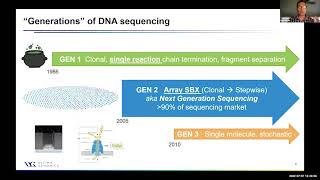
Thanks. Thanks, Sarah and Mark, especially for such cool talks. I learned a lot. So I'm super happy to talk today about driving the cost down on DNA sequencing. So I'm going to spend a little bit of time going back to the same mandatory plot that everyone has to put up in this. In this session currently. I'll try to get the right balance between history and sort of current technologies. I'll say that there will be a different flavor to this talk than the previous talks because we've been focused not so much on technology as system engineering and commercialization. And myself and the other co-founder, our backgrounds are not in the life sciences. Mine is in astrophysics. And lasers and optics, and his was in semiconductors and solid-state physics. Luckily, we hired some very, very good scientists in molecular biology and sequencing technologies early on, and those drove our biology. So let's see, that's that. Oh, I also wanted to say that I feel like it's super cool to listen to these single-molecule and nanopore talks. I feel like It's race cars versus mass market cars. So I'll be talking about the mass market, and it won't be quite as exciting in the cutting-edge technology. On the other hand, the net result hopefully will be exciting. So back to the mandatory plot here. So I've been looking at this fascinating plot for many years as NHGRI annually updates it. And this also sort of maps out the last 15 years of my professional life. So I guess I came 10 years later than Mark to this field. But I started in the— with the launch of the Select-a-Genome Analyzer. And I've been paying close attention to this because part of my mission throughout has been to work on whatever it takes to reduce cost. In the early teens, we were pretty excited about this curve because it seemed like we were plotting a new course relative to the semiconductor industry, which is driven by this empirical Moore's Law in performance. And what it seems like now, given the additional years that have gone by, is that we really just had one event and we've sort of captured Moore's Law again, and we're on this downward trajectory that doesn't seem terribly unique relative to Moore's Law. And I wanted to say a little bit about the technologies that got us here, starting with the technology that sequenced the first human genome, which is first-gen sequencing, Sanger sequencing. And it kind of apexed with the ABI 3730, which could do 96 reads in parallel. And that sort of was the terminus of that technology. It still exists, still used for certain applications. But a few years into the century, a small change happened in the field. It didn't really affect us that much, but a conceptually new sequencing technology came on the market. And that was the 454 GS20. That instrument introduced massively parallel sequencing. It wasn't terribly cost effective. Start off with, so it didn't take over the market. But a year later, Solexa introduced the Genome Analyzer and then subsequently an upgrade to that instrument. And together, those introduced a 3-order of magnitude drop in cost sequencing. And it was largely driven by the highly parallel nature of the new sequencing architecture. And strangely, when Illumina introduced the HiSeq 2000, which is a vastly more capable instrument, in 2010, it did not produce such dramatic results because most of the wind had already been taken by this massively parallel revolution. And it's been fairly steady evolution since then with the number of additional product launches from Illumina, who currently owns this market. And in fact, some people would even say that since 2010, 2015, we've kind of plateaued and we're not even following Moore's Law anymore. So this talk will be about essentially cost engineering and Ultima's first product and where we intend to go and how we think about engineering. So that's the emphasis of the talk, but I just wanted to throw this pitch out there from our marketing team. We're Why do we actually care about this? Well, sequencing cost is still high relative to the kinds of demands that scientists and clinicians are having for sequencing. And in particular, if you can drop the price of sequencing by 10 or 100-fold, it really changes the nature of experiments and clinical applications that one can contemplate. In particular, population studies could go to far, far larger numbers of participants. Clinically, you can look for very rare events, and this has extremely immediate application, which is looking for cancerous DNA and cell-free DNA, which tends to occur early on in very, very low frequencies. So sequencing to high depth at low cost is a real game changer in that application. And then If we want to make sequencing DNA and RNA a routine part of healthcare, dropping the cost is going to make that happen as well. So that's why we do this. So Ultima has actually existed since 2016, but we've been in deep stealth for our entire history until this year when we, unveiled ourselves. So a quick, uh, quick history of us. Uh, we started with a concept and some vague ideas about chemistry and instruments, but mostly a cost model in 2016, that we were going to do whatever it took to drive the cost of sequencing down. And all of our decisions throughout the history of the company have been driven by either driving the cost of sequencing down or the speed of sequencing up. And by speed, I mean the actual data rate not the time to answer, which will be hard to compete with you and Ashley and his turnaround time, that whole genome sequence. So in 2017, with our first good chemistry concept, we read a 7-base read early in the year. And by middle of the year, we were reading YX, which is a few kilobases. In the next year, we were able to improve the chemistry enough that we could read E. coli, this multiple megabase genome. And by 2019, we were able to shotgun sequence a whole human. Also in that year, we received our first NHGRI funding. We were very pleased to do that, to get that money, and to actually expose ourselves to outside criticism in the form of our reviewers. And we've subsequently got a second grant from NHGRI. The first grant was to greatly reduce the cost of sequencing by working on some platform issues around fluidics. And the second grant is to greatly further reduce the cost of sequencing, and that's for future generation sequencing, by working on our SBS chemistry. Also, let's see, in the next year, we engaged the Broad Institute as an early customer, and we've been in collaboration since. It's been very fruitful. We, we couldn't have done it without them, and they've kindly modified GATK to work with our data types, so it makes it very easy for us to offer that to other people as we broaden our customer base. In 2021, we achieved 300-base read length and started getting terabase runs, and we also installed our first products at customer sites. And then here in early 2022, we came out of stealth. We've got a number of scientific publications and abstracts. You can look, look us up online and start finding those. And we're, we're going to continue to have more application-focused collaborations published in the near future. And now we're in multiple customer sites. So stepping back to think about this in system engineering terms, We had the luxury, which many companies don't have, to actually be agnostic about what approach we were going to take because we really had a business goal in mind, not a particular technology goal. And so it's kind of interesting to think about sequencing architecture in various projections in design space. And this is a pretty interesting one where the rows here represent the way in which we detect the signal from our sequencing reaction. Are we looking at a transient? Are we looking at an endpoint on the left and right respectively? And then are we looking at single molecules? Are we looking at clonal populations in the rows? And each of these approaches has some pluses and minuses, and they're colored in red and green. So this is how we thought about the— the major design choice early on. Just for some background, the first next-gen sequencing system was actually looking at clonal sequencing, but looking at a transient signal, and that was 454. And most of the other kinds of sequencing we'll hear about here at NHGRI, NHGRI-funded, is looking at very difficult single-molecule sequencing And looking at nanopores and other methods around single molecule sequencing and base modification, it's extremely challenging. I have a huge amount of respect for that, but it turned out that that was not something that we were terribly interested in, primarily because of the difficulty in multiplexing. And that has to do with the transient nature of the signal. That you have to, you have to be watching all the time in order to see transient events. So what it means is that you, you're sampling data with fairly low information content temporally, although that may be changing now. It looks like data rates are fairly high and maybe the samples are not, it's not so oversampled. But also there are difficult signal-to-noise challenges. But what it means is the number of sensors you can put to work on your problem to multiplex reads is is fairly low when you're looking at transient. And that's also the problem that 4x4 and later Ion Torrent had. The real commercial success and what's been driving the cost sequencing down are sequencing technologies in the lower quadrant, lower right quadrant here, where we're looking at clonal copies, clonal copies, so much higher signal to noise. And it's an endpoint assay, so you can measure the signals at your leisure. And what that means is you can develop a very costly sensing system, and then you can amortize it over a very large sample. And you don't have to stare at a particular spot. Complete Genomics, later acquired by BGI, using the same technology. Solexa, of course, was acquired by Illumina and has driven their dominance in the sequencing space. So we also chose to operate here and to focus in particular on fluidics, and this is what our first NHGRI grant was about, was making our fluidics more efficient. But that's also where a lot of the cost of sequencing comes from is both the reagents that you're flowing in and the substrates that you're addressing with those fluidics. As Mark said early on, the space has really gotten exciting. We have 3 new entrants to the sequencing market as of this year. Element Singular and Omnium. Super excited to see where that takes us. But I won't be talking much more about that here, except to say that the space is— we're likely to see some real movement in the cost of DNA sequencing in the next few years. Or to step back a little bit, what are the generations of DNA sequencing? We talked about the capillary electrophoresis that sequenced the first human genome. It was really limited in its scalability because each sequencing read required a separate reaction. And that's only so scalable. It kind of topped out at 96 reactions in parallel. The real step forward in sequencing technology with next-gen sequencing or Gen 2 sequencing was to sequence an array of colonies all using the same chemistry steps in parallel. And to improve signal-to-noise, almost all of next-gen sequencing uses clonal sequencing. And when things are clonal, that means that every step has to proceed in unison. Otherwise, things get out of kilter in the clonal copies. We call this next-gen sequencing. And it accounts for at least 90% of the sequencing market today. So what we've heard earlier today is what's called Gen3 sequencing in my nomenclature. So single molecule, typically stochastic, that is looking at events that happen driven by random processes. So you have to stare, see the events happening. I won't talk much more about this because there are all the world experts are already in meeting and they can tell you all about it. But I will say that it's typically still used for for specific applications where the value of single molecules are very high, like assembly, or looking at long structural variants or base modifications. But the cost, the cost and the throughput are not in the same order of magnitude right now as— well, maybe getting close in the same order of magnitude in some aspects to next-gen sequencing. So next-gen sequencing tends to, to be the workhorse in sequencing work. So we've, we've taken an approach where every— everything was on the table for redesigning a sequencing system to drive down cost and increase speed. The— we'll talk a little bit about the first three here: open flow cell, our flow cell rotates, it's actually a wafer, and our sequencing by synthesis chemistry, which I should is a huge cost driver as well. We've also found, like Nanopore people, that machine learning has turned out to be really powerful for base calling. I won't talk about it here, but it's really helped us with accuracy. And we're just in the early stages of exploiting that. So a little— this is about as far as my molecular biology goes. We basically looked at the way previous kinds of next-gen sequencing that have been put out there and tried to figure out what the right step forward was. The first kind of sequencing by synthesis was a flow-based chemistry in which the reaction proceeded stepwise by introducing reagents that contained only one natural nucleotide to colonies that were prepped to copy. And so if the colony was ready to accept a particular species of nucleotide, it would go in, and that reaction would create an event. And then the sequencing system would detect that event. And in the case of 454, it was producing a photon. In the case of Ion Torrent, it was producing a single electron. And those were detected. And that was how you would quantify. And in this case, you have to quantify because you can have 0, 1, 2, 3, 4, et cetera. Bases go in, and you need to distinguish those, those levels of homopolymer. The sequencing technology that took the market was the Solexa SBS, the reversible terminator chemistry, in which case each step proceeded by adding a mixture of all four nucleotides, but they're terminated and labeled. And so one of those nucleotides will go in, presumably the same nucleotide goes into all all members of the colony. And then you can come back and read that at your leisure. And you can get extremely high signal-to-noise because you can generate, for example, hundreds of photons for each label as opposed to a single photon for each label. And you can take your time. And you can use expensive optical system because you're amortizing over a very large number of reads. In this case, started with millions and now going to billions. So we took a synthesis of both of these sequences sequencing by synthesis chemistries. And we think it takes the best of both. So what we're doing is using a flow-based chemistry, but we're only labeling a fraction— in fact, a small fraction— of the nucleotides so that the labels are not interacting with each other. And what this means is that we create data that we interpret every single step as a number of bases that are incorporated What this leads to is producing fairly long reads of nearly unmodified DNA. The cycle times are fast because it's fairly easy to incorporate unterminated nucleotides. We're using fairly natural polymerases. And furthermore, we can keep our polymerase on the molecule like flow chemistry for the entire sequencing operation. So we are not replacing an enzyme every step. That tends to be extremely big cost savings. And again, our mostly natural nucleotides are extremely cheap. So the system has turned out to be fairly accurate. In fact, we think it's very accurate and has potential to go a lot further. It's extremely scalable. This is our first step. And it's extremely low cost. So here for everybody is a little cartoon of our particular kind of sequencing by synthesis chemistry. And hopefully this answers questions, but it doesn't represent all the kinds of sequencing by synthesis chemistry, obviously. So the way that things work is that we introduce single species of nucleotide. In this case, we introduce C. Some of those Cs are labeled, they get incorporated into copy that's being made across on a template, and we interpret that signal as a 1. In the next flow, we put in the A nucleotide, and it turns out What we needed to incorporate was 3 As. We get a signal, we interpret that as 3 As. On the right side, you can see the signal versus homopolymer length, which is super important that the signal be monotonic and hopefully as linear as possible. So then we incorporate the next flow is T, and we incorporate 5 Ts, and again the signal goes up and it's much larger, and we incorporate— we, yeah. Interpret that as 5, and so on. So we continue this process. And by the way, after every step, we leave off the label and wash the labels away so that we're starting fresh with no signal every time. And so we basically have a system now that can detect homopolymers out to length 12. That's roughly the dynamic range of the system, and it's pretty linear out to that out to that length. Let's see, these are the median signals. So there tends to be a fair amount of variation around the median, and a lot of that variation has to do with the local sequencing context or sequence context. And that's where our machine learning for base calling really comes into play. I'm not going to talk much more about that now, except that it's a really important part of our system. And it's, it's, uh, still evolving. So we chose to, uh, approach the architecture, um, starting with the flow cell because this— the flow cell tends to be the most expensive part of the consumables, and it also drives the architecture in, in really important ways. So the flow cell by itself is already a fairly expensive item because it's part of the detection system. It has to be— it has to meet optical tolerances on all the surfaces which light is interacting with. So that, that right there is a fairly, fairly expensive thing to do. The surfaces have to be parallel, there are multiple layers, they have to be packaged, cut, whatnot. But even more importantly is that the flow cell channel has to be fairly large in order to get— especially as the flow cells get larger, like for example in the NovaSeq, the flow cells channels have to be fairly tall in order to get fluids through in a reasonable amount of time, and you can only push fluids through flow cell channels so fast. What that means is that a lot of the reagents are not utilized, that they may not interact with the surface and deliver the active ingredient to the colony sitting there. So that was one big challenge, that we're not, we're not getting very good depletion of the active ingredients. They pass through the flow cell. And then second, because these SBS reactions have to proceed exactly stepwise, any carryover from one step to the next can produce what's called phasing. That is, some of the clones get out of phase with others and it washes out the signal, and that usually drives the end of the run. You can't really sequence once things get mixed up. And one final thing is that the orientation of flow cells tends to lend itself well towards reciprocating scanning, so scanning forward and back, or even worse, just getting forward and then resetting to the beginning and scanning again. So that involves a lot of dead time in your acquisition system. So all of these things we thought about, and then we decided to move with— move ahead with a pretty radically new sequencing flow cell system. It's only revolutionary in the sense that it's new to sequencing. It's been used in semiconductor industry since its infancy. We basically take a 200-millimeter wafer, we put our colonies on there, and we dispense our reagents independently. Each reagent is a separate fluidic channel, so there's no contamination, no shared wet surfaces between reagents. Each is injected independently onto the, onto the wafer. The wafer is spun, it delivers very thin layers very efficiently and very quickly. Over the very large surface of a 200-millimeter wafer. So at our launch density, we're at 10 billion reads per wafer. We have quite a bit of headroom to go higher. The— our utilization of reagents is extremely high because our layers are so thin and the reagent gets a chance to interact with the surface as it's moving radially out the edge. And then finally, we have a very efficient scanning system because we're in continuous motion there's really no dead time for the system to have to decelerate and re-accelerate to scan in a linear fashion. So those are the big advantages of going to an open substrate. And I should mention as well that the area cost of, of a full wafer and whole wafer process is orders of magnitude cheaper than building a flow cell with a lot of structure in it. So Let's see. So our instrument is really built for industrial sequencing, extremely high throughput, pair bases, billions of reads in a run. The runs can be queued up back to back and kick off automatically. We have longer reads because we're mostly natural. We're starting off with 300-base reads, and we have good data already. Showing 400 bases, and we believe that, that we can continue going with improved enzymes. Our sequencing turnaround time, because our chemistry and fluidics are fast, is about 20 hours for a 300-base run. And the instrument is heavily automated, and it's built to be factory, factory automated so that you only need to touch it once a day to top up reagents, and it will handle It will handle the switchover from one reagent batch to the next, and it's got onboard water. It's just, it's built for automation and it adds a lot of value to the sequencing cost model outside of sequencing proper. And we, we already have robust and accurate results, which I'll show you in a second. Someone actually took a peek inside this at a recent conference, KGBT, where we first unveiled the instrument and got a picture of the automation inside. I didn't know that people could get inside the instrument. Anyway, it was an interesting Twitter. Anyway, here's the early performance looking at the NIST Genome in a Bottle samples. Human genome is 1 through 7. The important thing to— I like to highlight here is that 85% of our bases read are at Q30 or higher. Q30, for those not in this industry, is 0.1% error. So it's like decibels of error. So Q20 is 1%. So, and Q40 is 0.01% error. So you can see that on the base quality on the plot in the upper right, that all the way out to, 300 bases, our median error is still at 0.01% or better. So we're pretty pleased with that. We're still working on, obviously, accuracy and read length. But as a first shot, we're pretty happy with it. And we're putting this out into customers' hands. 2-minute warning. Yes? 2-minute warning. OK, great. One thing about flow chemistry is that it tends to have very low substitution error intrinsically because to make a base substitution error, you actually need to make two errors in your measurement in the flow space. You need to add a base in one flow and subtract a base in another. And so those kind of combined errors tend to drive substitution error down really low. And there's some applications where you can really exploit that feature. On the other hand, insertions and deletions and homopolymer length errors are the primary challenge that we work with. And quantifying those is sort of the main business of this platform. Our raw indel rate, which is essentially insertion and deletion of bases in this data set, was 0.4%. And we've had a— we've been working with the GATK team on a modified version of GATK. On variant calling, our SNP accuracy, F1 accuracy was 99.6%, and the indel F1 accuracy was 96.4%. In parallel, we worked with deep variant, and we got somewhat better performance. But I would say it's still pretty early days on variant calling and trying to identify and understand our systematics. And a large part of developing a system like this is all the fixing the problems in all the places in the system where they arise. And in the case of using clonal sequencing, unlike single molecule sequencing we've heard about earlier today, is that any errors you introduce or biases you introduce in making your clonal colonies will affect your end result. And in a lot of cases, we really have— we're really working on the upstream. We have an automated amplification scheme that goes with this system, and that needs some evolution as well to deal with some of these residual errors. Here's a 220 whole genome test that was performed at the Broad Institute. With instruments installed at the road. We— here's the rough performance across that dataset, 55x coverage over— mean coverage over the whole set. And then we had similar read lengths and errors to the 7 Genome in a Bottle samples we looked at earlier. And you can see down in the lower right, the coverage across the human genome by GC content. And this tends to be really important. And it's also driven upstream of sequencing, primarily by our amplifications. So we work a lot on this, trying to flatten out this curve so we get even coverage everywhere. Because obviously, we're going to have higher errors in the places where we don't produce as many sequences. So this is a sort of current state of affairs. And then we have a lot of things on the horizon. Because it's a new technology, it's got a lot of knobs to turn. We're, we're working on all these in parallel. The, uh, one of the first ones we're thinking about is improving our polymerase and getting longer reads. It's already in the works. This is real data you're looking at on the left, longer reads. And also improving our amplification to deal with these GC bias issues, which are common to any coronal sequencing system. And then coming up with better ways to The call bases as well as improved chemistry is going to improve our, for example, our insertion and deletion accuracy. We already have demonstration data showing 99% F1 error using improved machine learning and new chemistry and higher coverage. So we feel like these are all pretty promising and we're super excited to basically shake up the market a little bit, and I'm very excited to see other competition out there doing the same thing, and I think it's going to be good for everyone in the end to see a little more activity and competition in this market. So with that, I'll just acknowledge some of the key people on the team here at Ultima who were involved in this grant and involved in some recently published work, and we had a huge amount of help with Brook Institute. And I really wanted to thank Michael Smith, who has been super patient with us through stealth mode and accommodated our desire for staying under the radar. So this talk is actually a few years late. And I really appreciate NHGRI for accommodating us, in particular, Michael. All right, Mark, thank you very much.
More from Joshua







Scientist Stories: Hans Waterham, The value of phenotypic assays in peroxisomal disorders




Scientist Stories: Joel Zlotogora, Genetic carrier screening programs for reproductive purposes