Founder Stories: Mark Smith, Co-Founder and CEO of Finch Therapeutics
Mark Smith, CEO of Finch Therapeutics, discusses how the microbiome influences autism and C. difficile infection. His company's lead autism candidate, FINN-211, combines donor microbiota with a cultured strain that produces oxytocin. Early studies show improvements in both gastrointestinal and behavioral symptoms in autism patients.
Questions this video answers
The full‑spectrum component is characterized using a flow‑cytometry assay that quantifies viable bacteria without culturing, ensuring each dose delivers a consistent, viable community. The RSM (defined strain) component is selected based on pre‑clinical results across multiple autism models, focusing on mechanisms such as oxytocin induction, barrier function improvement, and immunomodulation; strains are grown in pure culture to guarantee reproducibility.
Safety data from a 200‑patient placebo‑controlled C. diff study showed no treatment‑related serious adverse events and even fewer adverse events than placebo. Prior FMT studies in ulcerative colitis and Crohn’s disease have demonstrated promising efficacy and tolerability. Finch will proceed with measured dose‑finding studies in pediatric autism populations, continuously monitoring safety, and the existing data suggest a favorable safety profile for comorbid IBD and autism patients.
Chapters
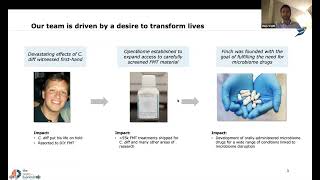
I want to thank the Brain Foundation for putting on this wonderful event. It's an opportunity to convene folks from both the autism research community and some of the families that we aspire to serve. So thank you so much, and thanks for including myself and Finch in this conversation. So, before I jump in, actually, my objectives today are, I want to be, with the time that we have, focus on first providing a little bit of a primer on the microbiome. What is this? John mentioned it as one of the emerging new modalities to potentially treat autism. It's a complex and very exciting sort of new organ system that we're just learning to drug. And so if you come away from John's talk with a point of view on diversification and patents, hopefully you'll come away from my talk with an understanding of the microbiome. And also would like to introduce you to Finch and to my own story and Finch's development in history, and then, you know, finally to introduce you to the work that we're doing in autism, some of the really exciting data that's been emerging from some of the academic investigators in this space, and our efforts to translate that into a scalable therapy that we hope can serve many in the future. So without further ado, I'll jump right in, and let me start off by providing a little bit of context on the microbiome. What is it, right? So, you know, we believe this is fundamental to our identity and many aspects of human biology and physiology. So, you know, we've co-evolved with this ecosystem of organisms that live on and inside us and in many ways define our character, right? So there are as many bacterial cells as there are human cells in your body and far more bacterial genes. So for every gene in the human genome, there are far more microbial genes. And in many ways, we outsource a lot of the heavy, complex biomechanical machinery to our microbial symbionts, these organisms that live inside of us. And what we've realized, for a long time, we didn't have the tools to actually understand this community, to understand how different behaviors of ours might shape this community. And over the last 10 to 20 years, by deploying high-throughput sequencing technologies to help us understand the microbiome, we've suddenly been able to understand and characterize the impacts of some of our behaviors. And what's interesting is, you know, we know that there are a number of recent changes to our interactions with the microbiome. So we've started, you know, deploying antibiotics on a massive scale. There are 42 billion doses of antibiotics that are used every year. And until recently, we didn't, you know, just go ahead and treat kids with antibiotics because, you know, and they have a very important role to play in, you know, treating active infections. But there's a, you know, we're just starting to realize now that there may be previously unappreciated consequences of that where, you know, early childhood exposure to antibiotics can significantly disrupt the microbiome, and that can have important impacts on development. And there's some interesting epidemiological data linking early childhood exposure to antibiotics and a number of other microbial factors to risk of developing autism later in life. There are changes in our diet that— and many of these impact not just feeding the host, but also feeding our microbiome. And if you can think about each of these microbes as sort of a factory that's producing bioactive compounds that can influence us in many ways. Well, if we change the inputs to those factories, we can eliminate some of those factories through antibiotics, and we can also change the inputs through changes in our diet, and those can have really significant effects as well on our host. And we've even changed the way that we're initially brought into this world, right? So, historically, humans are colonized by microbes, and we're just like we inherit the human part of our genome from our parents, we inherit our microbiome from our mother during birth. And if you were born by C-section, as I was, and about 30% of Americans are today, that disrupts that chain of transmission that enables the efficient colonization of infants at birth. And so there have been all these really significant changes to the microbiome. The question is, do they matter? What's the impact of all of these changes? And what's really interesting, and in some ways concerning, is we found that there are a wide range of diseases that emerge from disruption of these changes in the microbiome, ranging from response to certain forms of cancer therapy to autoimmune and inflammatory diseases, and we believe even conditions like autism. Really, our mission at Finch and what I've dedicated my career to is to develop tools to restore the microbiome and rebuild this community. And in so doing, we hope to really reverse the rising trend of a lot of these diseases, many of which were rare, infrequently observed 50 or 100 years ago before we sort of changed this relationship with microbiome. And so by restoring the composition of this microbial community, we aspire to really change the epidemiology of a lot of these diseases that we think are linked to the microbiome. And so there's some fascinating science, so much for us to learn. And as I'll describe in a few moments, we have a lot of humility about the challenges that lay ahead of us, but also a lot of optimism about the potential here. So So we see this as essentially a new organ system that we're just learning to drug now. So a little bit of context on the microbiome and what this is. Next, I'll just give you a little bit of context on myself and how I ended up in this space and how I ended up developing therapies to serve patients here. So actually my wife's cousin got C. diff. I was doing a PhD in microbiology at MIT and he got C. diff. And in many ways, I think his journey and my journey, I think, mirrors a lot of those that I hear when I talk to families of kids with autism, where at the time, there were maybe a dozen physicians in the world that were offering microbiota transplantation, or FMT, fecal microbiota transplantation, as a treatment for C. diff. And so he was a young guy, he was in his 30s. He got postoperative antibiotics. We don't have to go into all the biology of C. diff, but essentially emerges as an opportunistic pathogen that can make you sick after you take antibiotics for some other reason. And the treatments are sort of perversely or surprisingly are just more antibiotics. So the same tools that actually caused the disease in the first place.. And what we found is if you can restore the microbiome by essentially taking an intact community from a healthy donor, you can actually dramatically change the trajectory of these patients and just totally change their lives and deliver sustainable cures. So lasting prevention of recurrence of disease, whereas antibiotics often lead to recurrent disease. They can maybe treat the symptoms, But as soon as you go off antibiotics, many of these patients will end up getting sick again. So my wife's cousin was quite ill and he went on postoperative antibiotics, got C. diff afterwards, and he was treated over the course of a year and a half with 7 rounds of vancomycin, which is the most powerful antibiotic that we have today to treat C. difficile. And he was treated once and he failed, treated a second time and he failed. And I mean, it was really desperate. This is a really serious condition. It kills almost 30,000 people a year in the United States and is associated with crippling diarrhea. And in some cases, these patients have to get their colons removed. And so he was in a really difficult position and was desperately searching for an alternative. And actually, I met him, I was going home to Thanksgiving to meet her family for the first time. And I met him and he was like, hey, you know, can you tell me about fecal transplants? What do you know about this? And, you know, we spent time sort of discussing this, discussing some of the scientific literature, and ultimately because there weren't opportunities for him to get treated through the healthcare system, he did a procedure at home in his apartment in New York with a friend of his as his donor. And I looked on at this and said, how can this be the case that we have a treatment at this point? There was a study published in the New England Journal that was stopped early for benefit because they said, this is so efficacious, we can't continue to treat patients with standard of care. We have to give everyone access to treatment in the trial. So there's a lot of evidence that this might be effective here, but out in the real world, nobody had access. And this gets to the point John made around what you need to do to make these treatments available for patients. And so I walked and looked at this and was like, this is a really messed up problem. We have to do something about this. We can't have patients doing this in their homes. And so I started an organization called OpenBiome, which John mentioned in the introduction, with a mission, a simple mission of making this widely available to patients and clinicians so that there'd be a standardized— just like if you needed a unit of blood, you got in a car accident, you wouldn't have to go to your ask your friends and family to serve as donors. You would, you know, go in to, you know, get a unit of blood from the hospital, you get treated and go home. And my view is that it should be the same here. And, you know, I'm really thrilled with the progress that we made in enabling this therapy to be accessible to patients. And, you know, we had a sort of unique situation where the FDA, because of the unmet need, determined that they would make this available until there were approved products. And at the same time, they made it very clear that they wanted to see the robust clinical trials conducted to make sure that this is a really— could be a safe and effective therapy that would sort of build on this, the supportive early evidence. And so we started Finch with the objective of doing just that, of developing products that we could scale and ultimately develop to provide widespread access to this this new emerging treatment option. And so I thought it would be helpful to just provide a little bit of context on our journey and my own journey in many ways. And it has a lot of resonance, I think, with some of the challenges and the frustration of finding treatments that don't work and with trying to navigate a healthcare system that isn't always accommodating and supportive. And so I've certainly seen that in my work in serving the CF/SEAL community, and I've seen a lot of that again in the autism community. And look forward to providing new opportunities and new treatments that I hope can offer new solutions in the future as we continue to generate new data here. And so a little bit of context on kind of how we at Finch how we ended up working in the autism field and also just our general approach to development here. So, we believe that the microbiome is, again, fundamental to many aspects of human health, and it's incredibly complex, right? You've got this ecosystem of trillions of cells and millions of genes and thousands of different bacterial species, and to figure out which ones matter and how do you deliver them, it's very difficult. Our approach has been to really come at this with humility and say, "Okay, well, let's look at the clinical data." Trying to build some really sophisticated bottoms-up model of what's going on seems really daunting to us, but if we could work backwards from starting off with the answer and saying, "Okay, this is working for patients, and now we just have to figure out what about this treatment is working." With fecal transplantation, we can go in and basically Wholesale rewire someone's microbiome by delivering an entire community from a healthy donor, that really gives you this opportunity to start off with, okay, when you sort of do a reboot of the microbiome, what happens? Does it help somebody? And there are over 300 clinical trials right now asking exactly that question. So exploring new patient populations and really trying to understand what happens when you reset the microbiome. And so our approach has been, well, let's— not all of those are going to work. In fact, most of them are going to fail, but we can take advantage of of those that are successful and really then go and follow up on those promising early results and try to translate them into scalable therapies. And that's exactly what we've done. So, you know, we have a late-stage program in C. difficile building on a lot of that early promising clinical work. And we just completed a potentially pivotal study earlier this summer that we think can support registration for that product and enable it to be on the market to serve patients in the future, we hope. And so we're excited about our progress there. And we've developed a number of other programs that are in early stages of development based on promising data from these clinical studies, and autism is one of those. And so in the next couple slides, and in the interest of time, I'll kind of jump ahead a little bit and walk through some of the data that's really driven our efforts here in the product strategy. And so, you know, FINN-211, this product that we're developing to serve the autism community, it's really sort of an amalgam of two different product strategies. We're delivering this sort of entire intact community isolated from healthy donors. And we've also used a series of in vitro and preclinical models to identify a strain that we think is, you know, could be really additive and valuable, but it's not found in all donors. And so we said, we want to make sure that every patient has access to the strain. So we're going to add it in on top of this sort of diverse donor community. And that's really the sort of product design for the FIN211 program. And one of the things that we're excited about here is from some of the clinical data, which I'll walk through in just a moment, We've seen really promising outcomes in both some of the GI symptoms that some children with autism suffer from, as well as some of the behavioral measures. And so, our view is that this could be a really exciting new option to address both of those challenges. And from a, in terms of clinical development and mobilizing resources to advance this program, that one of the great features is because you have sort of multiple opportunities to show benefit, that also helps to reduce the risk of drug development in some ways because we have sort of two opportunities to win here. And so next, I'll walk you through some of the data, and some of this may be familiar to some of you, and for those who it's not, I'll try to provide a little bit of context on why do we believe the microbiome, What is it about bacteria in our gut that could possibly have an impact on a really complex condition like autism? And so, first, and maybe at a high level before I even walk into the data, we know that the microbiome, as I said, it's one of these factories that's just producing all kinds of biologically active compounds, and some of these are known to impact our behavior. Either modulate the production of, or in some cases, produce precursors for important neurotransmitters, right? So, things ranging from GABA to serotonin to oxytocin are all influenced by the microbiome. And so there's this early study that was completed about 20 years ago where they found that if they introduced vancomycin, a broad-spectrum antibiotic, they could see a transient benefit to individuals enrolled in the study. But when they pulled off the antibiotics, in many cases, the symptoms returned. And so there's sort of this transient benefit from vancomycin therapy. And what that was really suggestive of is perhaps, by sort of eliminated some of these microbes that may be producing deleterious metabolites, so metabolites that lead to challenging outcomes. But as soon as you take away the antibiotics, they come back. So what if you could sort of knock down those sort of bad bacteria and replace them with a new community? And so there have been a few preclinical studies that have supported this. So you can transfer some of the symptoms of autism in a preclinical model with all the caveats that come with a preclinical model of a really complex condition like autism. And you can actually correct some of these symptoms by transferring a microbiome from healthy individuals. And there are certain probiotics that can also have some beneficial effects in these preclinical studies. But the real exciting part here, and the part that has really motivated our own work and has gotten many and the field excited is some of the clinical data that's coming out, where you can go in with microbiota transplantation. And, you know, there are a number of studies that have shown, you know, benefits on both some of the behavioral outcomes as well as the GI outcomes here. And so we've really built our own work on that important foundation. And so I'll just walk you through one of these studies in a little bit more detail. And this was some of the seminal work in this space by, led by Jim Adams at Arizona State University. And in this study, they found, you know, after, you know, sort of an induction dose and daily dosing, they would, you know, look at both baseline characteristics, as well as, you know, these patients after they had been, you know, treated for a long period of time, sort of 2 months after therapy, and then 2 years after therapy. And they found a really significant improvement in GI symptoms, as well as on some of these behavioral scores where, you know, as John said, some of these kids, you know, were below the sort of diagnostic cutoff at the end of these studies. And these were importantly small open-label studies, and it's going to be incumbent on us to develop data in a placebo-controlled setting. But I think, you know, these are— we see these as really promising early observations that hint at some of the promise that lies ahead of us if we're able to effectively develop a therapy here. And another encouraging observation from this study is we think that many kids with autism suffer from severe GI symptoms, as I'm sure many of you know. And we think that there's seeing the severity of the significance of improvement in the GI symptoms actually correlated with this significance of improvement on some of the behavioral endpoints. And our view is that suggests that, you know, perhaps there's a common underlying etiology. So if you address one, you're actually kind of hitting both of these targets. And so, you know, we see that as a really exciting outcome from this study and again, you know, supported by similar results from a number of other studies. And so, you know, we've been trying to understand how this works, and we've aimed, you know, some efforts looking at preclinical models here. And I'll maybe just briefly walk through some of the results here where we found, you know, individual strain that's demonstrated the ability in murine models to both, you know, improve socialization time, reduce repetitive behaviors like ball burying,. And that was associated with a significant increase in the production of oxytocin. What was interesting is if you sever the vagal nerve, which is the nerve bundle that ties the enteric nervous system to the central nervous system, that actually eliminated that sort of rescue effect. And if you knocked out the oxytocin receptor, that also eliminated the rescue effect. And so we think this may— this is one mechanism which may be underlying some of the effects that we've observed before. And this is part of what's motivated our interest in ensuring that these strains that seem to be responsible for inducing oxytocin are included in every dose that we deliver. And so we're thrilled to be initiating a phase 1 study next year and very much look forward to continued development in this area. I think, you know, we're still very much in the early days, but the early signals that we've seen have been really encouraging for us. And so, you know, we're, as I said, sort of starting off here with, you know, mining these data. And we think that over time, this is going to help us identify, you know, new strains, new pathways, new targets that we can identify. And we see this as an iterative process where, you know, FIN211 is, you know, sort of our effort to, you know, move with urgency to make something available as quickly as possible. And there may be opportunities to to use data that we generate from this to improve future efforts here. So we've got a great team with a number of different disciplines that have been supporting this work. And again, really thrilled to be here and have the opportunity to share our work with all of you today. And I'll pause if there are any questions. And if not, I can hand it over to others to continue the dialogue. Thanks, Mark.
Very, very encouraging. I'm glad the community is getting to hear the story that I've been able to learn about, and it's just so exciting. And you did a great job of telling us the whole picture and what's to come. So I have a couple of questions that came up. One is, so how do you define what a full spectrum microbiota is? And then kind of related to that, what's the basis of selection of strains and amounts included in the RSM side of it?
Yeah, great questions. So on the sort of full spectrum component of the product, we have a flow cytometry assay. So it lets us identify without having to grow all of these bacteria, basically lets us identify which bacteria are viable and which ones are not. And that helps us ensure that we've delivered a consistent dose of viable organisms in every treatment that we release. That's one of the key techniques that we use to really understand what we think of as one of the key quality attributes of the product. And then on the RSM side, these defined compositions, so identifying individual strain that we can grow in pure culture so we don't have to isolate it from a donor. For that component of the product, we've used both a combination of preclinical results. So, we've looked at a number of different models of autism and identified a couple of mechanisms. I mentioned the work in oxytocin, but we've also been looking at barrier function and also some of the immunomodulatory effects of these treatments. And so we've used sort of a— taken a holistic view of a lot of those different mechanisms to identify compositions that we think could engage those key pathways. Wonderful.
There's another question here. Do you think your product is safe for patients with more serious IBD and autism? So I suspect they're talking about comorbidity, if you will.
Yeah. Yeah, it's a great question. One of the things that I think is really encouraging about this modality is actually the safety and tolerability data that we've seen. So, you know, I'll note that in a, you know, 200-patient placebo-controlled study in C. diff, you know, these are patients that are quite sick in many cases. You know, we saw no treatment-related SAEs. In fact, we saw more adverse events in the placebo arm than we did in the treatment arm, which, you know, we found really encouraging. And so, you know, there's also, in the specific case of inflammatory bowel disease, there have been a number of studies with FMT that have actually demonstrated some really promising efficacy there. So we see it as a potential, you know, a treatment opportunity in patients with ulcerative colitis and Crohn's disease as well. So, you know, we're always very cognizant of safety, particularly when working in a pediatric population. So we're going to move That's why we're moving in a measured way, starting off with some dose-finding work to ensure that as we continue through development, we continue to monitor safety closely. But I would say that the data that we've generated to date is encouraging that we may see similar results in this population as well.
More from Joshua







Scientist Stories: Hans Waterham, The value of phenotypic assays in peroxisomal disorders




Scientist Stories: Joel Zlotogora, Genetic carrier screening programs for reproductive purposes