Founder Stories: Martin Babler, Former CEO of Principia Biopharma
In this webinar, former Principia Biopharma CEO Martin Babler discusses the company’s origin, scientific platform, and business journey, then shares extensive lessons learned for building and scaling a biotech platform company. He explains how Jack Taunton’s discovery of reversible covalent bonds and Richard Miller’s vision led to the tailored covalency platform for safer covalent inhibitors, the early focus on BTK inhibitors, rapid clinical progress, and the financing strategy that raised $550 M while spending only $190 M before a $3.7 B acquisition by Sanofi. Babler then outlines 12 core themes for success: storytelling and benefit‑ladder framing; generating early proof‑of‑concept data; aligning therapies with patient needs; portfolio risk‑balancing across target categories; people‑first culture with empowerment, accountability, and a no‑asshole rule; rigorous hiring based on self‑knowledge and passion; building a blame‑free, empowered culture; board composition and alignment; investor selection and transparent communication; partnership strategy (avoiding low‑value pre‑clinical deals); disciplined decision‑making under uncertainty; and FDA‑focused data generation. He answers audience questions on patient insight, culture specifics, data avoidance, recruiting, and future endeavors. The talk provides a practical roadmap for founders and leaders of science‑driven biotech startups.
Chapters
Hey, so Martin, um, the company was founded by Jack Taunton, I think, and, uh, a co-founder. Um, I, I, uh, I remember Jack when I, I was applying to UCSF for grad school, and he was this, uh beatnik kind of guy, and I've talked to him a couple times since then. I didn't get into UCSF, but did you— you must have worked with him. He was probably a scientific advisor during your time, right?
Yeah, actually he's still to this day a scientific advisor to the company. So Jack, what happened is Richard Miller was trying to find a different way to make small molecules. And he got introduced by Jack by actually Principia, the person who ended up being Principia's employee number one. And so the two of them tried to get the company started. Um, and then, uh, in— that was in 2008 during the financial crisis, and that was really, really hard to get a platform company off the ground at that point in time. And then, uh, basically went back and forth, but ultimately in 2011 it came together, and then Jack remained an advisor to the company since, for the last 9 years basically.
The thing I remember about talking to Jack is just like he was doing this incredibly, what seemed to be abstract or disconnected from any application, the study of chemical bonding, and I just, I don't know how these, how does the idea to commercialize something occur or get brought to people like Jack?
So the way this actually happened is that Jack made a discovery in his lab. He and actually a postdoc of his, because they tried to make better covalent drugs and they made them more reactive and they couldn't find the— basically the drug and the protein bound together. And because they couldn't find it, most people would have said, oh, okay, it looks like this is a molecule that doesn't bind to the protein, but Jack was convinced that it did. So he actually ran experiments to find out what happened, and he found that not only are there covalent bonds, but they're actually reversible covalent bonds in nature. And he had created the reversible covalent bond. And then Richard Miller was trying to find a better way to make covalent molecules that will be safer. And the original stipulation from Jack was that because the protein and the molecules separate, that you would not get an allergic reaction like you get from other covalent inhibitors. So that was the premise, was you could make safer covalent inhibitors, and that's ultimately how they got together. And so you had all of a sudden an ability to make covalent inhibitors that did not have the allergic reactions like you get from to a penicillin or an aspirin, because the reaction comes from the fact that the protein gets chewed up and the one piece of the protein is still bound to the chemical entity. And that's actually what the body makes ultimately. That's the antigen that the body makes antibodies against. And so that's where the anaphylactic reaction or the allergic reaction comes from.
But the drug is—
Because the drug falls off. So when the protein gets denatured, our molecules basically come off. So the original premise was safer covalent inhibitors. That was the platform on which the company was founded. We found later that you can actually basically guide residence time, so you can figure out how, or you can basically modulate how long the protein binds the small molecule and when it releases it. So you can now regulate to a certain extent resonance time. So we could now use resonance time as an additional way to make more selective molecules and therefore safer molecules, not just from the allergic standpoint, but actually safer molecules from an overall standpoint, because we could now make molecules that were singularly selective for specific proteins. So you kind of get to the specificity of an antibody, but you get it in a pill.
That's really cool. Let's get started with the actual talk here now because it's about 4 or 5 minutes after the hour. So hi everybody and welcome to our webinar with Martin Babler, formerly CEO and President of Principia Biopharma. Now Principia Biopharma is in South San Francisco, but Martin right now is in Switzerland, so there's going to be a little bit of a lag once in a while. And we're very grateful that he's joining us even though it's virtually midnight where he is. Just a little bit of background, Principia was founded in 2008, and its main platform was based on tailored covalency, a platform technology for small molecules to optimize bonding, as we've just been chatting about, to increase the— maybe potency's not the right technical term, but, you know, increase the effect or minimize the side effects allergic reactions, specifically applied to immune-mediated disease, I guess, which you definitely wouldn't want to get extra anaphylactic reaction. And again, more specifically, inhibitors of BTK signaling. Martin joined Principia— I could be corrected at any point here, Martin— in 2011, following or during and following the Series C funding round and, and led the company, uh, through acquisition this past August by Sanofi for $3.7 billion. I don't get to say the word billion very much in these webinars, so I'm pretty happy about that. Um, Martin was previously CEO at Talema Therapeutics and had a— before that held several positions in sales and marketing at Genentech and Eli Lilly. Post Principia, he's moved on to a board position at Neolucan Therapeutics, based in Seattle. And I found on the web a press release where they were announcing how thrilled they were that Martin had joined the board. Just going to quote a little bit. Mr. Babler brings decades of experience in business and commercial development, marketing leadership in the biopharmaceutical industry. Since joining Principia, he's helped build and advance the company's team scientific platform and portfolio of therapeutic candidates for immune-related, immune-mediated diseases, and, and goes on to be even more enthusiastic. So I, I've had a look at your slide deck and it looks like an incredible bunch of lessons on leadership and, and specifically in taking platform technologies to market. So we're really looking forward to hearing about that. So we're gonna— Martin's gonna speak for about 30-35 minutes, and if you've got any questions that occur to you, please enter them in the Q&A field of your Zoom window. Over to you, Martin.
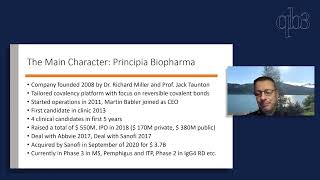
Thank you so much, Casper, and thanks for giving me the opportunity to talk to you a little bit about Principia. So I first want to just give everybody kind of a quick overview of who we were as a company, or who we are as a company, and then really want to share with you mostly insights. I felt like the most productive way to spent this hour is that I just share some key thoughts I had and insights that we had and lessons learned from the 10 years that we spent at Principia to take basically an idea that was found in Jack Taunton's lab and really figuring out how can you take that idea and create a business around it, but then also how can you do that in a way that you are not just ending up with one thing, but hopefully several different therapies, and you can actually show that the platform that we had is really viable and is something that could be developed even further in the industry. So the company was founded, as Casper just mentioned, by Dr. Richard Miller. He formerly was the CEO of Pharmacyclics, and Professor Jack Taunton from UCSF. And the idea really was this tailored covalency. We just talked about that a little bit. It was about the idea, can you make molecules that are covalent but ultimately are reversible so you wouldn't get anaphylaxis? It started operations in 2011. It's actually the Series A that we had in February of 2011, and I started with the company shortly thereafter. The reality is actually the company couldn't get founded until— or the Series A couldn't get closed until people actually knew who the CEO of the company was. And so that's how I ended up joining the company. We immediately at that point actually started to work on BTK inhibitors for those who who are familiar with the industry, Richard Miller was the person who really drove the development of ibrutinib or Imbruvica early on, and he wanted to make PTK inhibitors that would be safer and could potentially be used in autoimmune diseases. And ultimately that was the first target that we went after. We basically put that first target into the clinic in 2013. So it took us about 2.5 years from the start of the program to being fully in the clinic and trying out our first molecule based on this platform. Industry standard is about 4.2 years, so we did that quite fast, and I'll talk a little bit of what we believe might be the reasons for that. And we ultimately ended up putting 4 clinical candidates into patients or healthy volunteers in the first 5 years of the company. So that is quite productive. We had very little attrition I actually had a conversation recently with our former, with our CSO and now the site head for Principia, David Goldstein, because we never thought that we would have no attrition. And he said, I can never repeat that in my life. I hope he will continue to have this kind of success. But this was really quite a feat. In total as a company, we raised about $550 million. We originally raised about $170 million in private rounds, and I'll talk a little bit about that because I think it's really important to think about how that financing should work, especially when you have a platform company. And then we raised, uh, in an IPO, we raised about $140 million, another $240 million in the following financing. Interestingly, when you actually look at the parameters that make a company successful, it's really about how much value have you created with the money you have, and The reality is we actually did not spend a lot of that $550 million. When we sold the company to Sanofi, we actually gave them $367 million of those back. So that means we've basically only used about $190 million since inception until we sold the company. So every dollar that we raised in the follow-on or in the— even most of the money raised in the IPO, we actually never touched. And we did that because we had 2 deals. One was with AbbVie and one with Sanofi. And again, I think it's important to understand the difference in both deals. The AbbVie deal was a preclinical deal. I probably would never do that again. The Sanofi was a clinical deal, and that was extremely helpful for us as a company because they basically funded the last couple of years of operations of Principia. Ultimately, the molecule that we partner with Sanofi is so exciting for Sanofi, and they really felt that they wanted to own not just that molecule but the rest of the pipeline of Principia. And so in the summer, they approached us and said whether we would sell the company. And you can read in SEC filings, we went back and forth. We started certainly a lot lower but ended up selling the company for $3.7 billion to Sanofi. And so now the integration process is going on. And the key reason really for deciding to sell the company was that Sanofi had really a high interest to enlarge the opportunities for patients with our BTK inhibitors especially, but also with our other programs. And so Sanofi not only could develop the indications that we could afford as a smaller company, but can really go beyond that. And we hope that these products will ultimately be used in many hundreds of thousands, if not millions of patients across multiple indications in autoimmune disease because they are truly best-in-class molecules. So currently there are ongoing Phase 3s in multiple sclerosis, in pemphigus, and in immune thrombocytopenia. And the company just started IgG4-related disease Phase 2, and there's other Phase 2s ongoing and planned. So it's certainly an area that I'll be watching. We had a collaborative interaction with Sanofi all along, and certainly they promised us that they will take good care of the therapies that we created. So what are some of the key ingredients that led to our success? And so I really listed here what I believe are some of the most important things, and there I could run hundreds, write hundreds of pages probably of what some of the learnings are, but I really feel like these are some of the most critical things that I suggest that other people are in my same shoes or are in the same boat and trying to build a platform company or build a company, think about carefully. The first one is that this is, we're in the business of science and science is a business that is all about data. Reality, however, is that people do really not respond to data very well. They respond to stories. And so what I really want to encourage everybody to really think carefully about, how do I build a good story, especially around a platform? Because one of the issues is that the platform fundamentally doesn't matter. I know a lot of us have these platforms and we're so excited about it, but if it doesn't produce any therapies, It really doesn't matter. But at the same time, we want to create value for this platform. So how do I basically combine the story about the platform and the story about the molecules so that we develop, so that I can tell a good story and tell it right? So I'm going to talk a little bit about that. The second one is really that it's ultimately, it's all about the therapies, as I mentioned. And if it's all about the therapies, we have to make sure that the therapies that we create really support our story. The third, and for me, the by far the most important thing to pay a lot of attention to, is the people. In fact, most of platform companies at one point or another have to course correct. And so the science will always fail us one way or another, or the science will always challenge us. And the question is not whether you can overcome these scientific challenges. The question is how you're going to overcome these challenges. And the only resource that you have to really overcome these scientific challenges is actually the people that you work with in the company. And so I want to spend a little bit of time really talking about some of the key things that we felt were important that really made our company somewhat unique on how we function and why really the focus has to be on the people. And it's really hard, especially for many of us who come out of a scientific background, because we have to realize that the science matters, but the people actually matter more. The next one is all about culture, and I have a lot of convicts in Principia now because when we started the company, I said the culture is going to be so important that we have to pay a lot of attention to, and I'm personally committed to really not just have a culture on paper, but actually to have a lived culture. And so I want to talk about that a little bit because I think It is absolutely critical whether you're going to succeed, whether you're going to have momentum, and whether you're going to be very productive based on your culture. The next one is the board, and the board is really ultimately, if you're the CEO, the board is kind of who you report to, but at the same time you're actually in control of the board at least early on to figure out who should be that board, and they're advisors, so they have so many functions, but the most important thing about the board is that it has to be aligned.. I'll come back to that because I don't mean we have to have consensus on the board what we do, but we have to at least decide that we're all walking in the same direction. And so for all of us, making sure that throughout the organization that exists, but especially with the board. The next one is investors. That's the fuel of the business we're in. And so how do you make sure that you have investors that are supportive? How do you make sure that you have investors that stick with you because you are gonna have setbacks? And how do you have investors that are really, really happy about what you do because you're actually doing what they're paid to do, which is you make them money? And then I wanna talk a little bit about partnerships and collaborators because I think it's really important to understand that most small companies are under-resourced fundamentally. So how do you go about augmenting your own resources with people from the outside, and how do you do that in the best and most efficient manner? And last but not least, we do believe that a real big part of success of organizations is a very rigorous scientific and decision process. So you have to make sure that you're making the right decisions. You have to make sure that you understand how decisions can impact the entire organization. So let's dig in a little bit in these one by one, and I'm trying to really do that relatively fast so we can get to questions, but I'd happy to answer additional in-depth questions as we go along. So let's talk about the storytelling first. Ultimately, when you think about it, when you remember something, then, and you think about how you've been learning about something, it is all about storytelling. If you open a newspaper, if you go online and read basically a news story, It's all about the storytelling. And the funny thing is, is that the facts of the story are one element, but the reality is the facts are not really what drives your reaction to the story. The emotions are what drives the reaction to the story. If you open the newspaper today, almost every newspaper story starts with a specific person that is identified in that story. And what the journalist is trying to do is trying to relate you to that story. The reason why this is done is because we respond to emotions a lot more than we respond to facts. So as you think about how you're telling your story, you really have to become a good storyteller, and you have to realize that every word you say basically influences how your story is going to be perceived. The world is what you say it is, and especially when you have a big vision for a new scientific concept you are basically stating to the world that you're coming up with something very new and different. And so it's really important to understand how you tell that story. The other piece that I've learned, really, at Genentech, where I started to talk a lot to the scientists and why was there so much friction between the scientists and the commercial people, it turned out that there was really a misunderstanding. Because at the end of the day, the scientists were really focused about, we have to talk about the facts, we have to talk about the data, We have to talk about the features. But the reality is most of us don't really care about the data per se. What we care about is what advantages the concept that we have or the product that we have or the platform that we have provides us so we can make a better product. And then ultimately, what is the benefit of all of that? So I really recommend that you spend a little bit of time, especially if you become one of the storytellers of the company, that you start to really learn about this concept of what is called the benefit ladder, which is really what is the feature that we have, but how is that actually providing an advantage for us? And then what is the ultimate benefit that we get? Because if you have the most amazing platform and you find all kinds of really interesting data, but at the end of the day, the medicine that you create has no advantage over anything that is out there, it's useless. So you have to be able to describe that, what I call the benefit ladder. There's marketing books or things like that, and I know I'm, you know, I was a commercial person, so I had to spend a little bit more time with that. But what I ultimately had to help Genentech folks understand is that what the commercial people do is not twist the data or anything, but it's really about translating that data into a benefit. And the reality is, when you talk to investors, When you talk to thought leaders, when you talk to patients, when you talk to investigators, all these people are human. They all respond to the benefit a lot better than they respond to the feature. So the next one is really how to think about the evidence that will support our story. One of the hardest things for a lot of platform companies is that we are going out with this fanfare about the platform because we're raising money around the platform. But ultimately, we have to prove to the world that there's a real benefit to this. And so how can I create, as fast as I possibly can, proof of concept, not just for the molecule but for my platform? Am I really getting the benefit that I think I'm getting? Our commercial, uh, our telecure reality platform was all about finding molecules that should be safer, molecules that should be basically um, above in terms of safety over others are without losing efficacy. That was what our platform was all about. Well, one of the key challenges with that was that ultimately you couldn't show that until you were in the human, and you couldn't show that until you were in a human with a disease and could show that we have the similar efficacy but we have a better safety. Once we had that data, the story became a lot easier. So how, until you have Phase 2 data, are you going to explain to investors and investigators and thought leaders that you actually have a platform that is really going to make a difference. What animal data can you create to do that? And you might actually do an experiment that you don't necessarily need for the IND, but you need it to tell your story. So think very carefully about what data do I need to tell my story, to show that benefit, maybe in animals already. We don't inhibit as many targets. We have no off-target reaction here or there. What other things can I do that might be a hint or an inkling that there really is a benefit to this platform that I have? Or I found a target that nobody else could drug, I could drug it. Now I still have to show ultimately that I actually made a safe and efficacious drug. So what can I do early on? Because the proof is ultimately only going to be coming in phase 2, but I have to still make sure that people believe in my vision of my story that this platform will change something. One of the things I find really interesting, especially because when you're a scientist, you do your work and then you go and present it. And you basically tell people, you know, here's all my data and you lay it out for them and you either believe it or not. Here's all the support I have why my data is right. And you show experiments where you repeated the same thing 100 times. Reality is when you go and talk to the investigators, the investors, etc., etc., your data might not be relevant for them. What might be relevant is how is this going to help my patient or how am I going to make money. So listen very, very carefully and tailor your story to the audience that you talk to. Many presentations I get to see these days from early-stage companies have so much science and so much data in it because we're all in this, coming from this world where that's how you got your point across. You basically stood up on stage and somebody, um, you gave your presentation and then people started shooting at you. And if you still were standing after all the questions where you were bombarded with, then your hypothesis must have been right. That is not what this business is about. This is about bringing people to the place where you're going to bring them. And the only way you can do that is listen carefully what their objections are, listen very carefully what they want to hear, and really modify how you talk to them about that. So that's a really, really important skill that one must learn somehow along the way, which is not taught necessarily to us in the scientific education. And this really brings me to the last question, which is make sure that you're thinking about all these questions that might come up. And if you don't know it, Say, "I don't know. I'll get back to you with the answer." But really be prepared because at the end of the day, all these questions fundamentally are objections in the sales process. So the next thing I want to talk about is really the therapies. We're in a business where what we're actually doing and the only thing that really matters is can we create therapies for patients that will change the patient's lives and do Do we have therapies that are interesting enough for patients and physicians to change their behavior? Most patients today are on some kind of therapy. So there is an inertia to really move them and change their behavior. So as we go along, we have to really be very careful how we develop these therapies. The first thing we have to do is figure out how do they support our story. And I already talked about this a little bit. How does this support the platform? But the second thing that is really important, especially for scientists to understand, is that you actually have to start with the end in mind. One of the biggest changes that we made at Genentech when we started to develop drugs with more of a commercial focus is we started to really have the conversation where the commercial folks were not coming to represent, I need this pill size or whatever, but they came to represent, here is, if you go into this disease, Here's how patients feel today. Here's what they sense today. Here's what they get today. Here's what their issues are today. So the scientists would start to understand, oh, in that case, I have to think about it this way or that way. Again, one of the challenges if you're a scientist is that we all start in science with a hypothesis. Then we basically prove that hypothesis and we get a result, and it's either valid or it's not valid. Once it's valid, we move on to the next hypothesis. So we're taking one step at a time. Time and we're going where the data takes us. The reality is if we develop a product, we actually can't just go where the data takes us. We have to think about how can I along the way modify the questions I ask so I have the answers to the questions that the patients or the physicians or the payer are asking. So really think about what do they want, what are they looking for, and can my product deliver that.
60%—
or actually, based on the latest McKinsey data, 66%. So two-thirds of all drug launches fail. They do not hit the target revenues that people thought they would hit, and it's mostly because they were developed without the patient, the prescriber, or the payer in mind, and they had some flaws that did not convince those people that they really need to make a switch.. And so thinking about that is really important. And again, also how does that, does that for the platform. The other thing to really think carefully about is therapies as we have a platform is risk mitigation. One of the challenges with some platform companies is that we're starting with a platform risk, we add basically a target risk, and then we add the development risk on top of that because the disease we're going after has no validated endpoint. So you have basically a triple threat. So as you create your portfolio and as you think about how many of these programs am I developing, one of the things we did at Principia, we basically created 4 groups. The first group was, can we make a better mousetrap? Can we make a better molecule against a specific target because the one that's out there has a lot of side effects or is not very efficacious? But it's basically going after the same target. The second one is there's a target that is used maybe in oncology, like BTK inhibition. But the drugs that are used in oncology are so unsafe that you cannot take them into autoimmune disease. That's what we did with, with BTK. So we took a target that was validated, we knew it did something, but the molecules that were out there were not safe enough. So we started to make really safe BTK inhibitors that now can be used in diseases where even some of the other BTK inhibitors cannot be used. Our BTK inhibitor that is in ITP, rilzobrutinib, basically cannot be— it's the only BTK inhibitor today that can be used there because it's the only one that doesn't have bruising and bleeding. So because it doesn't have platelet aggregation effect. So the next group were the targets where the target is kind of validated but they're not druggable, so there's no drug against it. And then this fourth category was basically drugs or were targets that we don't even know what they do today. And so you actually first have to make two molecules, you have to figure out what is this target actually doing. And once you understand that, then you can make a molecule against it. So we decided that we have to really have a balanced portfolio between those 4 groups. And it was really important that we realized some of them really carry a lot of target risk, but some of them don't carry any target risk, but they carry a lot of development risk or maybe platform risk, etc. So it was really about finding that right balance in the portfolio. One lesson from a commercial guy is that strategy is to decide what you're not going to do. And especially when you have a platform like ours that could go after hundreds and hundreds of targets, the most important thing is actually not to decide what you're going to do, but what you're not going to do. How far do we take this? When do we stop it? What is the experiment that tells us that this is not worth a path pursuing? Principia actually validated our platform against 7 targets. One of them is public information, is the JAK3 target. We were the first company to make a JAK3 inhibitor that was really, really selective, but then we ran the biology and we found out that it actually did not do what all the people in the literature said. So we basically said, we said, if it does this, we're going forward, but if it doesn't do this, we're going to stop. So we stopped. And it saved us a lot of headache and a lot of money spent against something that we felt could not have certainly go on. Focus on patient need. We all talk about it, but if you pursue that truly, you will ultimately be successful. And then remember, there's only 4 strategic variables: risk, time, cost, and reward. So let me talk a little bit about the people. They are the most important thing. And when I say that, I really, really, really mean it. And a lot of people say it, but a lot of people do not behave that way. First and foremost rule for me is never compromise, never settle. You might have an empty position, you might think, oh, I just need a warm body in there to do the work. Do not do that. Do not hire that person. Find the person that you need. At Principia, we had a no asshole rule. It was actually in our corporate handbook. And if you were an asshole, you basically got first told by your manager, then you got told by me, and it still didn't change. You were let go. We have let go several people at Principia because they were assholes. You know who these people are. I have not found a better expression. I'm sorry I'm using this word, but the reality is we all know who they are and they are toxic for the organization. One of the things we found is that it's a group of people that are not quite 100% sure what they really love to do. And when they really find what they love to do and they really are passionate about what they do, all of a sudden things change. Change. So we've tried to either identify those people or we try to help people get to that point. But for us, this was really, really important because it made the organization extremely productive because we were not bogged down by somebody who would always be disruptive and really make people spend time thinking about them or their behavior or whatever instead of thinking about the work. People are most productive as their authentic self, and what I just said about the assholes is something that we did with everybody. We hired people who really were very passionate about what they did and really understood what their big passion was. And then we hired them and put them in this position. And we even did that, that when I hired you as the head of HR and you were very passionate about employee relations, but not passionate about compensation, then we said, then hire somebody who is passionate about compensation. There's always ways to find people in your organization that you can complement people for what they don't like to do with, and really make them focus on what they like to do. And that makes the most productive organization. And I think if you think about Principia, we were 35 people putting 4 compounds into clinic. We were 60 people running Phase 3s and Phase 2s. And ultimately the company ended up 150 people with 4 Phase 3s running with Sanofi in collaboration, of course. But then ultimately now it's 5 Phase 3s and several Phase 2s. And it's a small organization, but it's because It was set up in that way. And take care of people. If people really take care, feel taken care of, they will take care of business. A lot of that plays into the culture, and I am a firm believer that a strong culture makes all the difference, how productive you are and how much momentum you have. Every company has a culture. It's just a question, are you explicit about it or not? And if you're explicit about it, you have to live with it. You have to stick with it and you have to fight for it. Don't write it on a wall and then live with something totally different. It starts with the leader at the top. You are setting the tone and everybody in your environment, in your executive team sets the tone as well. So really be very, very careful. And for me, this was a really important piece. I always watched in the organization, if I saw behavior that was not based on our culture, I would call people out. It has to be done. If people see somebody not behaving according to the rules that we had all established and there's no consequences, this becomes absolutely useless. So really stick to that. And one of the roles of the CEO for me is that you really watch the people and you look and listen very carefully in the organization for these things. The most basic human need is connection. And so if you have a highly connected an integrated organization, you get a lot done. We basically had nobody that checked on the job of somebody else because we gave everybody the job they truly loved and they just went and did it. We basically let them loose and they went and fly. But the most important thing here is that everybody still felt very connected, but they never felt looked over the shoulder or anything like that. And then you have to have these safeguard mechanisms. We had a culture team that was across all the departments, across all levels of the organization. They met and they basically came together and said, do we have an issue? Do we have something here that is not working? And that culture team, they were the ambassadors and they were the stewards of the culture. And it really helped identify issues that we had in our culture. Let's talk about the board a little bit, and I want to make sure I leave enough time for questions. The board ultimately is your supervisor, it's your advisor, but you're also the person who creates it. There's nothing that prevents you from before you have your Series A to already put a board together to have as many independents as possible. And I really believe that the more independent your board is, the better off you are. And the reason for that is I'll talk a little bit about in the investor section, but the reality is when you have a lot of investors on the board, their funds ultimately will have a different purpose for this company than you have, just by the nature of their fund. If their fund is old, they need to get out. If their fund has not had an exit and there's a chance to have one, they wanna have an exit, et cetera, et cetera. There is always going to be divergence amongst investors. Independent directors are independent, and therefore they actually can think about what's best for the company, and there's a lot less of that, what is good for my fund? Coming into the mix. So try to make sure that you build a board that you're really happy with, that you really feel that these are people that I can trust, that I can believe in, and they give me really great advice. And don't think that you have to just have a board that is full of investors. They can be very, very helpful, but if they're starting to have a lot of divergence, it can also be really, really hard for a CEO or for a management team to manage the board. I always basically tell everybody that my number one thing is alignment. Alignment means not consensus. It means that we're just having an agreement, we're going in the same direction, but then I might not agree with you 100% that this is the right direction, but I'm going to stand behind it. And that's not a static situation, that's a dynamic situation. So you constantly have to make sure that you still align with your board board, you know, that you have to make sure that you have conversations with board members individually, you have to make sure that that same alignment goes not just to the board but goes to your management team, ultimately the entire company has to be aligned, but that alignment with the board is really, really important. You run the company, the board are experts, do not expect the board to tell you what to do, you decide what to do and then you tell the board this is what I'm going to do, and then they have the chance to say we agree or we don't agree, and if we If you don't agree, then you have to figure out how you come up with a better plan that they will agree with. This is really, really important because especially relatively junior CEOs, I did the same mistake at first. I thought maybe I should ask them what they think. No, you are telling them what you're doing, they respond to that. And take a stand. There's nobody understands the business better than the management team. And the board wants to be helpful, but sometimes they have a previous experience that really influences where they're coming from. So you have to take a stand. At one point at Principia, we had a discussion whether we could still afford a research organization. And so board members said, maybe we should think about not having a research organization because we should channel our money and our dollars towards development. And I said, okay, that's great, but that's a company I will not run. If you're doing that, if you're deciding that, then I will leave with the research organization. We're going to reassemble in the parking lot, we're going to start a new company. Company right away. I had to take a stand. I was not willing, I was willing to do all kinds of crazy things, but I was not willing to let the research organization go. You have sometimes to take a stand, and it might be hard because it might even put your job on the line, but the reality is that is so important and critical in the collaboration with the board. Again, I talked about the best interest of the company, so I don't repeat that, but the last piece I really want to mention is whether it's the board or on the next page is investors. No surprises. And the way you avoid surprises is that even if you know there is something that is risky and could come up, let everybody know ahead of time. But the one thing that board members don't like is surprises. So let's talk briefly about the investors. One of the most important things about being a private company is that the investors cannot work with, vote with their feet. You are are married to these investors as long as you're a private company. There's not a big market to sell private equity. And so therefore, you really want to be very careful who you select as your investor. There's fundamentally every investor is good for a certain type of company, but you need to find the investor that is great for your company because otherwise you're just going to get headache. We had some people in Principia that really were at different stage in their lifecycle of their fund than than we needed them to be as a company, and we had to deal with that. And that ultimately influenced very much where we are. A lot of us go out there the first time to raise money, and a lot of us basically struggle because, well, I found somebody willing to give me money, so let me just take that money. Be very thoughtful because it could basically be money that makes your company a success, or it could be money that ultimately really prevents your company from being successful. So be very, very thoughtful about that. Especially as a private company. Once you're public, if they don't like where you're going, they're gonna walk away, they're gonna sell your stock. If they like what you're doing, then they'll buy your stock. So that's a very different situation. Realize that ultimately the only thing that keeps somebody in your company as an investor is trust in you and your team. And so it's really, really important that you build relationships with investors, that you basically tell them, this is what I'm going to do, then do it and then tell them this is what I did. And it's that cycle that is really important. If you plan to IPO your company, you want to start 18 to 24 months before your IPO to actually meet with these public investors because you want to have gone through one or two cycles where you tell them this is what we are going to do, then you come back and say this is what we did and we did what we said we're going to do. And do that once or twice because then they start to trust you. They believe that you know what you're doing They believe that you know how to set the right targets for the company, because again, they don't like surprises. Don't overhype, especially when you have a platform. A lot of platform companies' first presentations look well, they all say we can do this faster, we can do this better, we can do this whatever. But the reality is the platform is not developing drugs. The platform helps you develop drugs. So be very careful, especially with a platform company, not to overhype the promise of platform. Because if you have a great platform that basically throws out really good data, how to make great drugs, but you have a lousy development or discovery organization and you can't make drugs with that data, then you're toast. So don't overhype. Really think about what is it. Is it a tool that gets me to a great end, or is it actually the end in itself? And if there is something like that to sell, that's great, but be very careful on how you talk about it. The next one is, this and the next one basically are also about just the truth. We're all gonna have setbacks and do not try to hide anything. The truth will always come out. Take accountability, no excuses. This is what we tried to do, this is what happened, sorry, I screwed up. And this is so worth so much more than just trying to do something else. You can go now, even in the year 2020 after Many people should have learned this lesson. There were, this year, were several examples where companies basically tried to say, well, it's really this, or it's really that, and it all blows up in everybody's face. Just be truthful. It's the best medicine. And we talked about the building relationships with the public company. And then the last one is really the rigorous science and decisions. Realize that when you're a young company, The only important customer is the FDA. The only important customer is the FDA. We never ever think about this until it's too late. So really, really just put that in your head. Everything you do early on basically is going to the FDA. And where this is really important is never create any data that you don't want, that you cannot interpret, because ultimately the FDA will ask you to interpret that data. Many companies make that mistake. And then basically had to do a lot of things to fix that. We did one of those at Principia. It took a lot of effort to get out of that. It's really— it's a lesson that I thought I had learned before. We made the mistake still. Really think about the FDA as one of— as your most important customer until you're somewhere in clinical development. And really also make sure that when you present data, it's not like you present them at the scientific meeting, but really, how would you present that to the FDA? How you present that to a review board at a big pharma company? Because the reality is, even as a small company, you can actually create data that really impresses the big pharmas. We didn't have a lot of data, but the way that the quality of data and the way we presented it was exactly like folks at big pharma wanted to see them. And so when we had business development discussions, they always were very, very pleased because they're like, wow, this is basically the amount of rigor, the amount of quality that we would have internally. So it was a lot easier for them to bring it back. If it's just a patchwork, if it's basically, you know, we did a little bit of this and it's a combination of several things, it's not going to fly. So really apply that same rigor that they would apply at their organization for your organization. But understand that you're not going to generate 3 duplicates of some model or whatever. You're just going to do one and with as few animals as you can, but you can still be rigorous about it. And then the last point I just want to make is really about governance. We basically start our organizations, they grow naturally, and all of a sudden we have this function in the organization. So think about governance. How do I structure this? The best. One of the most important things that we found is really that we have to separate the meetings where we discuss portfolio and scientific decisions and where we discuss operational things. And once we separate that and really have two very separate conversations, actually both can be addressed in a very different way and are actually a lot more professional at how we were able to address it. There's a lesson that actually I learned from a basketball coach, and that is that there's two kinds of decisions. There's the— you can make the right decision, or you can make a decision to make it right. In our business, this is really hard because as scientists, we're all trained to make the right decision. If we don't have data, we're just going to generate more data, and we're doing another experiment until we are 100% sure. In the business of biotechnology, most decisions are decisions that you need to make, and then you need to make them right.. And most of those decisions you need to make with maybe 30, 40% certainty on data, maybe 60% if you're lucky. But you're never gonna go back to those decisions that you made as a scientist where you had 100%, and if you weren't there, you actually ran the experiment again, or you tried a different experiment to prove your hypothesis. It's just not possible. So we all have to make that transition and really, really learn and get comfortable with that. And when I see people basically in, in, in Principia and even in Genentech that grew from the science side into a more leadership role, one of the hardest pieces was to help them feel more comfortable with that. Because the worst thing you can do is actually not make a decision because you're hoping that there's more information coming. So be explicit about this is a decision we need to make today, we don't have all the information, and then you just have to take a step.
Stand.
So those were some of the thoughts I had that I thought I'd share with you. You know, this is a little bit of laundry list, and some of it is for some of you probably absolute mother type, but the reality is for what we saw Principia when we really focused on those things, those are the things that I believe really helped us get a lot of momentum, get a lot of drive, and ultimately ended up creating a company that out of $180 million created $3.7 billion for our investors. So with that, I'm happy to answer any questions that you might have.
Thanks for a really great talk, Martin. You've just— the lessons— I told you we were interested in lessons learned, and you gave us like 50 slides of lessons learned. So I would like to encourage people to enter questions in the Q&A field. I have one. Of the many things that you highlighted as being important, one was to make sure that you're meeting patient needs with your platform, your therapeutics. How do you go about finding those patient needs, especially when you, for example, come in as the CEO later on? How do you find those patient needs and make sure that you're actually meeting them?
Yeah, so for me, one of the most important things when we started a new therapeutic area was to really go and talk to the patients. And, you know, I can give you the example. We had a lot of discussions about pemphigus and how should we think about pemphigus. And when you look at our program in Phase 2 for the pemphigus study, we talked to a lot of patients, and one of the most And you have to really listen and observe carefully. One of the most fascinating things for me is I saw two patients meeting for the first time at a patient, a pemphigus patient meeting. Pemphigus is a blistering disease of your skin. The glue that holds your skin together basically is broken. And so you get these blisters and your skin literally starts to delaminate. These people today basically are on steroid doses of 80 to 100 milligrams 60 to 120 milligrams. That's huge amounts of steroids, and, and you get all the side effects of the steroids with that. So when we actually got to meet the patients for the first time at an organization meeting, I saw two people that have pemphigus introduce each other, and the conversation went, hi, my name is X, hi, my name is X, nice to meet you, how long have you had the disease? And then the next discussion for the next 5 minutes was all about the side effects of the steroids. It wasn't about the efficacy of the therapies that they had. It wasn't about the latest and greatest. It was all about, are you diabetic now because of steroids? How much weight have you gained? Do you have mood swings? It was all about that. We also learned from them that the most important thing for them was not to get relief necessarily from the disease, but to be totally cured. One patient described to me that the that when I have an outbreak of my pemphigus, the only comfortable way to be is to stand in the middle of the room without any basically clothes touching my body and have a fan blowing on me. So you know that for them, these basically wounds are very painful. So we created our entire program for the phase 2 answered the 4 key questions for the patients. It was, how fast does it— is the onset so that I can get some relief? But more importantly, how fast will I have clear skin and I don't have any residual disease? Because even if I have residual disease, it's like having a burn on my skin. How little steroids can you use with this therapy? And then, can I get an oral therapy without having the side effects of all the other immunomodulators? Because Everything else I'm taking basically has a whole bunch of side effects. And that's basically— those were the questions that were most important to them, and those were the questions we answered in our Phase 2. So then you basically have already created your product profile. So go talk to patients. It doesn't cost anything. This is one of the things I found that, you know, we're sometimes so entrenched in our science, we forget to go out and actually talk to the people that we're ultimately going to serve.
A lot of audience questions now. Are you able to stay past the hour, or do you need to go to bed? If people can, I can. OK, great. So yeah, we've got about 9 questions, just so you know. A question from Anil Bhushan. Why will you not do a preclinical deal like you did for AbbVie? Back at the start, you said that you didn't like doing that preclinical deal?
Really a good question. And especially as a platform company, one of the biggest issues is that when you do a preclinical deal, you actually do not get a lot of value for what you have. And on top of that, your way to think about a molecule and get it into the clinic is going to be slightly different than a larger pharma. Most large pharmas have very prescribed ways to get a molecule into the clinic. And it requires to meet certain criteria and certain standards. It has to work in so many animal models. It has to have X, Y, and Z. And so all of a sudden, the preclinical folks, whether it's the chemists, especially for a chemistry platform like we have, they think they can make a better mousetrap. The biologist and the pharmacologist, they want certain models that it needs to fulfill, and there's a whole battery of them. And then the, the toxin preclinical safety people, etc., they will look at and they find something they might have found in a molecule 10 years ago, and all of a sudden this becomes a big issue when it might not be an issue that you have. So the best way to describe it to you is that it particularly on average to get from the idea into the clinic for the 4 molecules we put into the clinic was 2.5 years. Industry standard is 4.2 years. We gave our immunoproteasome program to AbbVie in 2017. And basically we were kind of a little bit advanced in 2019, but not much because all they spent the time on is basically fulfilling the checklist of what they need to do to get something into the clinic. If we did not partner this molecule, that molecule would be in the clinic today. It's likely going to be in the clinic now, a year from now or whatever. So it will be 5 years from the idea to go into the clinic. And the value you get is just not there. We had other term sheets and I just started to talk recently to somebody who basically said, we had these term sheets and this is actually something that's really important to talk to investors about is that you're going to take this to the clinic because you're going to get so much more money and so much more return on your investment in the clinic with a phase 1 molecule than you get with a preclinical candidate. Because in the preclinical candidate, what the large organizations pay you for fundamentally is your platform. And they play for basically the— it's like you are a CRO and you're doing— that's what you get paid for. And it actually doesn't cost that much to take it into the clinic compared to what you're ultimately going to get back. And I had a conversation with some of our investors and they asked me what the lessons learned were. And I basically said the one thing I'm never going to do again is a preclinical deal if I can avoid it, because I'm not getting the value and I'm going to lose time. And if there was something that doesn't fit the standard model, I might actually even get a molecule that gets rejected because it can't do something. We had one situation where we talked to somebody and they said, well, we want this kind of model. And we'd be like, well, it's not conducive for this pathway in this molecule. Well, then we can't do a deal because we have to have that for our thing. So it didn't even fit their prescribed kind of thing. So that's why people are very different and especially the risk-averse folks are very different when you actually have a candidate at the clinic and you might even have and preliminary data of some sort.
Great, thanks. Very insightful. So let's see, still got about 8 questions here. Ying Yang asks 3 questions in one, but I'm going to focus on this one. First of all, he says, thank you for such an inspiring talk. What is the culture of Principia and why did you shape it that way? You did speak about culture a lot in general terms, but not much specific.
So what we decided very early on in our first meeting was just the first 10, 12 people in the room, the word empowerment came up right away. And it was all about if we want to succeed with all the things we can do, the only way we can do this is if everybody is empowered to do their thing, and there's no people having to check the work of others. So empowerment became really critical. But then along the way we actually learned a couple of things. The first one is that some people can't— well, let me start here. The first one was that empowerment does not come without accountability. So if you say empowerment is our key value, you have to tell people, and that comes with accountability. So I'm going to empower you and I'm going to tell you, you love to do this, go do it, but deliver on time and on budget. And so empowerment and accountability became the two critical things. Then we learned a couple more lessons. The first one was that there are people who want empowerment really badly, but they're so afraid of the accountability they can actually not handle it. And those are not a great fit for our culture. And so we had to basically tell a couple of people, look, we'd love to have you, but the reality is you're not a good fit for our culture because we can't have somebody to have to take your accountability because that means we have to have somebody watch you do your work and control your work, and we can't afford that. The next thing we found is that if you basically have accountability and empowerment, you cannot have blame. And that became a really, really important thing because the moment somebody gets blamed, this all falls apart because then nobody wants to take accountability anymore and nobody wants to be empowered anymore. And so we had to make sure that we became kind of a blame-free environment. And that's not easy to do because we're living in a country where you can sue McDonald's for spilling their coffee on you. So we're all living in this blameful world, and we have to be a blame-free kind of zone in that world. That meant a lot of discussion with people, but it also meant making it very clear to people that you can't do this here. And so we basically created some language around it. One of the things that we had, one person who was particularly good about it,. And we basically said if they ever do it again, we can just all say ouch in the meeting. So we basically all would say if something would happen, the blame would come, we all said ouch. And that person realized, oops, I did it again. And at the same time, basically it became something that was really freeing for everybody else. We also had to make sure that people really, that I personally spent very little time ever to think about, okay, what happened back there that we're here today. My sentence always was, okay, we're here today, what are we going to do about it? Is there something we can learn back there? But other than that, I don't want to know anything. I don't want to know who did this or how this decision came about. All I need to do is I need to be present in the future. And I had to do that and my senior leadership had to do that. And then the last one that was really important was what we called instinct. Which is, and this was by the way the hardest and we're still not there, which is when you have people growing up in an organization, they basically are empowered to make these decisions. But sometimes they make decisions that actually affect a bigger circle of people. That can be just your team, this can be your lab mate, this could be an entire division, or this could be an entire company. So you have to really train people how to best go about having that instinct that when you, that how do I learn that this actually really requires a broader audience and I have to make sure I align my decision with a whole bunch of people. So when you had all that and then we added speed to it, because as a small company, that's the only advantage you have over large companies, if we had the scientific rigor and then we had the respect and, That's where the asshole rule came in. So it was a culture that was very empowered. It was a culture that had very little blame. So it was very productive because people interacted a lot with each other. And then, you know, we felt everybody brings something great to the table. And so that built an environment where people just loved to come to work because everybody loved what they did and worked really well together. And you never had to watch your back. And I think that for us was what made it ultimately so productive. And that's why when you talk to people at Principia today that came to the company and said, look, culture is really important, they're like, yeah, yeah, whatever. You know, it's something that is on the wall. I'm like, we have no culture things written anywhere on any wall in the company. Because I said, if you have to write it down, we're not living it. And so that's ultimately what the key element of the culture was.
Great, thank you. A question from Saul Cato: Can you give specific examples about the kind of data you mentioned to avoid collecting that complicates the FDA process?
Yeah, so one of the most important things is, especially when you think about safety and, and toxicology and things like that, let me give you an example that is, is an industry-known example. Um, uh, everybody knows Prilosec. It's currently OTC, but there, there was some data collected somewhere early in the Prilosec life cycle that showed in some dogs that there was some toxicity, um, that was cancerous. And when the drug launched, it was a real hard part because it had a black box in it about that. And so the company, um, AstraZeneca or Astra Merck at the time in the US, had to spend a whole ton of time to really deal with that issue. So sometimes you basically might have a finding and they're like, you know what, I want to better understand this, let me go dig in a little bit. When you do that, the most important thing is that the experiment you run is interpretable because the biggest mistake that people make is they might actually check something that ultimately they don't know what it means. Yes, there is a way to check whether this is real. This phenomenon that I see, actually, can I run another experiment repeat that phenomenon. But unless you know, when I have the data, this is how I'm going to interpret it, creates these runarounds. Because then that data has to be submitted to the agency. The agency can say, what's this all about? And if you can't say, well, I ran this assay and they basically produced this image, and we know it's there, but what it really means physiologically, and this is species-specific, and is it all these Those are all things. So stick to a real tight standard program and don't go look where you— you should always go look if you have a finding, but don't do experiments that ultimately you don't know what to do with the data. That is one of the biggest challenges. We've all done it, but sometimes we say, oh, that's a good experiment to understand, but then you forget about— but wait a second, if the information comes out this way or that way, so think about very carefully what are you going to do with the data when you have it. And if it doesn't come out the way you think it should, what are you going to do with it?
Question from Lee Sun about that, making sure you get the right people. How do you balance the effort involved in recruiting the right people with the time pressure to hire somebody to do the job?
You need something done. I was the leader, so I could basically say, we're not hiring until we find the right person. And we ran the experiment twice, and we failed twice. Because we had positions where we just said, look, let's just get somebody in. And I basically said, you know, I'll let it happen because we have to learn and other people have to learn. And at the end, we all got together and said, nope, it didn't work. It's just, it's really hard. What I found though, it is actually, the issue is not necessarily that. The issue is that when you grow in your career and you become more senior and you become a manager, you have to understand that you now actually have to have a different time management system. And your time management system, if you have a group of X, has to include Y amount of time that is fully dedicated to the people. I asked some people who struggled with that to just take an hour every day and put it on your calendar, that is for the hiring process. Because what I found is it was not the issue of, of I need somebody there and I have the pressure, but it was more about how much time does it actually take and what efforts and things, systems are we putting in place to help people find these candidates. And how good a salesperson am I going to be to actually convince people? We have one particular employee who basically became an expert at cruising through all kinds of LinkedIn profiles and really start to figure out, and then he would just approach people randomly. And it took him a couple of approaches, but sometimes he found really, really amazing people that way. It was a time effort, but over time you got a lot better at it. So it's what works best for me to basically get candidates, but it was more about time management and how much time do I allocate to this than it was about the pressure of I need to have this position filled.
A question from Parajat Bhatnagar, possibly a slight misunderstanding here. Do you suggest working in a startup before starting your own at the scale you did? So you didn't. Start Principia, but do you have insight into what it takes to move into that kind of management position that, that you did, you know, CEO during Series C? Would some startup experience be good?
How do you get that? I'm gonna say this, so I was there at Series A, not Series C, so, so we had nothing when I got there. Okay, the company was like a month old, so just to be clear so people are not confused, but But for me, actually, it's a different question. The question is not about the startup or not. For me, it's about how well am I prepared for the role. And the one thing, especially because a lot of us start as scientists, and if you think back at your entire scientific education, you basically never have any training about the people. And when you actually look at the company, the most important thing that you do is going to be about the people.. And so I recommend to everybody that does this that, that it goes back to some of the lessons learned here, is that the 2 or 3 things you need to learn, and you can learn that in many different ways, is that you have to be able to step away from being a pure scientist. And that means you have to realize that you have to build that second vessel, that is the people vessel, besides your technical knowledge. The technical expertise got us all really far in our career, But it basically only gets us so far, and eventually that technical expertise basically fails us because it remains our focus when we actually need to shift the focus to the people. So there are 3 things that, that we did at Principia to help people really grow beyond that. One was that we helped them build the people skills, and I just recommend before you do a startup that you learn something about the people skills. The second one is that people really understand how to think about it from the end in mind and really understand how to tell the story and really are better at, instead of telling us, giving a scientific presentation, really how do I tell the story. And then the third one was a really important one that we found, especially when people were like director level and wanted to get beyond that and want to be become great leaders is that you have to stop looking at the world from the inside out. Because when you're a technical expert, you look from your area and you look outside. And you have to start to look from the outside in. And you have to see how all the pieces fit together. And so wherever you can get this experience of people skills, of really being able to tell a story and looking at the world from the outside in, That, as long as you can get that somewhere, even if you start the company already, if you do that because you're on a, you're doing something totally different on the side, you're on a board somewhere or whatever, if you can get that, you don't have to go to a startup to start a startup, but you have to develop these skills. Because at the end of the day, if the startup is what you're super passionate about and what you love to do, you're gonna succeed. Because that is the most important thing. This is why Steve Jobs or others like that succeeded, and basically Bill Gates, is because they were so passionate about what they did. They didn't have all the knowledge, but they had the passion. And so I don't think that's an issue, but what we have observed is where people struggle is when they did not have those other skills, because that's not what you're trained as a scientist for.
Thank you. Question from Richard Yu. Thank you for a great talk. You spoke about many timeless virtues and guidelines. What do you think is different today from when you— what you started for growing an early-stage platform company? How would you have done it today? Is there anything different now than there was in 2008, say?
Yeah, so we actually had that conversation with some of our investors, and The one thing that today there's just, there's too much money flushing around in the system. That's my personal opinion. But so you can get a lot more funding today, but you have to be very careful that you have the right balance between the funding you have and what you need to ultimately deliver. We have a lot of platform companies today that spend too much time developing the platform, that go too far in really fine-tuning the platform, maybe even in areas that will not help with the drug development process. You only have to make it as good that it helps you make better drugs or better medicines. And so there's a risk because there's too much money around like that.
I would—
the one thing I would do is I would actually go for more in parallel. In today's environment, we had basically the money to do about 3 to 4 programs in parallel, and we assume that 2 of them will fail and 2 of them will continue. We were fortunate that that was not the case and we had less attrition, but the reality is I cannot prove a point about my platform with 2 data points. I need more than that. And so I really would set it up more, you know, maybe we need 4 to 6 programs so we get ultimately 2 or 3 or hopefully 4 at the end, because that I can draw a line across 3 or 4 points. I cannot draw a line across 2 points. So I would do that, but I also would be very careful that I'm not overbuilding. One of the observations that I have, and I get a lot of board requests right now, is that some of these companies have too much money and they're overbuilding and they overbuilt the platform and then they cannot deliver because ultimately if there's no drug coming out of it, that there's just a very ugly thing coming down the road eventually if you're not careful.
Thank you. Just a few more questions. A question from An Nguyen, I hope I pronounced that right. Principia started out the BTK project with a focus on rheumatoid arthritis.
Will Principia go back to that project? No. So we were fortunate enough that we had some data that told us really that RA is probably not the right target for BTK. There's a lot of really great targets for BTK, but RA probably is not the right one. So if you ask me today again and I would start over, I would not do RA.
Okay. Question from Ruihan Chen. Can you tell us something about your next endeavor? Now, I suppose that could go on for a while, so if you could give us two in a nutshell, that would be great.
Well, the only thing I can say is, look, that the— so I know two things about myself. The first one is that I was fortunate enough at one point in my life to really learn about what my essence was. I spent some time really with other people helping me figuring out, and it's realizing the possibilities in people. So for me, it's all about how can I make a difference in other people's lives, whether that's employees, whether that's whether that's other people in society or whether that's patients. So it's gonna be something like that. And the other thing I know is that what I really, really enjoy about this industry is that it's very complex. It's not in my bio, but I am also an olive farmer. And I actually, when I left Genentech, I took time off and became an olive farmer and started an olive orchard. But I realized it was not complex enough for me, and I'm back in this business because I love the complexity complexity. So I will do something with lots of complexity because that's what I love.
Cool, thanks. One— here's the final question from Divya Chander, back to recruiting that team. How do you recruit the best team? Do you advertise, word of mouth?
How do you, how do you find those people? So outreach is how you get the candidates, but the more important part about recruiting a team is actually is how you select them. There's some really good literature that shows that too many people focus too much on the technical aspect of people rather than the aspect they should really focus on. And the two aspects that you should really focus on is actually, do they know themselves really well and what are they passionate about? Because if you have those two ingredients, then the technical knowledge will come people who are passionate about something, really passionate about, will get really, really good at it. So for us, the outreach was via LinkedIn, it was posted on the website, it was going to places where people meet, it was using our network like crazy. We have a lot of people that came through our networks, but the more important thing to hire and to put together a great team is actually really be very, very careful how you interview, and how you hire. And it's really all about selecting the right people. And there, the only thing that you should really practice a lot, a lot, a lot is to, how can I ask the right questions so that I can understand whether that person really knows themselves well and what are, are they really applying for a job that they're going to be super passionate about? And if you can do that, that's when you get a great team together. Because if you're surrounded only by people who are passionate about what they do and love what they do every day, the whole organization has more energy at the end of the working day than they had at the beginning of the working day. If it's the opposite, they're all gonna drag their feet into the building and they have a job. We were on a mission. We did not have jobs. We were on a mission.
And I think that's the difference when you have people who are passionate about what they do. Thank you so much, Martin. We appreciate it so much that you were available, and then you are even doing this from a completely different continent, many, many time zones away. I hope you have a great night. Well, thank you.
This is a lot of fun, and as I want to realize the possibilities in people, this is perfect. So I hope I could at least stimulate some thoughts in everybody's heads and I wish everybody really the best of luck, and, you know, the patients are waiting for all of us. And so I wish you all the best success to really make a difference in patients' lives.
And have a happy holiday season.
Thank you very much.
Bye now. Thank you.
Bye-bye.
More from Joshua







Scientist Stories: Hans Waterham, The value of phenotypic assays in peroxisomal disorders




Scientist Stories: Joel Zlotogora, Genetic carrier screening programs for reproductive purposes