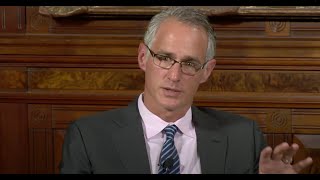
In this talk, Michael Pellini, co‑founder and CEO of Foundation Medicine, explains the company’s mission to democratize precision oncology by moving genomic testing and data sharing out of elite academic centers and into community hospitals across the United States. He reframes diagnosis as information generation, describing how Foundation Medicine extracts actionable genomic drivers from patient tumor samples and contributes them to a shared, global database. Pellini illustrates the impact of this approach with a detailed case study: a novel NTRK gene fusion first reported in a 2013 Nature Medicine paper, later identified in a 2014 sarcoma patient in Oregon, leading to rapid enrollment in an NTRK‑targeted trial and a dramatic tumor response. He emphasizes that without cross‑institutional data sharing, such life‑saving matches would be missed. The talk concludes with a call to integrate data from academic labs, commercial efforts, the Cancer Genome Atlas, and the NCI’s Exceptional Responders Initiative to enable true n‑of‑1 precision treatment for every cancer patient.
Chapters
In essence, what Foundation Medicine's aim is to, and what we're doing in fact, is taking what, what Jose described in terms of this precision medicine initiative and the work that is going on at the academic centers around the United States. Our aim is to really democratize it, not at the expense or not at the competition, not to be competitive with the academic centers, but let's face it, 85% of patients in the United States never end up at Memorial Sloan-Kettering at Cornell, Weill Cornell. They don't end up at MD Anderson. They are treated in the communities around the United States. So that's, that's an important component to understand. And where Harold started out by talking about the diagnosis is essential, that is the starting point. That's really what we're, what we're all working on up here. But don't think about diagnosis in the context of diagnostics anymore. Just think about it in the context of information. All the research is really dedicated towards generating new insight into cancer. What we do as a company is we try to extract the relevant genomic drivers from each patient's cancer when cancer centers and pharmaceutical companies and oncologists and pathologists from all around the world send those, send those tissue specimens to us. But we extract information, and from that information we're all building these databases that have to come together, and they should absolutely not just come together inside my company or inside a medical center or elsewhere, they have to truly come together over time because what we all have to do is take, you know, we're talking about very, very narrow definitions in terms of a patient's diagnosis going forward. They are not quite snowflakes, but it is the snowflake theory. The only way you can start to understand that is if you really combine learning from the West Coast and from the Southeast and from New York City and from Boston and from Hong Kong because you're going to see patients that are these snowflakes, tumors represented as snowflakes all over the world, and even the experts at some of the major cancer centers might not have seen enough of any one patient diagnosis to know exactly how to respond to that, to know exactly what to do with that patient. That issue is magnified many times over in the communities around the United States. I'm going to walk through a case, a patient case that we discussed at our board meeting last week. And it starts, actually, back in the fall of 2013 with a Nature Medicine publication. It was a publication— I'm sorry, no New York institutions, but we've collaborated with many New York institutions. But it's the Dana-Farber, University of Colorado, and Foundation Medicine. We identified a novel gene fusion, an NTRK fusion, in a patient that was diagnosed with widely metastatic non-small cell lung cancer. Based on that, University of Colorado, taking some input from Dana-Farber, treated the patient, treated the patient with a poor NTRK inhibitor. I won't go into the specific compound. That patient had a partial and short-lasting response, which might have been expected based on this particular inhibitor, this particular therapeutic. But it did give it some insight into the investigator that this is a patient with widely metastatic disease who just responded based on a novel gene fusion that had never been seen before. November 2013. September 2014, a patient is treated by a group oncology practice in Oregon. This patient was diagnosed— she's a 42-year-old mother with a large thigh mass. It ends up being a rare sarcoma, soft tissue sarcoma. She went on the routine chemotherapy, no targeted therapy initially. She did not respond. She then went through a very wide excision for that sarcoma. She was then put back on chemotherapy. 2 months later, her lungs lit up and she had widely metastatic disease. You know, this is— the CT scan and the PET scans are remarkable. Would happen over the course of 2 months. That tissue was sent to our company late last year. Could have been sent to one of the other institutions around New York as well. We identified that same novel fusion, that NTRK fusion again. Fortunately, somebody on our medical team saw it, reached out to the oncologist at Oregon, said, you know, based on this Nature Medicine correspondence back in 2013, University of Colorado actually opened up a clinical trial for these NTRK fusions with different NTRK inhibitors, and we also know they're seeing some, you know, they're seeing some meaningful response. Colorado connected with the oncologist in Oregon. That patient ended up getting on an NTRK inhibitor. If we had a slide, if I could show you the slide, over the course of 3 months, you would see her cancer melt away. Now, there will almost certainly be resistance at some time, at some point. But this was one compound based on that NTRK fusion, which no one even knew about 2 years ago. And in a little bit over 12 months, we went from the identification of a fusion to a, you know, to a class of inhibitors that may work or may not work. We built the evidence, and then about 14 months later, a patient was treated with one of these drugs and had an exceptional response, which will hopefully go in the Exceptional Responders Initiative down at the NCI as well. So, it points to the promise of what everybody is doing, but it also points to the challenges. If that information stayed at University of Colorado, if it stayed at Foundation Medicine, if it only stayed at Dana-Farber, if that patient didn't get connected from Oregon, I think we all know what the outcome could have, you know, would have been. So, what we have to do next is take the learnings from Silicon Valley, frankly, And, you know, let's learn from everything that's happening in the information age, and let's not rest until the data coming out of Mark's lab, the data coming out of Jose's institution and our company and the Cancer Genome Atlas and the NCI is all connected. That's ultimately what has to happen here in order to really pinpoint these, you know, these findings and match them up in an n-of-1 basis with, you know, with the therapeutic options.