Founder Stories: Nat Turner, Co-Founder and CEO of Flatiron Health
In this Forbes‑hosted interview, Nat Turner recounts the evolution of Flatiron Health from a college‑room idea sparked by the movie Elf to a $2 billion acquisition by Roche. He describes early ventures—a premature online food‑ordering service and a demand‑side ad platform—before deciding to focus on mission‑driven healthcare after a personal family experience with pediatric AML. The initial concept was a consumer‑facing second‑opinion service, which pivoted to aggregating unstructured oncology records from cancer centers. Facing integration hurdles with legacy EHRs, Flatiron acquired a cloud‑based oncology EHR to become the point‑of‑care system, enabling them to transform raw, “crude‑oil” patient data into research‑grade, FDA‑acceptable datasets through extensive human curation and machine‑learning. Turner explains patient‑privacy safeguards, HIPAA compliance, and opt‑out mechanisms. He discusses Flatiron’s work on synthetic control arms—using real‑world data to simulate randomized trial controls—and the ongoing dialogue with the FDA. The rationale for the Roche acquisition is outlined: access to capital, independence safeguards, and the ability to scale within oncology and eventually into other disease areas (neuroscience, mental health, ophthalmology). Finally, Turner reflects on the competitive landscape, noting respect for Amazon’s technical capabilities, skepticism toward IBM Watson, and a collaborative view of smaller data‑democratization startups.
Chapters
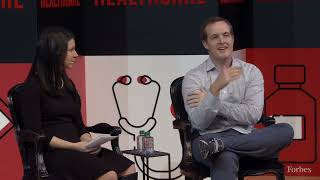
Please welcome to the stage interviewer Ellie Kincaid, assistant editor healthcare Forbes Media, and Nat Turner, co-founder and chief executive officer Flatiron Health.
So if any of you have taken a glance at the issue of Forbes sitting in front of you on the table, then Nat will probably look familiar as he's smiling back at you from it. So Nat's here to talk about how he started a company at age 24 that Roche bought in February for $2 billion, and how he thinks it's gonna change cancer care. But first, before we get to that, will you tell us how the movie Elf was involved with the story of Flatiron?
Yes, of course. First, thanks for having me here. Elf, my co-founder and I met at UPenn. So first day of school, we were in a writing class. You were supposed to write about movies, and you were supposed to pair up and pick a movie. And my co-founder Zach, who's a very confident guy from New York, just stood up and said, "I wanna watch Elf. Who wants to do it with me?" I said, "I love Elf." Boom. And then we actually walked home that night on Locust Walk and actually figured out we both loved entrepreneurship. And about 2 months later, we started a company that didn't end up working, but our passwords and all sorts of stuff for about the next 10 years were all elf-related. Like the yellow ones don't stop, if you know what that means. It's the taxi cabs, they don't stop in New York, so.
Yeah, so you started a couple companies together that weren't necessarily related to healthcare. How did those go?
The first one went horribly. We started an online food ordering company that was about 15 years before its time. Seamless Web and Grubhub and those folks have figured it out. The next one was Did well, it was online banner ad optimization systems called demand-side platform. There's actually a pretty big company now called The Trade Desk, which is very similar to what we did. That company was acquired by Google in 2010. We stayed on for a couple years to run it. But we didn't want our obituary to read, they optimized display banner ads on websites. And so within a month or so of getting to Google, we pretty much decided that we were gonna leave ad tech behind. Focused pretty much exclusively on healthcare.
And why was it healthcare that you wanted to get into?
Yeah, we were thankfully young and we had sold the company and we had a lot of people who were, for better or for worse, trusted us, wanted to work with us kind of blindly in our next thing. Engineers, that sort of thing. And like I said, we were very focused on finding something mission-oriented. We wanted something that, something we were proud about, you know, from a mission perspective that my mom and Zach's mom could explain, you know, to their friends. And so that was healthcare in general, and then, and cancer was, I have a cousin who was diagnosed with AML when he was about 7 years old, and that process, misdiagnosed, mistreated a couple times, disqualified from a trial because he was treated for the wrong disease, for example. And so that inspired us to look at cancer more specifically. We ended up angel investing in a number of healthcare companies to learn, Things like mental health, health insurance, that sort of stuff. But cancer just kept kind of rising to the top as to what we wanted to put most of our personal time into. We had a whiteboard at Google that had all of our ideas, and we crossed out most of them, and cancer was always there. It was very intimidating though, because neither of us are oncologists, we're not even doctors, we didn't— Zach didn't even finish undergrad. And so it was intimidating, but thankfully we met a few people that helped us see the path, so.
Mm-hmm, and how did the company kind of evolve to focus on patient data?
Yeah, so the first idea was not too dissimilar to Brennan, my cousin's experience, was a second opinion service for cancer patients over the internet. He was diagnosed in Augusta, Georgia, which you probably can't name even a hospital in that town, let alone a pediatric cancer center, and so he was discriminated based on where he lived, you know, for getting the right diagnosis and treatment, in our opinion. So we started a second opinion service over the internet. It turns out it's really hard to aggregate patients through that. You have to do Facebook ads and all this stuff, and all of a sudden we found ourselves right back, you know, where we were before. But we had a few medical records from that process where we said, hey, this is actually really interesting. This plays to our strengths. You know, the data was highly unstructured. It was in PDFs. There were scans where you could see like a crease through it. And it like, you know, you couldn't read the words. And so we saw that, you know, dirty information, which was, you know, web pages are no different. And, but we said, hey, we need millions of these, not dozens or hundreds. And so we pivoted, thank, you know, with a lot of advisors' help, pivoted into more of a business, an enterprise model where instead of working directly with patients, we worked with their cancer centers and unlock value basically for the physicians and researchers from that information.
And at some point in this process, you decided that it was necessary to own the electronic medical record.
Yeah. Yeah, I'm sure a lot of you in the room know the name Epic or these Cerners of the world, these EMRs. It's really hard to integrate with these systems. And we'd find cancer centers that were more than willing to participate. But then, you know, we didn't have to necessarily get Epic's approval, but it took a year or two years to integrate and pull that information out. And we just didn't have that kind of time. And frankly, more practically, it's really expensive. And we were a tiny little startup with seed funding. So we just couldn't make it work. And so about two years in, we had signed up, you know, 20 or 30 cancer centers, but again, struggling to make those integrations work. And we just needed to kind of step function change the scale that we were operating in. And thankfully, there's multiple cloud-based EHRs that have built, you know, decent-sized businesses in oncology specifically that had generated enough scale. And secondarily, we didn't just want to be, you know, pulling data on the back end. We actually wanted to help physicians at the point of care. You can't really do that unless you're the EHR, in our opinion. Doctors don't want another username and password to remember or a URL to remember. You need to be in their EHR. And at the time, Epic was not very friendly with integrations in the front end. So for those two reasons, we made a decision to acquire a company, electronic healthcare record company, and I'm glad we did.
Yeah. So you've compared patient data, you have a crude oil metaphor for that about kind of what Flatiron does with patient data. Explain.
Yeah, it's actually my co-founder Zach was the one who started using this. So basically, you don't put oil you find in the ground in your car. If you did, your car would break. In healthcare, it's very similar. If the FDA wanted to look at patient records from an EHR, it wouldn't work. If a researcher at Penn wanted to quickly do a study on EHR data from even their institution, it wouldn't work. You have to spend about 80% of your time analyzing— excuse excuse me, building the data set before you can spend 20% of your time analyzing it. And we wanted to flip that. So the data in the EHR is effectively crude. It's extremely raw. You have to structure it, normalize it. You have to have humans read it oftentimes, most of the time. You can do a lot of machine learning and AI type stuff to improve those processes, but it's just a ton of effort you have to put into refining that data. And ultimately, you can get to a point where it's research grade, where folks like the FDA, which is our highest standard, that we collaborate with, researchers, other regulators can use that information and trust it. But the getting from point A to point B, raw EHR data to research grade, I mean, that's Flatiron's secret sauce. Our business is built around our ability to do that.
And so with the necessity of having humans read medical records, I mean, When I was in undergrad, I did that for a chart review project. But how do you find that patients respond to the idea of a company doing this with their medical record?
Yeah, it's a great question. I mean, I think first and foremost, under the guise of HIPAA, we of course make sure everything we do is compliant. And it is. Everything we do is the United States. As one example, everyone's on our systems and trained and all that stuff. But more importantly, I mean, we take it as a huge responsibility. I mean, we're the stewards of their information at that point, and it's on us if we break their trust in that. For example, if there's a breach or some sort of unauthorized use. So we take that very seriously, and so we have entire teams. Our compliance, security, and quality teams are bigger than Flatiron was when we actually were getting started and building a company. But we interview and talk to a lot of patients. We bring them to our all-hands meetings. Have a lot of dialogue with them to make sure we're approaching this in the right way. We have abilities for them to opt out of our systems, which you can do easily on our website or through our patient portal. So we have a lot of mechanisms where we're expanding those touch points with patients to make sure. But by and large, it's a great responsibility we have, and we take it seriously.
And if anyone in the audience has—
we got one.
Got one.
This is Matt. Hi, Ellie.
Hi.
This is Julie Grant.
OK. Hey, guys up in the rafters. So my name's Julie Grant. I'm a partner at Kanan. It's a tech and venture healthcare fund. One of the most tremendous observations I've had about Flatiron in terms of your products is actually the ability to create a synthetic control arm for clinical trials, which allows us to move products faster to market in the pharmaceutical industry. But it also requires a very in-depth negotiation with the FDA. And so I was hoping you could speak a little bit about how your interactions have been with the FDA to get to a data source and method that they would accept and what you would recommend to the pharmaceutical industry that historically has not used that method for filing.
Yeah, it's a great question. I would say we're not close. We're still months, if not a year or so away from getting the confidence that we could actually replace a prospective randomized— the keyword being randomized— control arm. We have an active dialogue with the FDA, as does a number of companies, where we're effectively simulating this as if they would use the data, but they're not, and doing that over and over and over and over to prove the validity of that approach. One of the most important components of this is actually case matching the control arm that we synthetically create to the control arm of the randomized study, and making sure that the populations are the same. For example, making sure no one's cherry picking patients, that sort of thing. And also the endpoint. The endpoint— there's a lot of endpoints in cancer. You have overall survival, which is mortality. Progression-free survival, these sorts of things. And they get really complicated in a real-world setting because doctors are not routinely saying the tumor shrunk by this specific amount or increased, et cetera. So there's not a quantitative way to define some of those endpoints. Overall survival is a little easier. So we have a lot of work, actually, to do with that. Like I said, it's us and maybe half a dozen other companies that are actively working with the FDA. We do not want to be the only one, actually. We want the FDA to hold us accountable as Flatiron and hold our feet to the fire with our competitors to make sure that we're advancing the science in parallel. And as part of your second question, well, actually, let me say, I hope this happens because more importantly than this making it cheaper and faster for pharma, you don't have to put patients on a control arm. And you don't have to get the placebo, which is the standard of care in our world. They could take the experimental drug. We've seen horrible examples where twins are separated in a control arm and a prospect. And the comparator arm, and one gets the standard of care and one gets the experimental drug, and had different outcomes. So we feel very strongly that this should happen, but we are very much in agreement that it needs to go the right way, and the FDA needs to clear the path for us. As far as pharma, I think participating in these sorts of programs, whether it's with Flatiron or others, supporting 21st Century Cures, which is, I guess, the last bill Obama signed, which directed the FDA and gave them funding to look into these sorts of things, things, just getting behind those efforts. Again, it doesn't have to be with us, but one of the things we've kind of tactically helped pharma get towards is creating a team around innovation in research. They often have innovation teams that are outside of research around informatics and that sort of thing, but being open to disruption in your R&D programs, which often takes some additional budget or additional teams that are siloed out, there's some people that are doing a good job in that area, doing a great job, and we hope that everyone does as well. I hope that answers your question.
Sorry.
I apologize if I talk really fast.
Does it work? Hey, Nat. So, big fan, really excited when the first time when you guys announced the Flatiron effort. So you definitely built an awesome, awesome data platform across the oncology field. Honestly, I'm a little bit disappointed when I heard the acquisition because in my view, I think it would— well, kind of put this way, I think you probably will be able to make an even bigger impact if you were to be able to scale and replicate your success outside of the oncology into different diseases indications while remaining independent. Now, I'm wondering if you could kindly share a little bit insight on the thought process behind that decision-making. Pivoting on that, looking forward, what are the opportunities in your opinion for tech companies, particularly for the IT informatics technology companies? What are the opportunities you think would be the likely to see the highest probability of a success?
Sure. So on the Roche thing, I mean, nothing about that acquisition will prevent us from going into other diseases. And in fact, in many ways it makes it more likely. You know, Roche is— cancer is their largest segment, but they have many other segments that they focus on, ophthalmology being an example. And so we don't have immediate plans to do that, but one of the factors in deciding to go that direction was that expanded resources would allow us to more quickly accomplish our goal in cancer while maybe simultaneously or thereafter going into other diseases. In addition to the resources, that was the best decision for us. Fundraising is not a business model. As I've told a lot of my fellow entrepreneurs in healthcare, healthcare is a tough place to build a big business, and if you have ambitions that are very large, you need to raise a lot of capital, which we did. We didn't really have an appetite to keep doing that. We were making good revenue, but you have to keep fundraising if you want to do the things we were doing. Roche is a family-controlled company that thinks generationally. You know, they don't care about making 10-year, 20-year bets that are very expensive bets on the face value, but could pay off for the industry. And more importantly to that, they're a holding group that allowed us to be independent. That was, as far as your first question, that was an absolute requirement for us. You know, we have a public firewall document that states that Flatiron has its own strategy, does not have to be influenced by Genentech, for example. So those sorts of things we agreed to before the deal, actually, and got approval and handshakes from the people that matter there that that would be the case. And of course the funding, they're allowing us to expand our team, expand our resources, make acquisitions that would just have been so hard for us to do as a private company. But Matt, what about, this is Matt, what about 10 years, 15 years down the line where you would have owned everything and now it belongs to The Roche family. Again, I think we would— What does this work for your independence then? Yep, again, I think that we have a better chance of that in a more well-funded environment that has a holding company structure than we would have in a private environment. We were fearful that as a private company, we would not have been able to continue our resources and our investments at the same level, or increase them even, as a private company. To your second question, I think neuroscience, mental health, ophthalmology, there's companies in each of those areas. I hope that medical records are becoming more open with a lot of the things the government's doing, a lot of things that Epic's announced and others that allow companies like us to have an easier path than we did. We had to go out and spend a lot of money to acquire an EHR. We did not necessarily want to do that. It's even harder running an EHR than it is building a data business, to be honest. So I'm hopeful that some of the paths have been made easier over the last few years. But other disease areas, like the three I mentioned, a lot of opportunity. I also think drug development needs to get sped up through AI and ML. And there's a number of companies working in those areas. We're not really. But it's crazy that drugs take as long as they do and as much money as they do to get through the process. And I think software has a very important role to play there. But again, the FDA has to get behind a lot of those approaches, to the earlier question. I'm going to let Matt tell me where to go here. Yeah. Yeah.
Very nice talk. I need to have a little clarification because you mentioned the word randomized. So in clinical trials, you have both prospective and retrospective studies. And therefore, in a clinical trial, You provide a group of patients which are the control arm versus the non-control arm, which is from the pharmaceutical, or do you control both of those? Which one do you manage?
So we have not done this in an active interventional trial yet. We are doing simulations. So a trial that had concluded, say, years ago, we are in collaboration with the FDA and others simulating those control arms as if we had done them using real-world data. So we have not actively done an interventional study where the real-world arm or the control arm was a real-world arm. That hasn't happened yet. And that's to the earlier question where we're hoping to get with the FDA in the future. Hello. Nat, I wanted to ask, as you know probably, FASB's been looking at trying to recognize data as an asset on the balance sheet. If that ends up coming through, how does that affect how you treat the data in terms of not only within Roche's assets, but also how you determine which drugs you may be developing next? That's a good question. I mean, we are so separate. I have no insight into Roche's accounting methods or what drugs they're even working on, so I couldn't really answer to that. As Flatiron, we've never considered it an asset because we don't own the data. Patients own the data. We have access and we're stewards of that information as business associates with their cancer centers, but we've never approached it as an asset. So I'm not sure how that would change under Roche. I don't think they've probably had similar conversations. So, yep.
Front.
Really great and incredibly impressive what you've done. But you've kind of opened the gates for a lot of other companies, both big and small. And I just wonder if you kind of comment on these as competitors, frenemies, enemies, partners. And maybe let's look at one small one and one big one. So on the small side, you've got companies like Humanity who want to democratize data. And your value proposition is partially based on how difficult it is to access data. So there are small companies that want to democratize data, put it in consumers' hands, and basically make it open source. And then on the other side, you've got big companies like Amazon yesterday announced that they're gonna be, they're mining records.
Knew this was coming.
Yeah, yeah, so who's gonna make it?
Are you happy, are you unhappy, are you frightened? How do you react to both of those situations?
Yeah, I'll take the second one first. So Amazon, I thought that was awesome personally. Is anyone from IBM Watson here? I mean, Watson just hasn't done us any favors by saying to do all these things and then not doing them. You know, when we work with pharma and the FDA, the first question is, you know, almost always is, how does this actually work? Because Watson hasn't worked. And so that's been really frustrating for us and our competitors, I know. And Amazon, we respect great greatly from a technical perspective. I'm very hopeful that they can scale that. I don't know if it's going to work in cancer, because in our experience, cancer is so difficult. There's a reason why Humedica and these other companies and Optum have focused on everything but cancer when it comes to medical data, record data. So I don't think the Amazon thing scares us that much, because it just— in our experience, cancer has to have a unique approach. But again, I hope for the sake of health care and innovation that works. Humanity and Others, and then we have to end, is much smaller. I hope patients get more access to their data. That would actually benefit us as well, because we actually have issues still getting access to information from Epic and Cerner and Allscripts and all the others. We're very hopeful that that happens as well. We don't really view that as competitive either.
Great. Thanks so much, Nat.
Yeah, you bet.
More from Joshua







Scientist Stories: Hans Waterham, The value of phenotypic assays in peroxisomal disorders




Scientist Stories: Joel Zlotogora, Genetic carrier screening programs for reproductive purposes