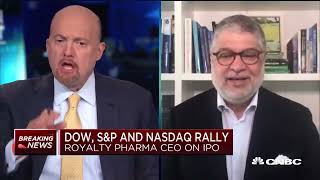
In this interview, Jim Cramer welcomes Pablo Legorreta, founder and CEO of Royalty Pharma, to discuss the company’s upcoming public debut, which will be the largest IPO of the year and the second‑largest pharma IPO ever. Legorreta explains Royalty Pharma’s core business: acquiring royalty streams from universities, hospitals, and biotech innovators in exchange for upfront cash that funds further research. The conversation highlights how the firm has secured stakes in blockbuster drugs such as Ibrance, Imgaliti, and the migraine treatment Nurtec, describing the process of identifying promising assets and providing capital to early‑stage biotech companies to fund Phase 1/2 trials before stepping in for later‑stage financing. Legorreta notes the company’s dividend policy and strong growth prospects, while also addressing competitive pressure from private‑equity firms like Blackstone and TPG that are entering the royalty‑acquisition space. Throughout, the interview underscores the dual mission of delivering returns to investors and accelerating medical breakthroughs.
Chapters
Royalty Pharma is making its public debut today and will be this year's largest IPO to date, second largest pharma IPO on record. It's somehow been hidden. I don't know how that's the case. I'm fortunate enough to be friends with Bill Ford, who's on the board, so I know about this. But let's bring in CEO, founder Pablo Legorreta. Sir Pablo, your business, you are— this is an immensely profitable company.. And it's going to start out paying a good dividend and has great growth prospects.
It's great to be here with you today. It's, as you might imagine, an incredibly exciting day for me and for the Royalty Pharma team after 25 years of really hard work.
You have a piece of the action of many of the great historic drugs, profitable drugs of our time. Can you explain to people how you were able to get such great pieces of such such incredibly profitable drugs that people know as profitable but don't know that you have a stake in them?
Thank you, of course. So look, I think we're living in the golden age of biotechnology and the golden age of medical research, academic research, hospital research. And we work on a very collaborative basis with all of the innovators in the life sciences R&D ecosystem to accelerate discovery and bring medicines to patients. And you were right in saying that these are some of the most profitable drugs, large drugs in the industry. But I think, Jim, the most important thing is that these drugs really what they do is they bring incredible treatments and cures for patients. And that's why they're big and important. And the way we acquire these royalties is we go to the innovators, to the universities which discover these things. These drugs and products. And we actually, you know, work with them and acquire the royalty, giving them an upfront payment so that the universities and hospitals can plow that money back into more research and discovery and, you know, really accomplish their mission.
I know that you've had some things that go wrong. It's not totally a sure thing. Ibrance didn't work that much, but you've got him. Unfortunately, I'm more like half your drugs here. You have Imgaliti from Lilly. Which is migraine and fabulous. You have Nurtec Biohaven. I think that may be the big drug of this year. How did you spot the migraine franchise, which is just incredible?
So, Jim, I was talking about how we get involved with academic institutions. You know, when they discover things, we come acquire royalties. We did a great deal in New York City with Memorial Sloan-Kettering years ago. And, you know, one interesting anecdote is that the money that they got from us went to fund the biggest research center in New York City, a huge building in the Upper East Side. But to specifically answer your question about this other investments that we have, once Royalty Pharma got big and diversified, we could take more risk. And what we started to do is to fund research and the products in the hands of the biotech companies, this incredibly nimble entrepreneurial companies that have gotten funded by venture capital firms. And use that money to fund the early stage of the trials, phase 1, phase 2. When these drugs get to phase 3, a lot more capital is required. And at that moment we come in, you were talking about Nurtec, this incredibly exciting migraine drug developed by a company in New Haven called Biohaven. So we did a deal with them a few years ago where we actually provided capital to them so that they could complete the clinical trials and launch the drug. The drug was approved. We took the risk. Now we're fortunate that the drug was approved. It's being launched now and it's a totally new way of treating migraine, which did not exist before. It really goes to the core of the disease, and that's why it's going to be a life-changing drug to migraine sufferers.
Mr. Legarete, it's David Faber. As you point out, Jim has— your company's been around a long time. You're an innovator in this field. But there are others who've seen the opportunity for profit. Blackstone, TPG are coming in with competitors. Is that something that concerns you or conceivably at least will act as, as a brake on your ability to generate significant returns from some of these investments?
David, good to hear you and nice speaking to you. I do not think it will act as a brake. And let me tell you why. The R&D ecosystem is so big worldwide that so much capital is needed to fund drugs. That there's room for many participants. And I'll give you a sense of how big this is with some statistics. There's $300 billion invested per year in medical research worldwide. $100 billion by universities, governments like NIH, Max Planck, and $200 billion by companies worldwide, biotech and big pharma. Many other industries invest in R&D in the scale of tens of billions. Life sciences is hundreds of billions. So we are part of this and the opportunity is so big that there's room for many. But I would tell you that we have many advantages versus the competition. Our scale is a really important advantage. You know, we're 5 to 10 times bigger than any competitor. Our cost of capital and now going public, David, is going to put us in a completely different category, having access to the public markets, the deepest pools of capital in the world, and also potentially a currency that we could use in acquisitions.