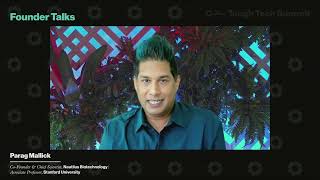
In this interview, Parag Mallick, co‑founder of Nautilus Biotechnology and Stanford professor, recounts the origin, mission, and growth of his proteomics company. He explains his personal frustration with the lack of tools to measure proteins, contrasting proteomics with genomics to illustrate why a comprehensive proteome measurement is essential for diagnostics and therapeutics. Mallick describes Nautilus’s ambitious goal to capture up to 98% of the proteome, the $25 billion market opportunity, and the decision to build a startup around the problem rather than the technology. He shares three core lessons learned: (1) assembling a diverse, cross‑disciplinary team to reduce execution risk; (2) maintaining openness, seeking advice, and setting ego aside; (3) hiring for "ceiling"—prioritizing growth potential over existing skill sets. He offers advice to academic founders about bandwidth management, the importance of delegating, and aligning personal motivations with company success. Finally, he reflects on how his role has shifted after Nautilus went public, emphasizing continued scientific leadership and public‑facing responsibilities.
Questions this video answers
Mallick sought a partner who complemented his scientific expertise, could challenge financial decisions, and had prior execution experience. Sujal, with a decade‑plus relationship and previous company‑building experience, fulfilled these criteria.
He focuses on hiring for "ceiling"—seeking candidates with high growth potential, willingness to take risk, and capacity to learn new skills, rather than those who already master a specific task.
Assess your career stage and bandwidth; be ruthless with time, know what to delegate, and prioritize building a company over personal ego.
While public‑facing activities (earnings calls, media) have increased, his core role remains driving the science and partnerships, focusing on where his highest value lies.
Chapters
Great, thanks so much. It's really a pleasure to be here today, and thanks, thanks everyone for joining in. I'm really excited to share a little bit about our journey and also answer any questions that you all have. What I was hoping to cover today were a couple things. The first was to just introduce myself and my background and the story of where Nautilus came from and why it exists. I'll take a moment in there to explain about what proteomics is and why, why people should care about it and And then really close by just chatting about some of the things that I've seen in the ecosystem and in our journey that really helped us really to provide some advice and support before diving into questions. So just to start off by way of background, as Dulce mentioned, my name is Prag Malik. I am one of the founders of Nautilus and also a professor at Stanford. My own training is really half computer science and half biochemistry. And I've lived in that world my whole life. Really trying to bring these different aspects together to ask questions in personalized medicine and diagnostics. And where Nautilus grew out of, I don't know if you're supposed to start a company this way, but this is where Nautilus came from, was my own personal frustration and irritation. I think really where it came from was believing that proteins are critical and that we need tools to be able to measure them. And every day going and doing large-scale multi-omic studies and appreciating just how powerful genomics tools had become. And then trying to go to the other side of the fence and study the proteome and really struggling. The tools that we had really being challenging to use and incomplete, lacking sensitivity, still amazing and powerful, but really what you want is you want parity. You wanted to be able to access the proteome just as easily as we access the genome today. And it was really that frustration and banging my head against this problem for literally decades that led to Nautilus, of waking up one day with a crazy idea and saying, wow, rather than trying to evolve our existing technologies, which is what many of us had tried to do, let's take a different approach. Let's try something completely new and different that maybe has the potential to measure the entirety of the proteome. And then pursuing the path to think about what was the right vehicle, whether it was my academic lab or selling it to a larger company, licensing it, or starting a startup company to most effectively bring that to the world. And then going through the process of of developing Nobilis. Maybe just to take a quick step back to explain about the proteome and why you should care, why it's so critical. I think we are inundated with genetic data all the time, companies like 23andMe and the power that Illumina has brought to genomic medicine and our ability to study that. But ultimately, if one thinks about the cell, one thinks about biology, the proteins do work. They are constantly evolving. Proteins every second of every day are changing and, and driving disease, driving health, and our monitors thereof. And the genome is fairly static. It's the same the day you're born and the day, the day you die. And so it's a really great way to look at what might be, but it's not a great way to look at what's going on today. And so that was really the foundation for Nautilus, was saying we need the proteome. It's a grand challenge problem. It's important. It underlies how we develop therapeutics, how we find targets, how we find diagnostics. But if we look at the state of the world today, when Nautilus was started, the best tools in the world were only able to measure about 8% of the proteins in a drop of blood. If all you want to do is just know what's there and how much, with a lot of work you can get to about 2,000 or so proteins. In contrast to genomics where you take a drop of blood, you take a cheek swab, you get 99% of the genome. And so one day you wake up and you say, oh wow, there's a way to do this and do this at scale and measure not just 8% of the proteome, but potentially 98% of the proteome, you have to act. And so that was really the history of Nautilus, was seeing a route, seeing a technological solution to a very hard, but very, very important problem. I did not go into Nautilus saying, oh, okay, I want to start a company. Let me find something to start a company around. It was very much the other way around, starting with the problem and saying, here's a problem that a lot of people care about, and here's a solution to it. And that was really the root of Nautilus. And I think that's one thing that when we were getting off the ground is important for everyone to think about, is having the coolest science in the world, particularly those of us coming from an academic foundation, We often are excited by these innovations, these technological things that are now possible. But Nautilus was very much rooted in what do customers want? What is our problem that we're trying to solve? And we were really fortunate that we were addressing a very large market, $25 billion market. And that was a huge part of how we were able to talk about the story It wasn't about, "Hey, look, here's this cool thing we can do." It was about, "Here's a problem that I personally have faced and have struggled with and have wanted to overcome that underlies all of health and medicine. And by solving it, we're going to help a lot of people." And as an investor, there's an opportunity there. When you help a lot of people, there's a large market to address and potentially a large opportunity. So starting with a problem that matters was really critical. The other key lesson that I learned was really about team. And again, coming from an academic background, at the end of the day, there is a first author and a last author. And while we do collaborative science often, really doing large-scale team science can be challenging within the context of a university lab. And it also has a consequence on how you think about your interactions with everyone around you. And success as a founder, success in a startup is becoming very comfortable with building the greatest team you can, about surrounding yourself with experts, about finding a diversity of people to bring to the table. And from the other side of the fence, when being evaluated, a lot of what they look at is execution risk. And that comes down to how great is your team? How experienced are they? How likely are they to take this to the finish line and get it into the hands of customers where it can do some good? So that was a huge, exciting opportunity for me. I love the opportunity to work with so many different types of people. And inside Nautilus, we have so many, we have, you know, protein chemists and organic chemists and bioengineers and optical engineers and mechanical engineers and computer scientists and data scientists. And they're all working together to solve exactly one problem. And building that culture where all of these different types of people are working together to solve one problem is a huge part of success that we that we've so far really prioritized. I'd say a third key lesson that I learned along the way was really about openness. That what I've seen in a number of founders and companies that I've evaluated is a lot of hesitancy to share and a lot of hesitancy to go get advice. When Nautilus was first getting started, right after Crackpot Idea occurred, The very first thing that I did was went and found some really amazing people, folks like Saad Nazem, who is now on our board and was our first investor leading our seed round, but was someone who I just trusted and reached out to and said, "Hey, I think I have to go start a company. What advice do you have for me?" And then my co-founder, Sujal, he was one of the first calls that I made, someone who I trusted tremendously, who had had a track record of success, who had built an this amazing company in Iceland and called him up and said, here's what I'm thinking about, and just laid it all out on the table and went through it. And the result of that conversation was him becoming very excited and joining me on the journey and really being a huge part of our success. And if I had been afraid to have those conversations and have that openness and I've been obsessed with trying to present this front of knowing everything instead of taking an approach of recognizing that there's a lot I didn't know and that it was valuable to solicit advice and get it to build the best company. Just getting my ego out of the way and really focused on the real objective, which is to build a great company and get a great product out in the world. That was really crucial in our early days. Of building the company, of not trying to be so super protective of this idea, but instead allowing it to breathe. And that trust was tremendously rewarded by people coming out of the woodwork to help, by getting creative input that has been a huge part of where we are today. So I'll close with one, just one last point, about building companies, one of the things that has been very important is who has been part of the journey. And at different times, different experience has been really valuable. In the early days where we were a couple people and we rented one lab bench, and we really needed people who were amazing at taking risks and moving fast and fixing as much as they could and trying things. Those people were amazing. As the company's evolved, what we've found are how important it is to bring in additional skill sets. Now, as we're on the path to commercialization, the sorts of experiences that you need about how to work through a development process, about how to scale a manufacturing process, it's a different group of experience. Recognizing that in a startup, everyone's going to do everything, but that really having that willingness to recognize when there are knowledge gaps and bringing them in at the right time, when you need external advisors, when to reach out and get advice. It's been a huge part of our journey, has been bringing an amazing group of supporters and amazing talent group within the company, but again, constantly seeking for what can we do better, who can help us, rather than letting our own egos get in the way and say we know what we're doing, we have everything, we don't need anybody else. And so I'll stop there, but just to say thank you all for listening, and I'm happy to answer any questions you have about the journey of Nautilus or about what we're up to in terms of the goal of bringing the Proteom to the world. And again, thank you.
Awesome. Thank you so much, Parag. We have a couple of questions. So one is, as an academic founder, as you mentioned, what were the qualities that you were looking for in your co-founders? And which of those ones that you started thinking about ended up being truly essential for the success of Nautilus?
Yeah, that's a great— it's a great question. So I think what I What I initially recognized is that— so I've done a lot of work doing evaluations of companies for different VC firms. And when those evaluations are happening, there are really 3 criteria that dominate the narrative. The first is technical risk. Is this something that's going to actually get to work? There's market risk of, is there a product here if they do get it to work? And then there's execution risk.. And so I'd been on the other side of the table evaluating companies along those ways. And the execution risk coming from an academic setting, we tend to think that execution risk is technical risk. And so we want to surround ourselves, our intuition is, okay, I need to surround myself by scientists and science people and all that. And that intuition is, I think, neglects the fact that the business side is substantial. So I came into it recognizing that what I needed was I needed somebody who complemented me. I needed someone who would be honest with me, somebody who we had mutual respect for, but also someone who really understood the financial side and could challenge the way that we were doing things. I have to say, I was just very fortunate with Sujal, someone who I had a decade-plus relationship with, who I had tremendous respect for, who had built a company before, Those were all really valuable of having a partner like that who had done it before. And I don't know that I'd set out saying I really need someone who knows how to do this and knows how to execute at scale. But there is something to be said for being a great executor, and he is amazing at it.
That's awesome. That's so important. Another question from the audience. What's your favorite way to recruit great people?
I think so. Inside the company, we really do focus a lot on ceiling, not floor. And I think a lot of companies when they're hiring, they say, okay, I need someone who fills this bucket, who knows how to do exactly this thing and has done it 1,000 times before. With what we're working on, it is Nothing like it has ever existed in the world. It is truly tough tech. There are not people in the world who have done this before. So what we need are we need people who are willing to take a risk, willing to expand, who are looking to learn, looking to grow. And so we really emphasize hiring unceiling. I'm glad that you know X, that's an important foundation, but are you going to be able to have the capacity, the willingness, the urgency, to grow, to learn Y, Z, Q, everything else.
Yeah, amazing. That's awesome. And I think everyone should want to work at an organization like that. Another question, what would be your number one recommendation for other faculty also looking to pursue this entrepreneurial route?
I would say it depends on where you are in your career. I was very fortunate to have already been promoted. And I think if you are a first-year assistant professor, being an operator in a startup company is very challenging. That dual focus could really be risky to both of your endeavors. And so really, I would say knowing where you are and being very cognizant of your bandwidth And what are the things that really matter and push either exercise forward? Because there are— it's— you do have to be a little ruthless with your time. And you have to know what compromises you can make. And that's probably the single hardest thing is to say, okay, well, do I need to do this? And again, to get yourself out of the way and say, okay, is there somebody better to do this? Should I be the one doing this? And I think that's really important because oftentimes you run a lab, you're like, it's my lab, it's my baby. Your mission with the company is to make a successful company. It is not to stroke your ego. It is not to be the know-it-all at the top. It is to build a successful company. And that is about finding the right people, empowering them to do their best.
That's awesome. One really quick question. We have about a minute left, and the last one is, has your role and thinking changed at all since Nautilus became a publicly traded company? I mean, I know that's a big question for 60 seconds, but anything major?
I would say my— I'd say some of the activities that we routinely do now have changed a little bit. We have much more of a public-facing presence. We have earnings calls. We have, you know, we have people making YouTube videos, commenting on us. And, and so I would say my role in the company hasn't evolved. My role has continued to be a driver of the science and to work with partnerships. And but that was a choice of saying, this is where my highest value to the company is.. And I think that's, again, focusing on where are you contributing, where are you using your skill set. And so that continues to be true, even now that we're public.
Awesome. That's wonderful. Thank you so much, Parag. We're out of time. Thank you so much for joining us here today. We really appreciate it. And have a great rest of your, your day. Thanks so much.