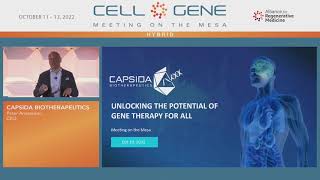
In this presentation, Peter Anastasiou, CEO of Capsida Biotherapeutics, outlines the company’s mission to broaden gene‑therapy access beyond rare pediatric diseases to all patient populations. Capsida’s core technology is a Caltech‑originated capsid‑engineering platform that creates next‑generation AAV capsids capable of systemic intravenous delivery, efficient blood‑brain barrier crossing, high neuronal transduction (10‑30% across brain regions), and significant liver de‑targeting (5‑fold). The company integrates discovery, preclinical, clinical, regulatory, and manufacturing functions under one roof, operating a 15,000‑sq‑ft facility with current 200‑liter production capacity scalable to 1,000 L. Capsida has raised a $50 M Series A (Westlake, Versant) and secured a $90 M upfront equity partnership with AbbVie for three CNS targets, plus a collaboration with CRISPR Therapeutics on Friedreich’s ataxia and ALS. The pipeline comprises seven programs (three AbbVie‑backed CNS targets, two disclosed CRISPR‑Therapeutics programs, and two wholly‑owned CNS programs), with plans to expand into other therapeutic areas. The leadership team includes the two founding scientists (Nick Flizanes, CSO; Nick Godin, CTO) and a board of industry veterans. Capsida emphasizes values of collaboration, curiosity, and execution, positioning its integrated platform and engineered capsids as solutions to key challenges in gene‑therapy delivery, safety, and scalability.
Chapters
Hello, I'm Peter Anastasiou, the CEO of Capsida Biotherapeutics. We are a new member of ARM, a proud new member of ARM, and first time here at the meeting on the Mesa. So congratulations to the organizers. It's a great meeting. So look forward to participating in many more in the future. So Capsida is a platform gene therapy company. And as you see on the screen here, our purpose is to unlock the potential of gene therapy for all patients. And that's our mission. That's why we exist. And there's been a number of challenges, as you all well know, in gene therapy development. And that's why there's only been 4 new therapies in the last 5 years, 2 of which just happened this year in 2022. And so that's the reason we exist, so that the potential can be achieved. And the reference to all patients means that not just to be limited to pediatric ultra-rare disorders, but less rare disorders, more common disorders, and across all ages. And I'll talk a little bit more about how we do that. So as I mentioned, we're a platform gene therapy company. Our initial focus is in CNS, but it's not limited to CNS indications. We do plan to get into other therapeutic areas. We are creating next generation of non-invasive targeted treatments. While, as the name implies, Capsida, the foundation is capsid engineering, and that's the main innovation that was created at Caltech. At Caltech and then brought over to Capsida. But we're not limited to capsid engineering. In fact, we've built out preclinical and translational capabilities. We've built out clinical and regulatory and importantly manufacturing capabilities. So we all have, we have all of those capabilities and functions under one roof. And we are developing products, gene therapy products, both in partnership with other companies, but also ourselves as well. We have our own wholly owned programs. So as I mentioned, the company was founded out of Caltech innovation. And two of the founders, we affectionately refer to them as the Nicks, one of whom is in the room here today. Nick Flizanes is our chief scientific officer, and Nick Godin is our chief technology officer. They worked in Viviana Gradinaru's lab. Viviana did not come over with the company, but she is on our board, and that's where the main innovation that the company's based on was discovered and developed. Westlake and Versant each put in $25 million to create our Series A of $50 million. And importantly, we have a partnership, a sizable partnership with AbbVie, who gave us $90 million upfront equity as a component of that for 3 targets, and we view that as really important validation of the work that we're doing at Capsida. And then subsequently, we have another partnership with CRISPR Therapeutics where we're developing 2 products using our capsids and their gene editing cargo. And those are the only 2 indications that we've publicly disclosed, and that are— those are for Friedreich's ataxia and for ALS. All of our other programs that we have with AbbVie and our own wholly owned programs remain undisclosed. We built a 50,000-square-foot facility that we do discovery as well as manufacturing. We opened that in January, state-of-the-art facility, and we presented some of the great data that we've been generating, although certainly not all of it, at ASGCT, and I'll give you a small snippet of that data shortly. And we're, as of today, and we're constantly filing patents, as of today we have about 40 patent applications that we filed. Our leadership team is anchored by the two Nicks as our co-founders, but we've surrounded them with a really strong management team that is experienced at developing new innovative therapies and have a long history of bringing those therapies from discovery to the marketplace. In addition, we have a very strong group and very supportive board of directors anchored by our two investors, Westlake and Versant, but also with Viviana from Caltech on the board, as well as Frank, who was on the board of one of the few gene therapy companies that's been able to successfully launch a product in Avexis, and he's currently the chair of Intellia. And then Sean Harper, who's developed many new innovative therapies as the head of R&D at Amgen. And then also Vivian or Rita Ballas-Gordon, who's the CEO of Muno Therapeutics. And so we really have a strong collection of gene therapy expertise as well as innovative new product development expertise. At the leadership levels of the company. As I mentioned, our purpose is to unlock the potential of gene therapy for all patients. And the way we do it is really critical. So our values are that we're in it together. We've built this multifunctional company because we think there's so much power in having not just capsid engineering by itself, but with all of those other functions. And that gives us the best chance to achieve that purpose. And so working as one and being in it together is a really core value. Also, because of the challenges in gene therapy, we have to be constantly driven by curiosity. And then also because we're not an academic institution, we don't just do science for science's sake. We develop really innovative things, but we marry that with execution because ultimately that science doesn't help patients unless we can matriculate it through the product development cycles and ultimately bring it to patients. I'm going to spend a couple of minutes on this slide because really it's the foundation of what we do and how we're trying to solve the challenges in gene therapy. As you can see here on the left, there's a number of challenges. One of them is that getting across biological barriers, particularly the blood-brain barrier, has been a challenge for existing first-generation therapies. And so with our engineered capsids, we are able to cross the blood-brain barrier and get significant neuronal transduction. And I'll show you some of that data here in a second. Also, there's been significant safety concerns with accumulation in the liver. And so because we're getting good transduction and good crossing of the blood-brain barrier, we're able to use lower doses. So that reduces some of the safety burden. And also we're able to engineer capsids to be liver-detargeted. And so that certainly helps address one of the major challenges in the field. Also, in terms of traditional gene therapies have been mostly targeted, as I mentioned before, on rare and pediatric disorders. But because really of the first two points that I made, we are able to— and our pipeline includes a mix of rare disorders, but also more common disorders across age ranges.. And so that's been one of the solutions that we bring to the field. And then because of the poor tropism for first-generation gene therapies, there often has to be intrathecal or ICM injection, which are very invasive, can cause risks in and of themselves, and still aren't particularly that effective. And so we do IV administration because we believe not only is it better from a risk perspective, but the number one way to deliver a therapy to an organ is through the bloodstream. And so we choose IV not only for safety, but for also effectiveness reasons. And again, I'll show you some of that data here in a second. And then ultimately, we want to be able to target multiple organ systems. And as an example of that, one of the therapies or one of the indications that we've disclosed is Friedreich's ataxia. And Friedreich's ataxia is a disease that involves both the brain and the heart. And so with one single engineered capsid, we are able to access both the brain and the heart. And there are certainly many other diseases that have multiple organ systems implicated beyond just Friedreich's ataxia and certainly beyond even CNS. So as we stand here today with traditional AAVs, all the challenges that I mentioned before about difficulty with administration and the risks, poor transduction in targeted organs, liver toxicity. Where we stand here today with Capsida is we've got the systemic non-invasive IV delivery. We are able to get, depending on the brain region, anywhere from 10% to 30% transduction of neurons. And then also with our liver de-targeting, we're able to get 5-fold liver de-targeting as we stand here today. We are constantly developing new generations of capsids. We're on our 4th generation. But the development times are shrinking. And so we'll be on our 5th, 6th, 7th generation. And we fully have confidence that we'll be able to transduce more than 30% of neurons in the brain and then also that we'll be able to completely detarget the liver. And because of— and by doing those two things, that's where we can get access to all patient ages and then also more common disorders. The way we go about doing that is that we start with billions of capsid variants and we screen them using next-generation sequencing and we screen them and engineer them primarily in nonhuman primates, but we also in parallel screen them in mice and then also in cloned human cells in vitro. And we're able to process large volumes and screen large volumes of tissues because we use automation, primarily robotics, to be able to do that. And that's why we're able to have such high throughput. And then through that screening process, we're able to get down to thousands of variants, and then we do further screening of making sure that we're getting to the tissues that we want, avoiding tissues that we don't want, but also we do checks on protein expression and importantly manufacturing. It's one of the great things about having process development and manufacturing in the same building as discovery is we're able to do early manufacturing screens, and, you know, it's not helpful to identify a really great capsid that you ultimately can't make in sufficient quantities. So that's really important early on. And then we continue into single variant screening where we're looking at other things like cell type distribution, immunogenicity, toxicity, and then of course manufacturing scalability even in a more further, in a deeper way. And so I mentioned that I'll show just a little bit of data. This is publicly available. But as you can see, I'll point out to a couple of these slides, these are all the various brain regions, and then the lowest bars you see here in the green are traditional wild-type AAV9. And what we're showing here is across brain regions, we have 100-fold better in our most recent generation of capsids, 100-fold better tropism than AAV9. And at the exact same time, we show that we have 5 times improved liver de-targeting versus AAV9. And when you combine those together, we're, as we stand here today, able to have 500-fold improvement in brain tropism and liver de-targeting versus AAV9, which we believe is one of the important things to unlock that potential. That we're talking about. And then, as you can see, it's across all brain regions. What you often see through ICM or intrathecal injection is that you really only get to cortical brain regions, but we're able to, because we're using the blood flow, to be able to get across all blood— all brain regions. And here's some histology data that demonstrates that, where in the cerebellum and then in the thalamus we are getting significant neuronal transduction. And in a midbrain region like the thalamus, the pink dots represent— we're using fluorescence here— represent neuronal transduction in the thalamus, which is historically a midbrain region that's really difficult to access. So these are just some of the data that we've made public. Certainly there's a lot more data that we haven't, but over time we will as we continue to progress. But this gives us some of the proof points of what we're able to, to do through our engineered capsids. Just to wrap up, I've already mentioned that we have the multifunctional capabilities, but I do want to say a word about our manufacturing capabilities. We have a 15,000-square-foot facility. We do all the process development and manufacturing in-house. We are able to do 200-liter manufacturing now, but we can scale to 1,000-liter. That will allow us to not only do clinical scale, but depending on the indication and the age of the patient, could do commercial scale. But certainly as we go into more broad populations and into older ages, we would continue to expand that manufacturing capability. And then just a final word on our pipeline. As I mentioned, we have 7 programs. 3 are with AbbVie for undisclosed CNS targets. 2 are with CRISPR. Those are the 2 disclosed ones. And then we have 2 internal programs that are wholly owned, also in CNS. And these indications are across a variety of rare and more common disorders across all ages. And we do plan to name more wholly owned programs, and we do intend to get into other therapeutic areas. So with that, I'll end it there. This is our contact information. We recently updated our website, so you'll be able to find a lot more information than you were able to in the past. So please check us out. Thank you.