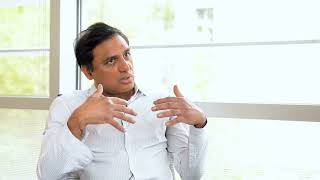
In this interview, Praveen Tipirneni, CEO of Morphic Therapeutics, explains how the company evaluates out‑licensing opportunities, emphasizing two core criteria: scientific/technology fit and the depth of existing relationships. He uses the Janssen collaboration as a case study, describing how long‑standing personal connections and mutual trust drove the partnership, and contrasts it with a different culture experienced in a collaboration with AbbVie. Tipirneni highlights that early‑stage collaborations are technically and legally complex—governance, IP, and deal terms are critical early markers of future success. He argues that cognitive diversity—different perspectives, heuristics, and models—is essential for tackling novel, complex biology. The discussion then shifts to Morphic’s internal culture, which he defines not by perks but by the people retained, a narrative‑focused board that never uses PowerPoint, and a mission‑driven hiring philosophy. He acknowledges rapid scaling challenges as the workforce grew from ~30 to 80, noting the need to catch up on processes while preserving culture. Finally, he advises being highly selective when choosing early hires, partners, and investors, as these relationships shape long‑term success.
Chapters
I'm Praveen Tipraneni. I'm the CEO of Morphic Therapeutics. When we were looking to out-license one of our programs, that was obviously a very important question. 2 big criteria there. One of them is to think about whether it's a right fit from a technology and a science standpoint, because there are some companies that have strategic interest in certain spaces, and that's important for a long-term commitment. But the other one, which is relationships. So unlike a number of other potential partners, Janssen was one— this is one of those cases where the relationships actually were really deep on all different levels. I mean, all the way from Matthijs, who was a friend of mine, all the way to previous bosses to friends to colleagues to mentors. And so I think this is another way to think about partnerships is that, you know, when there's a long-term relationship on lots of different levels and there's a trust and an interest in working together because of previous relationships, you know, partners, potential partners try to find ways to work together, like where it makes sense and things like that. And so this was actually a case where really the relationship drove the the partnership because we were searching for ways to work with each other just because everyone had so much mutual respect for each other. Yeah, I think, I think the, the collaborations, especially these early-stage collaborations— it's funny, in business development, people love the billion-dollar deal, the, the big dollars and things like that, but these early-stage collaborations are are oftentimes way more complicated, certainly from a business development standpoint. I, I used to love when training BD folks to start with the early stage collaborations because they're just so much more complicated with the governance and the IP and things like that. So sometimes not flashy, but in terms of complexity, it's very, very high on these early ones. And so because of that though, navigating the organization that you want to partner with and in both the technical side as well as the deal side for these early stage collaborations is actually a really big good marker of how you will work together. And so if you're seeing all kinds of red flags there about how nobody is budging on deal terms and, and the vision isn't the same and things like that, I mean, that's a really good marker that it probably is not going to work out in the future. I think this is actually a really great example of that because when Mark Arians— Mark Arians is at Janssen, he's the head of cardiometabolic at Janssen. And when he said, I want a true collaboration here, right? I said, it's not a collaboration where you guys will do all the work and then, you know, come back to us and then we will be on the governance committee. I really wanted a collaboration. He says, I really wanted a collaboration where both teams are going to be working close side by side. And then he looked at me and I said, me too. And he was super surprised. He's like, you do? You want a collaboration like that? Because that's a hard collaboration. That's not an easy collaboration. It's much easier when you're working within your company, but when you have to work across companies, especially in close collaboration, that's a difficult thing to do. So why was I interested in that collaboration, and why are a lot of people not interested in that collaboration? Because, you know, when you have really hard problems, you want cognitive diversity. You want that. And I think it can be diversity in the way we often think about it with gender, ethnicity, and things like that. But in this case, that's a marker of cognitive diversity. And here, It's actually pretty straightforward. I mean, there are lots of studies on it, but there's a fairly straightforward way to think about it is that each different person brings a different set of perspectives, a different set of heuristics, a different set of models. And so if you have super high ability folks, but all with the same perspective, the same models, the same heuristics, you're not going to get at those parts of the solution that you would with a much more diverse set. And so it was a very simple way of thinking about it in this this particular collaboration, we're working on very novel biology, very complex problem. And although, you know, it is a challenge getting these collaborations both negotiated and operational, the chance of success in the longer term is much better. In this case, unlike other collaborations we have where the teams know each other so well on so many different levels, right? And so I think in this case, it usually is a big challenge because, you know, just the different companies have different ways of operating. Like, for example, we have a collaboration with AbbVie as well as a collaboration with Janssen, and the two collaborations are completely different. How— and no, you know, no better or worse than each other, but just different because the cultures are different, the way they operate is different. I think in, in the case with Janssen, it is a more complex collaboration just because it's earlier stage and it's at a more nascent stage. But because the relationships have been so strong that in what would have been a big challenge, I think, with other companies, with Janssen hasn't been a big challenge just because we've— there's been so much trust and relationship that's been longstanding. You know, that's about 20-plus years of knowing each other. Yeah, I think I do have a perspective on this that is a little bit different. It's— I think when people talk about culture, oftentimes what you hear is about perks. So these are food every day, you know, the ping-pong tables and things like that. And I'm not saying there's a right or wrong to it. I mean, we don't have food every day, even though, you know, lots of people say you need to have food every day, otherwise you attract anybody. You know, we don't have it, and I don't think that you need it. But, but again, there's no right or wrong answer there. But that's not culture. I think the culture has to be specific to your mission and what you're trying to accomplish, you know, as an objective. And so I think a simple way to think about it though is that it's about really about the people you retain. Because a thought exercise I always do is, okay, if, you know, we talk about cultures and companies, if all the people leave, is there a culture left? So in some ways, it is really about the people, right, and who you're hiring and things like that. And so for me, when I think about our culture and what we are trying to accomplish, difficult problems, really staying close to the science, high ability, people who are serious in getting medicines to patients, these are all things that I value. And I think one representation of it that for me shows what's important to me and then filters down is that, you know, when we are doing our board meetings, I think it's probably the only board in the world that has never seen a PowerPoint slide. And for me, I like people writing and I like their narrative because, you know, I think of— when you think of science and scientists, what do you think of? You think of journal articles, you think of Science, you think of Nature and things like that. And why Why would you try to dumb that down? And so, but I think by putting that effort into the board meetings, it shows kind of what's important to me and it filters all the way down. So those are the things that I think are what matters to me from a culture perspective. I think the challenge has been growth, to tell you the truth, is that the— we in some ways, you know, we've had somewhat of a— there's always ups and downs, but you had somewhat of a charmed existence until, you know, last November. And with the imminent movement of our assets into development with the two collaborations. You know, we've grown from 30 to above 60. Now we're going to 80. And so, you know, kind of the rise of development, the more than doubling of the workforce has certainly brought in all kinds of challenges over the last few months that we didn't have to deal with. So we're in some ways, I think we're catching up with all the processes. We, I think we thought, we thought about our culture, we thought about our process very carefully, and so we've had a pretty seamless route to this point. But I think now, actually, it all, the momentum hit so fast that now we're starting to catch up. You really want to be very, uh, what's the best way, very choosy about who you work with, and that's on so many different levels, you know, who Be very choosy about the first few people you bring in because that's going to determine, you know, your culture and your standards for a very long time. Be very choosy about your partners. Be very choosy about your investors. You know, you can't be perfectly discriminatory in all these situations, but to the ability that you can, really try to get the right partners for you, the right people for you, because that's going to make everything so much easier. And you spend more time with all these folks than you do with, you know, your family, you know, when you're in this type of situation. So that's going to have all kinds of downstream, you know, positive effects if you pick very carefully.