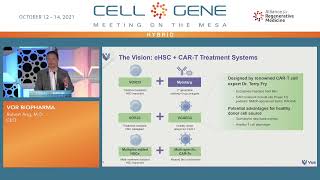
In this presentation, Robert Ang, CEO of Vor Biopharma, outlines the company’s mission to transform cancer therapy by protecting healthy cells rather than solely targeting tumor antigens. He begins by emphasizing Vor’s three core values—passion, fellowship, humility—and how these guide collaborations, especially with ARM. Ang explains the fundamental limitation of conventional targeted therapies: the same surface markers (e.g., CD33) are present on both malignant and normal cells, leading to severe on‑target toxicity and many clinical failures. Vor’s novel approach flips this paradigm by genome‑editing healthy hematopoietic stem cells (HSCs) to delete redundant proteins, rendering them resistant to antigen‑directed drugs. The platform rests on three pillars: (1) use of HSCs, the blood‑forming cells that can repopulate the entire hematopoietic system; (2) precise genome engineering—starting with CRISPR‑Cas9 and expanding to Cas orthologs, base editors, and multiplex edits—to create treatment‑resistant cells; and (3) generation of allogeneic CAR‑T cells from the same healthy donor source, enabling matched stem‑cell and T‑cell products. The lead clinical program, VOR33, is a CD33‑edited HSC transplant combined with Pfizer’s CD33‑targeting antibody‑drug conjugate Mylotarg; enrollment is open and data are expected in early 2023. Vor also plans VCAR33, an allogeneic CAR‑T derived from the same edited donor, and future multiplex‑edited HSC products to address tumor heterogeneity and escape. Ang reviews Vor’s history—from its 2015 founding (named after the Norse goddess of wisdom) and incubation at PureTech Health, through Series A (Feb 2019) and Series B (July 2021) financing, IND filing during COVID, to its recent IPO—and highlights key leadership (Bob Petrusko, John King, Sadek Kassam, chairman Matt Patterson). He concludes by underscoring existing collaborations with ARM and the need for unified effort to bring high‑quality, transformative therapies to patients.
Chapters
Good evening, everyone. So great to meet in person, isn't it? I mean, I got to say, I was a little apprehensive this morning putting my suit pants on for the first time and post-COVID, worrying that it wouldn't fit. But it's still great to be here and really great just to be part of ARM and the collaborative efforts that we're doing to bring transformative therapies to patients. So what I hope to be doing for you today So telling you a little bit about VOR, who we are, the kind of work that we're doing. I'm gonna talk a little bit about our history and lessons learned for us, and then really how we can collaborate in the future, which is I think the reason why we're all here. We are a public company now, and so I point you to our disclaimer slide at your leisure. I start with Vohr's core values. So Vohr has 3 core values, as you see on the slide here: passion, fellowship, and humility. We take these core values very seriously. The reasons why I'm telling you about this is firstly because this is our DNA. So if you interact with Vohr, and hopefully with me and with other folk, you at least know what we aspire to be. We may not necessarily represent that in the moment, but this is the kind of company that we really try to be. But why it's also here is because these kinds of values need to resonate just not within our company, but we'd like to do that for people we collaborate with as well, and for members of companies involved in ARM. And so I think this kind of DNA of who Vore is also reflects in terms of the DNA of what makes up ARM and the differences we can make in our community and society at large. So if we think about the problem Vohr is trying to solve, if you remember back 20-plus years ago to the advent of targeted therapy where the whole premise was that you could target specific targets on cancer cells and kill these cells very specifically and leave healthy cells intact. And the whole premise was really that there could be this set of targets that you could pursue, and with that kind of specificity, unlike the kind of sledgehammer radiation chemotherapy that we all, you know, love to hate. And that was an amazing paradigm, really targeting these cell surface markers. However, I think we quickly realized that the paradigm is not what it represents to be. And instead comes what we see in the middle panel here. So the reality is that any targets we genuinely pursue are expressed not just on healthy cells, but also on healthy cells— no, on cancer cells. And so you end up having this overlap, really because cancer comes from us, right? These are cells that are out of control, and this overlap in targets results in the fact that we get this severe on-target toxicity. That on-target toxicity not just translates into difficulties in developing products, but really explains a litany of failures that we've seen in the targeted therapy space, including in CAR-T work. And so what VOR is trying to do is a little different. When VOR was conceived by Siddhartha Mukherjee, if you haven't read his books, you really shouldn't be here right now. But he really had this novel idea that maybe instead of pursuing targets harder or faster, stronger, maybe you can work on the healthy cells instead. And so this is the advent of what we're trying to do at VOR. We are trying to edit healthy cells and essentially protect them from targeted therapy. We're doing this to start with in engineered hematopoietic stem cells. And what we're doing is what the phenomenon that you see on the right side here, where you can carve out expression of certain biologically redundant proteins from healthy cells, and therefore target cancer cells in a much more specific way, because now in the body of the patient, the only cells that should be expressing these targets are cancer cells. So that's really the concept behind Vor. So how are we trying to do this? Well, we do this with a platform made of 3 different elements. So the first element is we use hematopoietic stem cells. So these are the same cells that you use for a hematopoietic stem cell transplant, really a mainstay in liquid tumors such as acute acute myeloid leukemia. Hemopoietic stem cells are pretty magical cells, right? So these are cells that repopulate the entire blood system that, you know, create all kinds of differentiated cells of various different functions. The cells that actually are largely quiescent, and so they end up having difficulties in the way you need to manipulate these cells and even have different ways that they induce genetic repair. And so we want to make sure that we can manipulate these cells without doing any harm to the HSCs or their progeny. So the second thing that we're doing— sorry if I'm having trouble advancing this— is we are genome engineering these cells. So we start with CRISPR-Cas9 that we all know and love, but we're also moving into Cas ortholog enzymes and base editing approaches where we can manipulate these hematopoietic stem cells and create cells that are treatment resistant. And so we're starting with single edits, but we're also going into multiplex editing where we can give patients even more treatment optionality. Lastly, the third element of our platform are CAR-T therapies. These are CAR-Ts that are derived from allogeneic healthy donor sources. Why healthy donor? Well, what we can do is we can source cells from healthy donors for the hematopoietic stem cells, but we can use exactly the same cell source, in fact, the exact same apheresis product. We can take T cells and create CAR-T therapies out of these. The theoretical advantages are that these are healthy cell phenotypes that haven't gone through treatment because they're from healthy donors, and it's inherently matched to the stem cell therapies the patient would have just received. And so we're pursuing this not just with single targets, but even with multi-targeted strategies for the CAR-Ts. So what Vor is trying to do is firstly, we are entering a clinical trial where we are using Vor33, which is a CD33 gene-edited hematopoietic stem cell. So this is a stem cell transplant product that is missing CD33 expression. And we're marrying this with Mylotarg in the clinic. Mylotarg is an antibody drug conjugate. It's marketed by Pfizer. And it's very potent at killing anything that expresses CD33. This is going to be really important. So we're actually opening— we're open for enrollment right now. Treating patients, and we'll be hopefully demonstrating that our HSCs engraft like any regular transplant, but really opening this whole paradigm that you could couple with targeted therapies to change lives of patients. So we're not stopping there. What we're also doing is marrying this to CAR-T therapies. So VOR33 can be married to something that we call VCAR33. VCAR33 is a T-cell therapy where we hope to have that even more potent than Milotarg, maybe even more target-specific, and therefore potentially even better outcomes for patients. But we're not stopping there. What we're also doing is multiplex editing these hematopoietic stem cells so that we can essentially have more than one bite at the apple, so to speak. Pursue more than one target at a time, and hopefully worry a lot less about things like tumor escape mechanisms or tumor heterogeneity. So just to talk a little bit about history. So Vor, in case you're aware, is the Norse goddess of wisdom. It was started back in 2015 and incubated by PureTech Health. Things started accelerating once data was generated, particularly from our founding institution at Columbia University. We raised a Series A in February 2019. After that, things really accelerated. So, we managed to meet with FDA in a pre-IND setting at the end of 2019. We had a very questionable hiring process at the— in August of 2019 too. And then we generated more data, such as looking at targets even beyond CD33, which includes targets like CLO1 and CD123 that also exhibit very similar characteristics to CD33, where these targets may be biologically redundant in these stem cells and therefore make great targets to pursue with the VOR approach. So that catalyzed a Series B financing in July of last year. We then managed to file an IND in the middle of COVID And that triggered an IPO, which happened earlier this year. And now it's amazing that we are open for enrollment, treating patients. So let me just talk a little about what to expect next. So as we are treating patients in the clinic, we hope to be showing initial clinical data in the first half of next year for this initial approach of VOR33. With MalaTag. And we show— we hope to show that our cells engraft like any regular stem cell, and that these HSCs and their progeny function the same as any regular stem cell and their progeny. We'll be then marrying this to VCAR33 in that combination, in the treatment system combination. We're expecting to file an IND in the second half of '22, and really looking for transformative outcomes through that kind of combination approach. The CAR-T, in the meanwhile, is being studied in the relapsed/refractory setting at the NIH and at other institutions. And so we're looking forward to seeing their data sometime in the '22 time frame. Now, I just want to end with a slide just to talk about the ways that we're already collaborating with ARM and with many of you here. So we have some amazing people here from VOR, including Bob Petrusko, who's our Chief Regulatory and Quality Officer. VOR has a long— Bob has a long history in cell and gene therapy, and in fact was one of the pivotal people, who was responsible for AMAT designation at FDA. We also have here John King, our Chief Commercial Officer, who really focuses on market access and value and really reminds us every day about the value we need to be demonstrating to patients, not just to justify pricing and reimbursement, but really that fundamentally drives what we do for society. Many of you are also familiar with our Chief Technology Officer, Sadek Kassam. Sadek is an industry legend, having started his career at the NIH working for Rosenberg, developing the first CARs that went into humans, and is now spearheading work where we are developing our own in-house GMP manufacturing capability not just of engineered HSCs, which are tricky to produce, but also in-house work that we can use with CAR-Ts. We hope to be commissioning that in the first half of next year, really being able to intimately own and control our process because, as you know, our product is our process. Lastly, this wouldn't be a proper presentation without the appropriate sucking up to my boss, Matt Patterson. But Matt is our chairman, previous chairman of ARM, and I think really reflects the kind of collaboration that we need to see in this community to make sure that we can be there for each other through thick and thin. We've already seen and heard in this week around data that's been released and skepticism in the field. This is the time to unite. And really work together to get through those road bumps, create high-quality therapies for patients, and really aim to transform their outcomes and their lives. So that's all I have for you today. I will be at the back of the room if you'd like to touch base with me directly. Thank you very much.