Founder Stories: Stéphane Bancel, CEO of Moderna
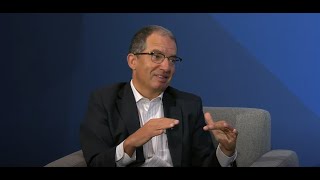
In a Flagship Studio interview at the JPMorgan conference, Moderna CEO Stéphane Bancel explains how Moderna’s identity as a “digital‑first” biotech shapes every aspect of the company—from rapid, data‑driven drug development to a decentralized, machine‑enabled operating model. He describes the company’s growth from ~800 employees in early 2020 to over 4,000 today (with a target of 6,000 by year‑end), and how Moderna preserves its bootstrap culture by emphasizing speed, high‑quality data, and a learning‑from‑failure mindset that is championed from the top down. Bancel details the current R&D spend ($4.5 bn) and the breadth of the pipeline, highlighting a chronic heart‑failure program that leverages mRNA‑delivered relaxin, and outlines “far‑shore” ambitions: a universal, single‑dose respiratory‑virus vaccine platform, vaccines against latent viruses (EBV, CMV, HPV, HIV), and a push into genomics and next‑generation gene‑editing therapeutics using mRNA‑encoded enzymes. Throughout, he stresses the importance of clean data, AI, and a culture where any idea—regardless of seniority—can win, and where failures are dissected openly to accelerate learning.
Chapters
Welcome back to Flagship Studio. Here in the studio this morning, we have Stéphane Bancel, the CEO of Moderna. Stéphane, we are so thrilled you would take some time from your busy week at the JPMorgan conference to talk to us. I want to talk first about digital because you talk so much about digital. You talk about Moderna as a digital-first company, which is not something you often hear about biotech or pharmaceutical company. What does digital first mean in a Moderna context?
Sure. Good morning and thank you for the invitation. So if you think about mRNA, because it's information molecule, we wanted to build the company in a way that we maximize the impact of that technology to patients. And, you know, I had the chance when I worked in larger companies before to to realize that in most companies, business processes that cut across groups go from digital, analog, analog, digital, digital, analog. And when you think about it, when you have digital information, you never want to lose it into an analog format. And so the challenge of Moderna from the beginning, as we talked about it with Noubar, as we were kind of bootstrapping the company and thinking about it, it was very clear to us that this will be are we a company going bankrupt because we run out of money before we have a product, or are we a company with a lot of product? It made zero scientific sense this would be a one-drug company. And so the thing I obsessed a lot about was scale. How do we scale this to 10, 20, 50 drugs, 200 drugs? I mean, we have 48 drugs today in development.
48?
48 today. And there's 50 more in the labs cooking. So the obsession was always, okay, how do we really maximize the impact of mRNA to patients. And when you think about mRNA, because the cycle time could be so fast, the development cycle time, you know, I remember in pharma, if you think about value creation, is having a great drug going after a great target, making that drug to market, so the probability of success, and the speed of development, because patients are waiting and your IP clock is ticking. And so As we started from a white page of paper, I'm like, we just need to build everything digital because it's so much easier to build from scratch digital than when you have everything analog on paper. Changing the engine of a plane as you're flying the plane is really hard. When I was at Lilly 22 years ago, we did a big SAP implementation like companies were doing at that time. And it was so painful and so costly. And it was not done super well. And so the idea here was, how do you build this company like if you had a magic wand that it's run mostly by machines that use people's brains to do like great scientific innovation, coaching people, HR, but that everything that can be done by a machine, why would you have a human do it?
And what's the answer been?
So we have been really digitalizing a lot commercial because we went so fast into commercial because the pandemic still has a lot to build. Manufacturing is already in an awesome stage, still a few more, but research is actually at the point now where we're doing a lot of AI work. Why? Because we have clean data. Because you can only do AI, as you know, with big data that is, of course, clean and relevant. And so the piece that is really interesting about how we run the company is that we are able to decentralize the information to a lot of people at the company. So that you don't have, you know, kind of management slowing down everything, but you have everybody at the company having access to all the data. And you think about digital, what I think it provides first is quality. Because if you think about what we do in the life science work, we just spend our time looking at data. We have an hypothesis, we do experiments in animals, we get data, we decide to do something else based on the data, and then we do what is called a clinical experiment, where you go into human and you do step by step for safety reason, phase 1, phase 2, phase 3,. But at the end of the day, you want to interrogate an hypothesis about a drug into a human. It's clinical research. And you look at data again to decide, do you take the drug forward or do you kill it? And so I think high-quality data is key because you're going to make hundreds of million-dollar decisions on data. You better make sure the data is right. The other piece is speed. Think about a company where everything, when you have a 20-step process to be done by hand on paper with mistakes, whereas if it's all done in real time like this by computer, it just changes everything.
I'm going to come back on AI because there's so much talk here this week on AI. But you talked about speed and scale, and I want to talk about that in a human context. When you were last at JPM in person, that would have been January 2020. Yeah. How many people worked at Moderna in January 2020?
Around 800.
800. And today, 4,000.
4,000. And at the end of this year, 6,000.
6,000 at the end of '23.
We're, we're, we're hiring 2,000 people.
So thinking about speed and scale, let me add a third concept, which is culture. You're known to care a lot about culture. How do you scale a culture from 800 people to 4,000 to 6,000 and keep the essence of those bootstrap days and the culture that made Moderna Moderna as you scale? What are your strategies?
So that's the number one challenge that we have today. If you think about the company, I've always thought about the company as science and technology, capital, and people. Well, we have a lot of capital. Science and technology is fantastic and growing, and we have an amazing team leading the science.
A lot of coverage this week on your increased R&D budget. Yeah. 40%.
Yeah. $4.5 billion, like Amgen. It's kind of crazy. And people, the challenge we have, in the industry is most companies have relied on small or large molecules that are few targets, 15 PD-1s or whatever, everyone doing the same thing, most things failing, and everything really slow. And so if you think about it, the biggest challenge we have as an enterprise is how—
Limits, slow, and failure, basically.
That's the industry. And for Moderna, it's abundance of targets, high probability of success. We always give you the same chemical matter in your body by application and speed. And so the biggest challenge we have is to find and cherry-pick the people from industry, being pharma or biotech, who have the intrinsic mindsets to be able to operate in a world that is totally different. Where we ask people to take calculated risk. In pharma, you are trying to not break anything, because very few things work. So if they work, you don't want to break it, because it's like a special jewel. But we believe that the most important thing we can do as a company in a new technology with a massive S-curve that we are just ramping up as we go is learning fast. We always said since the beginning, we won't have to be the smartest, and we should never assume we're smartest. I think it's a very big business danger. But we have to run the fastest in the world. And so we need the right people that are willing to take calculated risk, learn from mistakes, share their mistakes. So—
How do you operationalize that in a company, sharing mistakes?
So you do it starting from the top. I say I'm wrong 5 times a day, on a good day. On a bad day, it's more. Because we wanted to create a culture of debate, where it's the best idea that wins. We don't care your age, your gender, the color of your skin, any of those things, we don't care. We want the best scientific or business idea. To win, to make the company stronger because it's all about compounding.
Can you think of examples in your meetings where a junior person, a person newer to the company had the best idea?
Oh yeah, and it happens a lot, especially in science. So Stephen Hawking, who runs our science, is really quite amazing at when there's a big problem that something fails, first he gets energized. That's a thing that's really amazing about Moderna, and Stephen really set that culture by leading from the front since he was there 10+ years ago. Is in most companies I've been with before, when something fails, everybody runs away. Nobody is really involved with a project that failed. At Moderna, it's just the opposite. Why? Because we're obsessed about learning. And Stephen was convinced a long time ago that you learn more from failures than from successes. Because as humans, when something works, because you assume it was going to work, you don't really question what went into that work. But when something fails, if you really want to fix it,— you have to really take a step back and say, we thought that thing was going to work, but it did not. Where— So what are all the things that could explain what we observe, which is it doesn't work? So Stephen will gather people across functions. He doesn't care about org charts. He will just go and grab the best people, regardless of age and anything, get in a room and start on the board, okay, why did this fail? And just throw ideas, no critique, nothing, just write all the ideas from everybody. And then they spend a lot of time critiquing the ideas. That's why every voice is heard because a drug is a system. So it might be this time for this person, the other time it'll be a process engineer, we find out the true reason why it failed. And you want to create that culture where people are energized because nobody gets blamed because it's all about learning.
There's so much I want to discuss there, but speaking of things that are on their way to working, You spoke yesterday in your presentation about chronic heart failure as a clinical program that's advancing, and I think there's been less attention to that externally. Can you talk a bit about that program and where you see it going?
Sure, I'm super excited about this program. So heart failure, as we all know, big problem. A million hospitalizations in the US every year, US only. 1 million in the US. 1 million people a year going to hospital. It's really, really bad from a public health standpoint. And so We're very excited about the program because the technology that we use, the mRNA technology, the lipid, everything, has already been used in 2 drugs in the clinic. And on one of the drugs, for a year, those every 2 weeks in kids with very bad rare disease, where the safety bar is very high, looks very well tolerated and so on. So we're very excited about the technology and the probability that this technology is going to really work from safety standpoint. On the biology side now, the reason I'm really excited about this protein is two things. First, it exists in nature. Relaxin is a protein that exists in our DNA that women use and make a lot of during pregnancy. Why? If you think about pregnancy, and this is where evolution is this beautiful human machine, during pregnancy, very quickly, a woman, because of the baby weight, the placenta weight and the liquid weight, has a heart that has to work much more very quickly. And then it goes away after delivering the baby. And so people have—
A woman's heart still works very hard after delivering a baby.
Of course. It does work. Because now you have a kid. If you think about, with time, it's not the same job. And so then the quantity of relaxin goes down. So people have studied that protein. And that protein has a very important role in modeling the heart. In the heart function. And so based on that biological insight coming from mostly academia, Novartis has tried to make that protein as a drug using recombinant. But that drug failed in phase 3. So why did it fail? Because the half-life of a protein is very short. It's minutes. And so they realized that the only way they could give that protein to human as a recombinant was was a 48-hour infusion, which commercially is really heavy. So what they tried to do with the R&D team, I'm sure talking to the commercial team, was, hey, with 48 hours, are you crazy? They designed the drug in a clinical trial as you give infusion for the 48 hours before you release somebody from hospital. And so if you look at it, just after being released from hospital, the impact on the heart function is great, because of course the drug works. But over time, as you don't re-give a drug again, the effect goes down. Okay. And the drug didn't meet its endpoint and was not approved. But what if you could give that drug every 2 weeks or every week? We will learn the frequency in the clinic. And the beauty of mRNA, we got lucky on that one. One dose, the mRNA lasts in your body 48 hours. Okay. Bingo. And so when you pick up all those pieces and how we think about drug development is We know the technology is de-risked, the amount of technology in the lipid. We know the protein is a human protein. We know what it does in humans in the clinical trial of another company. So put all those pieces together, it's like, geez, these figures have a really high chance of working. And we're going to— so it's in the clinic in patients directly with heart failure. We're going to learn very quickly, and if it works, we will move very quickly to pivotal.
It's really exciting. Last question. Newbar's annual letter talked about the things you can only find far from shore. The ability to see the stars when you're away from the ability to see the shore. What are the far-from-shore things you're working on and that most excite you at Moderna? I think 3 to 5 years, what are the big leaps at Moderna that you'll be talking about at JPM 2028?
So some we're already talking about, but I think they'll be real in terms of launch product, is if you think about the respiratory viruses, and of course with COVID we've talked a lot about this, for me, the respiratory virus as a class, all of them together, they were in 2019 pre-COVID The third cause of death around the planet, WHO data. Third cause of death. So if you think about what we're trying to model now, which is getting to one dose, all the mRNAs we need against flu and COVID and RSV and more viruses that you get once in the fall at your local pharmacy or doc or at your company as a benefit, and you're set for the winter. What if we could move that third cause of death around planet to number 20 or 30?
Third cause of death in pre-COVID, non-COVID times.
Pre-COVID. Yeah. So that's one thing I'm really excited about. The other piece is latent virus. So latent virus, for the non-biologists, are those viruses that once in the body are in the body forever. You cannot get rid of them. Yeah. Some of those cause— Like EBV. Yeah. EBV, CMV, HPV, HIV, and quite a list. Most of them don't have a vaccine. To either prevent them or to treat them if you already are infected, because it's in your body, you can do nothing about it. All of those create long-term massive damage. You know, EBV, multiple sclerosis. Most of them create cancer, because having a foreign piece of DNA in your cells forever is not a good thing. So it's already believed that maybe 30-ish percent of cancer have a root cause being a virus. But we believe it might be more 40 or 50%. So what if we could— at Moderna, we're working on it— develop vaccines for all of those, to get those available to teenagers like HPV is? It should be given to every young girl and boy to prevent cancer in the long term. That will have a huge impact on cancer rates. Of course, our work in cancer gets me very excited. I think we can even go early to liquid biopsy. Get a liquid biopsy. We get the genetic information of your tumor, we make a product for you when it's very, very early to teach your T cells to do what they're supposed to do. Genomics, most people don't realize, we've talked about it publicly, I believe we're going to become the biggest genomics company on the planet because we're going to leapfrog the CRISPR-Cas9 company and so on because we have now huge investment in gene editing. We're looking at third and fourth generation of gene editing enzymes that we code in our mRNA technology. So instead of coding the mRNA to make spike protein or relaxin protein, we will code— we're doing in the lab, but we'll code in human the mRNA to do an enzyme that's going to go and edit your DNA. But if you think about it, we have all the manufacturing infrastructure of Moderna, all the suite of technologies for delivery. The issue always with nucleic acid being RNA, gene therapy, mRNA, is always delivery, getting the genetic material in the right cells. But that's what we do for a living. We already have 7 applications. We're working on another 4 or 5, and there's maybe 10 more coming in the next few years. So once we're gonna get the right enzymes, you're gonna see this company flying. We can go from zero gene editing program to 40. Everybody's like, what? And that's what Moderna is doing.
I look forward to my 2028 interview with Stéphane Bancel and talking about the largest genomic company in the world. But for our 2023 insights, we'll think about Bringing energy to failure, following the smartest idea regardless of where it comes from, continuing to ask what if even after you've answered the first question in a blockbuster way, and 50 things cooking in the kitchen. We've got to let you put your apron back on and go back to the lab. Thank you so much for joining us in the Flagship Studio, Stéphane Bancel.
Thank you.
More from Joshua







Scientist Stories: Hans Waterham, The value of phenotypic assays in peroxisomal disorders




Scientist Stories: Joel Zlotogora, Genetic carrier screening programs for reproductive purposes