Founder Stories: Stéphane Bancel, Founding CEO of Moderna
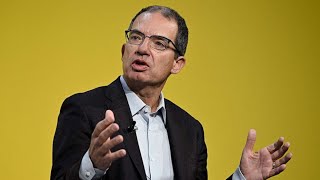
Stéphane Bancel, Moderna's founding CEO, discusses how mRNA works as a platform for medicines previously impossible to make, outlines vaccine programs for influenza and cytomegalovirus alongside cancer and genetic disease therapies, and explains why the company turned down IP waivers. Moderna ranked among the top three most reputable U.S. companies in an Axios-Harris poll.
Chapters
Now I want to introduce to you our first interviewer, and that is someone who I absolutely adore. I've spent my entire career in, in digital health. I'm currently the head of marketing for virtual pain platform Fern Health, and it is my pleasure to work with one of the, the person that I would say transforms New York City's health. New York City into the center of health transformation, and that is Bunny Ellerin. And Bunny is the co-founder and CEO of a professional network that I am a member of, and anyone in the New York area in the health business world should be, and that's called the NYC Health Business Leaders. She also is— because none of us are happy to do just one purpose-driven thing at a time— she is the director of Columbia Business School's program for healthcare and pharmaceutical management. So give Bunny a follow. She is a person to know. And without further ado, Bunny, I turn it over to you.
Thank you, Tara, and welcome everybody. Tara is a Clubhouse force. She's taught me everything I know and then some. So make sure to follow Tara. Make sure to follow all of the speakers. A couple of weeks ago, the Axios Harris poll came out on corporate reputation.. And both Moderna and Pfizer were in the top 10. This is, this is remarkable because never before has a biotech or pharma company been in the top 10. And Moderna landed at number 3, again remarkable and really truly a big deal for the industry as a whole, which most of you know historically has not had, you know, the best press and hasn't been viewed as favorably as some of us who work in it, you know, would have liked. So, you know, as I do, I reached out to the CEO of Moderna, Stéphane Bancel, to see if he'd be interested in talking about this and more on Clubhouse. And he said yes. So here we are. So Stéphane, I'm going to just give you a little bio and then we're going to get into Q&A. So full disclosure, I have known Stéphane since he graduated from Harvard Business School in 2000. And last November, I really had the honor of presenting him with an Alumni Achievement Award at HBS. And it was right on the cusp of the vaccine's approval. Now, just to give you some perspective, in 2000, when Stefan graduated, tech was the big thing, right? And he could have done that. But no, he wanted to go into life sciences. That was his passion. Lucky for us. And at the time, joined Eli Lilly. Where he eventually led operations in Belgium. He then went on to serve as the CEO of Biomérieux, a French diagnostics company, while only in his mid-30s. And then in 2011, he became an entrepreneur and co-founded Moderna. So welcome, Stéphane. And big news today, we just saw that the vaccine is effective for 12 to 17-year-olds. So, and you're gonna seek FDA authorization. So that is fantastic. My first question for you is, you know, Moderna has been around for a decade, right? It sounds, it seems like an overnight success, but it's been around for a decade and no mRNA drug really had been commercialized before for the vaccine. So can you tell us a little bit about some of the factors inside and outside that led to like this, spectacular success story. And now I'll go on mute.
Thanks, Penny. Hello, everybody, and thanks for the invite and the kind words. So, as you said, I do the same, I remind people this is not an overnight success. This is 10 years of hard work and a lot of people, you know, sweating bullets to make this technology work. Now, when we started this journey 10 years ago, everybody thought in the industry that I was crazy to think we could try to make mRNA a safe and effective new drug modality. And I think there's a few things that people need to kind of know about mRNA. So first, mRNA is an information molecule. It's a molecule we all have, you know, in each of our cells. We use, you know, a lot every day. And that molecule basically carries genetic information from our DNA into our cell to go to a little machine called the ribosome to make protein. And so the reason I got really excited, despite we only having, you know, data in one experiment of 10 mice, at the time I decided to resign from Biomérieux to join Moderna was first, if you could find a way to make safe mRNA in human, turn into protein, you could make hundreds, maybe thousands of medicines that are just physically impossible to do with either small molecule, the traditional way to make pharmaceuticals since the beginning of the industry, you know, 150 years ago, or protein or recombinant technology like, you know, Amgen, Biotech, and the whole industry after them has created. So that was the first super exciting thing is you could do medicines for patients that are just undoable with existing technology. The second piece that was very exciting to me because I've been totally traumatized in pharma by the 90% failure rate of drug in development was because mRNA was an information molecule, because what you code in the mRNA exists in life, it's protein that are coded, you know, in DNA and have existed in humans safely for literally millions of years. And because we use the same chemical matter to make mRNA coding for insulin or mRNA coding for flu vaccine or COVID vaccine or anything we do, we believe the probability of success once the first drug was to be safe in the clinic, show efficacy, gets approved, was going to be significant for the rest of the portfolio. And we're going to have basically a platform which has never really existed in the industry. The industry is really more of an analog-type industry. The third piece that was very exciting to me is if we were going to invest in process development, in IT, in robotics, because we made all the mRNA the same way, the speed where we could do drug discovery in the lab, the speed at which we could get into the clinic, the speed at which we could scale manufacturing for commercial was totally unheard of in the industry. And so those things made us kind of raise a lot of capital, work really hard, and build a portfolio of drugs because People know Moderna from the COVID-19 vaccine, and it's kind of super humbling to think that, you know, almost every other vaccine that has been used in the US has been used with a Moderna vaccine. So this is kind of a strange feeling when you walk down the street and you look at people. It's super humbling and super exciting at the same time. But we were working on the big pipeline, though. We have many more vaccines. Which we can talk about. You know, we have drug against cancer. We have drugs where we're trying to rebuild your heart blood vessel after a heart attack. That's in the clinic as well. Rare genetic disease. And the last big thing we are going after is autoimmune disease. And we think we can have a very profound impact on autoimmune disease. Back over to you, Bernie.
Yeah, well, let's, let's stay on that because we asked folks ahead of time, you know, for questions, and that came up again and again. What else can we use mRNA for, and what else is in your pipeline? So we'd love to know more about some of what is to come.
So if you look first at vaccines, I think it's easiest for people to get their head around, given that we have seen a successful mRNA vaccine get to the finish line, is we currently have 9 mRNA vaccines that are in development. We have couple dozens being worked in research that soon will be in development. So just to name a few that I hope people relate to, we are working on the flu shot because we believe the flu shot we are all getting every year, how many of us are getting as low efficacy in a flu shot, 60% efficacy in a good year, down to 25 to 30% efficacy in a bad year. We believe that we should be able to get the world a flu shot in a 90-95% efficacy, and more fun, we should be able to combine the flu shot with a COVID variant booster in the single dose. So you can get at your CVS just one Moderna shot that will protect you with high efficacy against flu and COVID variant. You know, we are working on another vaccine which is against CMV, which unfortunately is not very well known. CMV is cytomegalovirus. That's a virus that causes the number one cause of birth defect in the US and around the world. 1 in 200 children has lifelong disability because mom got unlucky. She was naive to a virus, never been infected, and gets infected during pregnancy and transmits the virus to the baby. There is no vaccine on the market. It's a very complicated DNA-based virus. It has been the number one priority of the National Academy of Medicine for 20 years. Every pharma company has tried and broken their teeth on CMV. And we believe that because with mRNA we have the ability to make as many mRNA we want in the vial so that we can do the right biology for a specific disease. Well, this is a product with 6 mRNA in a dose coding for 6 different proteins at the same time in your body. The Phase 1 and Phase 2 data are extremely exciting, and we are weeks away from starting the Phase 3, and hopefully in a couple of years have the CMV vaccine authorized so that any young woman, you know, 16 plus can, if she desires, get vaccinated before pregnancy so that in the case she gets infected by this virus during pregnancy, she will not transmit it to her baby and have a healthy pregnancy and have a healthy baby. And there are many more vaccines we're working on. And then if you look at the therapeutic side, we have 5 cancer drugs in the clinic right now. They are all combined to an approved commercial checkpoint. So either Keytruda from Merck or duvalumab from AZ. And the idea here is, as most of you know, immunooncology has transformed cancer care in the last 5, 10 years. When people respond to an immunocheckpoint, it's like a miracle, you know, tumor metastases go away. But unfortunately, we still have a lot of people that do not respond and we don't really know why. And so what we're trying to do with mRNA is to add an mRNA medicine to an approved cancer immunooncology checkpoint to increase the percent of people that respond to the medicine. We have some early signal in head and neck HPV-negative cancer that we are chasing with a larger study. We have early signal for another program in a couple solid tumor type where the patient did not respond to a, to DURVA monotherapy and that when you test them with the mRNA drug, that's the IL-12 drug monotherapy, they start to see a response. And that's even before it's combined with a checkpoint. So it's early days, but it starts to be encouraging. In cardiology, I have one of the most exciting drugs I think we have in the pipeline. It's a drug coding for a protein called VEGF. That's V-E-G-F. That's a protein that we all use to grow new blood vessels when we cut ourselves and our body needs to make new blood vessels. Well, we are trying this medicine by injecting it in people's heart within 48 hours after a heart attack, because if you survive your heart attack, you will most probably die of heart failure, and your quality of life after your heart attack might be massively impaired because of the loss of heart function, because of all the heart muscle that has been damaged. Through the heart attack process and the lack of oxygen. And so what we're trying to do here is to inject people within 48 hours of a heart attack. It's one intervention. It takes around 10 minutes. You get 10 to 15, depending on the scope of your, your heart muscle injections of that mRNA coding for VEGF. What we have shown in pigs, and for those who don't know, Usually pig models are very predictive to human disease for cardiology. What we've shown in pigs and AZ published is that you see a very material improvement of the ejection fraction, the ability of the heart to pump effectively blood. The drug has been tested in Phase 1 with a very clean safety profile, and they've also shown in the Phase 1B the ability to increase blood flow in humans, which can only be explained because you have new blood vessels. And so now we are really testing the real thing in Phase 2, injecting the drug in people's hearts, monitoring all their heart function over a 6-month period to see versus a placebo group, can the drug have, have a natural benefit onto people's heart's ability to pump blood. We have drugs in rare genetic disease where we basically give the instruction that those kids are missing because they got the wrong instruction in their DNA from the half of the DNA they got from their mom and half of the DNA they got from their dad. And so we're trying to give them the instruction that all of us on this call have so that they can have a good protein in their body and live normally. And as I said, the last frontier for us right now autoimmune disease. And here the idea is, can you restore homeostasis? Can you restore balance in your immune system so that you don't have an immune disease? So those are some of the things, Bernie, we're working on. We're also working on the lung with Vertex. So there's a lot of things over time that we think this technology can do.
Okay, Stephane, you've been very busy. Obviously, it's really incredible how much you're working on and that and folks probably didn't know about. So really exciting.
Hey, Bunny, it's Tara. I just want to reset the room. We've had a lot of folks join as we go, so I'd love to reset the room. Reset the room.
Okay, go for it.
For those of you who have joined us since we've started, we're live with the CEO of Moderna, Stéphane Bancel. Being interviewed by two leaders in the business and healthcare space. We are going to open this up for hand-raising in the last 15 minutes or so. We have a lot of questions that were submitted ahead of time. We'll be tossing those to the stage. If you're one of those folks who submitted the questions and you're in the room, we will be asking you to come up and join and ask it live, and we'll be asking others as well. So I'd ask everyone if there's someone that you feel wants to join this conversation, you can hit that little plus button at the bottom of your screen and tap on any of those faces you see. And those are folks that are just waiting there looking for rooms to go into. So pop on, tap on any of them and invite them into the room. And, um, over back over to you, Bunny.
Okay, awesome. Um, so actually, Rob, I'm gonna turn it over to you to talk about the poll and Moderna and the pharmaceutical and biotech industry.
Thanks, Bunny. So Bunny, Tara, thanks very much for having me. For anyone who doesn't follow or kind of connect with Bunny, she is certainly one of the healthcare badasses out there that I've had a privilege to now collaborate with a couple times. She's also one of those people that is very fun to basically call up spur of the moment where you have kind an idea on something, which is, I think, where a lot of this kind of conversation came from. And I didn't realize the connection that Bunny had to Stefan, but obviously a very relevant and compelling one. Stefan actually— so I was going to say, I'm going to bring a bit of a public perception lens into the conversation. But I think Stefan has actually done a really nice job of laying out one of the most typical questions I get when I've been doing sessions on this. So I actually had the privilege of doing a session with the Financial Times Stéphane also spoke at about a week and a half ago. But the most typical question is kind of like, you know, what's next? How can the industry kind of sustain its momentum? And I think, you know, when you look at what Moderna has done and kind of some extraordinarily ambitious kind of plans for the future and the technology to kind of get us there, it's, you know, it starts giving you a very clear perspective on the answer. But I'm going to start with just a little bit of a step back in time. When you look at the vast majority of the last 2 decades, throughout which we've been looking at a variety of aspects of how the public looks at industries, the pharmaceutical industry has been much maligned. Most people can't really describe it, don't really know what it's about. And most often when they hear about it, especially those who don't have family members that are dealing with some very grievous medical condition that it's helping with, the first thing they think about is the business of pharma, the pricing of pharma, things not working out, things being too expensive, versus what's really happened over the last year and a half since the beginning of 2020 has been a massive catapult for the industry, literally a doubling of positive public perception about the industry and a very, very new face for the industry. Moderna certainly is a very front-facing part of the picture, but in general, the industry has just come into clarity, into focus for a lot of Americans in ways it hasn't in the past, which really has created this new aperture shift from the business of pharma to the science of pharma. And again, obviously, the way I think Stéphane took us into depth of what the science can do and what the new science that emerging is, I think gives you a very compelling vision for that. But very specifically, Moderna, again, I won't take too much more time on this, but Moderna, one of the reasons for this is Moderna has really catapulted itself into the public ethos. So we run a study for the last couple of years with Axios, but we've been running it for 22 years, where we start off by asking people in the public— this year is just over 14,000 people— which companies are most relevant today. And then the 100 most relevant companies, we then take them through a very comprehensive scoring mechanism where we look at things like trust, leadership, growth, products and services, citizenship, culture, and ethics. When we went through that process, Moderna was recognized as one of the most relevant top-of-mind companies, and then came in as a top 3, which is extraordinarily remarkable, as Bunny alluded to, because there's never been a biotech or pharma company that high. Clearly, a new perspective, both on who Moderna is, but then also for the industry. And one of the things I wanted to stress, and then maybe this is one of the things we'll ask Stefan to kind of expand on a little bit, is it's not just the vaccine, right? So clearly the vaccine is very much the tip of the spear. There now is a solution. It's very high impact. It's 96— again, like, it's 92-96% effective. Remarkable numbers. Virtually everyone who I know that's in more kind of clinical medicine, when they started seeing those numbers, it was just, you know, well above any sort of expectation that people had, so rather incredible. But it's one of the things that's been very apparent around the industry, and I think around Moderna as well, has been the people behind it, right? So A, the leadership, but then really the culture that's been enabling this to happen, right? So maybe, Stefan, if you can tell us a little bit about kind of that perspective, really taking on that more of a leadership mantle for the industry, and then also kind of what's the kind of culture that gets us here?? How does that work? And how has that worked at Moderna?
Sure. Thanks, Rob. I will start by talking about the mission. And I would like to try for you to kind of close your eyes and think you're back with us 10 years ago, and we are scratching our head and trying to think about this big idea. And the sense of, I would say, responsibility to the world, which is If we are correct and we can figure out how to make this work safely, which was going to be a very hard scientific journey, we can impact so many diseases because, again, the industry has been an analog industry for 150 years where most drugs fail. But if we can make mRNA work, the impact we can have in the next 50+ years on so many lives is just so profound. And so, we got a team of people that are extremely mission-driven. I like to tell people, we would walk on our knees a full marathon to make this thing work, because we just understand the impact on lives, the impact on happiness, on family, And that's really, I think, that has been kind of a big fil rouge of the company history, is an extraordinary sense for the mission. And then as we, as we build the company, you know, I would say in the first year or two, you know, we didn't really have a culture articulated. You know, we were running for our life. You know, we started with $2 million, which Bernie will tell you is not a lot of money when you're trying to do scientific research and animal work and getting ready to go to the clinic. And as we grew to, I think, around 150 people, we started to realize that we need to really talk about our culture. And so what we did is we took basically half of the team out for the— and we just asked people who had a chance to experience us, the founding team, since the beginning. Okay, so who are we guys? What's our culture? And after a couple, you know, roundtable and a few hours of discussion, basically we set our culture as saying, you know, the three things that are just non-negotiable is integrity, quality, respect. We kind of all agreed pretty quickly that we could not be the science-based company that does important medicine in a regulated world if we didn't have those three things: integrity, quality, and respect as what we call kind of our base camp, the non-negotiable. But then we ask the question, so in terms of who are we, how do we behave, what do we expect of people? And we picked four values that I think you will not hear from other pharma companies. And, Bonnie, I would love your thoughts, given you know the space very well. We said we're going to be bold. We're going to expect people across the company to be bold, which doesn't mean crazy, which doesn't mean breaking the law, which doesn't mean, you know, doing things that are stupid. But we're going to ask people to be bold in their scientific thinking, to be bold in how they think about taking a drug forward, because we didn't have any constraint from being a big company. That does things in a certain way for the last 50 or 100 years. We had a white page of paper, so we asked people to be very bold. We put a very strong emphasis on using robotics, digital technologies to allow us to actually ensure quality, ensure good data across the board. The second value that we, we try to exemplify as leadership and we talk about all the time is collaboration, which I know seems like a cliché. I've been shocked in big pharma companies earlier in my career how the companies were siloed, where you have a quality team and then the manufacturing team and they fight all the time. And then you have a technical process engineering team who fights with manufacturing and quality all the time. And then clinical and the science and finance and so on. And so we basically said from the get-go, say, guys, this is bigger than any one of us. It takes a village to make a medicine. No, no human has made a medicine alone ever. We will not succeed to our mission, to what we're trying to do to help millions by creating a new class of medicine, if we are not massively collaborative. And I like to tell people when I do Moss Mondays, the onboarding of new employees, that we don't expect only collaboration passively. We expect proactive communication. And the example I use with people is to say, look, I want you to think about when you learn something, who can benefit from that learning in your ecosystem. And I tell them that, you know, half of the email I send every day is when I read an email, I always have, you know, the filter in my head. Okay, who should know what I just learned? And sometimes I forward it to one person, sometimes I forward it to 50 people. Because I just try to push myself to think about, okay, who am I going to make stronger on the team? Who am I going to make more capable to make the next set of decisions a week from now or 2 years from now? Because that critical information, that critical education they have. So collaboration, number 2. The third one is curiosity. You know, we started this scientific journey having to be curious about everything. Asking why. And we believe this is a very long runway for this technology. You know, I believe deeply that like any technology that mankind has touched, it's going to go— it's going, I should say, through an S-shaped curve over time where the performance of a technology in the first, you know, months and years don't really improve a lot. And then you see exponential improvement of the performance of a technology over the next, you know, 5, 10, 20 years. And then when the technology matures, you see the performance naturally improving, maybe a couple of percent a year, but nothing kind of to lose sleep on. And so we really nurtured and wanted people to stay very curious about everything, to look at other industries, as we like to say, that look, we should not assume that Pharma is the best way to do everything. And so we really encourage people to look at the tech industry, to look at the car industry, to look at the industries around us just to figure out how to do things better, how to do things in a different way. And last but not least is the fourth value is to be relentless. We've had a lot of scientific setbacks over the years and we have a type of team that because of the mission being so much bigger than any of us, and I've been lucky, the founding team has been very relentless. And so we ask people to be very relentless. You know, I like to joke to people, if a door is closed, you know, figure a way to go by the window. If a window is closed, you know, go by the chimney. The rule is always, of course, don't do anything unethical, don't do anything illegal. Those are no-gos, obviously. But please kind of don't get stuck on the first no. Don't get stuck on the first failure because we're trying to do something really complicated that nobody in the world has done before. And if we succeed, the impact on healthcare over the next 50 years is going to be very profound. And we cannot be the team that fails humanity by not getting this technology to work. So those are kind of the 4 values as part of our culture that are not only in the walls, Rob, but that we talk about all the time and we try also to recognize and reward. When we do town halls, we always have a prize for the individual in the— since the last town hall— that best represents one value and also to a team that has exemplified that value. And it's, of course, to recognize people, but almost most important is to teach and to tell stories so that the rest of the company hear stories that we believe, as a leadership team, really reinforce the values just to continue the upward spiral. Back to you, Rob.
Jump in, Bunny. I know you had— Yeah, I was going to say, I'd love to talk at some point. But Bunny, like, I think there's a clear question there for you.
So please hop in. Yep. So, Stefan, you asked for my opinion, um, on your four values: bold, collaborative, curiosity, relentless. Um, no, I haven't seen, or I haven't, um, heard a lot of that from some of the other companies that I, uh, work with. And I think it's such an entrepreneurial but human, human spirit that you've that you're talking about with your company. And clearly it resulted in some pretty outstanding work this year, this past year, and I'm sure will go in the future. One of the, one of the key points that you talked about is collaboration, and that's something that Rob and I have talked a lot about in the industry itself. So Rob, maybe you can ask about collaboration.
Yeah, I think there's, you know, I mean, it's I just wanted to add on. I mean, the values and culture are such an important piece and, you know, I mean, the proof is just in the pudding, right? If you're able to bring it all together, it works. And if they're more kind of like words on a wall, then it doesn't, right? So it's, I think it's, you know, we've really, I appreciate kind of the story behind it, but again, it either works or it doesn't, right? So, and clearly you guys have figured out a formula that does. One of the angles on collaboration we thought was, you know, again, across the broader industry, one of the ways that, you know, things have moved pretty quickly is different companies, you know, working together in a variety of ways. But one of the things we wanted to maybe hear a little bit about more from you, Stéphane, was, you know, collaboration with the NIH, right? So a unique kind of collaboration. There are other examples of companies that have, you know, partnered with the government where maybe it's been a little bit more bumpy. So we'd love to hear any perspectives you may have on that.
Sure. So I need to start by talking about NIH collaboration with Moderna before the pandemic. Obviously, as many of you know, Dr. Sfarci's team is highly recognized in the field of vaccinology and has been for a long time. And so as we were getting into vaccines in the 2013 timeframe. And I've had the chance to be in infectious disease all my career for 25 years. I know that infectious disease is a very small network of a few people that really counts a lot. And so we know, we build relationships, we know with BARDA, with DARPA from DOD, with the Gates Foundation, with Institut Pasteur in Paris. And with Dr. Fauci's team at the NIH. And the idea was initially for them to understand and to see the power of this technology. And so we just agreed on a few virus they were interested in collaborating, and we basically supplied to them for free as many mRNA as they wanted for the virus of interest. We had regular scientific meetings to learn, collaborate, debrief, find the next path. And in the meeting I was at in September 2019 with Tony and the team, at the end of the day, we were just discussing about pandemic readiness, which is a topic that has been dear to my heart for a long time. And knowing the speed at which mRNA could move, I always thought that mRNA should be an important answer in case of a pandemic. And so what is funny is, as we were talking about this, you know, they asked me, how quickly do you think you could get clinical-grade vaccine ready to go into a clinic to test it? And I said, I think less than 60 days. And everybody in the room started laughing. For context, for those of you that don't know the industry, Tony and his team developed a vaccine against SARS. It took them 20 months to go from the virus sequenced to starting their phase 1 study. And so I said 2 months to a team that has done 20 months, and it's a very good team. So they were laughing at the guy with funny French accent. And I told him, so why don't you come see us in our plant in Massachusetts, because you'll get a sense at least of how we do it. And then what we should do is we should do a trial where you send us by email a sequence of a virus you guys pick up. It could be a real virus or one you just make up genetically, and you start the clock watch, and you see how quickly we can send you back the vaccine ready to go into clinical studies, and you'll take it into a clinic yourself. We'll make it, you do the study. It was like, okay, deal. And then they come visit in November. They came see the plant. I'm not there, I'm traveling somewhere, so the team hosts them. They send me a very nice thank you email after and say, yeah, it seems that you guys could do it in 2 months. We're very interested. But what is very funny is they said— and this is again November 2019— They say, hey, we are super busy in Q1. Why don't we do that in Q2? I'm like, okay, we're not in a hurry. We'll do that in Q2. And of course, you guys know the rest is history. I'm made aware of a virus between December 2019 and New Year. Emailed by NIH. We exchanged email and had a couple discussions until the sequence of a virus is put online by the Chinese. When it is, the Moderna team starts working on the vaccine design. The NIH team works on the vaccine design in parallel, and then they share notes. We design the vaccine on the computer. We never have access to a physical virus. And, you know, on March 16th, I think it's 62 or 63 days after the design of a vaccine, the clinical trial started at the NIH. So for us, it was really a collaboration to get complementary skills. I think Tony's team are some of the best people in the world to design virus antigen, i.e., the protein of a virus that you want to code into a vaccine. Clearly, we're not so bad at making mRNA vaccines, so it was again one of those things where you try to find people that complement you. So that together you can do things that none of the parties could do alone.
Over. So, Stephane, given that, you know, the development timelines for the vaccine were so truncated, do you see this as like the model kind of going forward for drug development and approval, both vaccines and others? I mean, will we see a faster process going forward?
I think we'll see a faster process. I don't think, Bonnie, we're going to see a COVID speed again soon because I don't think the FDA team will be willing to work on Saturday night at midnight to save every hour for products. I think they're going to want to be sleeping Saturday night at midnight. And so, but I think it's going to go much faster. For a few reasons. First, the mRNA technology allows to do research very quickly. Then because it's always the same manufacturing process, we can go into the clinic or into phase 2 or phase 3 very quickly as well. So I think the timeline is going to be much reduced. And so we're gonna have a good test soon with flu. We're gonna get very soon into the clinic with a flu vaccine. Because there is an approvable endpoint for flu vaccine using neutralizing antibody. It would be interesting to see. So I think we should be able to get pretty quickly, maybe not 11 months, maybe a year or two, but I don't think it's going to take us 5 or 10 years to develop a flu vaccine and get it commercialized.
One more question before we start bringing people up. Obviously the Biden administration, you know, is talking about licensing the technology. So what's your feeling on, on this, and what as a society should we be thinking about for global market access?
Sure. So as I've said publicly, waiving IP is not the answer. It will not add one dose of mRNA in '21 or '22 for a very simple reason: that there is no mRNA industry. So you don't have, you know, mRNA factories waiting to crank vaccine in China, India, or pick your favorite country. And the only thing blocking them today is Moderna's IP. This is a joke. It's not the truth. And so if the IP was going to be waived, it will not add one dose of vaccine in the next 18 months, which is the most critical time to really stop this pandemic and the virus from spreading and mutating into new variants of concern. What we need to do, I believe, is to let the industry do its job now that the adeno virus vaccine have had issues with lower efficacy, you know, safety cloud issue, manufacturing issues. We've announced recently, I think it was last month, that we are investing billions of dollars to get to 3 billion doses of capacity next year for Moderna. Unfortunately, given it takes 6 to 9 months to build meaningful new capacity from scratch, And that's where, you know, May 25th, there's really not much we can do this year. You know, recently I told the health minister from a European country, say, if I give you a couple more billions, I say, if you give me a couple more trillions, I cannot get you more doses in the next 3 months. It's just not possible. We are running a regulated industry. I need to have the machines developed and built. And when they are delivered, they need to be validated. Because we're in a regulated business and safety and quality of a product are our number one priorities. So if you look at it between Pfizer and Moderna, they're going to be around 7 billion doses of mRNA vaccine for next year. That will be enough to give one dose to anybody on the planet as a booster, which is what I think needs to happen. Moderna, you know, has partnered with COVAX, the WHO, you know, facility for low-income countries. We've committed already half a billion dollars to COVAX. I'm already discussing with the COVAX leadership to tell them if you want a billion dollars, I'm happy to commit a billion dollars to you guys. So, so I think we have all the right pieces together. I think the move around the IP is not going to help. And I think actually is dangerous for the industry long term. And let me tell you why. Think about a parallel world where let's say 15 years from now, there would have been a big issue and the IP would have been waived. I will submit to you guys that Moderna might not have existed, or Moderna might not have existed at the same scale because we raised $5 billion. What is the chance we could have had in the last 10 years to raise $5 billion to invest in science if investors would have been worried about the risk that the government could come any day and at their own discretion decide to waive IP, they might not have been willing to invest in modern technology in the early days. And that would, of course, have been a pity because it would have meant that we would not have been ready for this pandemic to chase this virus. And so while I think it will have no impact on Moderna short to medium term, this IP waiver, I think it's a terrible idea if we want to make sure we don't destroy the next Moderna that might be saving a lot of lives, you know, 10 years from now.
Stephane, I never want to speak after you go. Everything from the core values that you talk about that landed you at the third most reputable brand in America, not just the vaccine folks, to the work that you're doing in the current pandemic and the future of everything that you talked about. But I am going to step in just for one moment to let everybody know that we only have 14 minutes left of your time before you go back to saving the world. We're going to be opening it up to questions. We're calling a couple of people on stage right now. Peter's on. We're going to have a couple other people after that. We'd ask that when you do come on stage, if you could just mute your mic, and Bunny's going to toss it to you. Some of these folks are folks who've submitted questions ahead of time. If you do remember your question that you submitted, you're up to ask that one. If you don't remember, Bunny has those in front of you.
OK, so we have a fellow HBS person, Peter Stebbins.
How are you, Peter?
Very good, very good. All right, so tell people what you do and then ask your question. And we just ask people, just be really, you know, as short as possible with your questions and ask questions, don't make statements.
Thank you. Yeah, sure. So, um, yeah, so thanks, Bunny and Stefan. Um, I'm a long-time, uh, J&J, actually just, uh, retired, stroke pivoted to, uh, to doing some, some new stuff in, uh, PE and VC, uh, as of this month actually. So, Stefan, I remember being struck by a chart that you used back in, I guess, 2019. And you had this risk of— technical risk versus biology risk. And you kind of mapped out everything from vaccines for seasonal things through to cancer, through to Veg App and some other areas. I'm curious, what did you learn, and where would where would COVID-19 have been on that? And what have you learned over the last, I guess, 12 months now that help you inform that? That I thought was a very instructive, very informative way of looking at things.
Thanks, Peter. And congrats on the new career. So COVID-19 would have been on the left side of that matrix because it's what we had, you know, the lowest technology risk, which was around infectious disease vaccine. So that would have been along vaccines we've done in the flu, Zika, and so on. I would have put it around the middle of the slide on biology risk just because it was a new virus, and, you know, when this thing came up, we're like, oh geez, you know, are we going to be able to figure the biology quickly enough? Now with what we know, I will put the biology risk of SARS-CoV-2 pretty low on the matrix because it ended up being that, you know, an antigen to the spike protein was going to do the trick. So that's, that's a bit how we would have thought about it. The success of a COVID-19 vaccine, I believe, takes out the technology risk off the table for vaccines, but it does not have a direct read across to the other modalities because they use different lipids, sometimes with different routes of administration, like Rare Disease is IV. But the things like operational risk, you know, can the company run the phase 3? Yes. Can we do— can we get the regulator to approve a product? Yes. Can we scale up manufacturing?
Yes.
So there are risks that have been kind of removed based on the success with COVID-19. Great, thank you.
Thank you. Okay, all right, Stephane. Now we have Richard Duran.
Hey, Richard.
Hi, how are you, Benny?
You're fine, so ask away.
Uh, Stephane, good afternoon. Uh, thank you very much for everything. My question initially was about the pipeline, and I think you addressed that very clearly. Uh, you could also have talked about everything you do in the public health sector, looking at vaccine against Zika and everything else. But my new question is, having all of that in front of you and having limited resources, I would assume, at one point in terms of either human or financial, how are you going to prioritize all of those initiatives that you just talked about?
Thank you for the $5 million question, Richard. So that's a place where we spend a lot of time with the team. I mean, the bottleneck used to be cash. For as long as I remember Moderna, we were always lacking cash. In the last 5+ years, we've been well capitalized. But because we were disciplined of keeping cash for runway, given we were not profitable, but we were losing money every day. We always wanted to keep runway because in biology you're always a day away from a bad clinical data that sets you back. And so what has changed really now, becoming a cash flow positive company and having, you know, $5 billion balance sheet, we have a lot of resources that we want to reinvest in making, you know, more product and in continuing to push or even accelerate our understanding of mRNA science. The bottleneck now is really people. And because of what we discussed earlier, you know, we've robbed around the culture. One thing I'm trying to really coach the team is to make sure that we don't confuse, you know, speed and quality in recruitment. I'm very worried about cultural dilution. And so the bottleneck right now is talent.. And so what we're trying to do as we prioritize is like we were doing when we are smaller in scale and with less money, is just to agree with a team based on, you know, public health impact, you know, how many people are suffering, how many people are dying, hospitalized, and so on, and try to look at both priorities of each product and then as well the portfolio. I always believe that Building a robust portfolio is important. You know, Peter just asked the question about technology risk and biology risk. I think we have a good handle on technology risk and we have a lot of redundancy with 6 different technologies across our 6 modalities. Biology risk always exists when you do medicines because some disease like rare genetic disease, we believe, is low biology risk. This is well understood, but some disease like HIV or cancer are very high biology risk. And so what we try to do always at Moderna is to build a portfolio so that we don't have one drug, you know, that kind of carries the company so that we can kind of absorb failures if we have failures. And so we're trying for a lot of teamwork and a lot of discussions to figure out the best portfolio. But it's a, it's a process and it's more art than science.
Thank you. Okay, I just have one ask. So, so sorry, Jack, would you mind hitting the mute button on the bottom right of your screen? We're super happy you joined us, but we can hear a little bit of background noise. Just tap the little mic button, Jack, in the bottom right of your screen.
Great, thank you so much. I think one of the great things about today is how many new people we've brought into Clubhouse, and so that's pretty cool.
Yeah, a lot of newbies. One announcement I will say as we end in our last 5 minutes of the session is if you want more conversations like this, we definitely invite you to follow the, the folks like Bunny and Rob who are co-moderators and interviewers today, as well as that little greenhouse on the top of your screen that says Business of Health. If you tap on that and follow that club, then you will always get into rooms and get access to rooms on Clubhouse with conversations like this.
That's funny. Okay, sure. Um, Dr. Jack Lewin, how are you doing today?
Hey, thank you very well, very much. Excellent presentation. So, Stephanie, my question would really be how you're determining when the, you know, the length of immunity, the likely frequency of of boosters and the design concepts that are going to go into those boosters, including whether there will be a combination, how soon there might be a combination through your technology of other coronaviruses like influenza and COVID as a single booster.
Thank you, thank you, Bernie. Thank you, Jack. So that's the $5 million or maybe the $5 billion question. So we are tracking immunity through another participant of the studies. CDC is tracking immunity through people that have been vaccinated in the real world. We have seen the immunity kind of efficacy drop from 95% to 90% after 6 months. There are a lot of groups, including a very good academic group in Australia, that has used natural immunity to try to model immunity for the different vaccines. And so it's really hard to know precisely because we don't have enough data, of course. We believe it should be at least a year of immunity If you don't have a great immune system, so maybe an elderly person, maybe with comorbidity, a 25-year-old with no comorbidity, you know, who does sport, is in great health, maybe more 2 to 3 years based on natural coronavirus infection that circulates in the community. But the big second question is not only neutralizing antibody levels, is what are you going to get infected with, which is where the variants come into play because when you get the vaccination that, you know, is on the market in the US, you get immunized to the Wuhan strain of a virus and you get a big repertoire of antibodies against that strain. But if you get infected, you know, 6, 9, 12 months after your vaccination by a virus that is quite different to the virus you were vaccinated against, you might not respond as well. And that's kind of the $5 billion question. I mean, I use the example, you know, my mother is 72 years old. She has leukemia. And so she was vaccinated in January because of her high risk. The question is, when would you want to boost her? And I use her just as a representation of a lot of different patients.. And I would submit that even we don't know, and it's unknowable, the length of immunity, especially with new variant infection. I would submit I would rather vaccinate people at high risk 2 months too early than 2 months too late, because it's unknowable when you're going to need to vaccinate them now. I don't think any of us wants to go back to a world where we have a lot of outbreaks and people at high risk get hospitalized, some of them die, and we go back for another wave. If I was in charge of a country, which clearly I am not, I will recommend that as early as September we start boosting people that were vaccinated last December because there will already be 10 months in terms of a waning immunity. And I will also want to monitor the variants There have been cases reported of people that have been vaccinated in the Seychelles, in South America, in India with either a Chinese vaccine or an adenovirus vaccine and who have been severely sick with either P.1 in Latin America or with 617.2 in India. And that's, I think, the really tricky part of your very good question. I really think we should be rather careful than sorry.
More from Joshua







Scientist Stories: Hans Waterham, The value of phenotypic assays in peroxisomal disorders




Scientist Stories: Joel Zlotogora, Genetic carrier screening programs for reproductive purposes