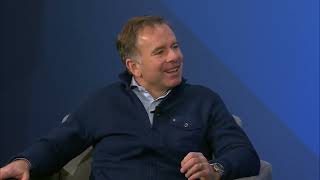
In a Flagship Studios interview, Sana Biotechnology CEO Steve Harr discusses the company’s recent milestones and long‑term strategy. He outlines two near‑term IND filings: a CD9‑based hypoimmune (cloaked) allogeneic CAR‑T program targeting specific blood cancers, and a gene‑edited primary islet cell therapy aimed at curing type 1 diabetes without immunosuppression. Harr then describes a broader platform for delivering gene‑editing material directly to specific cell types in vivo, emphasizing its transformative potential despite still being pre‑clinical. He reveals a less‑publicized glial progenitor cell program designed to repair white‑matter damage in neurological diseases, with an IND expected next year. The conversation shifts to company culture, where Harr stresses his personal responsibility for culture, hiring for intellectual curiosity and resilience/grit, and using “cultural bar‑raisers” to maintain standards. Finally, Harr projects a 2028 vision where Sana has solved allogeneic cell rejection, making hematologic malignancies as curable as hepatitis C, delivering a definitive cure for type 1 diabetes, and expanding the platform to new cell‑based therapies. The interview provides insight into Sana’s pipeline, technology platforms, cultural priorities, and strategic outlook.
Chapters
Welcome back to Flagship Studios. We're here with Steve Haar from Sana Biotechnology, presented yesterday on the main stage at JPM. What did you talk about in your presentation yesterday, Steve?
Well, first off, thank you, Christine, for having me. And we set— we focused on a couple of elements. One, when we set out the company, our major goal was to overcome a couple of the challenges of that really are holding back the promise of engineered cells. And we've invested and made progress in two. And one of the most exciting things for us is after years of investment in 2023, we're now at the place where we're treating patients and we will understand, does the exciting biology that we've seen in preclinical models really translate into humans? And so we outlined that we recently filed an IND for the first program, which is a CD9, a hypoimmune or cloaked CAR-T cell targeting patients with certain blood cancers. And I think it's really easy to tell. It would be really transparent. Does what we do work as we expect it? Well, are we able to hide these from being killed by the patient's own immune system? The second, we hadn't discussed this before, is one of our goals is to be able to cure type 1 diabetes. And we're developing a scalable hypoimmune stem cell-based program. We wanted to learn faster, and so we're going to go forward very shortly with gene-edited primary islet cells that we will trans— allogeneically— that we will transplant into type 1 diabetics. And you'll know, without any immunosuppression, whether or not what we really have shown in non-human primary and other models translates into humans. And if we have, But the blood cancers, we think we have the possibility of being able to cure, not just treat, tens of thousands of patients per year. With type 1 diabetes, which affects millions of people— millions, millions of people— we'll know at the end of this year. Right now, we believe that a cure for type 1 diabetes is possible. If this works, it becomes inevitable. And that is transformative because, you know, it's going to be hard. It's going to be way harder than we think. And so having that inevitability gives us the resilience to really make it happen.
And that, that's a huge leap. We're talking about bigger leaps this week. That's a huge leap. The inevitability of curing diabetes. But there is so much always going on at Sana. It's hard even for us to keep up. Beyond what you presented yesterday, give us a sense of some other things cooking at Sana right now.
Beyond what we presented, the thing that I'm really excited about is we've been working that we haven't talked a lot about. At least just is, the ability to deliver gene modification material specifically to certain cells in the body. What that allows us to do is gene-specific control of a cell in a cell-specific way. And today, you can do almost anything you want to a cell in a Petri dish. The hard part is delivery. And if we can actually deliver all of that material to the cells we want to get it to, That's transformative. We can't do it to every cell right now, but there are cells where we're getting this really to work and we're showing that we can knock out genes, we can edit genes in a specific way just in the cells that we want to target. And that we think could be really transformative. You know, it's not, it's not going to be in humans this year, but it's not that far away.
And what are some of the things you think Sana is working on that the company is least associated with?
That we're what?
Least associated with. What do people not know about sauna in terms of what you're working on?
Well, it's always hard to know what people know.
What do you get asked about last minute?
Yeah, I think the thing, the program that maybe we never talk about that could be really transformative is what's become clearer and clearer is that first of all, neurologic diseases are complex, right? Second, while most of the symptoms that we think about come from not having properly functioning neurons, most of the diseases are actually diseases of the white matter, right? And the white matter is what really is the soil which allows the seed and the flower really to flourish. And that fixing that white matter can be transformative. And so we've been working really hard on these glial progenitor cells which can go into the brain. What kind of cells? Glial progenitor cells.
Progenitor cells.
So they are, they're bipotent cells and they can either become astrocytes, which really are a big part of the support mechanism, or they can become oligodendrocytes, which are kind of the sheath that allows the electronic signals to work in the brain. And it's context-dependent. And if we're able to really transplant these cells and they go, they migrate throughout the brain and really fix broken cells and make them healthy cells, the number of neurologic conditions that we can go after and hopefully really transform is, it's hard to count. It really is. Now, these are really complex cells and our scientists have been working on them for a long, long time. We've made a lot of progress. We are at the point where we're really, you know, we're looking forward to an IND next year. And so again, that's one of these things where we could never talk about that's kind of on the pipeline chart, but they could really go after a host of diseases and with really grievous, grievous outcomes and hopefully have a really big impact for these people.
Let me ask you about culture. How many employees now at Sana?
About 425.
You talked about learning faster a few moments ago as part of how you, how you work. How do you inculcate that in a culture? How do you build a culture that learns faster?
I would say, first off, it Well, I always say I have 5 jobs and one of them is I in culture. And if culture is not any good, it's my responsibility, it's my fault. If it's to be really great though, everybody has to buy in, right? That's part 1. The second is we spend a lot of time thinking about how do you operationalize a great culture and what are the attributes of how you actually work together and work that makes it such that you have a great culture. 'Cause to me, a great culture is this undefinable thing that is really actually, do you unleash human potential or do you hold it back? That great culture to me is one that unleashes human potential. And the next part is who you hire. And that's where you really begin to get into how do you create a culture of learning. There are two, I think there are two.
Yeah, what do you hire for?
Yeah, the two attributes you cannot compromise on are you have to have people who are intellectually curious is if they're not intellectually curious, because what we're doing is we're on the sphere of the tip of innovation, right? And we're learning all the time. We're failing all the time, right? And so it really will be measured not often— our success is not often going to be held back by, you know, success or failure of a single experiment. It's how fast do we learn? That will define the company that really transforms the field. Right. So you have to be intellectually curious. And then we, and we really test for it in resiliency and grit because again, grit. So those two, those attributes, intellectual curiosity and resiliency, grit are the uncompromisable attributes of an employee. We actually have specific people who are set aside as cultural bar raisers who interview just for We look for those characteristics for every employee before they're hired.
That's amazing. My last question for you has to do with our theme here at JPM, bigger leaps. When you think about— you've talked about so much that's incredibly promising on the horizon at SANA. When we're in this chair in 2028 talking about your JPM presentation, what will SANA be talking about? What bigger leaps will you have taken between now and 2028, say 5 years out?
Yeah, I will talk about the The big leap that I hope will be taken first, if we've truly figured out how to hide allogeneic cells from rejection, it's— you've completely changed the way that we approach so much of medicine, transplant medicine, cellular medicine. And we're going to be spending a decade-plus figuring out where are all of the best places for us to apply it ourselves and where might we be better off partnering with others. And so My goal is that the first thing is in 2028, we're talking about, my goodness, you've solved that. Because if we've solved it, then I believe that first off, hematologic malignancies will be like hepatitis C. The vast majority of patients will be treated, will be cured with a single treatment. Second, we'll be saying that you guys, like you're launching now this cure for type 1 diabetes. And the third thing you'll be saying is, okay, what's next? What other cells are you going to be in? Like, that's the bigger leap is we'll have decided what else is coming. But right now, that's as far as we'll go. But we will decide what's next.
From hiding allogeneic cells to cancer to taking diabetes from impossible to inevitable to cure. Big leaps with Steve Haar from Sana Biotech. Thanks so much for being here, Steve.