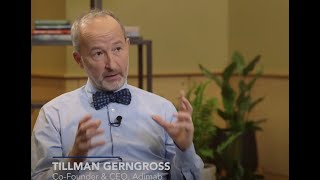
In this interview, Tillman Gerngross, co‑founder and CEO of Adimab, explains how the company’s antibody discovery platform helps partner drug developers lower costs and improve success rates. He describes the workflow: a partner presents a biological hypothesis, Adimab supplies a curated set of candidate molecules, and the partner tests and advances promising hits into drug programs. Gerngross shares Adimab’s pipeline metrics—over 300 discovery programs launched, about 30 currently in clinical trials, and one drug already approved—with expectations to move roughly ten more candidates into the clinic next year. He highlights a flagship partnership with Chinese biotech Innovent, which, using Adimab’s molecules, brought a drug to market in six years—half the industry average time from discovery to approval. Finally, Gerngross identifies neurodegeneration as the most promising therapeutic area for the next 5‑10 years, noting the massive unmet need and financial burden of diseases like Alzheimer’s, and hints at broader opportunities in regenerative and reparative medicine.
Chapters
Drug discovery is a really expensive and complicated process. And there's a lot of not just cost that goes into it, but a lot of hardship in terms of success rates. At Adimab, Tillman, you've created a platform that is really targeted at drug companies and helping them lower the cost and increasing the chances of success in discovering drugs. What does the platform do?
So it all starts with a partner having a hypothesis, a biological hypothesis of why a disease occurs in the first place. And once you identify that mechanism of why things are going awry, then it provides you with an opportunity to come up with molecules that change that outcome. And so at that point, they come to us and say, give me molecules to change this particular biology that I wish to change in order to benefit a patient. And so we then go to work and basically give them a selection of molecules that they can then test. Provided they find something that has the desired outcome, they then take that forward and actually develop real drugs around that.
And you talk about the funnel of drugs you have in the pipeline from 300 prospects to 30 in trials to 1 actually coming out of the system. Where do you see that going?
The industry averages for every 100 discovery programs that start, 94 fail. So only you get only 6 approved drugs for every 100. We've started over 300. We would expect at some point to have 18 approved drugs. But we're looking at a snapshot that is somewhere in the middle there. And so at this point, there are 30 drugs in the clinic, there's 1 approved drug, and we expect to put another 10 drugs into the clinic next year.
With all the different big pharma partners you have, you're having an impact on millions, maybe billions of people. What impact are you most proud of in the discovery process so far?
One partnership we're very proud of is our first approved drug with our Chinese partner, Innovent. They came to us 5 years ago and said, we want a drug against this particular pathway and this particular target. And we did our work. And within 6 years, they got a drug approved in China. And that is measured against the industry average start of discovery to an approved drug of 12 years. So they reduced it by half. And part of it was what we did in giving them quality molecules to select from.
When you think about regenerative and reparative medicine and all the theories around that, do you think there's an opportunity for Adimab in these emerging markets?
If I were to point to the area that I think has the most potential in the next 5 to 10 years, it's really neurodegeneration. That's an area of huge unmet medical need. We're talking trillions of dollars of healthcare dollars just to take care of an aging population that, you know, Alzheimer's and mechanistically related diseases that are going to bankrupt corrupt us if we don't find ways of solving it.
Challenge of our time, really.
Challenge of our time. And so I think in the next 5 years, we're going to see trial data coming out of current efforts based on antibodies that I think have the potential of being transformative. Very similar to what we've seen in oncology just 5 years ago, we see some of those concepts and some of those underlying scientific drivers of how we can harness the immune system to overcome and treat some of those diseases. Be proven out in the clinic. And I think when that happens, we're going to look at the world in a very different way.