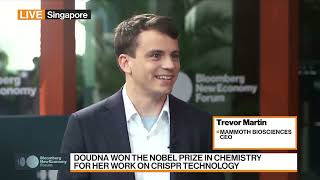
Trevor Martin, CEO of Mammoth Biosciences, discusses the company's CRISPR platform for diagnostics and gene editing. Mammoth publishes research to build public trust and designs modular tests that can be adapted across diseases and deployed in low-resource settings. The company is also working with Vertex on ultra-small CRISPR systems for permanent genetic cures.
Chapters
Give us an update on the progress that you've made so far in these large-scale tests.
Yes. So at Mammoth, what we're excited about is kind of building this next generation of CRISPR products. And I think it can be kind of surprising that CRISPR, which is usually thought of as this gene editing tool, can actually be used for diagnostics as well. And I think that speaks to fundamentally how this is this programmatic way of kind of interacting with life the same way that we interact with computers through software. And we've made a ton of progress. We've been really excited about working with organizations like the NIH to advance this CRISPR diagnostic technology for things like COVID-19. And we've even published some papers showing it in real patient samples.
So is this what differentiates your firm from other firms? Because, of course, we have seen so many different testing capabilities coming out, a lot of from all of these companies as well.
I think what we're excited about in terms of what CRISPR enables in diagnostics is to stop having to make this fundamental choice between do you want a result that's really accurate? Maybe you need to go to a lab or spend more time getting that result, or do you want something that's very accessible and easy to use and something you could even do at home one day? And I think we think the power of CRISPR is really bridging that gap and being able to do both of those things.
There, of course, when it comes to new technologies, there is some skepticism and perhaps a little bit of worry about where this might lead. How do you inspire confidence in people?
I think it's all about transparency. That's why we publish papers showing exactly how this technology works. We do a lot of education on our website, mammoth.bio, where we really try and describe in detail how CRISPR can actually be used both as a diagnostic tool and as an editing tool.
So tell us a little bit about this technology, because it's not only for COVID, right? We're talking about constructing tests for almost any target, any disease. Tell us about what this does and whether or not this is also available not only in rich countries but also the developing world, because that's been a key issue of the pandemic, that divide, right?
Yeah, I'll start with the second part. I think that's incredibly important is this idea of accessibility, not just within the United States, across all income brackets, but also worldwide. And I think long term, that's part of the promise of CRISPR-based diagnostics as well as really having more equality and access across the globe. And I think what's exciting is that it is a platform, so When we develop these tests for a specific indication like, say, COVID-19, a lot of that can be transferred over to many, many different diseases, whether that's other respiratory diseases or beyond. So that's what's very powerful is that you kind of get this flywheel going of as you develop one test, you're actually learning a lot about how to develop tests 2, 3, 4, 10, etc.
You've actually announced a collaboration with Vertex Pharmaceuticals, right? What can you tell us about that?
Yes, that's a really exciting example of how we work with partners also on the editing side. And there we've really pioneered this field of what we call ultra small CRISPR systems. And what's exciting about about that is they're actually physically small, so they are better at being delivered in your body potentially. And that's really exciting to do in vivo editing in particular. And that's an area that we're really excited to pioneer as well, is like really unlocking this class of cures for genetic disease.
What diseases are we talking about here?
So we don't have specific indications that are public right now, but in general, we're really excited about things where we want to have a permanent cure, for example, for a genetic disease.
So tell us a little bit about the new innovations in healthcare, not only for your company, but broadly in the industry that excites you right now?
Yeah, I think what's really exciting is that as these platforms like the CRISPR-based platform that we're developing are spinning up, you really have the potential not just to kind of have all this effort to tackle a single indication, but you actually can then learn from that and tackle multiple indications beyond. I think that's a very, very powerful concept. And we've seen that with mRNA, for example. And I think that means that hopefully we see a lot of increasingly rapid progress in biology across both therapeutics and diagnostics.
We've had so many lessons from this pandemic. And this forum, I think, has really facilitated some of those conversations about some of the strains that we've seen in global healthcare systems. What would you say is your biggest takeaway from the pandemic?
Yeah, I think the biggest takeaway is that, you know, an ounce of prevention is worth a pound of cure, really. And it's an old saying, but I think it's very, very true where, you know, now we're spending trillions and trillions of dollars, you know, probably every month really worldwide to battle this pandemic. And I think to protect against the next pandemic, we really need to make much smaller investments, frankly, now so that we can contain and prevent and even treat people in a much more efficient manner early on and these types of things.
Do you think the awareness is there in the sense that are we going to be able to maintain and sustain this effort post-pandemic? And it's not just a crisis response.
Yeah, I hope that's definitely true. And I think there is a lot of will and forums like this are a good example of people taking this very seriously and trying to think long term, both about the pandemic and about the economy in general. So I'm very hopeful that that's the case. But I think it requires us to constantly, you push that envelope to make sure that we don't just kind of go through this pandemic and return to the status quo, because then we might end up here again.