Founding AgBiome with Eric Ward
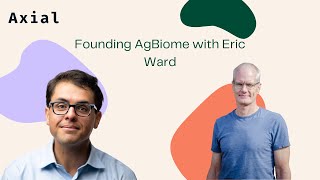
In this Axial Podcast interview, host Josh talks with Eric Ward, co‑founder and co‑CEO of AgBiome, about his 40‑year journey from a botany undergraduate at Duke to a plant molecular biologist at Washington University, through a 12‑year corporate career at Ciba‑Geigy/Novartis/Syngenta, and several entrepreneurial attempts (Paradigm Genetics, Crop Solution, Two Blades Foundation). Eric explains how his long‑standing friendship with Scott Eukness sparked the creation of AgBiome in 2012, built around a plant‑microbiome discovery platform and a commitment‑based, non‑hierarchical culture. He details the company’s organizational design (transparent hiring, agree‑or‑disagree‑commit decision making, committee structures), the strategic choice to commercialize products in‑house rather than rely on large partners, and the practical challenges of moving from platform science to market‑ready fungicides. Throughout, Eric shares lessons for ag‑tech founders: the importance of understanding growers’ economics, building deep networks, aligning business models with market realities, and maintaining curiosity and resilience. The conversation also touches on personal habits (cycling, networking) and the broader ag‑tech ecosystem.
Chapters
Welcome to the Axial Podcast. Axial is an early-stage investment firm based in San Francisco. We partner with great founders and inventors investing in early-stage life science companies, often when they are no more than an idea. Axial is fanatical about helping the rare inventor who is compelled to build their own enduring business. We're recording. Hey, Eric, thanks for taking the time to do this.
Sure.
Appreciate it. What a small world. You know, you're the father of Fred and Carl Ward. What's called with them. So I can put two and two together now. I do. It's amazing. But thanks for taking time to, you know, join this podcast and talk about your story in AgBio. Maybe we can embarrass Carl and Fred too. That'd be funny. A little bit funny stories, but maybe you can just start off a brief introduction and go from there.
Sure. Yeah, thanks, Josh. Appreciate the opportunity to do this. So I'll go way back. I was born in Buffalo, New York. I came down here to North Carolina where I live now in '78 to start going to Duke University, and that was the place where I really got super interested in plant biology. So it was a very old school university at that point. It had a botany and zoology department, not even a single unified biology department. And I, I was a botany major and I cottoned onto that because I, I took a couple classes and really liked the other students that were in those classes. And the teachers were phenomenally good and really focused on the students and learning. And it was not super top-down. It was much more kind of a collegial environment, even as a little, you know, crummy sophomore taking a class from some eminent professor. And then as I went through school, I got more and more interested in,, I guess, more reductionist stuff. So I got interested in biochemistry, and then I got interested in molecular biology and how molecules of life are created and all that. And right around that same time, I graduated in '82. That's, that was really the dawn of the idea that you could do genetic engineering on plants. So this is like way back when, you know, Genentech and companies like that had been founded within the last few years. Uh, so I started to look around. I decided I wanted to do a PhD. I looked at several graduate schools. It was a really nascent field. There are probably only half a dozen places in the country you could go where you could study anything like plant molecular biology at that point. Ended up at WashU in St. Louis. Um, were originally attracted to a woman named Mary Dell Chilton who was working there, who subsequently left actually. I'll come back to that. But she was one of the two labs in the world that first showed that Agrobacterium puts DNA into plant cells naturally as part of its life cycle, which led to the whole ability to put whatever gene you want to into a plant. So I ended up working for a guy called Wayne Barnes there, learned an incredible amount from him, and very fatefully met a guy named Scott Eukness the first day of graduate school. So the incoming cohort of plant biology students in late August of '82, I ran into this guy Scott, and I'm still working with him today. He's the co-CEO of the company that we co-founded. So It's only been 41 years now at this point. Yeah. Anyway, so I went to Wash U, decided I wanted to experiment with industry. So a detail probably of the way I'm wired, I never— I didn't really see myself as going hardcore academic science. I was really interested in a lot of different things. I wouldn't call myself like a polymath, but I'm just like some— somewhere between ADD and polymath. I get interested in a lot of stuff, including practical things about how companies run, finance, all that stuff. So I decided, okay, I should probably scratch that itch and try the corporate world out. So I did a postdoc at a company called Ciba-Geigy, which is a 2x progenitor of the current Syngenta. And, you know, next thing you know, I ended up spending 12 years there. I rose up through the ranks, I guess, because I had some modicum of common sense and ability to communicate pretty well, which is what all companies are looking for typically in like management positions. And then, so the company merged once with Sandoz, CBI did, to create Novartis. And then Novartis decided it was going to get out of the integrated life science business because they did everything from pharmaceuticals all the way down to nutrition, including ag, and decided they were going to get rid of the ag business. So they spun out the ag business, as did Zeneca at the same time, now AstraZeneca. And those two together, the Zeneca and Novartis ag businesses, are what became Syngenta. And I went through the pre-integration year, a lot of the planning, and I saw how ugly the politics were getting around that stuff. And I left that company on day one of Syngenta being floated as a public company and just said, peace out. I've had enough. Can't do this. It's no fun to have to go to work and kind of tell untruths to people every day to try to keep them motivated. That sort of thing. So, and simultaneous with that, Scott had co-founded a company a few years earlier called Paradigm Genetics, which they successfully took public back in the first genomics revolution back in the year 2000. He was getting disenchanted with that company. It kind of gotten big and it moved away from the stuff that he wanted to do. So he was leaving too. And together we started to you know, talk about ideas. And we got enamored with this one specific technology. So together, we started a company back at right at the end of 2000. So Scott was really the guy that put the breadcrumb trail out for me of like, here's what entrepreneurship can be. You don't have to, you know, work in an environment where you're not fully believing what you're doing, and you can actually control your own destiny. Or so, so we did that. Crop Solution was Interesting experience, learned a ton. It was around for about 7 years, never made any money, but it's some really interesting technology, some licensing of stuff. And, you know, it was a great learning experience to go from nothing to how do you actually raise some money and get a company going. And sometimes the counterexamples are the best learnings, right? Where you actually screw something up. And then I left there when we basically ran the thing out of money and didn't have any more grants and all that and worked for a not-for-profit for about 6 years called the Two Blades Foundation. That was a historical connection to some people I'd known a long time ago. So I guess lesson there is, you know, network a lot and do it for no good reason other than getting to know a lot of people 'cause you just kind of never know what's gonna happen. And then I, after being with Two Blades for 6 years, started to think about what I might wanna do next. I felt like I'd kind of done what I could there. And Scott had been in Germany because the second company he was with, Phoenix, had been bought by Bayer. He came back from that in April of 2012. I'd been in England with TwoBlades. I came back in August or July of 2012. We started hanging out together again. We'd seen each other in Europe a couple of times, both living over there. And he was kicking around ideas for another company. And one thing led to another. And he asked me if I wanted to help out. So It's like, yeah, let's do it. So we started AgBiome in the third, fourth quarter of 2012, and that's where I am now. So that was a little over 10 years ago.
Well, it's a great story. You have all these different points we can talk about, and one of the few people who've successfully built like an independent agtech company the last decade or so. And we talked about that, but maybe we could back it all up in the '80s. There's two questions. When I ever talk to people who were doing science around the '70s, '80s, did you know it was a revolution? And then second point, how did you— what was it like to try to be a scientist who didn't want to become a professor or wasn't all in on becoming a professor? Because versus now, scientists, the average PhD will talk to 20 VCs before they graduate, you know what I mean? So it's a whole different environment. What was it like back then just being a scientist trying to forge your own path?
Yeah, interesting points, Josh. So on the first one, I think the first I felt like I might be on the edge of a revolution was there was a really interesting cat in the genetics department at WashU named Maynard Olson, who, he was a mathematician who pivoted to becoming a molecular geneticist, had a tenured position at Dartmouth, completely redid his career, postdoc with Ben Hall at U-Dub, and then got this job at WashU. And he was restriction mapping the yeast genome. And his— what he wanted to do was prove to himself that a chromosome was actually a single individual DNA molecule. And I always thought that was like, well, that's what it says in the book. So, but I realize now he was laying the groundwork for what we now think of like genome science as, right? Like actually figuring out how are you going to do this that eventually led to complete sequencing of the E. coli genome and the yeast genome and the C. elegans genome and ultimately the human genome. And that's when I started, you know, first getting exposed to the idea of like, wow, if you could actually get the full sequence of everything you were working on, it would just change the world, right? You wouldn't have to do all this painful, convoluted genetics and positional cloning and all this stuff. And then, um, You know, on the, on the career stuff, I got very direct feedback from my thesis committee that I was— I wouldn't say they told me I was throwing my life away, but they told me I was selling out at some level by doing a postdoc in industry. And it's interesting because even back then, you know, like some careers, like let's say you, you were a chemist, it wasn't crazy. You would go work for a chemical company, right? Or DuPont or somebody like that. But in, in biological sciences, very much less than now. You didn't go into academia, you know, you were doing some alternative career, which wasn't looked very kindly on. And I think that's, you know, obviously it's changed a ton in the sort of biopharmaceutical world. It's almost a first choice for most people now. And in ag, it's certainly more that way than it's ever been, given the general interest in agtech and investing in this area. But, you know, it was one of those, I guess I felt confident enough in how I was wired. I didn't take that as like, I'm, you know, I'm screwing up my career to not go into academia. I just saw what that was like, and I knew I didn't want to be that narrow and have to be that focused on kind of doing one thing.
So, so in the '80s, '90s, you joined Ciba, you build a career there, and then how did you— especially people early on in their career, you have all the opportunity costs optionality. You're like, I do this or that. How did you keep your conviction on agriculture despite all the ups and downs versus, you know, it's the '80s, '90s and you're seeing Genentech rise or you're seeing all this other stuff happening. How did you say, hey, I'm going to stick with agtech?
I, you know, it's funny you ask that. I never really thought hard about doing anything else. You know, the closest I got to it was getting exposed to some companies that were doing things like natural product discovery. Using, you know, fungi and plants that could potentially have pharmaceutical use. That kind of got interesting for a little while. But I was pretty down for the whole plant biology thing from the start. I think the other thing that happened to me was I was fortunate when I was working at Ciba to be embedded enough in something that was like basic science that I was able to publish quite a bit. It wasn't discouraged there, at least. So if you had the, the drive to publish stuff, you could do so as long as you kind of did it on your own time alongside your other stuff. So I got a decent network within the hardcore academic community of that, you know, plant molecular biology field that was like this big when I started, tiny kernel that grew out now. So I knew all these people and, you know, I still have great friends in that community. So I've always sort of had one foot in academia the whole time too. Without really being committed to it. And that, I think that sort of network effect or social bond or whatever you want to call it made it such that I never thought about changing fields really. I mean, it's a, it's a, I've never thought about this directly until you just asked me that, but that's kind of the best, you know, post hoc narrative I can come up with why I didn't change.
That makes a lot of sense. I think, you know, I think people If you're the best at what you do, it's like you should probably do that. Or if you, if you're that network, probably stay there. But I think just sometimes people who are younger, you have a lot of optionality, especially out of a PhD program. You're like, yeah, what do I do? And even to this day, right today, it's like, do I work on CRISPR or do I work on sequencing or work on AgTech or I work on like proteomics? Like all the different subfields now versus 20, 30 years ago. And so it's just like a level, order of magnitude, probably harder to like figure out where to focus your time because it's something I dealt with too. Like, what do you actually wanna be the best at? It's actually pretty hard. So what you're saying is like social, social kind of connections kind of keep you— is if you make enough connections and network somewhere, you'll probably either be— have good taste in people though. That's the caveat probably. You probably have to—
I guess that's right.
Yeah.
You know, but I do think generally speaking, and this is something I probably know, I knew intellectually when I was younger, I had to really force myself because I was, I'm basically a natural introvert. I'm sort of, you know, functioning whatever, ambivert or something. But the more people you run into and establish some connection with, the better. And I had the great fortune in that PhD program I was in at WashU, because of the field being so young, the seminar speakers who came through was sort of the who's who of who was in that field at that time, because there are only like 25 names of people that were doing anything that was worth looking at. And the great thing that WashU did was they had this student seminar series that catered to the grad students. So the departmental seminar would be on a day X and a day X minus 1 for 2 hours, that speaker would meet with just the students and go over all the background of their field so that when you went to the seminar the next day, you knew the whole story and you could keep up just like somebody had studied it for years. And more importantly, they had dinner that night of X minus 1, and anybody wanted to go could go. And so I was like, well, number 1, it's free food. And I learned pretty quickly, number 2, I got to meet all these people. And, you know, these are folks in many cases I still am in contact with some of these people. We're talking 35, 40 years later, you know, folks who are now well retired. So those little, you know, that's the kind of stuff that makes your, your feeling of an impact more significant. It gives you a feed forward of feeling like you're successful and you matter and all that, which, you know, it's Sounds stupid to say it now, but man, when you're like 24, 25, that counts for a lot, right? You can feel pretty insignificant if you're gutting it out in the lab every day, none of your stuff's working, you're reading all these papers by other people and they're famous. You know, you start realizing, hey, they're just like normal people too. And by the way, you can learn quite a bit from them also. So, you know, that's one thing I've really tried to do a lot of is meet as many people as I can. And then you just, just for the sake of doing it because it's good in and of itself as an end unto itself with zero thought about any further outcome. But by the way, further outcomes do come from that. If you're not going at it in a prescriptive, I need to meet that guy because he's going to be good for my career, it's more like I need to meet that person because they're interesting and I want to find out what they care about and what they do.
So anyway, good point. So, okay, so Scott, you met Scott, your co-founder of AgBiome, first day of grad school. You joined Steve as a postdoc. What did he do? Was he always entrepreneurial? Who was the spark there? Was he always kind of—
I think more— you, you should— I would highly recommend you talk to him too. He's had a really interesting journey. He was probably more naturally entrepreneurial for sure than I was. Um, did a bunch of different odd jobs stuff, had a a company for a while that did like HVAC maintenance that he was doing. And I think he more so than me was, how do I want to put it, sort of marching to his own drummer, like really felt like he could do it better or differently. You know, I was more amenable to playing corporate politics up to a point, you know, a lot of stuff. And that's not all negative. It's like sensing the signals and who, you know, who's in power and that kind of stuff in the big company. That just seemed to be a path that was pretty natural and easy for me. I think particularly given the upper management of the company was Swiss. They're kind of quiet, unassuming. I sort of vibed with those guys pretty well. So that probably accounted for why I did it as long as I did. And then Scott decided to leave with another guy that we were both working for, John Riles, in '97 to co-found this Paradigm Genetics. And I basically stayed behind at that And I made a pretty calculated decision. You know, they wanted me to come with them or they offered it. I had 3 kids at that point under the age of 5. I had a good career at the company, you know, and there was a certain amount of this was a straight-up cash flow calculation, right? Which I don't think I would have made the same decision 1,000 out of 1,000 times.. But I do, you know, I was so I was a little bit of a late starter to the entrepreneurial journey compared to what could have happened. And, you know, that would have worked out fine too, probably. Although maybe if I was a co-founder of that company, it would have screwed up. You never know what the— what would have happened, you know, if you change the counterfactual a little bit.
But I remember hearing the Paradigm story, the IPO roadshow, where it's like you guys went public. But the company went public just on time before the bubble burst.
Yeah, Scott can tell you all about that. There was the first sort of genomics and IT bubble, if you will, was in the late '90s, right? If you look at the NASDAQ index, you can see this very clearly. And then the whole thing kind of turned over in 2000. And there was a blip where Tony Blair and Clinton both got up in front of a press conference and said that basically the human genome, nothing should ever be patented from it. And all the genomics company stocks stocks tanked that day, and that's like just when Paradigm was starting to raise money. I'm simplifying it a little bit, and Scott could tell you more, but they managed— there was a second window, they got out through that window, they went public, and, um, you know, this company did fine. Yeah, but, you know, it was one of those— it did eventually nose over and, and get— the pieces got acquired by other folks.
So one quick question: how did you and Scott keep in touch over a decade? Was it like you guys— were you just really best friends, or was it like Do you call every 6 months, invite them to a family?
Yeah, I mean, we were, we were best friends. I'd say there's probably some tension in that '97 to 2000 window a little bit because some of the stuff they were, some of the stuff they were doing was arguably an offshoot of ideas that we together had had within the Novartis empire. And but, you know, we still were social. I saw him several times a year. You know, we both live right here in North Carolina, so it's easy to stay stay in touch. And then, so over the course of that 40-ish years now since we met, but we did the calculation, about two-thirds of that we've worked together, probably coming up on more like, you know, maybe five, I don't know, seven-eighths the longer we're here together. So, but we've always been close. I haven't been like that at all.
Yeah. Yeah.
And it's, no, I think the real, the huge benefit to me, and I think Scott would say the same thing, is to have somebody to talk to about whatever's going on. You know, we get a little bit of backscatter about the co-CEO thing because it doesn't fit people's mental map of how things ought to work. But it's a power in the sense that, you know, it's a pretty isolating job and having somebody that you can talk to about anything is really great. It's like great emotionally and also leads to, I think, better, more considered decisions. I tend to be somebody who's like, gut, let's just go do it. Scott is more methodical about laying out options before choosing. That's super helpful for me. And, you know, we just have subtly different ways of looking in the world despite the fact we've known each other so long.
So you get—
I think you get a better outcome as a result. Totally agree. The challenge for some of the people— some of the people here see it, you know, that we're like monolithic, and when we've made up our mind together, it's like, forget it, you can't change it, which it's not really true, but I can see how people can get that impression too.
We'll talk about AgBiome's organization and how that relates to this whole story.
Cool. Okay.
So you're Ciba, Sandoz, Novartis, and then you finally get promoted to the top, one of the top spots in Syngenta after it spins out, C-suite. And that's when Scott pulls you out finally from corporate America to do crop solution. Why did you end up like you got— you, you climbed the corporate ladder to the top essentially, and that's when you left. That sounds, from the outside looking in, sounds crazy, but maybe in the moment was the smartest thing to do. But how did you finally— how did Scott finally get you out of corporate America to finally start a company with them?
Yeah, it was kind of simultaneous. I think we got each other out in that case. I was if for me there was a push and a pull. So I was repelled by some of the stuff that was going on within Syngenta, and I saw what the job was going to be for the next several years, which was going to be a cost-cutting exercise. Because all the stuff that, you know, this is, I think, a lesson to anybody that goes to work for a big company, however, you know, sort of bench-level entry, the more you can learn about that company, the better off you're going to be. Take advantage of the resources you've got, including all the stuff that gets communicated internally or externally by the top-level people in the company. So, you know, you start reading, it's like, okay, we're going to merge these two companies, we're going to pile as much debt onto it as we can and still have it have a high bond rating. And then we're going to take cost out for the next 3 years. That's literally what the pitch was to the investment community. So if you're sitting there, you're thinking, okay, my job is going to be to, you know, whittle away at this organism for the next 3 years. It's not going to be a building job at all. All. And that's just not very much fun. And, you know, it's kind of a— I'd rather go into science because you want to learn new stuff and discover things and have a growth mindset, not a, you know, who are we going to fire this week kind of thing. So I just didn't want to participate in it. And, you know, there were some interpersonal things that were going on too with some of my former colleagues that when I saw how they behaved, put into a milieu where arguably it's a little bit of Lord of the Flies when two companies come together, you know, last man standing kind of thing. Some of the behaviors I saw were just not things I wanted to be associated with. So it was pretty easy. So I like decided I was going to leave and then figure out what the hell else I was going to do. And then around that same time, Scott was thinking he was going to leave Paradigm and we, we ended up connecting up with a dude that had an interesting looking technology and we thought we could get something going around that. So that was really the genesis of it.
So you build Crop Solution, it doesn't work out. This is your entrepreneurial experience. Scott, after 10 years building up a career, you do a startup and it doesn't work out. Did you have a bad impression about startups or you're like, man, that was so fun, let's do it again despite it not working?
I had a bad impression. I think I will say we were incredibly resilient. Like what we managed to wring out of a really crappy situation was still pretty damn good. I just, you know, we were raising money. We had a board meeting on 9/11 of 2001. Like we're in a board meeting when the planes crashed into the World Trade Center. And we were approving a term sheet from a European investor to lead our Series A financing, which by the way, the European investor then said, we're not going to invest in the US anymore after the Trade Center attacks. So the whole, you know, the world went into financial lockdown effectively for some period. And back in that timeframe, so like 2001 to 2007, let's call it, the number of VC firms that were investing in anything like ag was very, very small, like maybe 5 or 6 total, which is pretty remarkable if you look at the landscape now. So I got pretty, I wouldn't say soured, but I was like beat up by the end of that. I didn't, you know, and I wanted to do something that was pretty directionally different from that. And that's how I ended up working with the Two Blades Foundation. Um, and you know, it was, it was really great from like a flexibility of time commitment standpoint. I had to travel a ton, but I sort of made my own hours. I was, you know, working remote back before that was a thing for several years, which was really good at that stage of my life too. So you still had the Like, I mean, you know, there's still something in there. It's like, what if we'd done this or that?
And if this had gone a little differently, you know, if we did that one thing, would it work? I'm trying to figure out what was in your head at the time where it's like it didn't work out, but you're still doing it. So you end up starting a company that was successful. So like between Crop Solution, AgBio, what was in your head? And it seemed like, man, that was really hard. But if we'd done these few things, it would have worked. And so I'm trying to figure out, in the world of nonprofits, what was the— how did you and Scott get back together to start iBio? 2012 or '11?
Yes, 2012. Yeah. So he decided to leave Bayer. I think he got a little tired of some of the machinations internally over there, despite loving living in Germany. And again, he can tell you the story better than I can. But he came back here and had a few months to sit around and think, kind of, and was coming up with some novel ideas about what we could do. And we, you know, we both saw the handwriting on the wall that there was a real need for new ways to protect crops. And there was this unexploited natural resource, which is all the microbial communities on the planet. And he, he had done a lot of thinking about that and realized there's pretty interesting business opportunities. Opportunity around it potentially. Then we together started talking about it. The critical juncture, it sounds goofy, but we actually were, he got me into cycling back in grad school and I've been into it ever since. So we were out on a bike ride and he was like, well, you know, explain to me about this idea around a company. And then he just out of nowhere said, well, do you think you'd be interested in helping out? And I was like, well, yeah, probably would. Next thing I knew, you know, we're co-founding this thing and we got two academics involved, two Jeff Dangle here at University of North Carolina, Howard Hughes investigator, and then Paul Schulze-Liefert at the Max Planck in Cologne, who together were kind of pioneering this idea of let's understand the plant-associated microbiome. And coincidentally, they published back-to-back papers that were on the COVID of Nature like that month. I think it was September or October of 2012. So the timing was really good. We got them in as co-founders. There were a bunch of investors that were thinking that was a thesis they were interested in and wanted to do more. And so we got the timing kind of ideal for getting it going. So that was really the genesis of it. And then, you know, we knew we hadn't worked around here for a while. We knew some people together. That pretty quickly came together to be the nucleus, like the first 6 employees that would like take the empty room and, you know, close your eyes and come back a week later and it's a fully functioning lab, that kind of thing, right?
Those are really valuable people to have. Only really possible because it seems like AgBio was like 10, 20 years in the making. Like it took, you know, all this whole journey to finally get to a point where you have the network, the trust and experience to like build something that— a viable startup. Also on the cycling part, I remember I used to go run in Berkeley Hills. Carl, you probably have your sons involved in cycling because I would see Carl or Fred, I forgot which one. Yeah, sure. They would be cycling in the Berkeley Hills. I'd be running like, oh, why are they cycling too?
Yeah, they took it up pretty early actually, and they've taken it to levels beyond what I've done. But yeah, because it, you know, it's great riding out there too, right? So, and they ride over in Marin a bunch now and still come back over to the East Bay. So it's one of the things we to do together too, like when we're all together.
There's just— I have friends that do cycling and Ironman, and they go cycle from Golden Gate to all the way to Simpson Beach.
So just like this really windy road. Yeah, right, right. That's pretty dangerous.
I don't know. It seems pretty— I had a friend— I was talking to a friend yesterday. Her husband broke her foot— broke his foot cycling. So these injuries that happen—
you have to have good situational awareness, right? There's always crazy people driving.. But net-net, it's not a super risky activity. At least that's the narrative I've created for myself.
So you're doing AgBio. What was the vision? Not only from a scientific perspective, but from an organizational perspective, what makes AgBio really unique? It's non-hierarchical where you— maybe you can explain it better than me. Maybe talk about that vision for the company, the origins, and why like you decided to design your company in a certain way that was a lot different, different than any other company in the world?
Yeah, we, um, back in 2001, uh, I read a one-page interview in Forbes with a guy named Jim Barron who was on the faculty at Stanford Business School, and he had done a study on the impact of company culture on on success of the company, basically measured through different financial metrics. What he'd done was basically create what he called a typology of cultures, having surveyed hundreds of startups in Silicon, basically in the Silicon Valley area with his grad students. And they arrived at the conclusion that this model that they called commitment was highly correlated with both resilience of the company and long-term financial Success. And the Commitment Model basically said you hire people as if they're going to spend the rest of their career with you. And there's this two-way commitment between employee and company where the employee is going to make that leap of trust that the company has its— the person's best interests at heart and vice versa. We, every time we hire somebody, we tell them we're making ourselves vulnerable to you coming in the door. We're going to say we trust you based on and in most cases, relatively limited experience, right? Even if you do as thorough a job as you can vetting people. So that really appealed because this long-term relationship aspect we felt was critical for being really innovative. If you look at how science is, you know, you were saying before we got started, science is really hard. It's like, yeah, most stuff doesn't work and it takes forever. Other than that, it's really fun. It's having people that are around that are really down for the struggle. And realize, you know, we're going to be at this together for years before we see anything like success is super important. Then another dimension is when you— a critical success factor for a company like ours is our interactions with the outside world and with partner companies. And being able to show a partner the face of an organization that has some longitudinal stability is really great. Like the same— you're going to deal with the same folks. These same folks are passionate about what they do. They really bought into what this company is about. And so that was really the seed crystal of it. We started doing that back-end crop solution, and then we kind of doubled down on it when we started AgBiome to the point where we got in touch with Baron, who since had moved to Yale School of Management, and Jim came here and did a case on AgBiome. I think he was like, so flattered that somebody actually read his article and then actually acted on it. So we've stayed in pretty close touch with him. And, you know, it's an interesting model. It's hard to manage because you can put yourself in situations where you maybe wouldn't move as expeditiously as you would otherwise. Like this person's not working out. Our first instinct is what What can we do to help them or put them in a role where they're going to be happier and their contributions are going to be more valuable rather than get rid of them and next person up, which is how most other companies are. And I don't, I can't claim that's better. It's different. It feels better. I think people here appreciate that. You know, it has upsides and downsides, but it's something that we're pretty familiar with now.
I think there's a few companies like that. There's a company called Aldivaron in Fargo, North Dakota, and people— if you join that company, you're probably there for life. And so they— those places cultivate unique cultures that, like, a little loyalty. And, um, it also seems like people are very honest with each other. Get to know somebody longer, you're more willing to be like, have a conversation. But like, why did you implement this structure in Crop Solution? And if not, did you feel that organizing your company this way enabled AgBiome success? Without it, would AgBiome be different? Would it have failed?
Would it, you know, something else happened? Well, it's valid questions. Crop Solution, we experimented with it. That company never got more than about 20, 22 employees, but we had, The remarkable experience there was the day when we basically told people, look, we're out of money. We can't pay you next pay period. And there was this sort of like, okay, what do we do now? And it was like, well, you don't have to work here anymore. You know, there was so much buy-in to what we were doing that we had like nobody leave despite the fact that we were extremely transparent. Transparent with what was going on financially. Yeah, almost had to sort of tell people, hey, look, you're not employed here anymore because the definition of employment is you get paid to do work. So that was a really strong lesson in how much loyalty you can generate if you're open with people. And, you know, one component of this that we took on board was really like, you've got to supply a lot of information to people if you— and then put people in a position where they can make the best decisions for the company without being told what to do. And so some of this gets to like how we're structured now. I think what both Scott and I repelled— are repelled by the idea that somebody at an arbitrary level on an org chart makes a decision about something that they know nothing about that's happening, you know, 3 or 4 levels below them. So why not put the person who's closest to that work in a position where they can make the decision. And that is really good for a lot of people. I think you have to be super into being very committed to your job. You have to put yourself out there and really survey the landscape and understand what's going on in the company and ask a lot of questions and consult a lot of people. To be successful. If you do all that, it's an incredibly rich growth environment for people. If you're closed off to that, you think you can, you know best without asking anybody else, or you're sort of overly suffering from Dunning-Kruger type effects where you think you know more than you do, it can be pretty toxic. You can make some pretty crappy decisions. And so one of the challenges of this system is putting up enough guardrails, if you will, that people can't— if WLGO, or they call them below-the-waterline hits, you want to make sure you're not putting people in positions where they're going to make a decision that's a below-the-waterline hit. And that's a, you know, it's a dynamic tension, right? You got to sort of keep it tight enough that you know what's going on, but loose enough that people are able to really get engaged with their work and not just show up and say, well, I don't know, I just do what they tell me.
Like, that's the worst case between organizational structure and then your growth. So you start off as a company focused on the plant microbiome, you become the market leader. My information has been outdated. I think you might have one of the largest or the largest database of plant microbiomes in the world. So a huge catalog of these things. And you develop— you have commercial products now and also a backlog of archive products too. Uh, you have like 2 products in the market and you have a ton of archive products. Um, uh, and so maybe we could talk about the interplay between like the actual organization and then how you develop a platform and these products. Like when you had to figure out like how to build the platform, how were committees formed, you know, for tough decisions around like which direction to tiebreakers? Like Do you have these kind of fiery conversations? And because it's not just you and Scott making decisions, it's committees of your teammates helping make decisions. And I'm sure there were some controversial directions that worked out, or maybe the pivot too.
Sure, for sure. So, you know, the thing grew organically the first couple of years. You can get everybody in one room when something's happening that matters. And we did a lot of that. And I think, you know, as long as— of course, there's certain people are going to dominate the discussion and the decision-making, and that includes the co-founders. It includes the first handful of first employees we had. We have a great guy named Dan Tomso, who's our first chief science officer. And, you know, we would debate stuff pretty vigorously in the open, which I think made some people pretty uncomfortable. But then, you know, once we're in, we didn't explicitly call it this, but it was sort of like an agree and commit or disagree and commit type culture. So when, when a decision got made, it was like, that's what we're going to do. That it's harder to maintain that as the company grows. Different people in different pockets of the company have different styles of communication and different managerial styles too. And, you know, I think in some cases we probably historically erred on letting people have too much freedom that really didn't know what they were doing with respect to how to elicit the best outcome from the team they were working with, right? That, that just goes on. I think it happens everywhere. The committee stuff that you mentioned, that was a really specific desire to involve people in the company more. So we started, we heard there's a book called Reinventing Organizations by this guy, Laloux, that we got turned on to that after we were already doing a bunch of this stuff, we realized, hey, we're not uniquely crazy. There's other companies like this too. And instead of having like explicit staff functions that did these different roles in the company, we put together these groups of people that were responsible for that. So they're actually, you know, working on the company as well as working in the company. We still do quite a bit of that. And it helps people to feel way more involved. They're not just like farming everything out to some, you know, disembodied HR group. We've got a really talented head of HR, Elizabeth Claypool, who has been willing to deal with all this crazy shit too. Because, you know, you think about it, the typical HR leader is like, well, that's all in my domain. And she's really good about involving other people. And, you know, they're great growth opportunities for folks too, if they want to learn better how to lead. You can run one of these committees or be responsible for some initiative within the company culturally or process-wise. And so, you know, we're, as we've grown, we've definitely put more things in place that make things more consistent across the company. That, of course, gets some people back up because it's not like it was when we had 30 or 40 people. We got like 120 now. But that in the, the cause of making things more consistent is to try to simplify. It's not to complexify or bureaucratize. It's to like, okay, every time we do this thing, we don't need to reinvent the wheel about how to do it. Let's just do it the way that we know best to do it, and then we'll tweak it as we figure out better ways to do it. So, you know, that's been an ongoing process and will be forever as the company continues to grow too.
I think it's— remember John Hamer was telling me like, yeah, AgBiome has a great culture, you should join them. Like this great, you know, this great team, everybody loves working there. So kind of testament to you doing something different and then making it work over time. So I'm sure there's all these growing pains. And we also talk about then agtech and— yeah, sure. How to build a startup in agtech. It's really hard because there's, you know, maybe you could touch upon what made AgBiome successful in the market, the opportunities in agriculture, they're massive, but also the challenges. Like, how do you fit in this like massive market opportunity with like this narrow, seems like a narrow path to that big opportunity. Very few people can get get, you know, fit in that narrow pathway and make it work till the end. But how did— how do you make an agtech company that goes from idea to product, like commercial product? It is extremely hard. There's only you, Pivot, maybe that's it, maybe one other I'm not remembering. But maybe you just talk about, yeah, how to be successful in agtech.
Yeah, it's— well, there's no like recipe for it, but I I think one key is to try to understand what the need of the ultimate customer is as much as you can. Like, what do growers actually need? And, or what are they, what would they be willing to open their wallets up for? Let me put it that way. I think there's a lot of hammers out there in solution of nails in the agtech world. Like, this looks really cool, but then if it's difficult to explain to somebody or they don't immediately get what the return on investment is from that, I'm purchasing that, it's, that's tough. And I think there's a ton of that stuff out there. We tried early on really hard to make sure that whatever we were looking for, we, we did it in a way that we were convinced we could identify a level of activity and efficacy that would actually prove out to turn into a good product. You know, the sooner you can filter things at whatever level in the lab or greenhouse or the field, the better off you are. So we, you know, we've worked really hard on this is what this product has got to do if we're going to try to get it to market. So I think that was pretty important for us. And then, you know, we've also done a lot of revenue and partnering in areas outside of ag. So we have a genome editing platform that we sold for human therapeutic use to Elevate Bio. We've done work in animal health. We've got a bio-mining deal. We have trait discovery for GM insect control traits in corn and soybean, that all of those came from either sensing a market need and building the platform specifically for that, or serendipitously, hey, we already have this platform, we have a ton of these genes sequenced, what's in here that looks interesting? Or partner we run into and they're like, hey, we're interested in trying to do something like that, do you guys think you could do that. So it's almost an extension of what I said earlier about interpersonal connections. It's like making the contacts with the different potential partners and getting into a real learning conversation with them about what they want, whether that's a grower all the way at the product level or whether that's another company that we're going to do an R&D deal with. I think that's rather than like, this is my technology, I love my technology, I'm going to explain to you till I'm blue in the face how great my technology is. Don't you want my technology? And about 10 seconds into it, you were like looking the other way like, I don't understand this shit. Why would I want it, right? Instead of getting into more of a, you know, listening conversation. What are your problems? What are you trying to solve? What are you interested in? You know, that kind of thing, right? And then of course, having a heavy dose of, well, by the way, we have something like this and that. So I think that that's a big piece of it is the kind of, you know, relationship challenger sale, whatever you want to call it, where you're like talking to people and getting to expand their horizons.
So how did you also make that transition from platform to product? I think biotech companies in general have that issue and it seems like AgBio built platform, you had a network to partner up to kind of validate your platform and get to a point where you can actually launch your own products. And so you've launched a series of fungicides. How did you, how did your organization figure out that, hey, we want to do this ourselves? And how has it been like to make that transition from, say, discovery tech company to commercial company where you're now, you're in the field and you're talking to growers and you're trying to get them to use your product?
Yeah, we realized pretty early on that trying to partner our agricultural biological products as product candidates was probably not going to be successful as a business model. The reason being, there— we were discussing quickly before we got on here, there's now, you know, 4 or 5 companies max that are really credible partners for a lot of this stuff that, you know, worldwide, big, big guys. And if almost all of them have been, at least for the last 10 years or so, in a mode of bring it to me after it's already on the market, fully de-risked, selling, and then I'll actually probably overpay for it versus sure, I'll take that on and share risk with you early. Companies will do that. They won't afford you any value for it though until the thing is on the market anyway. So we made the calculation back in like 2016, I guess it was. We should just take these things all the way to market because it's the only way to get the real true external validation that a partner is going to want in order to acquire a product from us. Moreover, if we do it well, we don't care if they get acquired because we'll sell enough of them and we'll make money off of them. So that was the reason. It was really a market dynamics thing. And it's a huge transition. We underestimated how difficult it is for sure. I don't think there's probably too many companies that have a product that wouldn't say that. Figuring out how to make the damn stuff reproducibly early on, tough. Finding the right partners to help do the contract manufacturing, and then building up a team that has the right mixture of experience in ag, but also an entrepreneurial mindset that can think of new ways to take stuff out there that isn't sort of doing it the same way other companies have always done it. Because if we just do that, we're going to lose, right? We're tiny and you got these other guys that have hundreds of salespeople. So we've got to be a little bit nimble and willing to take some risks about how we take stuff to market in order to have any chance of being successful longer term.
But the sales trips are really fun. I love— I used to do diligence on growers and you go visit these farms. It's so fun to go visit a farm and sell to a farmer grower and be able to like, you know, I'm sure the sales trips are really good.
They take you on a tour of their facility, and that's probably the exhilarating part. Yeah, 90+ percent of the people you meet are super open and smart and down to earth and willing to share what their problems are and all that stuff, right?
So yeah, that's awesome. Customers. These are the people you want to help. And so, uh, just, it's just that the market structure is the difficult part.
That's right, that's right. And, you know, and then you get the, you got retail distribution who we sell to, who then sell to the growers. And the retail distributors are all incentivized to work with the big companies because the big companies pay them pretty handsomely to carry their stuff, right? They give them good margins or give them rebates and you name it. So it can be really tough for a small, tiny company like ours that it has a limited product line to break into that and get any sort of bandwidth. That said, we've had good luck with it where we are able to make contact, you know, face to face with those retail distributors. They'll pick our stuff up. Everybody's looking for real innovation in this space. You know, as I mentioned at the start, one of the reasons to get the company going was we need new ways to protect crops. Everybody still needs it.
So absolutely. And so maybe wrap it up, just like any final lessons to aspiring agtech founders, any lessons to people who are working in corporate America thinking about a startup, kind of any kind of, you know, final thoughts or maybe tidbits of wisdom you want to give these people?
Wow. I, well, I think it's super important to keep thinking about what new things could come about It's easy, you know, at my age to be like, oh, I've seen it all. I know that won't work. It's great to keep ginning up ideas all the time because there's umpteen new ways that things can happen or cool things that can happen overlaid with, you know, try as early as possible trying to figure out, okay, what would actually the business model for that be? I think that's where a lot of would-be young entrepreneurs have a weakness it's like they're super strong on idea generation and technology, and their excitement level and all that is off the charts. It needs just enough of that, how are you going to make money from that piece, in order to work. And that, I would argue, that's more challenging in ag, just because it isn't like this standard, like, drug discovery model, where it's like, well, if we can get it to preclinical, or then we can get it to phase 1, you know, you have these inflection points and you know that other things being equal, at some point the market's going to be really interested in that if it's a new chemical entity or a new target or whatever. And in ag, it's different. It's, there's really strong like price thresholds. People aren't going to pay over X per acre for certain kinds of things. It's got to have an economic return for the grower. It's not getting paid for by some insurance scheme, policy, public or private. So, you know, having some basic understanding of like the economics of how that submarket you're going into works is, that's super important. So, I'd encourage people to do that. And then, you know, people that are in big companies that know a lot of this stuff already, it's like, there's, okay, the current market is going through a dip, no doubt, compared to a year and a half ago, but there's never been more interest interested in investing in ag among generalist private equity and venture investors. This is the all-time peak as far as number of potential participants. And so there's a lot of people out there looking for interesting stuff to invest in. And there's a lot of companies that can use a dollop of that commercial sense that might have like super cool technology, but can't figure out how to monetize it. So, you know, The world can be your oyster. You don't have to stay stuck in some monolith where your whole job is trying to squeeze cost out every day. It's way more fun to grow stuff, at least some people think anyway.
I think in agtech, just need more examples of startups becoming independent companies and independent companies. And so I think AgBiome is definitely that template to follow. So I think if If more people study AgBiome and a few other companies, I think there'll be more innovation in agriculture that's needed. But like you said, business model, it's about navigating the maze of the market. Because agtech is really— biotech's hard, but agtech is very relational-based too. I think that's something this conversation too, it's like reinforcing. You have to know the right people and build those relationships, that trust, because Looking back on my experience in agtech, yeah, everybody knows each other. Actually, agtech people tend to work at the same company for decades versus biotech.
Yeah, it's a small world. We always joked about don't burn any bridges or don't piss people off when you leave because you end up being a colleague of somebody who's a competitor a couple of years before. That happens more often than not. And, you know, it's a, I do think what a really heartening thing, I was just at that World AgriTech Summit in San Francisco a couple of weeks ago. If you look at the number of people that are getting interested in it still, right? Or you go in the startup room and there's like 80 companies that have kiosks in there. That's very heartening because, you know, there's no, there's so little risk in trying something like this typically. You know, it's like, what's the worst that happens? As long as you can pencil out what the worst that happens is and it's not existential risk to you, why not try it? Because you learn so much from those things too.
So yeah. Well, Eric, thanks for doing this. I really appreciate the time. I know a lot of people are going to find this useful.
Well, I'm very gratified to have the opportunity. And thanks for reaching out to me to do it, Josh. And thanks for doing these. I think it's a fantastic idea.
Cool. I appreciate it. Well, I appreciate it, Eric.
We'll talk soon and have a great day. Sounds great.
More from Joshua







Scientist Stories: Hans Waterham, The value of phenotypic assays in peroxisomal disorders




Scientist Stories: Joel Zlotogora, Genetic carrier screening programs for reproductive purposes