Scientist Stories: Ahmed Badran, Bioengineering our way out of Climate Change
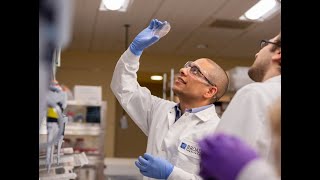
In this interview, host Drew Douglan talks with synthetic biologist Ahmed Badran about his modular, "LEGO‑like" view of biology and how it drives his work at Scripps Research. Badran explains why the enzyme RuBisCO, which fixes most atmospheric CO₂, is a bottleneck for carbon capture and describes two parallel strategies to improve it: (1) expanding the chemical repertoire of protein building blocks, and (2) resurrecting ancestral RuBisCO variants to explore new evolutionary trajectories. He broadens the discussion to other gaseous targets, highlighting nitrogen‑fixation enzymes as a next frontier. Badran contrasts bio‑based CO₂ sequestration with energy‑intensive material‑capture approaches, arguing that engineered organisms could fix carbon more sustainably. He then moves to plastic degradation, noting the discovery of microbes that eat PET and how synthetic biology can evolve more efficient enzymes using non‑canonical amino acids. The conversation shifts to antibiotic resistance, where Badran outlines a strategy to engineer ultra‑narrow‑spectrum antibiotics that selectively inhibit pathogenic ribosomes while sparing the microbiome, using Acinetobacter baumannii as a primary target. He envisions rapid, DNA‑sequencing‑based diagnostics that enable personalized antibiotic regimens. The interview closes with Badran’s personal interests—video games that echo his modular mindset, long‑term swimming, and a philosophy that imagination should never be abandoned in scientific pursuit.
Chapters
Howdy everyone, this is Science Changing Life and my name is Drew Douglan. Today we're going green with our discussion as we learn how new innovations in synthetic biology and chemistry can help us preserve our environment. I'm joined by Ahmed Badran, who is re-engineering some of the most fundamental biomolecules to develop solutions to major global issues like climate change and and antibiotic resistance. But before we get into these issues, let's learn how an early obsession with Legos put Ahmed on the scientific path toward playing with nature's building blocks.
Yeah, it's interesting. I've always really thought about biology as being reasonably modular. And I think when you look at things like the central dogma, you really do get a sense of this like Lego type of feature. So you have more or less the same building blocks that make up the nucleic acids and then the ones that make up proteins. And then what happens is biology puts them in different combinations. And then you have these like wildly different outcomes as a result. So all of the different forms of life that we see on the planet are built using the same building blocks. And that's kind of how I started thinking about it at the very beginning. And ever since then, it's been kind of at the forefront of my mind, you know, everything kind of comes back to this LEGO mentality. How do you put the different LEGOs together? How do you make new LEGOs?
It sounds like, yeah, you weren't really that fascinated until you saw the outcome. So do you think you're very sort of goal-driven?
I think so. And I always come back to this point that a lot of science isn't particularly interesting to most people until they can see the outcome, right? So for most people, that's, you know, you work a number of years towards a specific goal, and then you achieve that goal, and you have some sort of deliverable. That you can hold in your hand and say like, I made this, or I discovered this. And so I think it drives a lot of my thinking now about what type of science to do, namely that I want to be able to create something or to engineer or design something that really has a utility or has a function. And increasingly, that's trying to address what we think are really important global problems, like things like climate change or degrading plastics or, you know, really pressing issues that biology hasn't really been able to solve.
Got it. And then in terms of engineering tools, I mean, you just mentioned how you're passionate about solving these global problems. So what is it that your lab now here in Scripps Research in the chemistry department really does?
One of the major drivers of climate change is our increasing contribution to the amount of carbon dioxide in the atmosphere. And so for decades now, people have been thinking about strategies to remove that carbon dioxide from the atmosphere. And you can immediately see why that would be useful. It would reduce the greenhouse effect, which would then kind of readjust the temperature of the planet. And the majority of the strategies that folks have come up with really come back to biology. The reason for that is somewhere upwards of 90% of all carbon dioxide that is removed from the atmosphere is done by biological systems. In particular, there is one enzyme which is called RuBisCO, and that enzyme is responsible for the first step in photosynthesis where it actually grabs CO2 from the air and then subsequently uses it to build biomass in things like plants or cyanobacteria or any organism that can do photosynthesis. So this enzyme is responsible for upwards of 90% of CO2 fixation, but it's also a particularly bad enzyme. So it's a protein that doesn't function very well. It's reasonably slow. It makes mistakes and sometimes grabs oxygen instead of carbon dioxide. And as a result, biology has tried to overcome this limitation by making more protein. Because it's so slow, because it's somewhat error-prone in how it picks its substrates, biology can devote anywhere from, you know, very little amount upwards to 50% of the total protein in an organism, in a photosynthetic organism, can be this one protein. And so back-of-the-envelope calculations now suggest that it is the most abundant protein on the planet, and it corresponds to something like just under 1% of the total biomass on Earth is this one protein. So it's an immense amount, right? And I think it really speaks to the inefficiency of this protein compared to the efficiency the biology really wants it to be. And to offset it, it just makes more of it, right? And so this is for a long time been the holy grail for the basic reason that if you could make it better, you could now do something that is beyond what biology has strived to do for about a billion years, and pull carbon dioxide from the atmosphere better. You could start to affect climate change by doing that. You could also allow plants and photosynthetic organisms to grow faster, right, because they require this to build their biomass. So this enzyme then has been the subject of considerable research to try and understand what limits its activity and to try and improve its activity for these, of course, quite lofty goals. So this has been maybe about 30 years or so of attempts, and to date the improvements have been quite modest. So there's largely two reasons that are attributed to this issue. The first is that it's possible that the building blocks of life physically and chemically cannot allow this process to proceed any more efficiently. And so that might suggest that if you're able to introduce new building blocks into this protein, that you could potentially uncover new chemistries that dramatically enhance the activity of this enzyme. And so that's one strategy that we're taking to develop technologies that allow us to supplement the building blocks that are available for protein synthesis, and in doing so, potentially endow RuBisCO with new chemical functionalities. The other approach that we're taking to try and explore this problem is rather than taking the enzymes that exist today and trying to evolve them to be better, we're replaying the tape of life by taking these ancestral proteins. And we can reasonably well— like, we can approximate this process using computational strategies to nominate sequences that may have existed earlier and earlier, and using those sequences to evolve RuBisCO along different trajectories. So So what happens if you take the enzyme from the CO2 and oxygen concentration that existed at the dawn of life and you just immediately flip it, right? Can it come up with better solutions than if you have this much more graded response? And so between these two strategies, we don't know, of course, which one will work, but we can also easily combine them.
Is your lab involved at all with trying to evolve enzymes to capture other compounds in the atmosphere. So when I think of emissions, obviously carbon dioxide is a big one, but I think of these big smog clouds, you know, which have carbon monoxide and all these sulfur compounds and stuff, which, you know, you see these pictures, uh, and it, it really is sort of bad for people's health. So is there any work in modulating the capture of those?
Yeah, that's a fantastic question, and the short answer is yes, for the simple reason that because biology is so diverse, there's already sufficient insight into enzymes that have the activities that you're describing. And so you can imagine further engineering organisms that have enzymes that capitalize on other gases that might exist in the atmosphere and use them to build, say, biomass or for energy or what have you. The way that we're building our approach is theoretically agnostic to the gas that's being captured. And so it is something that we are thinking about from the get-go. One of the enzymes that we are starting to look at a lot more now is a class of enzymes that are responsible for nitrogen fixation. So this isn't necessarily a bad gas, but it has massive implications also in agriculture where microbes usually that sit around the roots of plants are responsible for grabbing nitrogen from the air and turning that into molecules that can be used by the plant as a nitrogen source. This is usually ammonia. And so there's huge utility also to being able to improve these processes so that the plant has more readily available nitrogen sources and also grows faster. So it is something that we're thinking about. It requires, of course, a little bit more kind of research and development to develop these strategies, but I think because of the approach that we're taking, it is something that we're will be an area of continued research in the lab for sure.
Yeah, that'd be really impactful. And aside from just the sort of bioengineering and I guess making organic matter that can capture these emissions, I was hearing some talk of different construction materials that could potentially capture carbon dioxide and other gases. So do you know what the progress is on that and are you involved in any of that work?
So we're not involved in those types of strategies, and they have picked up a lot of steam recently, certainly. So briefly, my understanding of these processes is that they capture carbon dioxide from the atmosphere and then typically convert that into materials that can be buried easily underground. So the major goal here is rather than using the carbon dioxide, sequestering it into a form where it can't escape again. To go into the atmosphere. So from a utility standpoint, you know, you could envision that it might be a lot better to fix or capture carbon dioxide and then build something useful from it that can't go back to the atmosphere, but still creates a resource for you as a researcher or as a consumer or whatever you might be. On the other hand, because of how these processes work, they are incredibly energy intensive, right? So you have to capture the gas, usually using chemical strategies. There's a lot of electricity that goes into the fans that have to funnel the air into these massive machines, and then also turn it into a form that can be easily moved, usually by compressing it, compressing the carbon dioxide gas. So I think there is certainly a lot of utility to these types of approaches. And of course, this is not a problem that any single strategy will be able to address. But for us, I think we're much more excited about the prospect of organisms that can carry out these processes for two simple reasons. The first is that you can fix the carbon dioxide and then turn it into something useful. And that to me will always have higher utility. The other, of course, is that organisms are somewhat readily engineerable to the point that you can, if we're wildly successful, imagine a plant that is tolerant to various environmental conditions. All the information is contained within that seed. And then you plant a lot of this plant and it's resilient and it grows without needing much water or any sort of other resources. And it is very happy to just fix carbon dioxide and grow. And so from an energy consumption standpoint, it is much, much cheaper to be able to rely on biological systems to do this.
Yeah, it's a tantalizing opportunity. And you brought up a great point there, which I think is really valuable for the listeners, which is just, you know, a lot of these biofuels and these other endeavors, they seem very cool on the surface, but it might actually take more energy input than the energy you save, right? So it's— you've got to do that equation of the sort of thermodynamics of everything.
That's exactly right. And I think a lot of these approaches are now becoming more cognizant of these energy consumption metrics. But I think that's really one of the more exciting elements about synthetic biology. As we continue to understand exactly what the cell does and all the different pathways that exist there and how to engineer them, you can imagine maybe a decade in the future that the approaches required to go from molecule A to molecule B in a cell are engineered in such a way that they take into account whatever energy is needed to support the organism, temperature changes, any sort of food that has to be provided to the point where you are actually getting more out than you put in.
Got it. And you had mentioned plastics degradation before, and I just had a thought. Are there opportunities for biologically engineering organisms that could do that process?
Yeah. So this is an area that is, I think, exploding now where It was really driven by the fortuitous finding of a microbe near a plastics plant where this microbe could actually eat the plastic. Wow. And so it would create these enzymes that it would spit out outside of the cell. The enzymes would chew up the plastic a little bit, and then it would take that into the microbe and then use that as a carbon source. To survive. So not unlike a plant subsisting off of carbon dioxide from the atmosphere, this microbe would eat, say, like a PET bottle for lunch. And this was really exciting because this particular polymer degrades very, very slowly. And so synthetic biologists and protein engineers have been wildly interested in this class of enzymes, in particular to create better enzymes that can degrade plastics. And so we feel like it's the right time to start to get into the space, in particular because we've developed these technologies that are really good at evolving proteins that supplement the chemistry of life to incorporate new building blocks that may have even more privileged functions in the degradation of these plastics. And I think increasingly, I am really excited about the prospect of synthetic biology affecting these problems because we're We're clearly kind of in this middle ground where we're finding these exciting activities. They're affecting these important problems. And so I think by having a larger body of researchers contributing collectively to this issue, eventually we'll be able to make huge strides in these spaces. Right.
Gosh, yeah, talk about evolution. Bacteria eating plastics.
Yeah, it's really interesting, actually. There's a number of examples throughout history where You know, we want a protein to have a specific activity. Usually it's to degrade something or to break a certain chemical bond. And the easiest way to find that is to go to a plant that makes that thing, whatever it might be. And inevitably you find a bacterium that has evolved to use that as some sort of energy or carbon source.
Along with Ahmed's work on climate change, his lab is also focused on solving the growing problem of antibiotic Antibiotic resistance in healthcare. His team is committed to developing new antibacterials that not only target specific strains more effectively, but also avoid nuking our own microbiome in the process.
Antibiotic resistance is a massive problem, and it's really, in my mind, born out of kind of two major issues. The first is that the way that we steward antibiotics and collectively as a species and use them, I think we've gotten a little bit too comfortable in how we apply antibiotics. And as a result, when you overuse something like antibiotics, resistance spreads very, very quickly. But the other major issue that I think is now becoming increasingly clear is that many of these molecules, many of these antibiotics, are purposefully researched and developed to have a so-called broad scope of target organisms. So if you think about it from the perspective of generating a therapeutic, the greater the number of indications you can apply it to, the better. And this has been the reasoning that's been used for antibiotics development for decades. Where if I want to make a molecule that kills a particular bacterium, it's better for me to kill a whole class of different microbes. Now, this does a couple of things that we probably don't want. The first is that it incentivizes widespread resistance. So, because this antibiotic will target any bacterium that it sees in that class, and that includes maybe things that are pathogenic or maybe things in the environment, the resistance mechanisms are incentivized to kind of spread throughout that population. And so you get widespread resistance. The other very important thing that is becoming clear now is as we continue to understand the contribution of a healthy microbiome to our health, or when the microbiome is disrupted, how that impacts disease progression potentially. That it relates back to antibiotics because whenever you take a lot of these clinical antibiotics, you not only kill the invading pathogen in your body, but you also wreak havoc on your microbiome. So, there's this sentiment that is starting to pick up a lot of steam now that says perhaps the better approach is to have a therapeutic for every more nuanced type of pathogen that we want to go after. This is a big ask because what you're saying now is you have to distill down the pharmaceutical pipeline to uncover new antibiotics into a single organism and do this over and over again. So, what it really means is that you just have to make it easier, potentially higher throughput to uncover these new molecular, these small molecules that could kill a pathogenic microbe and importantly, not have an impact on the commensal microbes that are in your microbiome. And so, we've been thinking about this a lot and it was born out of work that we did in trying to engineer the ribosome, which is the machine in the cell that creates all the proteins. And so, if you remember earlier, I was telling you about how we were messing around with this so that we could create new enzymes with new functions, with new building blocks. And in the course of those studies, we got really good at manipulating this protein factory in a way where we could actually take those components from any given microbe and create them in the laboratory. And so, we have these massive repertoires of ribosome from this organism, which is bad, ribosome from this organism, which is good, etc. What we've begun to do now is try and find antibiotics that only inhibit the ribosomes from the bad bacteria, the pathogenic bacteria. But not the ribosomes from the commensal bacteria, the ones that you actually want to keep. And you can imagine if you do this over and over again, you can potentially have a molecule for every pathogenic ribosome that you care about. So, when you look at it on the back end, if we are successful in doing this, then whenever you identify that you have, you know, some sort of sickness that relates to this pathogenic organism, you can take this antibiotic, your microbiome is unperturbed, and because this antibiotic only affects this pathogenic microbe, resistance should not become anywhere near as rampant and in fact just constrained to this particular pathogen if it arises. And so we think this so-called narrow-spectrum or ultra-narrow-spectrum antibiotic strategy is probably going to be the way to go in the future. And so this is kind of something that we're exploring right now.
Wow, that's so cool. Are there certain ones you're focusing on first?
Yeah, there's a couple of really bad bacteria out there that are high up on the list of organisms that we have to get rid of. The most important one that we're trying to address now is a bacterium called Acinetobacter baumannii. This is perhaps the worst microbe that we know of, and in fact, the priority pathogen on the WHO's list of infectious diseases. The reason it's so bad is this organism in particular has developed an exceptional capacity to find genes or proteins that give it resistance to all of the antibiotics that we have. You can think of it as it's building like its own Swiss Army knife.
Mm-hmm.
And now everything we throw at it doesn't kill it. And so, um, this has been one of the more important targets that we're trying to address. And we're trying to now find molecules that can actually kill this particular organism. And recently, we've had success actually in identifying new molecules that selectively inhibit the ribosome from this organism. So I think the strategy has a lot of potential, but of course, will still take a reasonable amount of time to advance this to a point where it can be a potential therapeutic.
Could you envisage us having in the future then, maybe personalized antibiotic regimens then based on our unique gut bacteria or skin bacteria?
Yeah, I think a lot of the direction that is clearly— that we are clearly going in is one of extremely rapid diagnostics. Right. Which I think is in severe contrast to how we've thought about a lot of infectious diseases in the past. So if you think about What happens when you think you have some sort of bacterial infection? So usually you might go to your physician or the hospital or whatever. They take some sort of sample and then usually for bacteria they have to plate these out on so-called indicator plates. So they're ones where they have specific things in them to tell the physician or the technician what is the microbe that's in my patient. Now, because you have to grow the bacteria, there's time now that you're waiting for, right? So there's a bit of a lag there. Once the indicator plates tell the physician or technician what the microbe is, the physician could potentially prescribe a specific antibiotic. Now, because the timeframe that this takes, often the physician might preemptively prescribe the antibiotic, which is in fact part of the problem, right? This is how we get the widespread resistance. But nowadays, especially— and this is maybe one of the few good things that has come out of the COVID pandemic— there is this sense that rapid diagnostics are really important. And empowered by advances in high-throughput DNA sequencing, one can easily envision a patient sample being sequenced to identify what that pathogen is on the order of, say, minutes rather than days. And if we do reach that point, which I think is very near, in fact, you can imagine kind of the other side of this coin that once the physician identifies what the pathogen is, they can prescribe a specific repertoire of antibiotics that is selective for that bacteria. And so the first half of this puzzle, I think, is we're well on our way to really being able to make this a reality. And so we're hoping by creating molecules that have this very narrow scope to a specific pathogen, we will eventually kind of realize this more personalized antibiotic regimens.
Yeah, it'll be a huge transformation, you know, not just like you said, pinpointing what's exactly wrong, but now we realize we need to preserve what's actually right, not just everything.
Yeah, that's right.
Maybe we can transition then away from building molecules? And when you're not in the lab, what are some of your other hobbies outside of the research? I mean, do you still play with Legos now?
No, I haven't, unfortunately, in a long time. I mean, I still do things that kind of come back to that. I mean, I'm very interested in video games that have that type of mentality where you can build complexity. That's where a lot of that energy has gone more recently. Especially LEGO kits get very expensive as you move up. So I haven't played with that.
Which games?
Oh man, I've recently gotten into No Man's Sky.
Okay.
For if you've ever played this game, it's a procedurally generated game where, you know, you jump from planet to planet and you start to more or less kind of build complexity. So you uncover new things, you find new organisms, and that element has always been really exciting to me that you can discover things that haven't been seen before. And that's really one of the strengths of that game. I've also taken a stab at another game called Satisfactory, if you've heard of this one. No. That one is, it's like a, It's like a resource management game where the goal is to create the most efficient factory. And so you progressively learn about different resources and how to put them together and how to build more efficient pipelines, which maybe that's a little bit too close to what I do in the lab. But it is actually quite fun. Outside of that, I'm very much into sports. So I've been swimming for something like 25 years now.
Oh, cool.
I find it very relaxing, but also it's quite energizing. So it's one of the few sports that really works all the different muscles in your body. And so I've been— I swim a lot still, and then I play lots of other sports. So I play soccer maybe a few times a week, going to the gym to work out. Outside of that, I've started to get more into reading about history. In particular, the history of science has always been really exciting to me. Kind of learning about the nuanced lives of, of people that you might kind of associate with these like big picture ideas, but really understanding their day-to-days has been really fascinating.
That's fun. Yeah, I've been reading a lot. I've been dipping into sort of economics, and I think my next book is maybe going to be Marcus Aurelius. Meditation.
That's got to be fun. Yeah.
So that'll be kind of fun. But yeah, I grew up swimming too. That was like my main thing and it was definitely a good one to be into for sure.
Yeah, absolutely. Yeah.
I love that first video game. It's like you're not content with saving our planet. You've got planets too in the virtual space.
Yeah, I think I've always really enjoyed kind of these games that keep you guessing. And, and I've— and this game in particular is just so out there. I mean, I guess literally also, uh, but it's the fact that you can't really predict what's going to happen next has been really fascinating to me.
Yeah, maybe that's your good outlook on life that you're embracing, right? Doing things that sort of keep you guessing.
I think so. I mean, it's— sometimes I, I think that I get bored quite easily And so maybe my motivation in a lot of things that I pick is to try and keep myself entertained with the novelty and the unpredictability of a lot of these things. Got it.
Yeah, we do as a species definitely seek novelty.
I think that's true.
Yeah, cool. Well, speaking of outlooks on life, maybe I'll just ask you my final round of questions I like to throw at all my guests, which is, you know, if you could give one piece of advice or your wisdom to anyone in I don't know, the realm of work, career progression, life, health, self-improvement. What do you think it would be and why?
I think I've always been motivated to pursue the questions that I went after in my science, mostly out of like a what-if type of mentality that as you progress through science, you kind of build your knowledge base about what things are known. And then you often will come up to a wall of, you know, this thing is impossible, or it doesn't exist, or it can't exist. And I think I've learned that that wall is kind of self-imposed. It doesn't really exist, right? The building blocks are, you know, sufficiently diverse, but the combinatorial space is virtually infinite. And so this idea that there's something that shouldn't be possible or can't exist is one that I very quickly gave up early in my career. And I think that's probably the best piece of advice that I could give someone is if your knowledge base tells you that something should be possible, this could be like from first principles, it could be chemistry, it could be physics, it could be whatever, but the dogma is that it's not possible. My experience has been that it's actually quite fun to try and challenge that. And you don't always get what you want, but I think it can be a very formative experience to explore kind of the limits of your imagination as applied to these very important scientific questions. So to sum that up, I think what I'm saying is, you know, as we grow older, sometimes we abandon our imagination in the pursuit of more kind of concrete things. And my piece of advice is don't give that up.
A wonderful perspective there from Ahmed, and he is proof that imagination is the seed of innovation. A big thanks to him for sitting down with me today and sharing his vision for solving these major but not insurmountable challenges. We'll have more on Ahmed and his work in the show notes, along with links to the latest articles from the Scripps Research Magazine Thank you as always for listening, and remember to hit subscribe and leave us that 5-star rating. So until we meet again to hear from some of the biggest names in science and medicine, stay curious and be well.
More from Joshua







Scientist Stories: Hans Waterham, The value of phenotypic assays in peroxisomal disorders




Scientist Stories: Joel Zlotogora, Genetic carrier screening programs for reproductive purposes