Scientist Stories: Ahmed Badran, Chang Liu Lab on Continuous Directed Evolution In Vivo
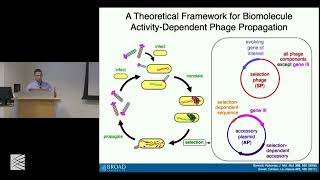
The presentation, delivered by Joshua Elkington, surveys the conceptual and practical foundations of continuous directed evolution in vivo, focusing on two complementary platforms: Phage‑Assisted Continuous Evolution (PACE) and the orthogonal replication system (OrthoRep). It begins by framing directed evolution as navigation of a fitness landscape, emphasizing the need to diversify biomolecules and to couple their activity to a selectable phenotype. The speaker explains how PACE repurposes the M13 bacteriophage life cycle, removing gene 3 (P3) from the phage genome and supplying it on an accessory plasmid whose expression depends on the activity of the evolving gene. This creates a tight link between biomolecule function and phage infectivity, allowing up to 50 evolutionary rounds per day in a continuously flowing “lagoon” with engineered E. coli hosts and inducible mutagenesis plasmids (MP4/MP6). Detailed case studies illustrate PACE’s power: (1) evolving T7 RNA polymerase specificity from the T7 to the T3 promoter, using hybrid promoters as stepping stones, and employing neutral drift and negative selection to achieve a 10,000‑fold specificity switch in ~3 days; (2) replaying evolutionary trajectories to probe epistasis, showing that different mutational paths to the same promoter specificity can involve distinct, pathway‑specific mutations. The talk then shifts to protein‑protein interaction evolution, describing the engineering of Bacillus thuringiensis (Bt) toxins to bind a novel cadherin receptor, highlighting the challenges of stepping‑stone design for complex interfaces and the importance of mutagenesis rate (MP4 vs MP6) for success. The second half, presented by a collaborator (Speaker B), introduces OrthoRep, an orthogonal cytoplasmic replication system derived from a linear plasmid of Kluyveromyces lactis. By refactoring the plasmid and expressing its DNA polymerase in the host genome, a separate replication compartment is created that can be engineered to be highly error‑prone (mutation rates up to 10⁻⁵ per base) without affecting the host genome. The speaker details the engineering pipeline for high‑mutator polymerases, the stability of the system over hundreds of generations, and the ability to tune mutation rates. Applications include: (1) rapid evolution of Plasmodium falciparum DHFR under pyrimethamine pressure, revealing greedy versus alternative mutational pathways (S108N vs D54N) and the role of epistasis; (2) deep, scalable evolution of HisA for temperature adaptation and for acquiring a new tryptophan‑biosynthesis activity, demonstrating the utility of drift to cross fitness valleys; (3) evolution of the thermophilic enzyme TRPB into a standalone, mesophilic tryptophan‑analog synthase in collaboration with Frances Arnold’s lab; (4) affinity maturation of nanobodies displayed on yeast surface, and plans for fully continuous antibody evolution. The speaker argues that continuous evolution offers unparalleled scalability (many parallel replicates) and depth (long mutational trajectories), enabling exploration of rugged fitness landscapes, crossing valleys, and generating rich datasets for machine‑learning models. The talk concludes with a vision of a virtuous cycle where computational design seeds continuous evolution, and the massive evolutionary data feed back to improve predictive models. Overall, the presentation provides a comprehensive overview of the theory, engineering, experimental results, and future directions of in‑vivo continuous directed evolution, emphasizing design principles (selection coupling, mutagenesis control, stepping‑stone intermediates), practical considerations (mutation spectra, population size, dilution rate), and the broader impact on synthetic biology, drug resistance studies, enzyme engineering, and therapeutic antibody development.
Chapters
It's a pleasure to be here. This is my second time giving one of these, and it's always a lot of fun because I think it's a really good overlap between the folks that do the computational stuff, which I am absolutely awful at, and the directed evolution, which I think could really benefit from a lot of this stuff moving forward. I'm really also excited to be here today with Cheng, who just had his birthday. So he wanted us to sing for him, but I feel like that would It's too early for that. So we'll move on to talk— yeah, in between the talks we'll sing. So I wanted to talk a little bit today about some of the considerations that we as synthetic biologists thinking about directed evolution try to conceptualize at the onset of a lot of these types of experiments. And I think a lot of the stuff that— I'll be talking about today will overlap with elements of Chang's talk as well, specifically with regards to how we think about mutagenizing a given biomolecule and how we subject that biomolecule to a selection or screen. So to open, I just want to talk a little bit about kind of the conceptual framework for what a directed evolution pipeline might look like. So we start with a given biomolecule. A lot of us think about these as these fitness landscapes. So you start off somewhere in a fitness landscape where a given biomolecule has some arbitrary level of activity, where you could potentially increase this fitness for a given selection by finding members that climb these evolutionary trajectories. But in the vast majority of cases, for an exceptionally large sequence landscape, most of these sequences are going to be relatively nonfunctional or very low levels of activity. And in general, these functional sequences are restricted to these so-called islands. This is a gross oversimplification. This figure actually says nothing about what a fitness landscape might actually look like, but is mostly there to show the dichotomy between having a member of a population that has a high fitness, versus the vast majority of sequence space. An especially interesting point, which I'll touch on multiple times as we move forward, is that there's a number of unique combinations in sequence space that can often give rise to very similar levels of activity and therefore have very similar fitness. So when we as synthetic biologists or bioengineers are thinking about doing directed evolution, often the way this looks is we start off with a biomolecule that sits somewhere in this fitness landscape, in the sequence landscape. And that biomolecule has a given amount of fitness. Typically, this will be very low if we're trying to improve it to have some sort of arbitrary activity. And the question then is, how can we best survey the immediate, or if we're really good at being able to mutagenize and select for functional members affect the broader sequence landscape to discover variants that have improved functionality. And so again, to keep going down this track, perhaps we start off with this one biomolecule, which we iteratively diversify and select for members where we climb this fitness landscape all the way to a point where we reach members that have dramatically improved activities. And so we can boil down this, relatively complex idea into two very important stages. And these are kind of the crux of any sort of directed evolution method. The first is how do you diversify a given biomolecule? That is to say, how do you introduce in mutations to allow you to best survey the possible sequence space within the vicinity of your starting point? And the second is how do you assess the phenotypic consequences of the mutations that you just introduced? How do you select for members from that population that have this improved level of activity? This is typically called either a selection or screen, depending on whether or not nonfunctional members are either killed or removed from the population, or if all members of the population are assessed, and then you, as the researcher, pick which ones to move forward with. So for a lot of the work that I've done and that we continue to do, we've focused traditionally on work in vivo in E. coli. It offers a very easy handle to manipulate for the various stages of directed evolution. And I want to kind of show you how we conceptualize a lot of these steps here. So for a given selection, let's say where we're trying to evolve a population of nucleic acids to go from one that encodes many different colors to, in this case, we just really like the red one for some reason. And so the steps are first that we introduce in the genotypes that correspond to the biomolecule that we're going to subject to selection into our host. In this case, this is E. coli, which is a relatively easy one to use. It doubles very quickly, and it allows us to progress through these various cycles very rapidly. These genotypes are then translated into the biomolecules that are the basis of the selection. In this case, we're We're trying to find a protein in this case that has the color red instead of the color blue. We can then subject this particular population now to this selection or screen, where we pick out the members that are encoding for this phenotype of interest. These so-called winning members can then be mutated and amplified to generate yet another library of variants of diversified members that build upon this starting material to allow them to discover potentially improved variants of this genotype and phenotype. Now, the important aspect of this is what we call a round of directed evolution, which is a complete progression around this cycle, takes, depending on the technique, depending on the organism, and depending on how you're actually subjecting it to selection or screen, can take on the order of days to weeks to complete. —and often, depending on the various selections that are used, can be fraught with certain technical challenges that make it particularly difficult to kind of progress from one stage to another. So using traditional methods, a directed evolution project might be complete following, say, 5 or 6 or 7 rounds of directed evolution. And the reason for that is that a lot of these conventional methods poorly couple the various stages around this cycle., and in doing so requires significant researcher intervention and lots of time to be able to seamlessly progress from one stage to the next. And so what my colleagues Kevin Esvelt and Jake Carlson recognized, and this was as I was entering grad school, is that a lot of these steps from the conventional directed evolution life cycle, or cycle, can be superimposed on a viral-mediated life cycle, in this case, bacteriophage called M13, which infects E. coli, propagates to generate novel progeny phage. And so a lot of the hallmarks of the directed evolution steps are mirrored here. So the introduction of the genetic information into the host is mediated by infection rather than transformation. The genetic information is then translated into functional form, shown here, and if the virus is fit propagates and results in the production of new viral progeny. But the question then is kind of at this crux here. How do we couple a given biomolecule activity of interest to this cycle? If we can theoretically achieve that, that allows us to progress through many more rounds of the cycle in a much shorter time frame, mainly because the phage or the bacteriophage can progress through one of these cycles within 10 minutes. And that contrasts very heavily with kind of the conventional directed evolution life cycle, or cycle, which can take days or weeks to complete. So to really enable this, one mechanism to be able to link a biomolecule's activity of interest to this viral life cycle is by making it depend on the activity of the biomolecule of interest. That is to say, if— The genome, the phage, the virus is not fit unless the biomolecule of interest has a given activity. One easy way to do that is to refactor it such that the genome lacks an important element where that element is now provided by the selection. And the way that Kevin and Jake decided to do this was using a protein called P3. So M13 bacteriophage is a very, very small prokaryotic virus. It has a total of 11 genes, all of which are absolutely necessary for function. And so you might expect that the removal of any one of these genes results in an incredibly not-fit virus, and therefore might serve as the basis of selection. P3 turns out to be an especially useful version, an especially useful basis of selection, because it has a number of different roles that it plays during the course of this life cycle. So first, P3, which is the so-called minor coat protein on the surface of the virus, interacts with what are called pilus proteins on the surface of the E. coli cell. And in doing so, unlocks the phage particles and enables the phage genome to enter the host cell. Once it does that, the central dogma kind of does its part. The phage genome is replicated, the proteins are made, and then P3 regulates the step wherein the phage is excised from the membrane to result in the new progeny viruses. So now all of these very important steps suggest that if you were to remove PIII, that you would not necessarily have useful virus production. And this actually turns out to be the case, where phage that have PIII compared to ones that don't demonstrate a very large kind of dynamic range and enable us to use PIII as a suitable basis for for selection. And so going back to this life cycle, what this now looks like is if we zoom in on the selection stage, we can refactor the phage genome into two elements. So what used to be the phage genome we now call the selection phage. And it lacks gene 3, the gene that encodes for this important protein, P3. And in its place, we've added this evolving gene of interest. The other part of this refactoring is including Gene 3 on what we call the accessory plasmid, which is a selection-dependent plasmid wherein if a biomolecule can access some aspect of the sequence that then results in the production of Gene 3 or the translation of P3, then it would potentially complement the deficiency in the selection phage. So more schematically, this selection phage would produce this one protein. If this protein can positively affect this selection sequence, it makes P3. That complements the deficiency in the selection phage and results in infectious bacteriophage. And so putting this all together is what we described as PACE, or phage-assisted continuous evolution. All of these steps take place in what we call the lagoon. In this lagoon, we have a constant outflow of engineered E. coli cells that bear this accessory plasmid, in addition to a mutagenesis plasmid, which enhances the diversification during the course of the selection. And I'll talk a little bit more about that downstream. We initiate one of these PACE experiments by infecting these bacterial cells with selection phage that have been engineered to encode the evolving gene or genes of interest. Infection then occurs. And if the selection phage encodes a functional library member, P3 is produced, which then results in these infectious progeny, which can undergo continuous cycles of this process. We can, again, through this mutagenesis plasmid, continuously induce mutations into the selection phage to enhance the diversity of the elements that we're trying to evolve. On the other hand, if the SPE does not encode a functional library member, no P3 is produced. And while these do result in packaged viral-like particles, these particles are noninfectious. And so they do not get retained on average during the rest of the experiment. We can further modify the selection stringency during the course of this experiment by regulating the outflow rate from the lagoon. So as the outflow becomes faster and faster, then the phage would be expected to replicate accordingly faster to be able to overcome this constant. Dilution. So depending on the selection, and there are many different types, and I'll tell you about some of those today, we can do upwards of about 50 rounds of directed evolution every 24 hours. So again, I'll contrast this with what I said before, where a conventional traditional directed evolution round can take anywhere from days to weeks to complete, we can do 50 or more every day. And because of the nature of the system, the mutations accumulate only in the SP. That is, because everything is subject to dilution and we can control the rate of dilution such that it's faster than the replication of the bacterium, but slower than the replication of the phage, on average, all mutations that enable passing the selection are retained in the SP and nowhere outside of that. What this looks like is somewhat shown here. There are many different flavors of this now that have been done by us and many other labs. Including miniaturizing this whole setup to about a foot-by-foot tabletop platform. We like doing these in a warm room largely because it allows us to manipulate these large volumes that increase our putative library size. So to kind of highlight the elements that I described on the previous slide, these engineered E. coli cells bearing the AP and the mutagenesis plasmid are housed in this TurbidoStat, which is maintained at a constant turbidity to ensure efficient phage infection. All of the liquids shown here are handled by these peristaltic pumps, one of which pumps these modified host cells into the lagoons. And this is where we've added the phage that have been engineered with the evolving biomolecule or evolving gene of interest and subjected to selection. We can also then hook up syringe pumps to add any number of additives. This might include chemical mutagens. In our case, our mutagenesis plasmid is inducible by small molecule arabinose, which allows us to circumvent many of the issues with chemical mutagens while introducing robust mutations in the genome. Just one of the first examples that was really applied to PACE was to demonstrate that we could use this to evolve RNA polymerases with modified promoter specificities. This particular case turns out to be relatively difficult because RNA polymerases that derive from these bacteriophage, like T7 RNA polymerases, which I'm sure many of you have worked with before, are exquisitely specific RNA polymerases for their cognate promoter sequences. So in this case, T7 RNA polymerase interacts with this nucleic acid sequence in the DNA to then initiate transcription and produce and RNA either in the cell or in vitro. There's a number of these polymerases that have been identified. They all have names that sound like letter numbers. So T3 is another version. SB6 is another version, K11. And they all derive from relatively homologous bacteriophage that selectively interact with their cognate promoters to initiate transcription in E. coli. When you start to mix these elements together, for example, when you ask whether or not the T7 RNA polymerase can initiate from the T3 promoter, you find that this activity level is quite low. And in general, for these bacteriophage-derived polymerases, this has to do with a major specificity element that exists between positions -12 to -10 with respect to the transcription start site that really dictate the specificity of one polymerase for a given promoter. [Speaker:JOSHUA ELKINGTON] Right, so the question here was whether or not T7 RNA polymerase could be evolved to interact with this phylogenetically related, but quite distant RNA polymerase promoter derived from T3. And so the design principles that were used here were first to construct this so-called hybrid promoter, which bears resemblance to both the T7 and the T3 promoter., but does not include many of these specificity elements that would need to be changed to going from T7 to T3. And this would serve as a so-called stepping stone, which is an important concept in directed evolution to be able to evolve biomolecules towards arbitrarily difficult final products, but going through intermediates that may not necessarily be as difficult. And so schematically, what this looks like is if we have the T7 RNA polymerase, we engineer the T7 promoter upstream of this gene 3 cassette, T7 RNA polymerase should faithfully interact with this RNA— sorry, with this promoter sequence, transcribe gene 3, and that ultimately results in P3 production. Conversely, if we substitute the T7 promoter with the T3 promoter, the end result, which is production of P3, is dramatically reduced. And so the hope is, via PACE, we can evolve variants that now interact with this T3 promoter. And this turns out to be quite true. So what I'm showing here is the evolutionary trajectory over the course of about 8 days. What's shown in the dark red is the hybrid promoter I described on the previous slide. Light red is the T3 promoter. And what we're modifying here is the copy number per cell. So you can imagine this as manipulating the concentration of substrate in the cell. So as the concentration of substrate or promoter in this case goes down, the polymerase must evolve to become more proficient at producing a high amount of PIII from a lower number of substrates. And so this is, in fact, what we find. So going over the hybrid promoter, we evolve variants that show apparent improvement in activity on the T7 promoter, but importantly, provide access to variants now that can initiate transcription on the distant TIII promoter. And as we progress to the more difficult versions of the selection, we can dramatically enhance these activity levels. And so what PACE then has enabled over the course of this experiment is the evolution of RNA polymerases with novel promoter activities over the course of about 8 days. Now, looking at this data, there's a couple of points that might stand out to you. The first is potentially this, the length of this evolutionary trajectory. This is particularly relevant for us because we know the number of mutations required to access this activity, and it turns out to be exclusively 3 mutations. So if you go into the system, take T7 RNA polymerase and make those three mutations, you get these levels of activities. So why are 8 days required to be able to reach these levels? Importantly, from kind of a synthetic biology perspective, if we're trying to generate biomolecules with novel activities, perhaps we also want them to be orthogonal. And in this case, the promiscuity of the resultant products, that is the T7 RNA polymerase variant can still initiate transcription on T7 promoter quite efficiently, may be an undesirable side product. And so to cut a very long story short, we developed— sorry, my computer is— yeah, we developed a number of strategies to mitigate both of these issues. We developed strategies to enable what's called genetic drift or neutral drift to acquire mutations in a gene of interest in a selection-independent manner. This allows access to variants that might be potentially detrimental as intermediates during the course of evolution. And in addition, we developed ways of tuning the selection and introducing negative selection variants that then improve the specificity of the resultant biomolecules. In this case, our basis for negative selection is a modified version of gene 3 that acts as a dominant negative, such that we use the T3 promoter to reward variants that can access this activity by producing P3. And we penalize variants that have activity on the T7 promoter by making this dominant negative version, which then poisons phage propagation. And what you can see here, starting from the wild type T7 RNA polymerase, as we progress through these cycles of drift and increasing the selection stringency, as well as incorporating negative selection, we can discover variants now that have dramatically improved activities on the T3 promoter, and importantly, not have any activity or at least very little detectable activity on the cognate or starting T7 promoter. Importantly, we were able to achieve this approximately 10,000-fold change in specificity over the course of just under 3 days. And so I think this really speaks to the ability of PACE and kind of improved modern methods of doing directed evolution for achieving these very difficult evolutionary trajectories in a very short period of time. Importantly, in this case, variants that have this specificity switch require on the order of 7 to 8 mutations compared to the 3 mutations that were necessary before. Now, an interesting— and throughout the talk, I've kind of included these points that I'm showing up here, which I'll talk about for each slide. And these really serve to highlight some of the considerations that we as synthetic biologists are really thinking about when we're designing a lot of these experiments. So for example, what does the sensor actually look like? How much time does an RNA polymerase need to be able to initiate transcription on this promoter? And how does that affect the feasibility or strength of our selection? How we modulate selection schedule or stringency, or how we kind of push the selection in a way where it discovers novel activities. Um, and so these are all very important kind of considerations to make. Um, this is the end product of a lot of that analysis, which, uh, required the optimization of these various parameters. As we've progressed through these various pace selections, we now have a better understanding of which parameters to tune. To really be able to push a given biomolecule in a given direction. One of the interesting things that comes out of this, especially now that we have mechanisms of being able to survey much larger sequence spaces, is given that we can achieve an end product, that we can evolve a biomolecule to have a given activity, does it matter how we got there? And does the way we've designed these selections influence the efficiency or the utility of the final product? To answer this particular question, my colleagues Brian Dickinson and Aaron Lecomte were interested in replaying the so-called tape of life. So if you take a starting material and evolve that starting material to an arbitrary endpoint, if you were to arrive at that endpoint by different trajectories, to what extent does that influence the genotypes or potentially phenotypes that arise at the end of the directed evolution campaign. And so to achieve this, they took the T7 RNA polymerase promoter and sequentially introduced mutations that approximate, for example, in this case, the T3 promoter, but then kind of go beyond that to a completely synthetic final promoter that's shown here. They similarly repeated this trajectory towards this endpoint via another homologous promoter called the sp6. Promoter from yet another completely different bacteriophage. And so they did the equivalent of about 1,600 rounds of directed evolution over the course of, again, about 8 or 9 days. And all of these were done in 4x replicate, which I'll describe why that was important on the next slide. But importantly, a lot of this work revealed that depending on the starting material and depending on the trajectory, the endpoints that you get may not look like— sorry, depending on the trajectory, you might get different genotypes. If you've done your selections right, the phenotypes at the very end should be relatively similar, but they may have nuances and differences between them. And so for this specific type of work, we also consider how to build specific stepping stones. For particularly difficult sites, in this case, where about half of the contacts in the promoter would need to be modified to be able to access this activity, how do we start picking what stepping stones would be appropriate over the course of these various trajectories? We integrate things like interactions with the host or crosstalk, which might allow for cheaters to arise during the course of the selection. So for example, in this particular instance, one issue was as you begin to modify the T7 RNA polymerase promoter, you start to introduce sequences that are host E. coli RNA polymerase promoters. That then allows the RNA polymerases that you're trying to evolve to be surplus to the requirements of the selection, and so nothing really evolves. So certain considerations like that really start to arise when you're carrying out some of these experiments. So the multiplicate kind of pathways that were taken here were really useful to inform a very important concept in directed evolution, which is epistasis. So over the course of these evolutions, there is one particular mutation that arose that was very interesting, which is this phenylalanine 646 to leucine mutation during the course of this sp6 pathway. Now, the nature of the mutation itself is not important. What's more important is that none of the other populations across either arcs develop this point mutation. And so what Brian and Aaron were really interested in is, what does this mutation actually do? It doesn't seem to be kind of a pathway-specific mutation, doesn't seem to be kind of a broadly useful mutation. Is this potentially an epistatic mutation that has influenced some aspect of the trajectory of this evolution? And what they found was that this mutation was only beneficial in the context of clones derived from this population 3, any other variants that were tested in the context of this mutation saw a dramatic reduction in activity. And so what had actually happened is during the course of the evolution, this mutation had evolved, and compensatory mutations or additional mutations had evolved around this variant to be able to incorporate this as an important aspect of the final activity, but only in this specific background.. And so as we go through these various directed evolution projects, we continuously consider many of these epistatic effects and what they mean, both in the context of the protein that— or the biomolecule that we've evolved, but also if they can be extended to additional biomolecules. What this particular set of data also illuminated is the importance of being able to kind of discover many of these epistatically difficult mutations. You might expect, as your ability to survey sequence space, or maybe more technically, to mutagenize a gene of interest goes up, you can survey more combinations of possible mutations, which might open up your landscape to many of these potentially useful epistatic interactions. To highlight that, I want to kind of do a back-of-the-envelope calculation. That really, I think, will hopefully stress the importance of mutation rate for a lot of these direct evolution pipelines. So in bacteria, the spontaneous mutation rate is on the order of 10 to the minus 9 or 10 to the minus 10 mutations per base pair per generation. So a relatively low number if you consider that the entire E. coli genome has about 4 billion bases. If we assume that a generation size which is relatively moderate, of 10 to the 10 members in a given generation. And we can somehow convince the bacteria to exclusively localize all of those mutations to a 1-kb gene of interest. This would provide access to about 10,000 or so single mutants of that gene of interest. Now, this might seem like a lot, but the important consideration is here to what extent can we survey, again, the sequence landscape around the starting material? And so 10,000 mutations might provide very modest coverage of all possible single mutations of that gene of interest, but very little and effectively no overlap with all possible double and triple mutations of this given gene. And so these spontaneous mutation rates are incredibly low, typically useful at the level of an organism to be able to evolve improved fitness for environmental conditions. But for directed evolution, especially where we're focusing on a given biomolecule, we would need dramatically enhanced methods to be able to mutagenize a gene of interest to allow us not only to ensure or really bias the selection to discover useful end products, but also to putatively discover some of these epistatic or codependent relationships that might be necessary for these downstream functionalities. So I told you I skipped over the mutagenesis plasmid aspect a little bit. And I'd like to introduce that here. So the way the mutagenesis plasmids work in PACE is they are small molecule inducible plasmids that produce so-called mutator proteins in E. coli. And what these do, and they're kind of organized here to depending on the pathway that they disrupt, is they start to affect mechanisms that the E. coli uses to be able to ensure that DNA fidelity is very high. For us, what we care about is actually taking that in the completely opposite direction. So we want to be able to reduce that as much as possible, and in doing so, increase the apparent diversification of a gene of interest. And so again, to cut a long story short, we developed a whole series that are just kind numbered here. All this data is shown with absence of induction or induction with the small molecule arabinose. And you can see that for our most preferred variant, which is MP6, when we induce it, we see a dramatic increase in the mutagenesis efficiency compared to in the absence of the mutagenesis plasmid. In this particular case, it increases the rate of mutagenesis many hundreds of thousands of fold. And for a 1-kb gene of interest, this now provides access to not only all single, and double, and triple mutations, but also all quadruplet possible mutations of a given 1-kb gene of interest. And this provides access to theoretically much more different starting materials at the end of a PACE experiment than those at the beginning, and in doing so, providing access to potentially novel phenotypes. Another important consideration when thinking about mutagenesis with regards to directed evolution is the mutational spectrum. So the spectrum allows you to traverse, in the case of at least proteins, modifications from one amino acid to another. As your mutational spectrum becomes more restricted, the access to specific types of amino acids from a given starting material would similarly get reduced. So an important consideration is to ensure not only that you have high and robust mutagenesis,, but also to ensure that that mutagenesis is quite diverse. And so MP6 here shows a relatively useful kind of mutagenesis spectrum. This is for a given gene of interest, in this case LacZ, where we've mutagenized it with MP6. This is the starting base, and this is the kind of mutated base. And you can see that we do have access to the vast majority of these mutations and that the spectrum is quite even. So to kind of benchmark these mutagenesis plasmas, we showed that we can take MP6 and compare it with mutator strains. These are strains for which many of these pathways have been constitutively removed or inhibited. And so these strains are constitutively mutators and therefore not particularly happy because as they grow, their genomes deteriorate further and further. As well as to chemical mutagens, which are small molecules that you can add, in this case to bacteria, to affect very specific changes in their genes. Chemical mutagens, in addition to being not the safest thing in the world to use, offer very narrow mutagenesis spectrums, and therefore would also restrict access to given genotypes in a directed evolution campaign. But what you can see, hopefully, is that the black bars are typically higher, and in many cases much, much higher, than the next best either mutator strain or chemical mutagen, suggesting that this mechanism of mutagenesis would be really useful for evolving many of these novel functionalities. Interestingly, in the context of PACE, MP6 also allows us to discover variants in much more rapid timeframes. So if you remember kind of the progression that I talked about before, so in our first instance, we could evolve T7 RNA polymerases over the course of about 8 days to have this novel activity. With our improved selection methods, we could do this in about 3 days, but we had to use neutral or genetic drift to be able to access those variations. At now higher mutation rates, and in the absence of drift, and in the absence of long evolutionary trajectories, we can reach these activities, which correspond to all 3 mutations that I told you about before, in a fraction of the time. And this turns out to be especially important when we're trying to evolve starting materials into particularly difficult end products. Now again, the other point I wanted to stress, going back to the mutagenesis spectrum, is when you think about taking a gene of interest and evolving it to a given— towards a given activity, not only does the method of doing the mutagenesis on the gene of interest matter, but equally importantly, and I think often overlooked, is what that gene looks like as a starting material. So to conceptualize this a little bit, so this is schematically showing what might happen during PACE. We include a gene of interest on the selection phage that we constantly mutagenize with the mutagenesis plasmid. Now for a given gene of interest, let's say this is part of what the gene sequence looks like and the corresponding amino acid sequence. For that given gene, this is one of many possible permutations of the starting point that would ultimately all be the same end product in terms of the protein. So you could have many different flavors of this gene, all of which are encoded by different codons, all of which result in the production of the same identical protein at the end. And what this corresponds to kind of in the fitness landscape example is various starting points along the course of this landscape. And each of those might have a unique ability to, say, make one mutation that allows it to discover a variant that is much more fit versus something that is much farther away from this local maximum. And so I think an important consideration is how we think about the biomolecule itself in addition to how we mutagenize it and how we diversify it to be able to efficiently enable sequence-based exploration. So to stress this particular point, I want to tell you about one story that I worked on in David Lu's lab, which is the directed evolution of novel Bt toxins. So these particular proteins are very interesting in agriculture. They're very useful bioinsecticides. They have no known effects on human biology because they initiate their mechanism of toxicity through interactions with very specific receptors on the surface of insect gut cells. And typically these toxins interact with so-called cadherin receptors, in this case on the surface of insect gut cells from these various pests. One very interesting example of this is Trichopilus iae, or cabbage looper, which is a pest that, as you might have guessed, ravages cabbage. And in doing so,, it interacts with a number of receptors on the surface of that particular cell that are shown here, but doesn't interact with cadherin receptors as it does in the context of many of these other pests. Unsurprisingly, when resistance arises, the cognate receptors are either depleted, or mutated, or made dysfunctional in some sort of way to allow these pests to now become resistant. And so what we asked is, could we build a selection to evolve BT toxins interact with a different receptor, in this case a cadherin receptor, that would potentially bypass this mechanism of resistance in Trichoplusia. Now, protein-protein interactions are a notoriously difficult class of things to evolve. And the reason for that is often when you are evolving a biomolecule that interacts with something in kind of a linear or primary sequence space, it is easy to construct stepping stones that have single permutations along the way to allow you to access stepwise improvements in activity. Protein-protein interactions, by their very nature, require tertiary structure interactions, which are composite interactions between amino acids that might be very differently separated in sequence space. And so how you begin to think about so-called stepping stones may not necessarily be as straightforward. In addition, it requires often mutations in the target protein that are all over the corresponding interaction interface. So to kind of highlight this, I've shown the toxin binding region from a number of these cadherin-type receptors for organisms that are indeed targeted by, in this case, Cry1Ac, versus the corresponding region from the cadherin receptor that we wish to evolve activity towards. And as you can see, there's a lot of elements here that are highlighted that really showcase the differences between these various sequences. Um, and so it was a struggle to kind of figure out how do we evolve something that interacts with this to something that interacts with this. And so skipping over a lot of data, um, that showcases really how we thought about, uh, achieving this end goal, took some inspiration from the T7 story, took some inspiration from certain structural information that we had on hand to be able to develop this stepping stone that was quite varied, even as you can see, from kind of conventional partners of Cry1Ac. So we did this pace over the course of about 3 weeks in a number of phases. As we go from left to right, we're increasing time, but also the stringency and difficulty of the selection. In this case, we're using the stepping stone that we call TBR3 for the first half of the experiment, and the second half we're using the target receptor TN-CAD. And importantly, we chose to initiate these experiments using MP4, not MP6. The reason for this is, and I'll show you on the next slide, this protein has a number of different activities to be able to address this pest toxicity. So first, must interact with the cognate receptor. Once it does so, it must be proteolytically activated by gut proteases. And after that, it must oligomerize to be able to poke a hole in the membrane for the insect cell that then is the basis of the toxicity. And one might imagine that as the mutation frequency or efficiency goes up, many of these supplementary functions that would not be subject to the selection, which in this case relies on a protein-protein interaction exclusively, many of these functionalities might be disrupted. And so we might want to strike a balance between the efficiency of mutagenesis to be able to discover novel protein-protein interactions, but not disrupt many of these downstream activities. What we thought was a very important and critical aspect of the design of this selection turned out to actually hurt us in the end, specifically that if we go from this stepping stone to the final receptor using MP4 over the course of 3 or 4 attempts, all of these selections fail. So no phage can persist during the course of the selection that is able to pass the requisite conditions. When we then switch to MP6, we find that we can now discover variants that do indeed pass the selection. And I think both sides of this argument, I think, are quite reasonable, that using lower mutation rates to mitigate detrimental effects on non-selected aspects of the protein makes sense. Using high mutation rates to access very difficult evolutionary outcomes also kind of makes sense. And a lot of this ends up being kind of trying to figure out what is the best particular mechanism of accessing the endpoint for your particular protein, for your particular selection. So there's a little bit of testing that happens along those lines. But again, mutagenesis efficiency turns out to be a very important aspect here. Both in providing access to potential mutations through this balanced spectrum, but also the absolute efficiency of that mutagenesis to be able to explore various permutations of the starting space. So as I was telling you before, this protein has a number of functions. They're kind of organized by the domains shown here. So domain 1 is basically the warhead, what pokes the hole in the membrane. Domain 2 is what interacts with the receptor. And domain 3 serves an additional kind of supplementary role interacting with sugars on the surface of the insect cell to further improve affinity. And one of the really interesting things for us is after about 3 weeks of PACE, we found that the vast majority of mutations kind of localized to domain 2, suggesting that we'd built a robust mechanism for protein-protein interaction evolution, as the interface that is responsible for protein-protein interactions had indeed largely evolved. And as we monitor activities using a complementary assay, over the course of this particular evolution, we see that we go from very little or undetectable activity levels to quite robust activities. Now, over the course of this entire experiment, we now had a wealth of samples of material that had evolved along these various trajectories to be able to achieve this end result. And in some ways, that's a good thing. And in some ways, it's a bad thing. Because after about 3 weeks of pace, we now had on the order of 23 coding variants— or sorry, mutations per variant. Many of those were, in fact, consensus mutations. That is, they appeared in multiple different populations during multiple different selection pressures that suggested that they would be functionally important. And one of the things that we were really interested in is trying to figure out which aspects of that evolution, which mutations that arose, were the ones that are important for functionality versus ones that had just so-called hitchhiked alongside useful mutations. And so now because we have all of these samples that have been frozen in time effectively during the course of this evolution, we can do next-generation sequencing to assess the various genotypes that arose during the course of this evolution, but also ones that were not particularly productive, even though at some point during the evolution they dominated the selection. And so you can see starting from this starting material, these are color-coded again by the various arcs. Various members arise and are kind of kept in the population. Others are effectively weeded out. There are instances that turn out to be quite important, and I'll highlight this one here, where two members infect the same cell and recombine with one another to give access to an important functional member that then ends up kind of dominating the pool downstream. And through a lot of other analysis, we found that of those 23 mutations, only about 9 of them are important for activity. And this, I think, highlights the important consequences of being able to do directed evolution, where you're unbiasedly surveying sequence space, that often it provides access to variants that do have this improved functionality. But in addition, it provides mutations, or it brings about mutations that may be surplus to activity, or potentially even in some instances have negative effects on the phenotype of interest. So we evolved these variants over the course of about 3 weeks. We then tested them against— insect cells in this assay, basically, if you see green, that means the membrane has been disrupted and the fluorescent dye that becomes fluorescent upon interaction with DNA can now enter the cell and enter the nucleus and become fluorescent. Compared to wild-type Cry1Ac, our variants are now quite robust at affecting this toxicity only in the presence— sorry, in the presence of the target receptor, whereas wild-type Cry1Ac is not particularly proficient at doing so in insect cell culture. And importantly, if we now look at actual insect cell larvae, this is naive insects that have been not treated or treated with wild-type Cry1Ac. This is quantified here using a dose-response curve. You can see that our variants against naive larvae are quite efficient at killing them. But importantly, our newly evolved variants dramatically outcompete the wild-type starting material in toxicity against these resistant larvae. One of the important aspects of this is that this shift to our best variant, of which we only tested 3, corresponds to about a 350-fold improvement in activity, which brings it within about 4-fold of the kind of starting activity against the naive larva. And this was very useful for us to see because it suggested that indeed evolving novel protein-protein interactions allows us to endow BT toxins with improved efficacy. Interestingly, they're very specific to the target organism. So we assay these against a number of pests to ensure that we weren't killing anything that we didn't want to kill. As you can see, again, comparing the black to the various blue curves, they're no better or worse than the wild type Cry1Ac against many of these different insect pests. So I guess in the interest of time, I'll stop here. I'd included a couple of slides on our current work, which deals more with trying to apply a lot of these principles to evolving ribosomes that have differential biochemical properties or improved kinetics or evolving them to read completely non-natural genetic codes. But what we find is that a lot of these principles hold. So how you implement mutagenesis impacts the efficiency that you discover these variants that have these improved activities. How you also design selections, the starting materials, all of these turn out to be important considerations to apply not only to the studies that I showed you,, but to basically any sort of directed evolution study. So I'll thank basically all of the folks that did this work. So I presented work from a lot of papers by a lot of different people, some of which I played a part in, some of which I did not. And so I've enumerated the folks here. A lot of funding agencies supported this work, both in my lab now, but also in David's lab during the time we conducted these study, so I'd like to thank them all here. And of course, I'd like to thank you all for your attention, and I'm happy to answer any questions.
Well, thanks everyone for coming and, uh, for bringing me here. Um, so it's a great opportunity to share some work with a new crowd. Um, that I think might touch upon some of the, uh, computational aspects that you guys are working on. And I also wanna thank, uh, Ahmed for giving that wonderful, um, talk earlier. And you'll see that a lot of the themes he presented I will also cover, um, perhaps with a more Southern California flair. Okay. So the main, uh, work in our group is centered around building cells that have what we call orthogonal replication systems. So this idea I started the lab on, and the basic setup is that in addition to the genomic replication system that the host of course relies on, we want a new one consisting largely of a DNA polymerase that drives the replication of a plasmid. Okay, and we want to enforce independence between these two systems such that this DNA polymerase doesn't touch the genome and vice versa. And in this way, we can start engineering how DNA replication works in a cell. So the general reason for developing orthogonal replication is that, you know, as you know, since DNA replication is how biological information propagates, this gives us an engineering platform to change how molecular bio— biological information is transmitted in vivo. And you can even go further and talk about orthogonal transcription systems and orthogonal translation systems, which I've worked on too, and others here have as well. But the larger picture is that we can control how molecular biological information transfers in vivo. And the specific reason for doing this is if we have this orthogonal system, you can imagine by increasing its mutation rate, then we have a way of driving the rapid continuous evolution of user-selected genes in vivo. Okay. So that's basically the structure of the talk. And then in terms of specific outlines, I wanna start with kind of a thought experiment on mutation rates. Then I'll show you kind of the molecular and genetic basis of OrthoRep. I'll show you an example that we've used OrthoRep for. In studying drug resistance. I'll give you some perspectives on continuous evolution, touching a lot on points we just heard about through some projects we have in progress. And then I'll give you some thoughts on the synergy between continuous evolution and machine learning. And just to— in the interest of full disclosure, I don't know anything about machine learning. So during this part, I'm gonna just look at Debbie Debbie Marks, and if she's nodding, I'll continue. And if she shakes her head, I'll just say the opposite of what I'm saying. Okay. So here's a thought experiment on mutation rates. And this is really to get at the question that motivates our work on how fast we can mutate a genome. So let me start with a replicase, okay? Something at the origin of life, a very small information system. With a genome size of, say, 200 base pairs. So tiny. And of course, for this to have function, some of those bases in that information space have to be essential. Let's just assume arbitrarily that half of that genome is essential. So we can calculate basically the chance of offspring survival at some given mutation rate. If we set this to 10 to the minus 3, then the calculation is rather straightforward. Basically, this is the chance that you correctly copy a base. And you have to do that 100 times because that's the number of essential bases. And so this lineage can propagate rather successfully. But if you raise the genome size to something that we're more familiar with, say 2 million base pairs, then at this mutation rate, You won't get survival. So, of course, natural organisms don't run at these high mutation rates. They run at much slower mutation rates. If we reduce this error rate to 10^-7 per base, then we have this much more accurate copying rate. That, taken to the millionth power, gives us about the same number again. So the point I'm making with this analysis, with the simple order of magnitude analysis, is that really if you look at modern genomes, they can't withstand high mutation rates because they're large and complex. And this has been explored in detail in a number of fields at greater nuance. One quote from Manfred Eigen's work, seminal work in this area, is that, you know, there's a mutation rate at which information essentially evaporates. Okay? And you can see that for the bacterium, if we just do the simple calculation on lethal mutations, the chance of survival is very high, but then at some mutation rate you drop to very low. Okay? I think there's a corollary of this basic conclusion that I want to explain. And the corollary is that really the scale of evolution over complexity, over growing complexity, is forced to expand. And so let me tell you what I mean by this. So if we take this replicase, you see that the same kind of curve holds.. But the transition is at a much higher mutation rate than with our bacterium. And so, as a good reference point, there's kind of a 1/N scaling in terms of this critical mutation rate, where N is genome size. But if you imagine, as life evolves, genes are added to the genomes, right? The size of genes don't change much. It's just that genomes get more genes. And so mutation rates per gene must necessarily decrease. Okay. And so this means that modern organisms have to find ways of innovating that are at the genome scale. And so their innovation, since mutation is a source of evolutionary innovation, is occurring at a much larger scale. But this is a problem if you're interested in innovating at the gene level. For instance, if you're a protein engineer, which is what I was trained as, where if you can get to this range of mutation rates, we can approach these questions where we're sampling enough new sequences at the level of a single protein or enzyme in order to find new function. And really, even if you can get to even higher mutation rates in a cell, you can imagine now using mutational information as a history of development. Phylogenetics, you use evolutionary relationships over millions or billions of years even to figure out how organisms are descended from each other. If your molecular clock of mutation is ticking faster, then you should be in a sequence length of an Illumina read, be able to track development where cell relationships are manifest in mutations. Okay? So there's a lot of reason to get to these areas. And so kind of the unifying theme of our lab is that we are developing specialized genetic systems capable of breaking this lock that nature has forced upon organisms to get to these regions of mutation. And so, I don't have time to talk about a system we're developing in mammalian cells that accumulate mutations at very high rates, but we released a bioRxiv preprint on it recently. And what I will talk about though is this orthogonal replication system, which is the bulk of our work, as I've already explained before. Okay, so, Now let me tell you how OrthoRep was set up. And so the basis of OrthoRep in terms of the people involved are shown here. There's a person in the audience that looks exactly like Arjun Ravikumar. He just moved to Boston, and he led this project. Okay. So Arjun started the lab when I did in 2000— started in the lab when I did in 2013. So he's really brought this to fruition.. And then many other talented individuals have joined him since. So that's the people basis of OrthoRep. Here's the yeast basis. We were looking for a natural system that already could have some of the properties we were interested in. And after searching through a lot of replication systems, we found this interesting killer plasmid system from a certain strain of yeast called K. lactis. This is milk yeast. And in this particular plasmid system, which was described in the '80s, you find these two cytoplasmic linear pieces of DNA. If you look at what's on them, you find that DNA polymerases are encoded along with a number of other proteins. But the key is this DNA polymerase plasmid. Plasmid pair. And we figured that these DNA polymerases were responsible for replicating those plasmids. Okay. And so, beyond that basic analysis, there were two very attractive properties that might predict orthogonality with the host genome in this system. The first is that this linear replication system uses a very unusual replication mechanism. Called protein primed replication. In protein primed replication, the linear piece of DNA is capped, covalently capped at the 5' ends by these proteins called terminal proteins. And these terminal proteins essentially act both as the primer and as the origin of replication for propagating the system. The way this works is that you get initiation, but in the initiation step, you have a DNA polymerase that brings its own copy of the terminal protein along with it. And then that terminal protein gets a nucleotide added to it, and then you extend. So you get semi-conservative replication of DNA as usual, but now part of that is a protein, okay? So this unusual replication mechanism suggested to us that maybe it was going to act independently from the genome. The other thing that was striking is that this replication system, as far as people could figure out with fractionation, was exclusively in the cytoplasm. And we did a quick experiment where we showed, or we confirmed this result by adding an unnatural nucleoside that has this alkyne on it. And DNA polymerases are known to get tricked and incorporate this into replicating strands. When we added this, we could then just label using this dye that we can click onto this alkyne. Newly synthesized DNA. And we found that it was all in the cytoplasm. In fact, if you alpha-factor arrest cells, which is a trick in yeast where you can inhibit nuclear replication, you see these dots light up in the cytoplasm, but nothing in the nucleus. Okay. And so this fact that we had an unusual replication system and spatial separation suggested that this natural system might already be orthogonal. But the natural system, very little was known about it at the time. And even so, it was not set up to do genetics. So we set out to do quite a number of things turning this plasmid into an engineerable system. So kind of in the first couple of years of the lab, we hijacked and refactored elements on this replication system. We figured out techniques to encode only our genes of interest on p1, this plasmid that's orthogonal, we think, and gut everything else on it. We showed that if you encode the DNA polymerase that is found on p1 in the genome and then have it expressed as usual in the cytoplasm, that's able to complement the replication of p1 from a DNA polymerase encoded in cis.. And so this led us to the first version of orthogonal replication. Most of our time in the past few years, though, has been spent on turning this initial orthogonal replication system into one that's highly error-prone. For continuous evolution, we want this polymerase to now go at a very high mutation rate, which was hard. Because it involved a lot of polymerase engineering. But Arjun led the quest to do so. Here's an image from his thesis presentation that I borrowed showing that this was a quest. Each one of these plates has 96 spots on it to screen for different mutations and combinations that we can build together on the polymerases that have high mutation rates. It turns out mutation rate screening is a hard thing because it follows this Luria-Delbrück long-tailed distribution. So you have to do a lot of replicates of everything. Anyways, at the end of this, we had a series of very error-prone DNA polymerases. We also showed that this system can be ported to different yeast strains. All common yeast strains will hold this autonomously. Work understanding the basis of orthogonality. We've developed specialized promoters and upstream or untranslated regions to control the expression of genes we put on the system. And as of late, we've even been pairing this with automated evolution experiments where we have continuous culture setups that are running these experiments. But the point is there's a lot of work that was and we have this now at a stage where you can basically put on your gene of interest and drive it at a high mutation rate as you culture the cells. Here's a key summary of some of our mutational data. So we now have a series of DNA polymerases that drive the replication of this plasmid. Plasmid spanning many mutation rate orders of magnitude. And so the wild type one comes in around 10 to the minus 9 per base. But we've gotten this up to about 10 to the minus 5. And we're still working on this effort to get more and more mutagenic DNA polymerases. So you can choose your mutation rate, just like you could in PACE. The nice thing about these high mutation rate systems is Indeed, they are very stable at holding on to this high rate. We've now done experiments for several hundred generations. But in an earlier characterization of the system, after about 100 generations, if you remeasure the mutation rates, they remain the same as they started. And if you measure the genomic mutation rate in the presence of these high mutation rate cytoplasmic systems, you find that there's no increase. So the mutation rate increase is fully selective. And I want to convince you, with a slight aside, that indeed we are getting beyond what the host genome can tolerate. So going back to that order of magnitude analysis on mutation rates, indeed there are these critical thresholds that you can't cross. So this is an experiment following work from Alan Hare's lab, where we encoded various versions and combinations of mutator genes for the genome. Okay. And long story short, as you can see, as we increase the genomic mutation rate, Above some threshold, we see very sick cells. And above an even more stringent threshold, we see basically no propagation of the cells. And so somewhere between this bar and this kind of projected mutation rate is this error threshold. Where the interpretation is that we're making a lethal mutation every time you replicate the cells. So that's here. But we also wanted to characterize what these cells were doing. And if you look, indeed, even though they were alive, because they were suffering this massive fitness defect, if you passage those cells, very quickly they will find ways of decreasing their mutation rate, especially since their mutation rate is high to begin with, so they can do more exploration. But with ortho-rep, whatever we encode on there, we can maintain at this high mutation rate for many generations. So this basically is the ortho-rep version we're working with now. We call it version 2.0. And we have it now running at about 10 to the minus 5 mutation rates with this whole range as something you can select for your experiment if you want to go at lower mutation rates. And it enables continuous in vivo evolution at these elevated rates above genomic with exceptional stability and no off-target genomic mutagenesis. So most of our work now in terms of applying OrthoRep is in the field of directed evolution, much like with PACE. And so we're using it to create interesting and useful biomolecules. We're using it to study rules governing adaptation. I'll touch on this in a later section to predict evolution in nature and to uncover and understand pathways of adaptation.. And in this category, we did our first sort of real experiment, real application with orthoRep, where we tried to understand how drug resistance in a target was evolving or could evolve. And for this, we chose DHFR from Plasmodium falciparum, which is malaria, the pathogen for malaria. And we encoded this version of DHFR onto our orthoRep system, and we deleted the endogenous DHFR that yeast were relying on for survival. And so now, since the yeast require the function of this gene for survival and it's undergoing rapid mutagenesis, if we challenge yeast with an inhibitor, a malarial drug that hits DHFR, resistance has to emerge. Or the cells will die, right? So we just passage these cells in increasing concentrations of pyrimethamine, this inhibitor, until we reached the maximum soluble concentration of pyrimethamine in media. And after about 13 passages, about 3 weeks or so, we get multi-mutation pathways emerge. And here's just a sequencing trace or time series from one of our experiments where you see, as you might expect, one mutation come up that confers some resistance, another come up on top of that background, others come up, etc. Okay. Now the neat thing is that because this whole process is occurring continuously as cells are growing, right, the scalability of ortho-rep experiments like this is quite large. We can do many, many replicates. We're just growing cells, so it's easy to grow cells in 96 wells. And we did that for this experiment. And at the end of this replicate experiment, we sequenced the evolved DHFRs. This is what we get, where every column is a mutation we've seen across the whole set of experiments, and every row is the mutations that we saw in each particular line, each particular replicate. And this is fixation of those mutants in that population. And so what we saw from this picture is, of course, that resistance arises through many possible mutations. But there is a set of— there are a set of patterns that emerge, that you can roughly see here. In more detail, one of the things that caught our attention was that almost all of the populations contain this mutation S108N. But there are 4 populations that lack S108N. And in those cases, they fixed D54N. Yet at the same time, several of the populations that have S108N also have D54N. So we thought there was some interplay between these two mutations that could be resolved by other mutations. To get a hold of what was happening, we basically synthetically made all 32 combinations of the 5 most common mutations that we saw, including D54N and S108N. And we measured their resistance, their fitness. And this is the map we got. So basically, red means that it's not very resistant, blue means very resistant. And you'll see that largely as you accumulate mutations across the set, you get more resistant variants. Okay? But this allowed us to get at some more detailed insights about what was going on in our experiments. The first thing we could explain is why most of our experiments we're showing an adaptive path that goes this way, through these set of intermediates. And the main reason is because this first mutation here, S108N, is a greedy mutation, meaning that it's the most accessible advantageous thing early on. So basically, if you had to pick one mutation to be resistant to DHFR, you would pick this one. And then that would take over a population. Everything else would come on that background. So that is responsible for eliminating many other possible paths through this map. But one of the things we observed was that we think that for high resistance, to emerge, we need this other mutation, D54N. And it turns out these red circles are cases where D54N and S108N are on the same genotype. Most of them, or all of these red ones you'll see, basically result in an inactive protein, or at least no fitness.. But there's one combination here where these are both present, but you get a very fit variant. And so because of this negative epistasis between those two mutations, and the fact that these mutations that occur in between, namely Y57H and C59R, can resolve that epistasis, we get a very reliable convergence. In terms of what's happening in the experiment. But what about these mutations, these mutants that don't have S1OAn, this greedy mutant? So we found, for instance, in this synthetic landscape that characterizes what we found in the actual experiment, that there's, for instance, this quadruple mutant that doesn't contain S1OAn. And it's highly fit. We don't have the power yet to resolve whether it's more fit than these, but we think they are. So this is even more fit than what the evolution experiment through this path gives. And the conclusion is that the greedy mutation here is basically suppressing this other path, but we find it rarely. We find it rarely because it takes a double mutant to kind of leap past this single mutant. Point and explore the rest of the synthetic landscape. And you can see that if you look at an experiment sequencing trace. So here you have in early passages this S108N greedy mutation fixing. But before it gets to 100%, this double mutant takes hold and then eventually gets into these other territories of the fitness landscape. Escape. Okay. So the conclusion is that a highly resistant outcome is suppressed by greedy mutation. But because we've done this experiment in so many replicates, we can access them. So this leads to a prediction, you know, the flux between these two mutational pathways leads to some predictions on how we might favor one over the other, which is useful in a broader sense in terms of dealing with resistance. And so one kind of easy prediction is that if we force S108 to be farther away from N than the original coding, so this is using a synonymous codon, right, that also encodes for S, but now it takes 2 mutations to get to N instead of 1., then we now put D54N pathways on equal footing. And in fact, if you run this experiment with 12 replicates, you see that this does occur. And the other thing you might imagine is that if you increase population sizes, where now you're not stochastically accessing double mutants, but more deterministically accessing double mutants, then you can also find this before the single mutant fixes. And that indeed occurs. So this was our kind of first experiment using OrthoRep. And it allowed us to uncover and study interesting areas of a fitness landscape. And so as you can imagine, we're doing much more work on this, especially with more relevant drug targets. Outside of DHFR. Okay. So, um, I want to move on now to give you some perspectives on continuous evolution, uh, through a lot of products we have in progress. So, you know, OrthoRep was set up, we published on it, uh, um, late last year. And so a lot of our work, um, is unpublished right now in terms of its application. But I want to show you some of it. Okay. So the motivation for this section is the question, you know, why is continuous evolution a worthy problem? And of course, um, one reason it's worthy is because many groups are working on it, including, um, Ahmed's group. Um, but, you know, more, uh, specifically, the reason it's, it's worthy is because, If you look at how classical directed evolution works, you'll find that even though it's very powerful, right, and leads to a lot of biomolecular discovery, worthy of a Nobel Prize, I might add, there are some limitations. And we heard about some of these limitations earlier, but let me just summarize it in my own way. Basically, in a standard directed evolution pipeline, kind of traditional method, you take your gene of interest. And to get these high rates of mutagenesis, you have to carry mutagenesis out in a PCR test tube. And then to get gene expression and some coupling to a survival phenotype, you put them back into cells. And this process is very time-consuming. And as a result, this process is both difficult to scale and difficult to run across the depth of iterations that you might want to find long mutational pathways. So it's limited in scale, and it's limited in depth. The reason continuous evolution is a good a good modality is because it promises to replace this manual process with a more autonomous one involving simply the culturing of cells. And so culturing cells is straightforward, and therefore you can scale. You can have many independent experiments, and you can search deeply within each experiment. And so I'll give you some examples where the scale and depth are beneficial. So here is a summary of why I think scalability is critical. So one thing we already showed is that many replicates in this DHF-R case allows us to detect interesting regions of adaptive landscapes. Matter of scale, especially this rare outcome that we found. And you can imagine another reason for having scale is to go after related activities from a single starting point. Many times you have an enzyme parent, but you want to diversify its function to specialize in many categories of the reaction. But I think there's also a more fundamental reason for scale. Which is that it's a way of crossing fitness valleys through population structure. So if you look at the old literature on theories of evolution, you find that everybody brings up that crossing fitness valleys is a challenge. If you are at a local maximum in fitness space, how do you get to the next thing? Okay. And one way of doing it is to split your search into many smaller searches that are independent of each other. Um, the way this works is that at least in the simple case where let's say you just, uh, use a bunch of replicate small populations, some of those populations will find a mutation that is not the greedy one, but because it's a small population, it'll have to be satisfied with it for the time being. But then there might be another mutation that comes later that really synergizes with that first one. And so we are seeing some evidence of this in our DHFR experiments even, where you As I showed before, the original experiment was done with 90 replicates of half a mil cultures. And we get this greedy pathway. If you use larger population size, you get this D54N pathway that here is rare. If you use smaller population sizes, you can force the cells to chug along with this mutation as well, because you're mutationally bottlenecked. And so one kind of, I think, very exciting thing about continuous evolution as a directed evolution modality is that you can decorate fitness landscapes better. And in fact, you might argue that any directed evolution experiment, if you have the ease of continuous evolution, available should be done in many independent replicates at smaller sizes. Most of those independent replicates won't find as good of an outcome as if you mixed everything together and had everything compete, right? But there will be some that can tolerate late bloomers coming into the mix that might be better than everything else. So the other feature of continuous evolution is this idea of depth. We can go along mutational pathways. And the kind of obvious point is that if you have an ambitious function that you're going after, it'll probably take many mutations to get there. And you saw some of that work in Ahmed's talk., um, BT, uh, evolution. Um, but it's also a way of crossing fitness valleys. Okay? So if you have long selection schedules involving fluctuating or changing selections, right? Then you can basically force drift past these fitness valleys and allow the cloud of sequences to spread, to find perhaps the basin of another attractor. And so here are some examples that show how OrthoRep is able to get at some of these issues. One thing that we've been working on for a little bit of time now is the use of HisA as the parent enzyme. And just as a model of protein evolution, because if you put HisA in yeast, there are a couple very easy selections you can do. One is you can challenge it essentially to have HisA activity in yeast. The reason it doesn't originally have this if you put it in yeast is because HisA is a thermophilic enzyme. And so the yeast homolog His6 is mesophilic, of course. And so we're doing a temperature adaptation. So if you just drop out histidine, you can challenge this to be a better HIST6 activity enzyme. But it also catalyzes a related reaction that's involved in tryptophan biosynthesis. Or sorry, there is a related reaction that is quite close in terms of the chemical transformation to what HisA naturally does. So we can challenge also HisA to basically take over for a TRP1 deletion. Okay. And so what we do is we just culture in diminishing histidine or tryptophan and/or both combinations. And what we find in the selection for TRIP activity is that indeed we find, you know, kind of long mutational pathways being traversed. And so here are examples of mutants we isolate. We're still in the process of characterizing a lot of these.. But in terms of just their effectiveness, you see that the mutants we evolve can basically get to or support growth rates of these cells as well as the wild-type enzyme, the yeast wild-type enzyme. The other interesting thing we observed in this experiment, and we've, of course, done this in many replicates, is that if you select for TRIP1 activity, most of the time, strongly, uh, starting from HisA, most of the time, you get a plateau in terms of your improvements. Okay. So at some point, you basically, no matter how much more you run the experiment, uh, you don't get activity improvements. And this, in our case, is manifest by, the fact that at some point, as we drop out tryptophan, we still have to have a little bit of tryptophan in to support growth. But at that point, if you carry out some form of drift, then you return to selection for TRP1 activity. You can get full TRP1 activity reached. And the particular drift condition that works is to select for HisA activity, kind of the endogenous close-by activity of the enzyme. So this could be a stepping stone, but it also— and we favor the latter explanation with some early sequencing data— it's a way of essentially recasting the fitness landscape so that what was once a valley is no longer a valley or perhaps not as severe of one. Okay. And so we are doing enrichment studies on these mutants and synthetic versions of these mutants to figure out what's going on. Another example that highlights search depth is a collaboration that we're doing with Francis Arnold's group. They've been very interested in evolving this enzyme called TRPB in order to essentially synthesize tryptophan analogs. So here's how TRPB works. It takes indole and it couples it to serine to make tryptophan. Okay. But in its natural form, TRPB is attached to, or at least associates with it depending on the organism you're in, with another domain that synthesizes the indole. And if you break these two apart, this doesn't have any activity. But if you imagine the goal of synthesizing tryptophan analogs, perhaps even in a cell-free environment, and if you want to be able to throw in indole analogs, you have to have this work as a standalone enzyme. So that's one challenge. For this application. Another challenge is that TRIPB, as with many enzymes in directed evolution, is a thermophile. I mean, directed evolution— practicers of directed evolution like to start with thermophiles because if you run a reaction at a high temperature, it's more efficient. So you have more activity just by the Arrhenius equation. If you want to run a reaction at scale in an industrial setting, you might want to do it at a lower temperature where you don't heat the reactor. Or you might want to do it in a cell, and model cells of yeast and E. coli are mesophiles. So another thing you want is for this to occur at lower temperature. So of course, what we did was we took TRPPB, just this domain, and encoded it on orthoRep. And we pressured it to evolve the ability to complement a TRPP5 deletion only when we added indole. So I'm masking some of the mutations we found because we're still doing some IP on this stuff. But again, like the HISA to TRPP1 case, we find multi-mutation pathways. If you compare these mutants against each other, about like 20% of the mutations are shared. So there are a lot of ways of getting to new activity. And if you look at these mutants, indeed they behave as we want, and they behave quite well. So basically, this is a case where this is just all control, where we add tryptophan. So we don't need— the activity of these enzymes. When we subtract tryptophan and we don't add indole, then all of these TRPB domains don't work anymore, right? Because they're reliant on this other component that feeds them the indole. OK. But TRP5, of course, can synthesize the indole. If we add indole, then we And then only our evolved variants support growth. The wild type one doesn't because it needs this counterpart. But we've evolved these to be standalone enzymes. And they're quite operational. They basically can support growth just like TRIP5. And Francis's group has done some in vitro work on this. They're characterizing the kinetics of these enzymes we've evolved. In a very kind of preliminary way of doing it, we've measured kcat over Km subsequently. If you just look at total turnover numbers, indeed our enzymes are performing quite well. And even though we're now carrying out a different selection where we're pressuring the cells to make unnatural tryptophans, We're doing this by, in case anybody's interested, by having a synthetase that incorporates the unnatural amino acid into a selectable gene. Even though we're pressuring these to be specialists, it turns out what we've evolved are, you know, have decent promiscuous activity for a lot of analogs that they're interested in. So now we're doing library-on-library screens with Francis. In order to see if all these different variants we've evolved— and we evolved this like 60 times or so, so we've given them 60 variants— have different profiles on a whole range of substrates in the service of getting these valuable compounds synthesized enzymatically. OK, so now I'll end this section by giving you some examples where you might want both scalability and deep evolutionary search. And one of the places you really would benefit from this is in antibody evolution. So antibodies are protein-protein interaction. So you can imagine that deep evolutionary search, the capability of building many mutations on top of each other, is valuable for getting high affinity. And in traditional affinity maturation studies, the best antibodies often will pick up 10+ mutations to get to a sub-nanomolar binding capability. But it's also a problem where scalability is important, because simply there are a lot of targets that you might want antibodies for. So in service of antibody evolution, what we've done so far is we've encoded antibodies, in particular nanobodies, in collaboration with Andrew Kruse's lab at Harvard Med School on OrthoRep in a way that allows them to display on the surface of the cell. So display technology is quite well worked out by now. And what you can do, at least in our first version of this, is affinity mature simply by culturing these cells so that this guy diversifies, and then sorting for binding of a target. So if you go through this a few cycles, you can affinity mature this antibody. And since this is work in progress, I'm not showing the exact outcome. But we've successfully affinity matured at least one nanobody against a GPCR that Andrew is interested in. Which is a difficult target, using this method. Okay. Uh, what we're now working on is to try to turn this into a continuous, a fully continuous system where the selection is occurring in culture rather than through fact sorting. So, uh, this is the subject of a grant that Andrew and Debbie Marks and I are putting together. Where we're building these cells that display the antibody and diversify it, but also cells that display the antigen and can stimulate proliferation of these cells. So mixing these, the hope is that you can essentially drop in an antigen and immunize yeast to produce your antibody. So there are some other applications that also benefit from scale and depth. We've been working on intracellular protein-protein interaction evolution, where the two components are associating not on the surface of the cell, but inside the cell. And the selection is the reconstitution of a selectable enzyme that's split. We've been working on transcriptional small molecule biosensors, doing positive and negative selections for the binding and activation of a transcription factor by arbitrary small molecules. And we've also been applying this to create kind of bespoke target-specific gene therapy tools. Right, like Cas9, of course, is sold as a programmable nucleus. Of course, it is, because you can program in the RNA sequence. Many RNA sequences don't hit their target very well. And a lot of that has to do with how the protein is acting. So improving Cas9 and having a version of Cas9 for your target of interest optimized specifically for it is something that requires scale. So let me end with this, with some thoughts on the synergy between Continuous evolution machine learning, looking at Debbie for nods and, uh, for praise and disdain. Um, okay. So the basic idea is that, you know, um, large evolutionary datasets are a critical resource for machine learning, right? Especially protein, uh, folding and protein function prediction. But natural evolutionary datasets have limits. One, it's a non-renewable resource, right? It's the product of millions and billions of years of evolution, just like oil. The second is that, of course, it's less available if the protein or gene you're interested in is young and poorly conserved. And the third is, by definition, if you're— going after de novo computationally designed proteins, which there has been, of course, a lot of advances on, these starting points don't come with evolutionary datasets to support learning and improvement on the designs. So natural evolutionary datasets have limits. Mutational scans have been a very powerful way of looking at the effect, at high throughput of mutants in a protein. But you can— I think it's fair to say that mutational scans are very shallow in terms of the depth of evolutionary search they're going. You're looking at all single mutants, perhaps some double mutants, and weighing the fitness of those. So they're high throughput, but they're not deep in the evolutionary search. And classical evolution, of course, as I argued, is limited in depth. I mean, you can go— deeply if you're, uh, if you have the time and the will to just do many iterations. Um, but to do depth and, uh, scalable search, right, where each experiment is addressed independently, that's hard. Okay. So the promise, I think, of, uh, continuous evolution as a resource for machine learning is that we can carry out deep evolutionary search at scale. Okay. And so I showed some experiments where we do in about 100 replicates, um, but we're looking into modalities to do thousands of replicates. For instance, just like replica plating plates, uh, where each colony is an evolving population might be a way of doing this and scaling it massively. Um, here's the vice versa of how machine learning can help, continuous evolution, directed evolution. Uh, of course, one of the criteria for evolution to take hold is that you are at or near some initial low-lying activity, right, that you can then select for. And so computation is good at predicting candidates for activity. Um, the other thing is that, you know, computation might be a way of giving many initial starting points, for instance, in library design, um, that allows you to seed evolution experience from many points on a fitness landscape. Okay. And so you get a better picture of what that landscape might look like. So basically, the pairing looks like this, um, where you have, models for prediction and design of proteins, giving candidates for continuous evolution to start from, and then at scale generating data, um, that can go back to train these models. Okay. And hopefully somewhere in this cycle, you can kind of leapfrog over valleys and things like this. You can imagine how that might come to be. And so in this kind of framework, And with more discussions with you, hopefully we can have a productive cycle where we can gain more understanding of sequence-specified macromolecules that are easily represented in both computer science and, of course, biologically, and engineer those for new function. So with that, let me turn it to the discussion. Certainly, I have a very talented group. Here are the current members. Here are previous members for projects described, and I thank our collaborators and our funding sources for supporting this work. Thank you all.
More from Joshua







Scientist Stories: Hans Waterham, The value of phenotypic assays in peroxisomal disorders




Scientist Stories: Joel Zlotogora, Genetic carrier screening programs for reproductive purposes