Scientist Stories: Bernard Feringa, The Future of Chemistry
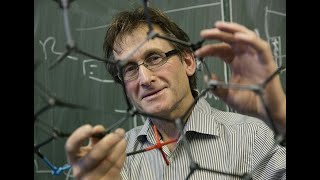
In this keynote, Nobel Laureate Ben Feringa surveys the past, present, and future of chemistry, emphasizing the shift from building static molecules to engineering dynamic, functional nanomachines. He begins with historical analogies—flight and the evolution of aircraft—to illustrate how humanity moves from mimicking nature to creating wholly artificial systems. He argues that the boundary between biological and abiological will disappear as chemistry and biology merge. Feringa highlights the vast combinatorial space of possible molecules, the need for sustainable processes, and the challenge of imparting dynamic functions (motors, switches, self‑assembly) to synthetic systems. He describes his group’s work on molecular switches, light‑activated drug delivery, nano‑valves, self‑assembling nanotubes, smart antibiotics, and optogenetic‑style control of bacterial communication. He then moves to molecular motion, presenting rotary nanomotors powered by light, their visualization in liquid‑crystal matrices, and applications such as responsive surfaces, nanocars, artificial muscles, and self‑healing materials. He discusses broader future directions: artificial photosynthesis, DNA‑based information storage, directed evolution of new chemistries (e.g., carbon‑silicon bonds), and the grand challenge of chem‑biogenesis and homochirality. Finally, he envisions nanorobots that could navigate the bloodstream for diagnostics or therapy, stressing that the future will be built by the next generation of scientists. The talk blends technical detail with inspirational rhetoric, urging funding agencies to allow exploratory research in the “paradise of science.”
Chapters
So I have the privilege of introducing three— the first three speakers of the afternoon, and another privilege because as President of European Research Council, the three of them are actually grantees from the ERC. So it's It's a fantastic coincidence built by the organizers. The first speaker is Ben Feringa, who will speak on the future of chemistry. And Ben Feringa, as probably you already know, received the Nobel Prize in Chemistry in 2016. Ben?
Thank you very much, Dr. Bourguignon. Let me congratulate the organizers with this absolutely wonderful event. It was a feast, these two days of science, hearing all these different aspects. It's absolutely wonderful. So, I was asked to talk a little bit about the future of chemistry, but I gave it the subtitle "The Art of Building Small," and hopefully you will recognize during my talk why I gave this subtitle. When we walk towards the future on this path to head for the big question marks, let me make a small message to our funding agencies, which I'm extremely happy with, of course, otherwise we couldn't do anything. But please, governments and funding agencies, allow us to get lost in this beautiful garden which is called the paradise of science, because the most beautiful discoveries and question marks might be out there and not there. Let me go back in time a little bit. And often I feel a little bit like these guys. 100 years ago, slightly over 100 years ago, mankind was flying for the first time in this artificial flying machine at Kitty Hawk, 1903. Nobody would have predicted that 100 years later we would build in Europe the Airbus or the Boeing 747. Was happening in the United States. You know what people said at that time? If God wanted us to fly, he would have given us wings. We all admired for thousands of years the flying bird. But you realize that this Airbus is completely artificial. The 3.5 million parts are all synthetic, and the flying principle of the Airbus is not the flying principle of the bird. But it's perfectly suited to do its job to carry 400 people at 900,000 kilometers an hour, 10,000 kilometers across the ocean. Try to do that with a pigeon, to carry 400 people across the ocean at high speed. But we should also be very modest. Because 100 years after the after this event, we still cannot build a pigeon. And my biology friends tell me that they cannot build a single cell of the pigeon. They cannot even build one of the machineries of the cell of the pigeon. So we should be a little bit humble. When I bought my iPhone 5S— this is now in 2013, and my daughters who are students tell me this is absolutely old-fashioned and obsolete— The correspondent was writing, "Disabled were walking again, the blind were seeing again, and the dead rose from the graves. 2013 was the year in which prophecies from the Bible became reality. The world moves at a marvelous pace." Robot legs, the macro scale, 1 meter. The brain implants, you heard about brain functioning. Micro scale, 1 millionth of a meter. And the ancient DNA that gave an embryo again of a species that was extinct. We heard about ancient species earlier at this conference. This is 1 nanometer size, 1 billionth of a meter, and I will talk about nano quite a lot today. So my first message to all of you for the future is that the distinction between biological and abiological will fade away. So we hear a lot about synthetic and natural, but the future of biology and chemistry will be symbiosis. And so there will not be a clear distinction, and it's fading away rapidly. So I'm a chemist, and chemistry par excellence is a creating science because we make all kinds of materials. So the challenges are, for instance, the sustainable processes of the future. How are we going to produce things? Green design. Reinventing materials. If you want to drive an electric car, we need new batteries and new materials. Or how are we going to change the face of the industries that produce all these goodies that we use every day? Or how are we going to make our drugs in the future, going away from trial and error and making millions of compounds used to take the knowledge of molecular biology and design much better drugs. So fundamental questions and challenges and perspectives from industry and for society. So let me start very briefly that we are chemists and we build from atoms and molecules all the materials that surround you, the molecules and the materials that make our body, and make everything on this Earth. Let's not forget. And for that, we have the periodic table of the elements, and next year we celebrate 150 years of this gentleman, Mendeleev. And I put him in this group of heroes in science because he deserves this place, because he told us what the relation was between all these atoms that make up all these materials all these molecules of our body, of the whole world, of the universe. Mendeleev, a giant and a hero. We are able in this world to build very simple molecules: 2 carbons and 4 hydrogens. That is called ethylene, and it's the basic for plastic, at least an important plastic. We produce 160 million tons a year. And you use it every day. Of course, we can debate about plastics, but it's quite essential. We also build very complex molecules: vitamin B12. Carbon, hydrogen, nitrogen, oxygen, phosphorus— equally or even more important for human beings, because without vitamin B12, you will not be sitting here, you will not be healthy. But we need only tiny amounts, microgram quantities, and the world production, as far as I know, is 35 tons a year, and we can supply the whole world with vitamin B12. Simple and complex. So we make the drugs and the dyes, the cables and the cars, all the components of the materials that are so common to our world today. But we all realize, coming to the big question of life, it is a very long way to molecular complexity, from a simple molecule like ethylene and plastic to the complexity, the molecular complexity of a living cell. But luckily, we are not limited by the building blocks that Mother Nature used in evolution: the amino acids, the nucleotides, the sugars, the fatty acids, a very, very limited set of building blocks. It's absolutely remarkable what nature did with it to create even ourselves. But of course, our playing field— we have the periodic table, and our playing field is endless. If I would look at the number of molecules that is possible— we build around 20 million new molecules a year, everybody around the world, all chemistry laboratories, pharmaceutical industries, etc. But if we would work 1 million times harder, and we do that for billions of years, and we look at the molecules that are possible the size of a drug, which is a small molecule, this is our playing field, ladies and gentlemen. Look at this number. This is only the number for small molecules. We can continue for billions of years. And so our playing field is endless, and that is, we only scratched the surface of what is possible. But what we cannot do, or are not very good in, although we build all these materials, including your smartphone, we are not very good in building something that does these marvelous things that we have seen before, that is to say, dynamic functions. The rotary motors, the nanomotors that transport the things in your body, the ribosome, which was alluded to, the bacteria flagella motor, a fantastic propulsion system, the optical switching in the eye. Dynamic functions, something that moves autonomously. And it was Richard Feynman in 1959 who predicted that there would be plenty of room at the bottom. And of course, many people followed the top-down approach to give us all the molecular— the electronics, But the bottom-up approach, now starting like Mother Nature does it in your body, in the biological system, 50 years later, we have now tiny machines, and I had the privilege to go with Jean-Pierre Sauvage and Sir Fraser Stoddart to Stockholm. So we started several years ago with the very simple idea: can we make information storage and molecular computing starting with the switching process in the eye? And in your eye, the fact that I can see you and you can see me, Ladies and gentlemen, it's only due to a tiny change in this retinal molecule, an isomerization, a rotation around a carbon-carbon double bond initiated by light. Extremely fast process, but this triggers the signal to the brain. Of course, there are millions and millions of these molecules that make that possible, and it should be reversible, of course. But you cannot use this to build a computing device or an information storage system because they are only stable in the natural, biological environment. So we built artificial switches, and then you can build, for instance, materials where you can write information. So for instance, we made a kind of a compact disc, and this is what you can calculate: you can write on one compact disc 240 years of music. That's to say, your grandparents and your grandchildren for 6 generations can constantly play music with one compact disc. This is the death for the CD industry. But it's also not reality. This is the potential of nanotechnology, because we still don't know how to write zeros and ones when they are extremely closely packed. But of course, this is only the potential in two dimensions. Think about three dimensions. What is possible when you are able to use the principles that you can write and store information in molecules? We made molecular memories together with our physics colleagues, or we can introduce these switches in protein channels, so we take advantage of the protein channels, for instance, from the E. coli bacteria of your body, engineer them to build in these switches, and then we have a nano-valve that we can open and close. And we can make capsules that on command we can open and deliver a drug, or transport something through a membrane. These are the potentials coming from these switches. But, Mother Nature has its molecules instructed to do all kinds of things, including assembly, and it was mentioned earlier, how to assemble things, and we have to learn that. And you see here these tiny physical-type structures which look like miniature cells, or these nanotubes based on molecules that we design in the laboratory. You put them in water, and they assemble. And these nanotubes are exactly 30 nanometers in diameter— sorry, 28 nanometers in diameter, precise dimension, all exactly with walls, bilayers of 3 nanometers. And you can go from tubes to vesicles, you see, we can reconfigure it with an external signal. So they are responsive. We can go from capsules to tubes. And why is that interesting? Because we learn how self-assembled structures at the nanoscale adapt to their environment, to signals from outside. But we can also use them to fill them up and then use them as a kind of an injection needle to a cell, because we all know that shape makes a difference, how things penetrate, for instance. Or we can connect maybe two cells together via such a nanotube and to have them communicate. I want to share with you one other small study, and that is about smart drugs. Once you can trigger, we thought, why not triggering a drug on and off? And we heard all the beautiful work of Dyson Rhodes and all these people that work on these light-activated protein complexes. But realize, for that— absolutely flabbergasting what has been done there, fantastic in neuroscience— but realize you have to do genetic modification. And I don't know if we want to do that with a human being. With rats, fine. But we all take drugs now and then. So we thought, what if we would introduce an inactive drug, introduce a switch, and activate it precisely on the spot? And can we get high-precision therapy? Imagine you have a tumor here, tiny tumors, and with the new imaging techniques, You feed the information to a laser, and you write your chemotherapeutic agent without all the nasty side effects. We did. Not in the clinic yet, but we did it. And here you see an example of an antibiotic, and we heard about antibiotics, a big problem, antibiotic resistance and precision therapy. And so we took the broad-spectrum antibiotic Cipro which is used broadly in the clinic. We built in a light switch, and we can switch the antibiotic activity on and off. So imagine what we are doing now in the laboratory. There is a local infection, you take the antibiotic, it doesn't do anything, it doesn't harm the other good bacteria, for instance, in your gut. We switch it on with a red lamp, it does its job, and after 24 hours it's off, it leaves the body, and you don't build up resistance because the bacteria grow normal. You see here a pattern of bacteria because we simply can take a mask and grow bacteria in a certain pattern. We also can look at the communication between bacteria. This is an important issue. How do cells communicate? They don't speak a language. Bacteria have quorum-sensing molecules that they signal and recruit their mates. To make, for instance, a biofilm, which is really serious when you have a hip implant. This is a real big problem in the hospital. Now, what we do is we modify these tiny molecules, we build in a light switch, and then we can switch on and off the communication between bacterial cells simply by using these tiny molecular regulators and using light of the proper wavelength as an external signal. So the future of bio-nano is extremely bright, I think. There will be smart drugs. We are not in the clinic yet. We can use these kinds of techniques for regulating networks, just like the optogenetic regulation, editing the genomes, it was mentioned earlier with CRISPR-Cas, or rewiring the brains. And these are just a few of the endless possibilities that you see appearing in the future. Where chemistry and biology merge. Now let me move on to molecular motion. And when I was recently in an elementary school, I asked these kids, 7, 8 years old, "What is life?" The same question that Schrödinger asked. And you know the answer was? One small girl put her finger in the air and said, "Oh, sir, I know it!" "Look, there! There is a fly. It's moving. That's alive." Motion is often considered as one— of course, it's not the unique aspect, but it's one of the aspects. Your car is also moving. I don't think it's alive. But definitely, living things can move. So what is really important, of course, is out-of-equilibrium. If people tell you, you sometimes hear this, people tell you, "Be in equilibrium." Please don't. Be in balance. If you are in equilibrium, we all know thermodynamic equilibrium, then you are dead. So we have to learn how to put things out of equilibrium when we design something from bottom up at the nanoscale. Nature uses tremendous amount of molecular motors. Here is my favorite. You have seen this before, the ATPase. You might think the motor in your car is beautiful. I agree, it might be. Depends on which car you have. But this is by far the most fantastic molecular motor in this world. In your body, millions of these motors, billions actually, generate the ATP, and it was mentioned earlier, If you think about that figure, that almost half your body weight is made by these tiny machines every 24 hours. These are nanomachines. And your body is also fantastic in recycling. Recycling is a big issue for all governments. How are we going to recycle? Look at Mother Nature. In your body, it happens all the time. We still don't know exactly how to explore that in our industries, in our society. But coming back to these motors, these rotary motors tell us something. What we have to do when we design a motor. And that is two fundamental questions: how to control rotary motion in the nanoworld, and how to distinguish between left and right. Because think of your car. If there's no fuel, the car will not go anywhere. And if there is equal probability going backward and forward, your car will not go anywhere either. So we have to go either forward or backward. And so we took advantage of chirality. And chirality is like your left and right hand, as we all learned in school, mirror image. And this is the most beautiful example, the Mona Lisa of modern science, but of course the amino acids, etc. Your body inside, the essential molecules have a preferred chirality. And that is called a signature of life. And it's a big mystery. Because we have no idea, although there are some theories, especially the younger people, please help us, we have no idea where this homogonality on the Earth comes from. But it's crucial for life. So we built a tiny rotary motor, 9 nanometers in size, 1 billionth of a meter. We have controlled motion, it consumes energy, and it has directional motion. Why do we call it a motor? Because it has all these features. It is a continuous rotary process. You see it moving around here, around this axle. And it's powered by light. Light is the fuel. And you see here two bonds, two carbon bonds, and exactly the same as in your eye, you have to break one bond, it can rotate under the influence of light. It's a power stroke motor. Here it is. It rotates. At the nanoscale. But then, can we see something rotate? Because I cannot see a nanomotor. It's too small. But then what we did is we put it in a liquid crystal material, the same stuff that is in your displays. And now we put a glass rod. You see here, this rod is 10,000 times the size of the motor. It's microscale. And now we suddenly see it spinning in a unidirectional sense, clockwise, or we can do it also counterclockwise. You see the whole surface changing. The color changes. We can make responsive surfaces, and you can make things moving autonomously without touching it, just when you put in energy and you push it out of equilibrium. We can make motors on surfaces, and you'll forgive me for this Dutch design, These were our ancestors 500 years ago. But if you ever want to make a device, you have to interface. This is what Mother Nature does all the time with your membranes, all the components. Interface phenomena are extremely important. So we built these tiny windmills on gold. So we have monolayers with all these spins, windmills spinning. They are just 1 billion times smaller. And you might ask, why are these academics doing this? Is this just for playing? Realize there are now coming up a lot of materials where you have surfaces that are responsive or dynamic. So we get the self-cleaning windows, and the first samples appear. We get the solar panels, and you might say, "Oh, in Ireland it's not a problem because it's raining all the time and they clean themselves." But go to California, go to the Sahara, or to Spain. It helps a lot, if you have self-cleaning materials. Or you have cars that clean themselves. We also build a nanocar. So you might know that the engineers, the students from the technical colleges, they go to Australia for this car race every year. And my students were a little bit jealous because they also wanted to go to Australia. But then I said, "Look, we are not engineers, we are molecular engineers." So we built it. A four-wheel drive nanocar. And so here you see the four wheels, you see the difference in size, 1 billion times smaller, and you see it moving over the surface. And you might again ask, "What are these guys doing?" But of course, we were answering the fundamental question: if you have a rotary motor, can you make translational motion? Can you move from A to B? But again, biology tells us that the world at the molecular scale, at the nanoscale, is different from the cars that are here on the motorway outside Dublin. The biological world is more like this, and this is how our nanocar moves over the surface. So like the motors in your muscles, you have this kind of stepping motion. My final example here is about muscles. And very recently, we thought, would it be not cute if we could make an artificial muscle? And I don't have to go into muscles because many here are biologists, they all know these filaments, they glide with respect to each other due to the fact that you have these motor functions. And so what we did is we made these motors now and made them so that they dissolve in water and that they self-assemble into fibers. And what you see here is a tiny muscle, a free-hanging tiny muscle, excuse me, and if you hit it with light, this is what you see. So it bends to the light, and we can bend it in different directions. So for the first time, we have an artificial muscle that can move, that can grab things, lift things, and what you see moving here, ladies and gentlemen, is a small molecule, not a big protein. Less than 1,000 molecular weight, and it's 95% water, what you see moving here. 95% water, only 5% of material. So I showed you in this nano revolution that we can build— start with Mother Nature. But taking advantage of all the opportunities that we have in the molecular world, we can build switches and motors. This is what I focused on. We can build smart pharmaceuticals, materials for soft robotics. This will be a really huge area in the future. We can also build self-healing materials. I had no time to think about it, but why not? Recently, people have made, including ourselves, self-healing materials. Think about a scratch in your finger. If you are healthy and it's clean, it will repair itself. You don't have to do anything. Why can't we do that with a scratch in your car? And we have now the first self-healing material. You cut them, you put them together, and they are clean, healed again, self-healing. So in the future, and I will predict within 10 years, you will have cars with coatings where you can scratch and you don't have to go to the garage anymore. You just wipe it with a cloth. Because when you have a scratch, tiny capsules pop open, light comes in, Pops open, and it repairs itself. So in my last few examples, I want to put it a little bit in broader perspective because we all know that this is a serious point. What will be our fuels and materials for the future? And again, we look at Mother Nature, the green plant, and how to use CO2. But we also know that the photosynthesis complex is extremely complex. Fantastic how nature ever evolved that. But look, if we want to do artificial photosynthesis with all the electricity or light that we get, more or less for free in the future, from our solar panels, the concentration in the air of CO2, despite the fact what everybody wants to believe you, it's only 0.04%. And every chemist knows that if you have a very low concentration, reaction goes extremely slow. That's one problem. The second problem is, of course, that the efficiency in nature is extremely poor, and we have to do 10 times better. Your solar panels can do already 10 times better. But how to do that with an inert molecule like CO2? Then let's look at chemistry as a molecular information science. We learned about DNA, but there is a lot going on in DNA computing. Absolutely fantastic. Or materials. Look, this is the map of the world in DNA. You can make cubes, you can make all kinds of structures from DNA. Very robust. They last very long. Or what Frances Arnold recently did. She took a directed evolution approach, re-engineered at the level of the genome, re-engineered a protein to make carbon-silicon bonds. So this is not natural evolution, this is directed evolution. And science picked it up and wrote a nice article, and then it was on the news: "Is silicon-based life out there?" I don't know. I think it's a bit exaggerated. But making carbon-silicon bonds, which is not done in nature, but now it certainly can be done by re-engineering and making the proteins doing a completely different chemical reactivity. This is what industry will use in the future. And then, maybe the most important question: the origin of life. What was before the Darwinian evolution? What is this chem-biogenesis? How do we get from elements to something, molecules, that make primitive life forms? So for that, we have to learn how to make dynamic molecular systems artificial cells, molecular replicators, and as I mentioned before, the origin of homochirality. Very pressing, challenging questions. So to go from a primitive amino acid to something that is alive and produces beautiful materials is a big challenge, and it connects the simple, relative simplicity of atoms and molecules to the complexity of matter and life. And let me emphasize also here in this theater, we go from practical also to beautiful. Enjoy the beauty of your molecules, the materials, being it natural or unnatural. So, how to build artificial life? How to feed 10 billion people? How to fly without kerosene? Talking about some of the most difficult future questions. There's still a lot to be discovered. I want to finish, if the chairman allows me, with just one example. Is this science or science fiction? You probably all have seen "The Fantastic Voyage" or read the book of Asimov. Will we have robots that go through your blood veins? In the future? Let me show you one of our designs, as I talk about motors and machines and movies. Here is a carbon nanotube. This is just a kind of a molecular nano-submarine. We decorated it with two enzymes that we took from Mother Nature, catalase and glucose oxidase, and we discussed a lot with the students, if you want to make such a submarine at the nanoscale, what fuel would you use? What is the fuel in your body? And we thought, oh, There's plenty of sugar. Let's use sugar. And what you see here, ladies and gentlemen, is a tiny spider of these carbon nanotubes. The enzyme converts glucose. You see here bubbles, that is oxygen coming out. And it's a kind of a rocket or submarine, it propels itself. The only thing I have to do is add sugar water. This is sugar water. I don't touch it, and it moves autonomously. And you might say, This looks so primitive, but realize we can move sugar as a fuel in water. And of course, we have now built submarines that go in a certain direction, that deliver something from A to B. So is it science or science fiction? We know now how to move at the nanoscale in water. Why not going into cells or in the body? My prediction will be that in 50 years from now, the surgeons will be injected in the blood veins. Not all the surgeons, of course, but several. Because they will be nanorobots, and they will go to look for a defective cell, a cancer cell, or deliver a drug, or do a repair. I don't think it's science fiction, but I'm not very good in prediction, so the best way to predict the future is to invent it. This is what we do together as scientists. But most important, what I want to finish with, is towards the future, is inspiring the next generation because they will make it all possible. And it's really an honor to be amongst a community of young scientists, the students in the laboratory. They are my heroes. We speak a universal language across the world. We have shared international cooperation. We have no borders, ladies and gentlemen. We go beyond frontiers and take apart borders. That's our destiny. And we share a passion. Let me finish with this quote of one of my real heroes, Leonardo da Vinci. 500 years ago, he said, "When nature finishes producing its own species, man begins." with the help to create an infinity of species. And for the young students in the audience, imagine the unimaginable. I thank my team, I thank all the funding agencies, I thank once again the organizers for inviting me here, and thank you for your attention. Thank you so much.
More from Joshua







Scientist Stories: Hans Waterham, The value of phenotypic assays in peroxisomal disorders




Scientist Stories: Joel Zlotogora, Genetic carrier screening programs for reproductive purposes