Scientist Stories: Chang Liu, Orthogonal Replication Systems for Rapid Continuous Evolution
Dr. Chang Liu engineered OrthoRep, a plasmid system in yeast that mutates 100,000 times faster than the genome, enabling rapid evolution of drug resistance, enzymes, and antibodies. He showed how Plasmodium falciparum developed resistance to antimalarial drugs, evolved tryptophan synthase variants for new chemistry, and matured nanobodies against SARS-CoV-2 in three weeks.
Chapters
So, hi everyone. Thank you for attending today's seminar. Today's presenter is Chengxi Liu, who is going to talk to us about synthetic genetic systems for rapid mutation and continuous evolution in vivo. Dr. Liu has a very impressive academic track record with many prizes and distinctions. He initially studied chemistry and graduated summa cum laude from Harvard in 2005, and he directly went on to do a PhD in chemistry and chemical biology at the Scripps Research Institute under the supervision, supervision of Peter G. Schultz. Afterwards, Dr. Liu went to California where he completed a postdoc at the Miller Institute at UC Berkeley before becoming an assistant professor in biomedical engineering and chemistry at University of California, Irvine in 2013. And becoming an associate professor in biomedical engineering, chemistry, and molecular biology and biochemistry in 2020. And he also recently participated in the founding of the Center for Synthetic Biology and Evolution at UC Irvine. So once again, thank you, Dr. Liu, for your time, and the floor is yours.
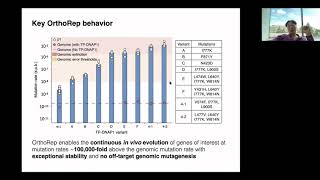
Thank you very much. So let me share my screen again. Okay, well, it's a pleasure to be with you virtually, and please of course chime in with questions throughout the talk. And if there's anything technical that is, you know, in terms of like the Zoom not working, let me know. So hopefully everybody can see my screen. So I'm going to tell you about the main project in our lab, which is the one that's kind of outlined here, where we're basically trying to create cells that have what we call an orthogonal replication system. And this is an additional replication system we install into cells where the DNA polymerase of the new replication system only replicates our orthogonal plasmid and doesn't replicate the genome. And in this way, we can basically make the new system be governed by mutational and other replicative parameters that we choose without being constrained by the fact that the genome needs to always be maintained efficiently and accurately for the cell to survive. And so to introduce this topic, I want to first consider a question, kind of a thought experiment, which is how fast can we mutate a hypothetical genome. And so if you will allow me, we can go back to maybe the origins of life or something very early in life where perhaps there was a small genome, such as a replicase, that allowed the organism to survive. And let's say that genome is just 200 base pairs. With a small genome like that, of course, some of it will be essential to the activity of the genome and the activity of the organism. So we can assume, let's say, 50% of that genome is essential, where any mutation at those bases would kill the organism. If we have these assumptions and we add in a mutation rate, we can calculate the chance that an offspring is viable. In this particular case, our mutation rate is 10^-3 errors per base, and so the accurate copying rate is 999/1000 per base. And we have to copy 100 essential bases accurately for the organism to be viable and its offspring to be viable. And so if we take this to the 100th power, we get a reasonable chance of survival. But of course, this changes if we talk about big genomes. So if we consider now a modern organism with, say, a 1 million base pair essential genome, then at this high mutation rate, we don't get any survival because we have to take this fraction to the millionth power now. So of course, what modern organisms do is they reduce their mutation rate. And here at a mutation rate of 10^-7 errors per base, we have a much more accurate copying fraction. And if we take this to the millionth power, we get a pretty reasonable chance of survival again. Okay, and so the reason I want to go through this example is to make the point that modern genomes aren't in a space now where they can withstand high mutation rates. Because they've gotten very large and complex. And this is worked out in theory, in empirical observations with a very influential paper by Drake in the early '90s. And also people have considered using high mutation rates to push viruses over thresholds where they can properly maintain essential information. So all of these derive from the general rule that as genomes get larger, they can't withstand high mutation rates. So if you're interested in this idea in more detail, you can look into these fields here. But I want to draw a corollary to motivate our work from this observation, which is that really the focus of evolution has been forced to expand over the history of life and growing complexity. And let me unpack that statement for you. So basically, the example I showed before, we can also plot the calculation at a range of mutation rates. And so if we do that for a mutation rate or for a genome size that's small, i.e., the replicase case, you can see that at a mutation rate of 10^-2, you get this transition to essentially no chance of survival. And likewise, for a bacterium that has a much larger genome, you get a transition to no survival around 10^-6. And so what you'll appreciate is that this kind of fall-off in the ability to create viable offspring occurs around 1/L, on order 1/L, where L is genome size. So basically what's happening over the history of life from the lens of mutation rates is that as complexity increases and genomes get more and more genes, then it also means that the per-gene mutation rate must necessarily decrease. If the per-base pair mutation rate must necessarily decrease by this guideline, then the per-gene mutation rate must also decrease in the same fashion. And we know that mutations are the source of evolutionary innovations. And so what's happened really is that modern organisms are dedicating most of their innovation to the systems-level function rather than gene-level function. That is, it's very hard for organisms with large genomes to focus innovation at a particular gene because their mutations will have to occur at a low rate on that particular gene. And what's more likely is that mutations are going to be spread around the genome, and that will lead to systems-level adaptations. So from the organism's perspective, of course, this is all fine because the organism is interested in improving its whole function rather than just the function of an individual protein or an individual gene. But if you're a protein or enzyme engineer like we are, then this is not designed for what you want to do. So we have a big goal in the lab, of course, to do protein and enzyme evolution. But if mutation rates for organisms are locked in this low mutation rate regime, then we won't be able to sample enough diversity at the level of an individual protein in a natural organism. And there's also another reason that mutations are important. Mutations are not just a source of innovation but are a record of evolutionary history, or rather a record of descent, right? You can take two genomes, you can compare them, And based on the mutational differences, you can calculate how close they are related to each other and how far they are from their common ancestor. And so there, if you have a low mutation rate, you essentially have a much lower resolution, time resolution, as to what mutational relationships you can detect. What organismal relationships you can detect. And another idea that requires increasing mutation rates is to use mutations as a source of understanding how cells are related to each other in a developing animal rather than species being related to each other in an ecosystem. And so all of these big goals, or these two big goals in particular, require us to break the lock on the genomic mutation rate that governs complex organisms. And so our lab's goal is to develop specialized genetic systems using synthetic biology ideas capable of getting us to these mutation rates. And the way that this will occur is through what we would call targeted mutagenesis, where, of course, because this is kind of a law, we can't just break it, but we can circumvent it if we can direct mutagenesis to only be fast at a particular gene or at a particular locus so that we can avoid trashing the entire genome but work only on the smaller systems that we're interested in, which afford the ability to have higher mutation rates. And so in the history of my lab, we've been working on two synthetic genetic systems for doing these applications or getting into these problems. The one I'm going to focus on is called orthogonal replication, or orthorep for short, where by establishing a new replication system in a cell that's only dedicated to the replication of a plasmid, then any gene we put on here can be mutated at a high rate dictated by its sort of 1/L mutation rate threshold and the 1/L mutation rate threshold of the genome, which is much lower, can still be maintained by having low-error, high-fidelity host DNA polymerases. So basically for the rest of the talk, what I'm going to do is give you a brief history of how we established OrthoRep, and then I'll show you some applications of OrthoRep. In terms of exploring drug resistance and doing enzyme and antibody evolution. And then I'll give you some perspectives at the end on basically this whole idea of doing continuous evolution, where by continuous we mean that we can just evolve a gene of interest by the usual way of evolution, which is growing cells, rather than just making libraries all the time and having to run manual cycles of directed evolution. All right, so for OrthoRep, as with most synthetic biology projects, we're not constructing everything from scratch, but rather we're stealing from nature. In terms of orthogonal replication, our first strategy that we looked into, and the one we took, was basically to see if there were any unusual replication systems already in nature that we thought we could hijack for orthogonal replication. And this particular one shown here really stood out because basically in the early '80s, a number of researchers described certain Clavamyces lactis yeast cells that had a plasmid system in the cytoplasm. And if you look at what's encoded on these plasmids, you find that they actually encode their own DNA polymerases. So it was speculated that these DNA polymerases are responsible for replicating the plasmid.. And so this gives you potentially an autonomous replication system that we said we thought might be orthogonal to genomic replication. And there are a couple of reasons why we thought this would already be an orthogonal replication system. One is that it's in the cytoplasm, so it's spatially separated from where genomic replication occurs in the nucleus. But the other is that it uses a very unusual replication mechanism involving terminal proteins. And so if you look at these plasmids, on the 5' ends are covalently linked proteins. And these proteins act basically as the primer, as well as the origin of replication, so that new polymerases are recruited to these proteins. And then the first step is you nucleotidylate this terminal protein that's free, and then you extend in a template-dependent manner to copy the rest of the DNA. That mechanism is unusual. It's certainly not how genomic replication works. We thought that would give us another layer of orthogonality that we can depend on. This observation of this unusual natural genetic system basically set the course for the early developments in my lab. We set out to first hijack and refactor the elements encoded on this replication system, work out the genetics for putting our gene of interest on here rather than what already exists. And in early work, we showed that indeed the DNA polymerase did exclusively replicate this plasmid. And not the genome, and vice versa. Genomic DNA polymerases didn't touch our plasmid, so this was necessary and sufficient for replicating our plasmid. And this demonstration of orthogonality was good, but early on we found that the DNA polymerase for replicating this P1 orthogonal plasmid was actually pretty accurate, and so its natural mutation rate was about 10^-9, and so that is still in this regime that is not fast enough for evolving proteins. So we basically spent a lot of time, a big effort, to engineer this orthogonal DNA polymerase to be highly mutagenic, and now we have it at around 10^-5 mutation rate, and we're working to get it to be even faster. But this is a pretty good mutation rate for already doing some significant protein evolution experiments. We've also shown that this system is general across various yeast strains. We have some understanding for how the orthogonality works. We're always adding new parts, such as specialized promoters and untranslated regions, so that we can control the expression levels of the genes that we encode on here. And various other genetic methods decorating this platform. So that's basically a summary of our lab's work from 2015 to 2018, when we published these high error rate DNA polymerases. And I want to just show you one slide on the key behavior that we are interested in capitalizing upon with OrthoRep. And so this is a slide where we've measured the mutation rate of a series of DNA polymerases that we've engineered to be error-prone. And so these bars show us the mutation rate of the P1 orthogonal plasmid in the presence of those mutator DNA polymerases. And so as you see, we have some that are very high mutation rate, up to about 10^-5. But what's also shown here is the regimes in the genome that lead to basically extinction of the cell. So we wanted to test this idea that we've crossed the error threshold of what genomic mutation allows by basically making now genomic mutators, where we take for instance, different versions of genomic DNA polymerases and make them error-prone. And what we found was that if you get the genome to mutate above 10���� or so, then the cell will basically die in one generation. It's guaranteed to make a mistake at an essential position in the genome, so it will be dead. But what we also found, and this is not a surprise, is that even if we're not quite at the genomic extinction threshold, if you just elevate yeast's endogenous mutation rate by a couple orders of magnitude, say to 10^-8, you start seeing growth defects that are quite severe. And what the cells do is even if even though they can grow, since they're growing very slowly and they're obviously sick, they will find ways to then reduce their genomic mutation rate back to closer to 10 to the minus 10. So what I'm showing here is that there's a large region shaded here of mutation rates that you could just not achieve on the genome in any durable fashion.. But when you have those mutation rates on the orthogonal system, you can maintain them for as long as you want, at least as long as we've tested, which is hundreds of generations. And what allows this to happen is, of course, when you have this high mutator on P1, the genomic mutation rate stays near 10^-10. So it's basically unchanged. In the presence of the mutator, and we're measuring these in the same strain. So we really do now have this system where we can achieve continuous hypermutation of genes of interest at mutation rates that are about 100,000-fold higher than genomic mutation rates, and there's no off-target genomic mutagenesis. So this makes the system quite stable and durable for evolution of genes of interest. And so at this point, we decided about in 2018 that we were going to first focus a lot on basically a bunch of applications showing that this is useful. And these applications, as you would imagine, are in the space of directed evolution. And so on the one hand, we're interested in evolving useful biomolecules, such as enzymes, biosensors, gene therapy agents, antibodies. I'll show you some work we've done with enzymes and antibodies. We have work that we're publishing soon on biosensors, for instance, and we're working on gene therapy agents in the lab. But with this system, you can imagine doing some other things as well. You can study the rules governing adaptation, right? If all you're doing is evolving a single gene, you can really look at how it is adapting, and you can test ideas like how population structure changes how something evolves, how selection schedule changes the speed and type of evolution that you get. And more broadly, you can use this to uncover and understand fitness landscapes that govern the function of individual proteins and genes. A related version of these ideas is to predict evolution in nature, where if you have, say, a drug target, you know that it will develop resistance over time. And if you can speed up the evolution of a single gene, the drug target, then you can predict how that resistance will develop over time in the laboratory and potentially guard against Okay, so I'll give you some examples of these types of applications next. First, I want to show you the first experiment we did with OrthoRep, which was, you know, in retrospect, a reasonably straightforward experiment where what we were trying to do was just predict how mutational paths create resistance in this drug target DHFR. So DHFR is a common drug target for all sorts of pathogens, including malaria, Plasmodium falciparum. And for the malaria case, one of the first-generation inhibitors of malaria was pyrimethamine, and it worked by basically selectively inhibiting the DHFR of the malarial pathogen. And so I should state that this is no longer used as a line of treatment because there's already resistance in the field and there are better drugs out there, which was good for us because we didn't have to worry about creating gain-of-function mutants that could potentially escape into nature. This is an area of research that you want to be careful with if you're going to actually be making resistant genes to drugs that are actually important. Because even though you learn information, if they escape the laboratory, it might lead to negative consequences as well. But that isn't the case here. And so what we did was we put the malarial DHFR on orthoREP. We deleted the DHFR that yeast normally rely on for survival. And we just grew these cells in increasing concentrations of pyrimethamine. And what we found was that over just a few passages, 13 passages to be exact, where we were increasing the pyrimethamine concentration, the cells were able to adapt very readily. And this is only true if you have this hypermutating version of DHFR. If we don't hypermutate DHFR, the cells are killed very easily and don't adapt. Beyond, you know, even the first passage. And I also add that we stopped at 3 millimolar because basically that's the maximum amount of pure methamine that's soluble in water, and so you can't really go beyond that, and it's not that relevant to go beyond that. So we did— so we basically defined this as the end of our evolution experiment.. And so when we do this, what you see is what you might expect, where you get the sequential, in some cases non-sequential, but in most cases sequential fixation of resistance mutations. So here we track the mutation frequency of certain mutations that are coming up over time, and we see that one sweeps here, right, S108N. The resistant mutation that takes over, and then you get other resistance mutations that help it become more resistant. And so this is an example of how one line of DHFR will evolve in the presence of pure methamine. But one of the nice things that we can immediately do with OrthoRep is we can replicate and scale our evolution experiments quite dramatically. And in this first example, what we did was we basically did evolution in 90 replicates. So each replicate was independent and therefore could find its own solutions. And so the same experiment was done in plates for 13 passages. And at the end, we sequenced the evolved DHFRs. And the goal of this replicate study was to understand not just one way you can achieve DHFR resistance to pyrimethamine, but kind of sample the interesting regions of the fitness landscape that define resistance. And so here I'm showing the mutations that we see across all of our replicates, which are the columns, and then for each individual replicate, different collections of mutations actually emerge. And what you might appreciate here is that resistance arises through many possible possible collections of mutations and adaptive pathways, but there are certainly convergent patterns that repeat across these replicates. And so some of these patterns include the fact that almost all populations contain this S108N mutation. But we also observed some interesting features, which are summarized here. So there are a few populations that lack S108N entirely and instead fix this D54N mutation. But D54N, even though it's always fixed when S108N is lacking, it's also sometimes fixed when S108N is present. And so this gave us some sense that there might be an interesting synergy, or at least rather conflict between S108N and D54N that could be resolved by other mutations, and we wanted to explore this further. So both to explore that particular hypothesis and just to get a general sense of the important regions defining this fitness landscape, what we did was we took the mutations discovered in this forward evolution experiments and took the most common 5 mutations, which are shown here. And then we just made all combinations of those 5, cloned them into fresh strains, and measured their minimum inhibitory concentration that they could tolerate for— or that they couldn't tolerate of pyrimethamine. And so this is 32 combinations, because at each of these sites, you can have the wild-type residue or the mutated residue, and we have the synthetic landscape defining this area of the fitness landscape. And so this is what we see. So in this plot, red means not very resistant or basically dead, and then blue means highly resistant. And so you can appreciate that roughly going up this chart, you get more and more resistance, right? You get more and more blue. And of course this makes sense because this is what our evolution experiment was actually doing, which was accumulating mutations that achieve greater resistance. But what's interesting and is reflected in many other experiments defining fitness landscapes, right, is that this isn't just a monotonic increase across all paths. There are cases where if you get a particular order of mutations, you get a red guy. And so there are definitely epistatic interactions among these mutations that define an interesting landscape and also limit the types of searches you can do on this landscape. So we use this information to make a couple of insights on what our actual evolution experiments were doing and also to explain this hypothesis that we had about the conflict between S108N and D54N. And so one of the insights that we wanted to make and that this limited landscape already gave a good explanation for was why we were seeing a lot of convergence in our experiments.. And the convergence has to do with two features. One is that the most common, the most effective single mutation you can make in DHFR for gaining resistance is S108N. And so what typically would happen is that you would find that mutation first, and in a replicate evolution experiment, that mutation would sweep across the population. So paths that start from other mutations would be excluded once you fix this one. And so this immediately limits the search we can do if we're admitting this uphill climb. And so that explains some of the convergence in that we've excluded 80% of the other paths that can get to high resistance. But there was another feature, which is that if you look at the most resistant phenotypes, they all have this D54N mutation, which is designated B here. But one of the strange things, or interesting things, was that if you were to synthetically combine B D and E, which is this S108N mutation, you typically get these circled cases here that are red. So there's some conflict where presumably you're making a nonfunctional DHFR when you combine those two mutations. There's an exception though, which is if you also have these mutations. C and D on the genotype that has both B and E. And when you have those combined, then you relieve this conflict between B and E. And so this defines— this further constrains your search, right? And basically the most common path we see is going up the arrows I'm showing here, where first you fix S108AN and then you fix one of these other mutations. And then you fix D54N. Okay. Now, there was another interesting observation that this landscape led to, which is that if you look at what the most resistant variant is, at least in this combination space, it's actually this guy here, which does not contain S108N.. And so what we can conclude is that S108N is kind of a greedy mutation that suppresses paths avoiding it, including paths that could potentially more quickly lead to the most resistant genotype, right? But every once in a while, in rare cases, we actually do observe pathways leading to this genotype that doesn't contain S108N. And the way that works is that in some cases, you will get a double mutation before or at the same time you get this single mutation in the population. And so when they're coexisting, then this more resistant double mutant can take over,, and you open up other areas of the fitness landscape to climb. And this can be seen by tracking the mutations in one of our experiments. What you see here is that initially S108N, which is this greedy mutation, is sweeping, but before it quite gets to 100% mutational frequency, this double mutant emerges and takes over, and then it's allowed to find other areas of fitness in this landscape, including ones that don't contain S108N, of course, but do contain D54N. And so at the end of the day, what we concluded was that basically what's mostly explaining our experiment are these two competing pathways, one of which avoids S108N rarely, but mostly pathways use S1OAn because it's greedy. And this led to some predictions that we could make, at least qualitative predictions, where you could imagine that population size or the way you code the gene can influence what path is prevalent. And the ability to kind of adjust what evolutionary paths you take in the context of resistance is potentially insightful for how you might defeat resistance or slow down resistance in the field. And so let me explain, this is just very brief, but the two, well, I'll go back. The two predictions were one, that if we change population size, rather we specifically, if we make population size much larger,, right, then you can imagine a scenario where you are sampling double mutants deterministically at the same time as you're sampling single mutants. And so then you should be able to prefer this path. Another way of modulating this search is by coding DHFR differently. Where if we take S108 and instead of using our original coding, which is AGC, we use TCA to code for S, then it actually takes 2 nucleotide substitutions to get to N, basically making it equivalent statistically to doing the double mutant that gets into a region of the fitness landscape lacking S108N. And so these predictions were borne out in the original experiment. Most of our paths converged onto S108N solutions, but if we recode S108, then we can prefer the D54N-only paths. And if we increase the population size, we can also favor these paths. So this means broadly speaking, that with information like this, we can start figuring out how we can control the direction of evolution. And perhaps another version of this would be to control it with the addition of other inhibitors to kind of trap the outcomes into ones that we can actually address. So that's my description of our first experiment that we did with OrthoRep, and after this experiment, we started exploring other topics, such as enzyme evolution and antibody evolution. So I want to show you a couple of recent pieces of work in these areas. So here, the goal was to evolve an enzyme called tryptophan synthase, or TRPB, so that it can synthesize tryptophan analogs. And this was done in collaboration with Francis Arnold's group, who have been for many years trying to engineer, and successfully so, new versions of TRPB that couple unnatural indoles to serine to make unnatural tryptophans. The natural reaction, of course, is to couple indole, undervatized indole, to serine to make tryptophan. And we thought with OrthoRep, we could basically improve these enzymes to make many more analogs. And we had a couple of ideas of how we were going to do this. One, which is currently ongoing in the lab, and I think going reasonably well, is to directly select for the production of unnatural tryptophans, and we were going to use a biosensor, or we're using a biosensor to do that, that can be linked to the translation of a gene that's a survival marker. But one of the other directions we took in this project was to essentially just evolve TRPB for tryptophan activity, but hope that the diversity in the outcomes we would create would capture a lot of different promiscuous activities. And this is inspired by nature. It's an approach that I would call synthetic ortholog generation, where basically the natural version of ortholog generation shown here is one where you often will have many variants of a protein in nature, and if you look at the primary activity of those variants, they all do the same thing. But then if you start digging deeper and you ask, well, what other reactions can you catalyze, those different variants, because they're so diverse, will often have different promiscuous activities, right? And so in the natural evolution case, The idea is that because enzymes have diverged for millions of years, perhaps billions of years for older enzymes, the extant diversity you see, even though they have all been constrained by selection for their primary metabolic activity, will be so different from each other that they might just have a lot of new activities that you can mine. And our idea was to basically recapitulate this idea with OrthoRep, where we would do weeks of very rapid evolution, all still selecting on the primary activity of TRPP to make tryptophan. And then we would have lab-evolved variants, because we would do this in many replicates, and those would all be quite different from each other., and then we would look to see if they had new activities. And so here is the evolution experiment setup. We basically encoded TRPPB, as you would imagine, on the orthogonal plasmid, and we deleted what I think, roughly speaking, is the yeast homolog of TRPPB, and then we evolved these strains to make tryptophan by basically adding indole and then growing them over time in less and less tryptophan. And over time, what happens is you accumulate many mutations, and as far as we have characterized, these mutations are all helping the TRPB that we evolved adapt to higher catalytic efficiencies for making tryptophan. And this, at least their growth effect, can be shown here. So this is just a check that our variants are doing what we think they do. Indeed, if you take our variants and put them into fresh cells without TRPP5, they only support growth of the cell if you add the indole. So they're presumably coupling indole to serine to make your defam. Now, when we have these variants, here comes the interesting part. We then profile their ability to catalyze new reactions. And I showed about 12 variants here, but I'm showing a lot more here because these were 12 individual replicates of the experiment. But within each replicate, you also expect some diversity around the consensus sequence. And so when we basically take, say, about 5 clones from each of our 12 replicates, we get 60 different TRPPB variants. And these are all distinct in terms of sequence. They contain 200 unique mutations across the board. And then we took those and we profiled them against analogs. So we fed them analogs. This is all done in vitro now, and asked whether they could make the corresponding tryptophan. And in fact, a lot of them could, and there was diversity in their activities for different analogs. Some of the different activities that we found are highlighted here. So there are some variants such as F7D2 and F1 that are rather broad in their activity. So these can catalyze efficiently the formation of a natural tryptophan from a number of indole substrates, natural indole substrates. There are some variants that are very selective, for instance, these variants here. That are ortho rep evolved are selective for 7 over 5, which may be useful in an industrial capacity where you might have a dirty starting material that has bromine substituted in different ways, and you might only be interested in one output. So these can do that reaction. And then there were also some, in particular G6, this clone called G6 that was able to catalyze some rare activities that Francis's group has not had much success on in their previous efforts of evolving TRPPB. And so these are already at the point where we could use them, but they also would be very good parents for new directed evolution experiments. So hopefully this gives you a sense of why the depth of evolutionary search and scale of evolutionary search that we can do with OrthoRep is important in this particular case, at least, where we're trying to deliberately create diverse pools of enzymes that are highly functional to mine for their promiscuous activities. One of the latest things we've done with OrthoRep was to do antibody evolution. And I think I don't have to explain that antibodies are important because, you know, they are these magic bullets that can target various antigens and also can be used as therapeutic proteins for doing the same thing. So we wanted to basically see if OrthoRep could streamline the process of antibody generation, and the concept is rather straightforward. There's a technique that is tried and true used in biotech and academia for at least 25 years or so by now called yeast display. And what yeast display does is it displays an antibody on the surface of yeast. So you basically secrete the antibody attached to a cell wall protein. And now the antibody can be kind of treated like a reagent because it's just free in solution. And what you typically do in yeast display is you encode antibody libraries, and then you select for ones that bind your antigen. And of course, since they're attached to the yeast, you can sequence what antibody actually was the one that bound the antigen. You can enrich, you can even do further evolution cycles with that. What we wanted to do was just add orthoRep to the picture, because we thought it would be quite valuable to be able to continuously diversify the presented antibody. And if you can continuously diversify the presented antibody, you can imagine a very streamlined antibody evolution cycle, where we just grow cells that diversifies the antibodies presented, and then we use the typical FACS selection. We're working on more streamlined selections as well, but in this experiment we just did FACS selection for target binding. And the nice thing is that whatever you select, once you passage it to grow it up for the next round or for analysis, it will automatically re-diversify. And so then you can select again on the antigen, and you'll get continuous or not quite continuous, but very streamlined affinity maturation for better and better binding to your target. And so we started this a few months before the pandemic, and so we had a lot of targets that we were going after. Once the pandemic hit, we decided, well, let's see if we can kind of optimize this system as we're optimizing it, go after after targeting the SARS-CoV-RBD. And so I'll show you a couple experiments from these two phases of this project. The before-COVID-era phase. Here's a case. This was our first experiment where we took a nanobody that weakly bound AT110. Or sorry, this is the nanobody called AT110. It weakly binds the angiotensin receptor. We wanted to basically make one that binds better. We did these cycles, and as you see, over multiple cycles, we get mutations fixing. If you then look at what comes out at the end of the maturation process, these mutations are actually contributing much better binding and also conformational selectivity in terms of the GPCR conformation they bind. But I'll show you in more detail what we did with RBD. So when COVID hit, we decided to see if we could make good nanobodies against the RBD of coronavirus, the receptor binding domain of coronavirus and its spike protein. And what we did was we first took a naive library that our collaborators had made, and we just screened for binders of RBD. And this gave us about 8 decent binders. I mean, these are decent in that they're, you know, they are able to be selected, but they're certainly quite weak in their affinities. But then we just decided to clone all of these onto orthoRep, and in independent experiments, evolve the nanobodies for better binding. This is one of our independent experiments, and here I'm just showing cycles of the FACS and culturing steps. What's important, I imagine most of you know how to read a FACS diagram, but just briefly, what's important is that the x-axis tells us how well we're binding RBD. To the right, we're binding RBD better. What you see is that in the first cycle, this nanobody barely binds RBD, even though we had 40 nanomolar of RBD. But then when we select for the fraction that do bind, of course, they will fix and they'll bind better in the second cycle. But what you'll see is that over cycles, what happens is that when we select for new binders, they will then spit off a subpopulation that binds even better, and then another subpopulation that binds better, another subpopulation that binds better. And presumably those subpopulations are the ones that have sampled a new mutation now that is improving the binding. And so in less than 3 weeks, we can— I should add, this is 3 weeks of kind of uninterrupted time. There were a lot of interruptions, as you can imagine, during, you know, COVID research. But in an uninterrupted time, about of about 3 weeks, you can run multiple campaigns like this, starting from different parents, and we did 8, and you get this sequential fixation of new mutations that lead to the affinity maturation of the antibody. And at the end of the day, if you sequence these, of course we have, you know, we see all sorts of mutations. Many of them are in the CDR loops, which directly contact RBD, but we were also, you know, interested in the finding that a lot of the mutations were in framework regions, and these are ones that when we verify later actually also increase the affinity. So there's a complicated way that these nanobodies are learning to bind RBD. We then tested their activity in more detail, And I'm just showing a select number of good nanobodies that came out of this effort. Some of these nanobodies have very high affinity, such as this one with a nanomolar affinity, and moderate potency in terms of neutralizing a pseudotyped virus, pseudotyped SARS-CoV-2 virus in an infection assay. Some of these have decent affinity, but not the greatest affinity, but they also neutralize the virus very well. If you look at why there's this diversity in behavior, it has to do with the epitope they're binding, as you can imagine. The ones that neutralize very well compete with ACE2 binding very strongly, whereas the one that binds very well but doesn't neutralize as well as you might expect, competes with ACE2 binding weekly. ACE2 is the natural target of the RBD on the cell that allows SARS-CoV-2 to enter. And so we've actually done, I don't show here, epitope mapping, and it's neat. You see these subtle differences of how the antibody binds the epitope. And now we've proceeded to also characterize these antibodies against variants, right, such as the, you know, B.1.1.7 and P1 from Brazil, and some of these are able to neutralize the variants. And we're also now taking these and evolving them specifically for better neutralization of the variants. So that's ongoing. But the reason I mentioned kind of the variants in the context of these multiple antibodies is to reinforce the point that, you know, we didn't just evolve one antibody, but we did independent evolutionary experience from various parents, which is something that would be hard to do in a traditional manner. And that diversity that comes out gives you much more opportunity to address new problems with variants and also just maximizes the chance in at least a kind of naive scenario of another pandemic, maximizes the chance that you get variants that bind the epitope you want. Okay, so this is a summary of the work. We basically see that in these maturation campaigns, we get improvements in binding and potency over rounds, and these are because we basically can rapidly cycle through the fixation of affinity-increasing mutations. So that's all of the work I wanted to show, but I wanna end with just a few perspectives on the field of continuous evolution, which our work of course falls into in the sense that we're running evolution experiments in a continuous or almost continuous manner. And there are a lot of people working on this problem. So you might conclude from this that there might be some importance here. And I'm hoping to distill the importance for the audience today. So to understand why continuous evolution is, I think, a significant advance, we can first consider the classical approach to directed protein evolution. So this, as you know, was awarded the 2018 Chemistry Nobel Prize, Frances Arnold, and Smith and Winter, who developed phage display and antibody display using directed evolution. But basically, this is the general pipeline for doing a directed evolution experiment. You have a gene of interest that you'd like to evolve towards a new function. You, in a test tube, make libraries based on that gene, such as through PCR mutagenesis. You clone that into an expression vector. You put it into cells so that the protein product can actually express and so that the cells can be engineered to apply a selection for the function you want. And then you take out the DNA that is selected, and then you repeat the cycle. And as you see, basically, we can separate this process into kind of in vitro steps and in vivo steps. In vitro steps are required because for the mutation, we need very high rates. Earlier, I said that you can't do that in a cell with a typical system, and so that's why we do it in a test tube. But of course, we need to be in vivo if we want the protein to even express, let alone be selected for, and so we cycle through these steps. The limitations that basically come out of this cycling process is that when you now do an evolution experiment this way, you are very limited in how far you can search in terms of traversing mutational pathways, right? Because each cycle is only one step in terms of a climb of a hill, let's say, on a fitness landscape, or terms of some, you know, foraying into a valley on a fitness landscape. Each cycle is only one step, and you can't do many of them. And for the same reason that you— that this is, you know, hard to stage, you can't scale your evolution to many experiments or many replicates. And so the hope with continuous evolution is that with systems like ours, you can replace this process by one that is just going to involve culturing cells over time. And you can culture cells for a long time. You can do many passages. That's very easy. So you can achieve depth in evolutionary search quickly and in a straightforward manner. And you can scale the number of independent experiments because, again, culturing cells, as you saw in the DHFR case, you can basically replicate that without much additional effort. And so the value of continuous evolution, I think, is pinned on these two features, which is that we can now access more depth and scale in evolutionary search. And these are important. So depth is important because if you have an ambitious function, by definition, it's many mutations away from your parent. So you want depth to get there. But depth is also important in an idea that we are now doing a lot of experiments on, which is to cross fitness valleys. One of the fundamental challenges of evolution is how do you escape local optima? So if you reach a local optimum, then any movement away in sequence space from that local optimum is by definition something that reduces fitness, and so you're never going to get away from it unless you do things like change the selection pressure or fluctuate the strength of selection. And that will make it so that if you're moving away from the previous local optimum, you're not immediately eliminated, and you can start crossing fitness valleys that way. And maybe when the selection is restored, you can climb a new optimum. And so those kinds of complicated selection schedules, by definition, require depth in evolutionary search. You're just taking long forays and long walks on the fitness landscape rather than short ones. And so this newfound depth is also important and may lead to the ability to find fundamentally new functions. Scale is similarly important. So as I showed with DHFR, it allows us to map fitness landscapes in some detail, gives us some statistical understanding of how evolution works rather than just these one-off just-so experiments. If you want related activities from a single starting point, of course, you need to be able to scale those experiments. One of the things we're very interested in now and working with collaborators on is to basically use scale that's accessible to continuous evolution to just generate a lot of sequence data, a lot of functional sequence data of different levels to feed computation. Especially with the development of machine learning algorithms, we're at this point where they are just very hungry for data. And so natural data, of course, is very extensive, but really it's a limited resource. Evolution at the protein level isn't occurring fast enough for us to just expand the natural set of protein sequences. And so I think there's a real opportunity to use continuous evolution to just generate in thousands of versions that are highly distinct from each other of any given protein and kind of synthetically start making protein families. And so that hopefully will serve the protein engineering field at large. So with that, let me acknowledge those involved. The bolded names are those postdocs and grad students who have worked on the projects that I directly described. We have great collaborators, very generous funding support, and I— yeah, I'll turn it over to you for questions, and thank you very much for your attention. All right, so should I field some questions if there's time?
Maybe I can start, if that's all right with people. Yeah, please. So thank you for the talk. Really, I've heard François talk a lot about this system, so it's very, like, it's very cool. I have some questions maybe on the Like what happens if you were to kind of maintain a culture or like a population for a very long time and passage it and passage it? Do you find that at a certain point you reach kind of a local maximum and nothing changes in the well? Or is there a point where mutations in the genome, just in the yeast genome, begin to have more effect than mutations that you could find in the orthoreplacement?
Yeah. So I think all of the above can happen. And we don't have enough examples to say which happens exactly when. But I think for most of our evolutionary experiments we've done so far, the selection that we're doing is rather simple and one-dimensional. So typically what happens in those cases is that we do reach some plateau where things aren't improving much. And then we just stop the evolution experiment there. And I do think that there is, of course, going to be an opportunity for the yeast genome to do something as well, even though it's supposedly doing at a much lower rate. But we've seen that mostly as a problem. So I think for the most part, our experiments have such a strong selection for the function we want that is very well-tuned for the protein that we're adapting that it doesn't happen frequently where the genome figures out something else. But it could be a feature going forward. Maybe, as you implied, the genome can then kind of change the selection environment. And that can be another way of kind of crossing a fitness valley or, uh, you know, leading to adaptation after you already plateaued on some fitness.
So, um, those are all worthwhile areas to investigate. That would— yeah. And maybe just related to that, I was wondering if you had started or you were planning to try and work out kind of the— maybe the genetics of this system in baker's yeast, like understanding which endogenous proteins or elements can interact with the system to kind of know where this noise can come from in your experiments if it interferes sometimes?
Yeah, I mean, I think there's two sides of that. You know, anytime we run an in vivo selection, of course, what we're selecting for could have interference from genomic contributions. But then there's also the question, does the system itself, this replicating system, have some interference from the genome? And we tried a little bit to explore this by putting it into all sorts of yeast deletion strains to see if there was any influence on it. And so far, we haven't found anything notable. It is like pretty close, if not entirely autonomous in terms of the replication. I mean, obviously it requires, you know, the energy of the cell and the building blocks of the cell. And if you want to translate a protein, it requires the ribosome and all this stuff. But other than those obvious couplings, it's not like there's some protease that's necessary to like act on the terminal protein.
No specific mechanisms so far have we determined.
Excellent for the answers.
I'll let other people talk. I wonder if I can go next. I'm actually supposed to be teaching, but I have somebody covering for me for a few minutes. Oh, cool. Thank you.
Wow.
That's a compliment, Chang. That was a great talk, and I really, really enjoyed it. Thank you. So I'd like to ask about the trip B, because you got what you in fact were not screening for, right? With the screening for a function, and what you got was the promiscuity you were looking for, but the cells didn't know that. And so of course there's a risk, because when you're doing cycles of selection, as you showed with the antibodies, you can go towards specialization of function. But what you were looking was to build in promiscuity. So do you feel that the conditions that you established for your system, can you promote obtaining more promiscuity or promote obtaining specialization?
No, that's a great question, one that we've, um, you know, that I think is still a mystery to us. Um, I mean, the— there are definitely examples where the greater the activity you evolve, the more specialization you get. Right. And so that would be counter to the goals of our TRPPB experiment. But I think it's still an open question whether that's generally true. I mean, I think it's underappreciated how promiscuous enzymes are actually.. And so it's very possible that the promiscuous space is so vast that even if you specialize, it'll remain vast enough for practical purposes that you can mine. And so that may be what's going on. There's another thing that's going on in our experiments where even though we're adapting on activity very strongly, there's still a lot of genetic variation. That probably is not as functional as what is converging in the sequence. Basically, there are two things going on. So at any given time in the evolution experiment, new diversity is being generated. So when we harvest the diversity at the end of the experiment, there will be a lot of diversity there that hasn't probably undergone purifying selection. And so that might be kind of increasing the tail of less active but also more promiscuous enzymes. And we do see that because a lot of our variants, when we measure on their natural activity, are also weaker than the average of that culture. And there's yet another source of variation that's possible where our plasmid is actually multi-copied. And so you can imagine a case where you have a few copies that are doing the majority of the work, and then the rest of the copies can be allowed to drift more. So I'm actually hopeful that that is a that's a great mechanism for us because it allows these kind of, even under high selection, these kinds, these periods of drift or these like, this standing kind of oscillation of drift that is just because plasmids can be in the presence of other plasmids that work better. And I think when we go in and take out the diversity at the end, some of those are also captured. And so those may not have the activity. So I think the, the short answer is we don't know. It could be that even though we are getting high activity, promiscuity remains, or it could be that there is a correlation between specialization and promiscuity and activity.
But we're allowing enough diversity that isn't as highly active to emerge too. Fantastic, thank you. I hope we can pick up conversation at some point in time in the future.
Yeah, absolutely.
Thanks a lot for your time. Thank you. Hi, thanks. I don't know if there's time for another question, but that was awesome. I really enjoyed that. One of the things that I'm particularly interested in is working on a large multi-domain protein and having certain functions parsed in certain domains and not wanting to necessarily erode those, but evolve other domains and functions. I wondered if you've considered the OrthoRep system at all for evolving domains or regions of proteins somehow. I don't know. I'm thinking of some kind of recombination that could happen or something like that.
Yeah. We've thought about that in kind of, you know, in simple cases where there's a protein and one part of the protein, you know, there's a case we're doing right now where we're fusing proteins to a split DHFR, and we want to evolve the protein that's fused to the split DHFR to bind another protein. That of course is fused to the other half of DHFR and selecting on the DHFR. And there we run into the problem that although the protein-protein interaction does evolve, DHFR can also evolve to complement the other half better. And so we have successfully in that case just encoded a split intein to separate the two domains and then put the DHFR domain in the genome. So I think you could probably do the same thing if the domain architecture is amenable to a split in team. But beyond that, we haven't really considered any tricks to further target only one region, or as you say, use recombination to always cross another region back to wild type or something like that. Cool, thank you.
You know, that's really cool. Thanks. Okay, so I think this is going to be all the time we have, uh, for the questions. Thank you everyone for attending, and thank you, Chang, for your great presentation.
It was super interesting. Thank you.
More from Joshua







Scientist Stories: Hans Waterham, The value of phenotypic assays in peroxisomal disorders




Scientist Stories: Joel Zlotogora, Genetic carrier screening programs for reproductive purposes