Scientist Stories: Christopher Garcia, Co-Founder of Synthekine
In this award lecture, Christopher Garcia discusses his laboratory’s multi‑decade effort to overcome cytokine pleiotropy—a major obstacle to therapeutic use—by applying structural biology to engineer cytokine signaling. He first outlines the classic cytokine receptor dimerization model and argues that, like GPCR pharmacology, cytokine receptors can be tuned via partial agonism and biased signaling. He then presents four case studies: (1) IFN‑γ partial agonists that maintain MHC‑I up‑regulation while reducing PD‑L1 induction; (2) IL‑10 mutants that preserve anti‑inflammatory effects but lose pro‑inflammatory STAT1‑driven actions; (3) IL‑12 variants that retain T‑cell activation but avoid NK‑cell‑mediated toxicity; and (4) synthetic cytokine receptor dimerizers (including engineered EPO dimerizers) that modulate STAT output by altering receptor geometry. He expands the platform using nanobody‑linked dimerizers to create cell‑type‑specific IL‑2 signaling, and introduces “synthokines,” bispecific molecules that pair receptor subunits from different cytokine families to generate novel signaling complexes, exemplified by an IL‑2Rβ/IL‑10Rβ heterodimer that activates STAT5. Throughout, he highlights structural determinations (cryo‑EM, crystallography), mutagenesis strategies, phospho‑STAT assays, RNA‑seq, and in vivo tumor and sepsis models that validate the engineered cytokines. The talk concludes with a forward‑looking vision of a new pharmacological parameter—receptor dimer orientation—and a disclosure of his role as founder of Synthekine, which is commercializing several of these engineered molecules.
Chapters
Before— just before we move on to our next talk, I wanna quickly just mention one of our junior investigators who I think we maybe skipped over when we went through the awards presentation. So we had a new award a couple of years ago, the Amanda Proudfoot Award, as a tribute to the late Amanda Proudfoot, and it's for excellence in chemokine biology, and this year's awardee is Douglas Dyer, and Douglas is from the University of Manchester. So congratulations to Douglas, and we'll hear his talk later, later in the week. So our next speaker is Chris Garcia. It's the William E. Paul awardee, the BioLegend Award. And Chris comes to us from the University of Stanford, or Stanford University, and he's going to talk about his work on cytokines. I've lost the title of his talk, but his talk is coming up. Thank you.
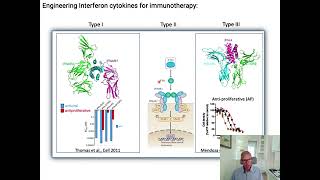
Hi, this is Chris Garcia, and first of all, I'd like to acknowledge the receipt of the Bill Paul Award. I'm extremely honored and flattered and want to express my gratitude to the board members as well as the members of the Cytokine and Interferon Society. I knew Bill Paul quite well. He was quite instrumental in stimulating a lot of my early interest in cytokines and was also a wonderful person. So this is a really great honor for me to have this award in his name. And in the interest of time, I'm just going to dive right in and present my lecture today. So I want to talk about what I call an emerging cytokine pharmacology, which is really are attempts to address pleiotropy, which is the phenomenon by which cytokines have actions on many different cell types which can counterbalance one another because of shared receptor expression. And this has been a barrier to clinical translation as well as to cytokine research and is something that I've thought a lot about in terms of mechanism-based approaches to try and narrow cytokine pleiotropy. And we've done this in several different ways in my lab over the years, rooted in structural approaches. And that's what I'm gonna talk about today. Now, I first wanna start with really the cytokine receptor dimerization paradigm, which was originally established by people like Harvey Lodish and Jim Wells in the early days.. But what we've gone on to really definitively establish recently is that cytokines are not preformed dimers. In fact, they bind sequentially to their receptors to dimerize their receptors in a ligand-induced fashion, and which causes transphosphorylation of the JAKs, phosphorylation of the STATs, and subsequent downstream gene expression. And this paradigm really offers a great deal of opportunity and information cytokine engineering to address the problem of pleiotropy. And really, the concepts I want to talk about today are the ideas of tuning cytokine agonism for therapeutic benefit. And I'm gonna kind of counter that against GPCR pharmacology, which is a well-established classical field and which really has been clearly shown that GPCRs, depending, ligands can be modified for GPCR PCRs that can elicit biased and partial and inverse agonism. And these are classical pharmacological concepts which really have not been translated to cytokine receptors, which work as two proteins that get brought together by a ligand. So there are technical difficulties in applying these kind of concepts to this type of type 1 transmembrane receptor system. But we've done so in a variety of ways, and I think really established what we can start to call now a cytokine pharmacology. Now, this is the menu of cytokine receptors, which I feel that at a meeting like this is kind of required to show. This is the— we're all interested in one or more members of these receptors here, and most of them have some kind of therapeutic relevance of some sort. And the traditional pharmaceutical path of overexpressing the recombinant forms of the cytokines and putting them into people have generally not been very successful for cytokines because of this pleiotropy issue, no matter which family member you're working on here. And so I think this issue is a larger problem, which not only for cytokine research, but for clinical translation and something that my lab is very focused on at the moment. So my work has been focused been rooted in structures of cytokine receptor complexes from the beginning when I started my lab in 2000. And that's because they really open doors, and they really— we, we tend to look at them as blueprints for cytokine engineering. They offer very high-resolution blueprints for what areas of the cytokine to modify to try and generate specificity. Now, I'm not going to get into the nitty-gritty of the structures and the different details of the dimerization of these different cytokines, other than just to show you that we've generated this large panel of cytokine receptor complexes, which has really been the starting point for the kind of projects I'm going to talk about today. Now, the first one I want to talk about involves interferons. And certainly, you know, to the members of this society, interferons are very near and dear obviously I've been very interested in interferons since the early days of cytokines. And we've done some published work on the type 1 and type 3 interferons that I won't go into other than to just mention that really natural type 1 interferons were very stimulating for me as a nature's example of cytokine engineering. And there's 16 different subtypes of type 1 interferons. They have been shown to decouple antiviral and antiproliferative actions depending on the interferon subtype. We provided a structural basis for that in 2011, and it really got us thinking, well, maybe if we could endow natural cytokines with these types of type 1 interferon-like properties, we might be able to create useful therapeutics. And so I'm gonna talk today about type 2 interferon, gamma interferon, because that was sort of the lingering interferon that we have not been able to obtain structural access to until very recently. Now, gamma is a typical highly pleiotropic cytokine. It's made by many types of immune cells. It has actions on many types of immune cells. And therapeutically, it's been very difficult to use because of this. But the actions I want to talk about today mainly focus on its ability to enhance PD-L1 expression at the same time, class 1 MHC antigen presentation, which is probably one of its best known actions. And these kind of counterbalance each other in the tumor microenvironment and prevent its use as an effective immunotherapeutic. So Juan Mendoza in my lab in 2019 determined the structure of gamma interferon, which is a dimer that binds two gamma R1s and two gamma R2s.. And it's this beautiful hexameric structure which afforded one the opportunity of making structure-based mutants of the gamma interferon dimer, which allowed for different numbers of occupancies of receptors on the gamma interferon. And so one then subsequently made each one of these, for instance, 1R1, 1R2, 2R1s, 2R1s, 1R2s, and he tested their effects on phosphostat 1 and found that compared to wild type, he was able to make a series of partial agonists which had lowered Emax for phosphostat 1. He went on and looked at these partial agonists by looking at their gene expression profiles using RNA-seq, and he found something rather interesting that Despite these variants being partial agonists for phosphostat-1, most of them showed what we call stable gene expression in the sense that the wild-type level of gene expression was the same as the partial agonists. And that was for most of the responsive genes to gamma interferon. In contrast, there was a small set of what we call tunable genes where the wild-type gamma interferon had much higher levels of gene expression than the partial agonist, at least as judged by phosphostat 1. And what we found was that one of the stable genes was MHC class I. No matter how partial the agonist was, you get very strong upregulation of MHC class I, whereas that was not true for the checkpoint ligand PD-L1. And this is now showing one exposed, the A549 lung cancer line, to both wild type and partial agonist gamma interferons. And you can see they all strongly upregulate class I, but the partials are diminished in PD-L1 expression. And that was also true across a number of other different cancer cell lines to different extents of biases, strong in the colorectal line, very weak in the pancreatic line. But in general, we saw bias across most of the cancer cell lines. And this really now has opened up the possibility that revisiting gamma interferons and immunotherapeutic in the tumor microenvironment that could have in some way decouple the concomitant activation of the checkpoint ligand with class I. And that's something we're exploring. So another cytokine that we've explored this tuning concept is with IL-10.. And this is work from Bobby Saxton that was published this year. And IL-10 is mostly known for its anti-inflammatory actions, but it also has pro-inflammatory actions that are mediated by STAT1. And we know IL-10 is secreted by macrophages and Tregs, and it inhibits monocytes and macrophages, but it has some pro-inflammatory actions on T cells. So we wanted to see if we could decouple these actions. And much as we did with gamma interferon, Bobby solved the cryo-EM structure of the IL-10 receptor complex, which I'm not going to get into in detail. But suffice to say that much like gamma, there are two IL-10R1s, two IL-10R betas. And using the structure, looking at the interface of IL-10 with IL-10R beta, Bobby designed a series of structure-based mutants to impair binding of IL-10R beta to IL-10 in a graded way. And these are the mutants shown here. And what I'm showing you here are the phosphostat-3 induction on a monocyte cell line, the THP-1, and the Dowdy line, which is B-cell derived. And what we found that when we looked at phosphostat-3, some of the mutants retained actions on the Thp1 cells but had greatly diminished activities on the Dowdy cells. And when we then looked at PBMCs, we found that some of these mutants, for instance the IL-10De, retained actions on monocytes but lost actions on T and B cells. And that was proportional to the level of IL-10R beta expression. The monocytes are very high in IL-10R beta. So through mass action, this partial agonist was able to retain actions on monocytes and lose it on these other types of immune cells. And Bobby went on to show that this myeloid-biased IL-10 has reduced capacity to promote pro-inflammatory genes. And this is showing here wild type versus the partial agonist. You can see the partial is greatly diminished in these pro-inflammatory gene expression, and also looking at cytokine secretion, interferon gamma, IL-9, granzyme B, the partial agonist is greatly diminished compared to IL-10. However, when we look at the anti-inflammatory actions, the partial agonist and IL-10 are about the same. When, for example, when we treat monocytes with LPS and look at the ability of IL-10 to inhibit TNF, IL-6, and IL-8 secretion, They're about equal. So we've lost the pro-inflammatory actions, but we've retained the anti-inflammatory actions. Bobby went on to show in a mouse sepsis model, essentially a cytokine storm model, that his partial agonist, the IL-10DE, was able to promote survival of mice treated with LPS to the same extent as IL-10. And so really, this is very exciting because what we want to do now is revisit this partial agonist in a clinical setting for inflammatory disease such as inflammatory bowel disease, where we've now essentially shimmed out the pro-inflammatory actions and could perhaps give it a whole new life as an anti-inflammatory drug. Now, finally, I want to show you some recent work on another class of cytokine, the IL-12 family, which are what we call the tall receptor family because they have many more Ig domains than the typical kind of short receptors that I just talked about, like gamma interferon and IL-10. IL-12 is an unusual cytokine that it's a four-helix bundle P35 subunit that's complexed with a cytokine receptor-like P40 subunit and is secreted as this heterodimer. And We've been interested in this family going back to our early work in the early 2000s on IL-6, but we've never been able to crack the IL-12 structure. And Caleb finally managed to do that in the lab through a combination of crystallography and cryo-electron microscopy. And what I'm showing you now here is the complete quaternary complex of IL-12 R beta 1 in green, IL-40 in orange, P35 in purple— in blue, and IL-12R beta-2 in purple. And it's a very unusual type of geometry. And what I want to highlight your attention to is the IL-12R beta-1 is forming a direct interaction with the P40 subunit of IL-12, not the cytokine four-helical bundle portion like most of the cytokines that I've previously shown you. So this really breaks the mold for how cytokine receptors dimerize. Now, we noticed that this p40 IL-12R beta-1 interaction was of particular interest to us because one of the main functions of IL-10 is it acts on NK cells and T cells to promote secretion of interferon gamma. And in fact, the NK cells secrete tremendous amounts of interferon gamma, and that's one of the reasons why IL-12 is so toxic. Clinical trials of IL-12 really were not successful because of its extreme toxicity. And some early studies from 2000 showed that that's due to gamma interferon because gamma interferon knockout mice survive IL-12 administration. And when you deplete NK cells, they also survive. So the gamma interferon is made by NK cells. So what Caleb asked is could he use the structure to make partial agonists of IL-12 that would retain actions on T cells but not NK cells. And this is now showing some residues of p40 engaging the IL-12R beta-1. And what Caleb did was he tiled these residues with alanine mutants, and but looking at phosphostat 4, he made partial agonists. Now this blue line here is a 2X Ala,, but he made other alanine mutants which had almost unmeasurable STAT4, yet they retained biological activity. And in fact, our design strategy was, could we make partial agonists that retained actions on T cells that had high IL-12 or beta-1 expression as opposed to NK cells that have low IL-12 or beta-1 expression? Through a similar type of mass action approach that I showed you that Bobby Saxon used for IL-10 and IL-10R beta. Now, what I'm showing you here is an ex vivo experiment on OT1 mice where Caleb took T cells and NK cells out and showed that the T cells retained their ability to make interferon gamma by the partial agonist, whereas the NK cells did not. So we seem to have decoupled the T cell and NK cell actions ex vivo.. But he then went on to show in vivo that in mice in an MC38 tumor model, that in mice treated with the cytokines— and here showing now the black line is wild-type IL-12 at 30 micrograms is killing the mice. Wild-type IL-12 at 1 microgram is making the mice very sick until the cytokine is stopped administered. But the partial agonist, the mice are perfectly healthy. There's no weight loss, and in fact their anti-tumor actions are just as strong as IL-12. So really what we've done now is we've retained the anti-tumor properties, but shimmed out the toxicity here. And we're extremely excited about this as a potential immunotherapeutic where we've really solved the toxicity problem and we're trying to translate this into the clinic. So what I've shown you here, the paradigm is that by borrowing concepts from GPCR pharmacology on partial agonism, we've been able to show that different immune cell types are hardwired to respond to cytokines with different response thresholds. So by essentially detuning the strength of the cytokine signal, we can shim out certain kinds of cell types and achieve some degree of selectivity for the desired cell types, whereas eliminating TOCs on undesired cell types. And we're really exploring this concept on many different cytokines beyond what I'm showing you here today. Now, in a different kind of approach, so what I've shown you so far is that we've detuned the cytokine signal strength by essentially impairing the binding affinity to one of the two receptor subunits to make this a less efficient dimerization. But here again, by comparison to GPCR pharmacology, where medicinal chemistry is able to access the conformational plasticity of GPCRs to elicit different downstream signaling outcomes, we're not really tapping into this type of, of potential here because these are not changing the receptor dimer shape or topology in the way that small molecules are changing the shape of the GPCR and eliciting biased signaling. So we wanted to develop a system, a platform where we could change the relative orientation and proximity of cytokine receptor dimers and ask if we could generate biased signaling by a similar kind of concept as GPCR medicinal chemistry. And for that, we wanted to develop a scaffold, an alternative to the cytokine that would be able to change the dimer orientation and topology in these different types of movements in a way that the natural cytokine would be unable to. And for that, we collaborated with David Baker on some engineering of a synthetic cytokine receptor dimerizer that we're able to make in different lengths and angles. And as you can see, this is showing here by changing the dimer angle of EPO receptor, we're able to essentially tune the STAT5 signaling output from maximal to essentially non-signaling. And when we then took these different dimer angles and put them into a red blood cell differentiation assay, you can see EPO causes complete red blood cell differentiation from stem cells, whereas these partial agonists arrest the differentiation in proportion to the extremity of the dimer angle of the EPO receptor dimer. So we're essentially, this tuning concept on the outside of the cell really translates to being able to influence cell phenotype. And is something that we're now looking at in more relevant models. For instance, in interleukin-2, since those synthetic proteins that I just showed you are really not, don't have drug-like properties, we've gone more towards the idea of using nanobodies linked together to artificially dimerize receptors as a proxy for this kind of tuning of receptor dimer geometry. And so we've made nanobodies to IL-2R beta and common gamma chain. This is work done by Michelle Yen in my lab. And we can link them together in multiple combinations to create these large matrices of dimerizers, synthetic dimerizers that would predict to dimerize the two receptors in different orientations and proximities. And what we find is that they have vastly different STAT5 phosphorylation signal strengths. And we find even beyond that in data that I'm not gonna show you here, they also have biased signaling properties and cell type specificity. So really, this new area of reorienting the receptor dimer is something that I think has some deep— is going to have some deep pharmacological implications. And there really is a new pharmacological parameter for tuning cytokine receptor signaling that you'll be hearing more about from my lab in the future. Now, looking forward, I think we're really in the midst of a whole new renaissance about thinking about cytokines as therapeutics as we start to understand how to tune them. And I've shown you two different ways that we're thinking about cytokine receptor tuning. But I just wanna finish here by showing you what I think is on the horizon, which is going beyond the cytokine receptor dimer pairings that exist in nature. And pairing cytokine receptor dimers that don't normally come together in nature but are expressed on the same cell. And by that I mean we are creating molecules that we call synthokines where we borrow a receptor subunit from two natural cytokine receptor heterodimers, for instance cytokine 1 and cytokine 2,. And we borrow a chain from each to create a new heterodimer on the same cell surface using a synthetic bispecific molecule. And in this case, unpublished, I'm showing you we borrowed the IL-2R beta chain and the IL-10R beta chain from the IL-10 and IL-2 complexes to create a JAK1-JAK2 heterodimer. And we asked if this thing would be active in STAT5 signaling. And indeed it is. Compared to IL-2, we're now looking at phosphostat5 in an IL-2R-beta IL-10R-beta heterodimer that is induced by a nanobody-nanobody fusion protein. And not only can we elicit a STAT5 signal, we can tune the amplitude of the STAT5 signal by varying the linker length between the nanobodies. So we're very excited by this because I think this really gets us out of engineering natural cytokines and takes us towards a platform where we can engineer large numbers of synthetic cytokines with drug-like properties and explore different cytokine receptor pairings. We can tune cytokines, as I showed you earlier, but really sort of takes us out of this local minima this local evolutionary minima that the structures of natural cytokines keep us in and take us out into sort of being able to explore this in a much wider spectrum of possibilities. So I want to end there, and I want to thank the people who did the work. Caleb Glassman led the IL-12 project. Bobby Saxton led the IL-10 project. Kritika Mohan, working with the Baker Lab, led the ePO DARPA project. Juan Mendoza was the leader of the gamma interferon project. And I do want to disclose that I'm a founder of Synthekine, where several of the molecules that I talked about today have been licensed and are being commercialized. And again, I want to thank the Cytokine and Interferon Society for the Bill Paul Award.
I'm very honored, and I'll be happy to take any questions. That was a spectacular talk, and I think really fitting sort of tribute to Bill Paul and his work over the years.
More from Joshua







Scientist Stories: Hans Waterham, The value of phenotypic assays in peroxisomal disorders




Scientist Stories: Joel Zlotogora, Genetic carrier screening programs for reproductive purposes