Scientist Stories: David Baker, The Coming of Age of De Novo Protein Design
David Baker explains how de novo protein design evolved from physics-based methods to deep learning, enabling designed antivirals against SARS-CoV-2 and RSV, synthetic pores for sequencing, and nanomaterials that self-assemble. His tools like RosettaFold and ProteinMPNN cut binder discovery from thousands of screens to dozens of designs per week.
Chapters
I want to welcome you to the Wednesday afternoon lecture series. My name is Michael Chambers. I'm a graduate student at Georgetown University, and I'm doing my research up here with Miroslav's group at the National Human Genome Research Institute. And yeah, I'm really excited today to be introducing Dr. David Baker, who's here with us today. David got his start with a PhD in biochemistry working with Randy Sheckman. At UC Berkeley and then went on to do his postdoc with David Agard at UCSF. And he is now a professor at the University of Washington. He's also a Howard Hughes Medical Institute investigator. He's also director of the Institute for Protein Design. In 2021, well, maybe I should just say like 2021 was a huge year for the field at large, but especially for the Baker group with the development and release of RosettaFold, which is a highly accurate protein structure prediction model. And together, RosettaFold and AlphaFold 2 just completely transformed the field, which happens I think pretty rarely. But yeah, it was pretty exciting. I still— it gives me goosebumps. And it was recognized. The two were recognized for the Breakthrough of the Year in 2021 by the journal Science. David's scientific metrics are completely off the charts, whether you look at publications, companies founded, all these numbers. They're just huge numbers. And I don't want to downplay that. But what I want to emphasize maybe is the dedication he has to the well-being of his trainees, which is a small army. And the reason I want to emphasize this is that these are the folks that are going to continue to revolutionize the field for decades to come in ways we can't even imagine. And the last thing I want to touch on here is it's really a special honor for me to be introducing David today. He's had a pretty— excuse me. He's had significant impact on my career, at least as far as inspiring me to get involved in biomedical research. I mean, who doesn't want to make proteins? It's just, it's pretty enticing. And also I want to mention too that David is not afraid to think big. He's been dedicating his career to a pretty darn difficult problem that a lot of folks didn't think could be achieved in this lifetime. And so I really admire both his persistence and his ability to apply new novel methods to tough problems. So with that said, thank you, David, for being here in person today. I'm really excited for your talk titled The Coming of Age of De Novo Protein Design.
Thanks for that very nice introduction. All right. So today I want to tell you about de novo protein design. So as you know, proteins in nature carry out a really wide range of important functions. And the de novo design is basically the problem of making brand new proteins with new functions to solve problems that weren't really around during natural evolution where all the natural— when all the natural proteins came about. And so for many years, we approached this problem sort of using a physically based model where based on the idea that proteins fold to their lowest energy states. So if we wanted to design a protein to fold to a given structure and have a given function, we searched for an amino acid sequence whose lowest energy state was that structure. Now more recently, as you're all aware, deep learning has become increasingly powerful. And so now we can actually— now we can use deep learning methods to design proteins, not using sort of a physically based model, but using a deep neural network. And I'll talk about that in the second part of my talk. And I want to sort of— there's also a theme of pandemic preparedness that runs through my talk. So we've been designing both vaccines and antivirals. And in the first part of my talk, I'll show you how we've been able to make quite a number of antivirals that could be useful against future pandemics. And that's what we call just in case, because that's sort of anticipating where the next problem is going to come from. But you also want— we also would like to have really fast methods for making therapeutics in the event of a new pandemic outbreak. And when I get to the deep learning part, I'll show you how now we can do everything much, much faster than we could before. So it's an exciting time for us. We have our first computationally designed medicine. This is some number of years ago. We— oops. Let's see, we designed self-assembling icosahedral nanoparticles. My colleague Neil King, those are in white and cyan here, my colleague Neil King put the receptor binding domain of the coronavirus on it, and it turns out to elicit a really, really strong immune response, quite a bit stronger than the mRNA vaccines. It's also very, very stable, so it doesn't require a cold chain. So this is now in use in Korea and hopefully soon elsewhere. So the first part of my talk will be about design of binding proteins. And so for— so we've developed general methods, and this is using the physically-based approach to design proteins that are shaped and chemically complementary to protein targets, like in this case the receptor binding domain. And these proteins are very small. You can see this is— These are 3 copies of this small protein. It's only 55 amino acids. It's very stable. It doesn't melt. And the structures— so we designed these on the computer. We designed a sequence to fold up into a particular structure and then dock to the spike. And then in this cryo-EM structure, you can see that the design model is actually very close to the actual structure. So we can design these small proteins very accurately. Now, this is a very potent protein. It protects mice and hamsters against the coronavirus when administered intranasally. To make it even more potent, we basically connected 3 of these receptor— little proteins that bind to the receptor binding domain with a designed trimeric unit that's sort of designed to bind so that it can bind all 3 at the same time. Here's the cryo-EM structure. You see the sort of the tripod-like structure inhibitor bound to all three domains at the same time. And because it's binding trivalently, it's extremely tight. We can't measure how tight it is. It neutralizes all of the variants that it has been tested against at very high levels. So again, it can get hard to measure neutralization below below 100 picomolar. And it also provides— so basically the way it's administered is intranasally. You can give it up to 4 days before exposure and up to 1 or 2 days afterwards. And it also blocks transmission, which makes sense because it's basically just blocking the ACE2 interaction both either on the way in or on the way out. And this will be starting clinical trials early next year. So we have been excited then, interested in sort of like this just-in-case kind of idea. Basically, can we make potent inhibitors like this for other major classes of viruses? And we've been using the same basic approach where we start by designing small proteins. This is the case of RSV. We designed small proteins that bind to the virus. And then we oligomerize them. And in this case, again, we have picomolar level neutralization of these multimeric versions. And this is the case of MERS, where again, we're down with neutralization IC50s in the picomolar range. So I'm pretty confident this is— I'm not showing data on the flu. We also have binders to flu. So I'm pretty confident this is a general approach for making antivirals. And the nice thing about these proteins is that they're so stable that you could combine them all in some sort of spray that instead of taking your COVID test in the morning, you just spray a little bit in your nose if there's going to be— if you're going into an infected area. But there is a caveat, which it did take us some time to make these.
It took us—
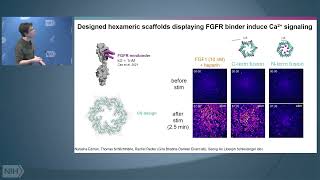
we had to screen quite a large number. They all get made on the computer, but then we have to test a number. And I'll show you towards the end of my talk how we can make these class of proteins much more rapidly. So you'd really like to be able to do this, and a new virus breaks out, and you get the sequence, and you'd like to be able to make an antiviral within days. And that's obviously much faster than you can do with antibodies. So we've used this approach to make binding proteins to quite a number of human cell surface proteins, receptor subunits primarily, tyrosine kinase receptor subunits, cytokine receptor subunits. And what's exciting now— so we have antagonists for all of these, which may be interesting on their own, but what we can do is now combine them in different ways to bring receptor subunits together in different arrangements. And that gives a whole host of new agonist activities. So for example, Here we have a— we made a binder against the FGF receptor, and when we can place that on designed scaffolds that space these FGF receptor binding domains in different arrangements, and we find that these give different effects on cells when they're added. So here you see in this arrangement we get potent calcium signaling.. But in this arrangement, we don't get any— we get much less signaling. So we can tune the response by changing the arrangement. And this is— these compounds have very interesting effects that differ from FGF. So this is looking at vascular differentiation. And you can see the ratio of— during endothelial cell differentiation, the ratio of arterial to venous cells that are produced differs dramatically between FGF, which is primarily going down the venous pathway, whereas the synthetic agonist down here is primarily going down the arterial pathway. And this is, I think, really just the tip of the iceberg. We can— this is an example here where we can take two different binders, one against the IL-7 receptor, one against the common gamma chain, and make extremely potent IL-7 mimics. And so now we're exploring different combinations of these little domains and sort of seeing what the richness of induced effects can be. So I think there's a lot of opportunity for regenerative medicine. You could even imagine things like transdifferentiation and other— and in the case of the immune system, being able to selectively amplify subpopulations of immune cells So it's kind of an exciting time. So I talked so far about making binders against folded structures, but we can also now make binders against structures which aren't folded. So in particular, we can make binders to peptides which form amyloid. This is to A-beta. And the basic idea is we can bind it when it's in a beta strand conformation. And here you see the basic idea. Here's the design, and there's the peptide slotted in. And these proteins bind to their target peptides quite tightly. And of course, A-beta, if you just let it fold on its own, will assemble into these amyloid fibrils. If these design proteins are added, they completely shut this process down. And so there's a collaboration with Thomas Knowles' lab. And here, A-beta aggregates very rapidly. But when the proteins are added at actually just at stoichiometric or even just substoichiometrically, there's a complete suppression of aggregation over multiple days. And this is actually much stronger than has been observed for the therapeutic antibodies. So of course, the role of these amyloid-like structures in Alzheimer's and other neurodegenerative diseases is still unclear, but we think that this class of proteins will provide a cleaner way to prevent aggregation and should also serve as diagnostics. So there's, on this theme of binding to disordered parts of proteins, These have been hard to target by conventional methods. Kaja Wu has designed proteins which bind to extended peptides such that each amino acid or every other amino acid of the peptide fits into a pocket on the protein. And she can change the pockets here to get specificities for different amino acid sequences. And these design proteins, the sequences they bind to are, for example, shown here. This is all— this is the same pocket repeated 6 times, so it's the sequence leucine, arginine, proline repeated 6 times. And as you can see here from these KDs, they bind very tightly, and they bind both in vitro and in cells to their targets. And what's neat is now she can target intrinsically disordered regions of human proteins And so she can pick out regions with— and then basically make modular proteins that bind to that peptide sequence. And she can use these proteins— this is actually a collaboration with Manu Derviri— to pull out the proteins from basically a cell lysate and see what other proteins come with them. So that's pretty much where we are with using sort of this energy-based approach. To designing binders. And again, I'll come back at the end of my talk to you doing this with deep learning. We've also been interested in the problem of delivering biologics. So how do you deliver guide RNAs or protein therapeutics into cells? And we designed these antibody nanocages. And they're made out of a design protein, like this pentamer in green here. And they bind to antibodies, like the yellow ones here— as shown here, and they basically wrap the antibody into an icosahedral nanocage, and that's shown here. We have other ones that will wrap antibodies into octahedral cages, and then these other forms shown here. And this is nice because you can take any antibody, add the corresponding design protein, and you will get a nice folded sort of virus-like cage from it. So from the delivery point of view, we can include— we can basically put on the cages an antibody which targets them to particular cells in the body. But then we need to— then the particles get taken up along with whatever we've put inside into cells. But then they have to get out of the endosome. And so what Aaron Young has done is first of all to keep the cargo in— oops, let's see. I need to go backwards. So if you look at this original one here, there's kind of a hole. There's a hole here. And what Erin Yong did was to— a graduate student in the lab, she designed a trimer that fits right in there. And here's the cryo-EM structure now. And you can see down the threefold and fourfold axes of the design, and here's where the plug sits and here's where the antibody sits. She's designed this to be pH dependent, so when it gets taken up into the endosome, the plug comes out, and we're now trying to optimize the endosomal escape so that what's inside the cage can now come out, because it gets out of the cage when the plug comes out, but it's still got to get across the endosomal membrane. So I've talked so far about— about soluble proteins, but we can also now design transmembrane proteins. So here is a designed transmembrane beta barrel, and this is the crystal structure of it, and you can see they're very close. And what's exciting about these transmembrane beta barrels is since we're designing them, we can change the interior to be anything we want and then get selectivity for different types of compounds. For example, as many of you know, single molecule DNA sequencing can now be done with naturally occurring pores, but since we can design them from scratch, we can really optimize them for that or for peptide sequencing or something else. And these design pores are very stable. They have these very clear single-channel conductances, as you've seen here. So we're now kind of— now we're designing proteins with different size and shape channels. So one of the things that if you haven't looked at a lot of proteins before, you probably find these pictures kind of hard to look at. And generally, when the first protein structures were solved, it was felt, oh, they're so complicated and asymmetric. And that's because nature really never cared about creating proteins that were easy for people to look at. But Tim Huddy, a grad student in the group, reasoned that there was no particular— it didn't have to be that case— way. So he's designed proteins which are really more like the building blocks you would use to, say, construct a house. So he's built these totally straight proteins, which are like these kind of blocks here. And then since they're just made of repeating elements, so he can make them longer, he can put in right angle turns like this. He can make curved versions like this, and then make ones that interact put in interfaces between the blocks so they can interact in different ways. And from these, he can build all kinds of cool things. This is just— up here is a crystal structure of one of the blocks. Here's showing that with different shape, different types of corners, he can make triangles. This is electron density data, and/or squares. And by putting the curved blocks together, he can make these very homogeneous populations of circles. Now, by combining the curved blocks here with these sort of interaction blocks, he can build different types of polyhedra. And these are EM reconstructions of designs that he's made in this way, really just by putting blocks together. And you can see that the electron density fits really well with the design model. One of the easiest ones to see is maybe this one here, which is made by taking this sort of this block with 4 subunits, kind of like in a cross shape, putting it together with this right angle interaction. And what that gives is this cube shown here. And since these blocks are perfectly straight, he can simply change the length of this block to make either a short cube, a medium-sized cube, or a big cube. And all that's happening, if you look at these pictures, is that this is getting longer. And this is, again, electron density. So he can also make unbounded structures like these, which he calls train tracks, which is putting together these blocks and these blocks, which— so he gets these two parallel things with this connector here. And you can see pictures of them here. And then finally, I showed you those rings before. He can take an inner ring and an outer ring and combine it with these blocks to make these sorts of structures here, which we're very excited about for larger pores that could fit into silicon wafers to enable coupling whatever's going through with an electronic readout. So, so far, everything I've told you about is designing proteins that are very rigid, that just have one structure. So Florine and Phil were interested in designing proteins that have two different structures, but very discrete. So here, this is the system. So they designed— there's one state here, and then another state where this blue sort of rotates around the orange. And only in this state will it bind an effector, a peptide. This is DIR spectroscopy, which allows monitoring of how far apart probe spin labels are that have been placed on the protein are. And so in the presence of the peptide, these two probes in the model come closer. And indeed, this is the distance as read out using this DIR measurement when the peptide's added. When the peptide is not present, then the probes are further apart.— and you see the distances move to further apart. So when the peptide is added, you switch from one state to another. And Florian Phil were able to solve the crystal structure of this in both states. So here's the crystal structure in the absence of the peptide. It's basically identical to the design model. And here's the crystal structure with the peptide. And you can see it's identical to the second state. So again, we have two very well-defined states. So Arvind Pillai has taken this system and built allosteric assemblies. And here's the basic idea. So the system is like this— so it's like this straight protein, which when you add the effector, it bends. This is kind of an idealized case. So if these units have an interface on the end that allows them to interact like this, then when the effector is added, then that will change the outcome because now the geometries of these are different. And so he's been able to make a series of different assemblies. So this one involves two of these coming together in the absence of the peptide, but when the peptide binds, the conformation changes, and now he gets these trimers, these triangular structures. And here's one that goes from being a cyclic trimer with three copies to a tetramer when the peptide's added. Let's see. Sorry, I skipped one. I don't know. Oops, I'm going the wrong way. Sorry. We're about to get to deep learning, as you can see. So it's neat. So we can design these proteins that switch between two states, and we can use them to drive changes in assembly state. Here's a particularly nice one that goes from being a tetramer on the right with the absence of the peptide to a pentamer on the left when the peptide's added. OK, so now I'm going to switch gears and talk about deep learning. And so we've developed this network called RosettaFold, which is pretty good at predicting structure from sequence. And it has 3 tracks. It has a track sort of sequence information is going through on this track, then distance information is going through on this track, and finally structure information is going through on this track. So various types of information come in and the structure comes out. So one of the things that we've been doing recently is to extend it to more general problems. For example, we now have a version of the network that— this work from Frank DiMaio— that will take in not only protein sequence but also DNA or RNA sequence. So it will build models of protein-RNA or protein-DNA complexes. And these are examples of some of the predicted protein-DNA structures that it has generated. So I apologize for how complicated this slide is. This is showing you what actually one of the— what the architecture of one of these neural networks looks like. If you haven't seen a lot of these before, it looks— they're kind of complicated. And don't worry too much about the details. But what this network does is it does the classic design problem of given a backbone of a protein, predict what amino acid sequence— predict amino acid sequences which will fold to that backbone. And one of the things we found— we'd been developing this Rosetta physically-based method for many years. And we found that when we developed this new method called ProteinMPNN, and we did the classic test of taking many, many naturally occurring protein structures, throwing away the side chains, and asking the network to predict what the sequence of the protein is, that this network did far better. So the fraction of amino acids So it predicts the sequence based on the structure. And this protein MPNN did a really good job at predicting what the native amino acid sequences were, far better than Rosetta. So that became very evident when we did— in the work leading up to this experiment here. So here what we did is it was our first attempt to design proteins using one of these networks. And so what we did is we started with completely random sequences and we predicted the structure. In this case, we used AlphaFold. And a completely random sequence won't be predicted to have any particular structure at all. But then we could start changing the sequence and identify changes, basically do a Monte Carlo search, identify sequence changes that made it predicted to form some structure. And then if we— after enough amino acid sequence changes, we would get sequences that were strongly predicted to fold to a structure. So in this experiment, what we did was to ask not only that the sequence fold to a structure, but that it be symmetric. It would be a cyclic oligomeric structure. Now, when we did this, we got these sequences out that were predicted by AlphaFold to fold to a very nice oligomeric structure. But when we made them in the lab, and the way we do everything— we've done everything— everything has been done. I've described so far is we get synthetic genes, we put them into bacteria, bacteria make the protein, and in the examples I showed you so far, we got these nice proteins that were flu inhibitors or whatever. So in this case, we just got gunk at the bottom of the tube. Then we took the protein MPNN and kept the backbone the same but found a new sequence. In that case, the success rate was very high, and we were able to get structures, ultimately these cryo-EM structures of these very large rings that, again, just came out from this random sequence search. So that was sort of our first experimental evidence that this protein MPNN could really make proteins that fold. And these are very close to the design models. OK, so then another example of using deep learning is enzymes. So designing enzymes is harder than what I've described so far. This is not just binding. Selectively stabilize the transition state. And the reaction that Andy and Chris chose was this luciferase reaction. And they made proteins which selectively stabilize the transition state for this reaction. And the way they did this was to use these deep learning methods. We call it hallucination, the method I described just a moment ago, because we're kind of doing this— we're searching over all the possible inputs of the network. It's just kind of making up things from from scratch. And we searched for sequences that fold up to scaffolds that look like this. And then we, in this case, this was sort of a hybrid. We used Rosetta to design side chains that interact with this substrate for the luciferase reaction. And what we found is we got quite active luciferases out of this. And they were close to as active as naturally occurring luciferases with, for the enzymologists who might be listening, Kcat over Km of 10 to the 6th per mole per second, which is really pretty active. There was an interesting difference from— sorry, I keep doing that— from naturally occurring luciferases, which have very broad substrate specificity. This designed luciferase is very highly specific because the pocket is very well packed around the substrate. So Andy is now trying to make luciferases that are specific for for other substrates. OK, so now the rest of my talk, I'm going to talk about really work of the last 3 months that's involved a lot of people, and it's very exciting. So I hope you will enjoy this. So basically, so this hallucination approach where we were kind of just randomly searching in sequence space for sequences that would be predicted by the network to have the properties that we wanted, was not very efficient because every time we changed the sequence, we had to make a structure prediction again with RosettaFold or AlphaFold. So we couldn't really direct it. So we wanted really a more directed way of doing this. So the first way we tried to do this is we sort of took RosettaFold and treated it like, well, you know how when you type a few words into a word processor, it'll try and sometimes complete your sentence, sort of that autocompletion? We tried to use RosettaFold as, sort of a protein autocompleter. And so what we did is rather than just training it on sequence information and asking it to predict structures, some of the time we would delete sequence and structure information and ask it to complete the missing sequence and structural information. And so then what we could do is take just parts of proteins, like in this case a di-iron site. We could just take a little bit of a protein that had a function. Leave out the rest of the sequence and structure, and then RosettaFold would just build it in. And in that way, we were able to get proteins that, as a crystal structure, actually had that design site and bound metal. We could also— we've been obviously interested in making better ways of making vaccines. We could take epitopes from a virus, like in this case respiratory syncytial virus. This is RSVF protein. We could take different epitopes and ask for a single protein that could present them all in their folded form. And so here are a couple of these in-painted designs that are made using this approach, and we've made these proteins in the lab and they actually bind all 3 different neutralizing antibodies against these 3 different sites. So we're very excited now to see how they work as immunogens. But there was a problem, and that was that This inpainting approach does everything in one step. And so we couldn't get it. So it always like, it was like having a sentence auto-completed that always auto-completed the same way. And in the same way that a sentence auto-completer would have, you always had to give it some minimal amount of information. If you gave it too little, too small a functional motif, it just couldn't fill in the rest. So diffusion methods have become very popular for things like, for building images and things like DALL-E that go from text to images all use diffusion models. And the basic way they work is you start with a completely random noise distribution as shown on the left, and then you successively remove the noise. And you do that, at each step you remove a small amount of the noise. And the way— what we're using for removing that noise is RosettaFold. We ask RosettaFold— we give RosettaFold whatever the— say, we start with completely random noise. We ask it to predict what the structure is. It really can't make much of a guess, but it will make some guess. And then we take a small step in that direction. And that's how we move down to less and less noise. And then as we get closer and as we remove more and more noise, starts to look more and more like a protein structure. And in the last few minutes, I'll show you examples of how we can apply this for a number of different types of design problems. So the first thing we can do is just use this to make up brand new protein structures. So we start with random noise and put it through this denoising process. And every time we do this, we get a different structure out. And these are some examples of actually very large proteins we can get this way that look like they could be proteins, but they aren't any actually occurring protein. Now, what we can also do is we can take this random noise, and then we can make copies of it, in this case, 3 copies, and go through the denoising process, forcing the noise to be symmetric at each stage. So what happens then is we get symmetric oligomeric structures out, as you can see here. I'll just let that play one more time. So because we're starting with a random noise distribution, every time we run this, we get something different out. And so here are some of the things that come out. And it's really quite fascinating. Sometimes— these are just different examples, and what you see here is EM data on these structures. This is work from Helen Eisenack and Andrew Borst. You can see they're very close. They have some interesting properties. For those of you who are familiar with natural proteins know that tin barrels have 8 strands and 8 helices. What this network is doing is generating things that look like tin barrels, but they have 24 strands and 24 helices or 18 strands and 18 helices. So the network has been trained on protein structures, but now it can go considerably beyond. So we can also ask it to make— just by the way in which we're symmetrizing the noise, we can ask it to make dihedral structures. So this is, for example, an 8-subunit D4 structure. So it's got like 2 cyclic rings of 4 subunits each that are stacked on each other. And here you can see the negative stain— the EM reconstruction is very close to the design model. And coming back to that very first slide I showed with the COVID vaccine, we can say we can just give it a certain chain length. In all these cases, we have to specify the chain length and say make something that's icosahedral. And so in that case, the noise is copied over 60 times into an icosahedral shape. And then this is what the proteins look like, these nice little icosahedra. And then these are the negative stain class averages again match the— or reconstructions match the model. OK, so what about binding? I promised to get back to binding. And so now this is the last part of very last few slides. So the first problem we can do is this is MDM2, which degrades p53. So it's an important tumor suppressor. We can take just the p53 peptide and say, build a protein around it that binds MDM2. And when we do that, we get out proteins that bind with very high affinity to MDM2. We didn't have to— the protein's being made in place in this case. In the calculations I talked about at the beginning of my talk, we started by generating a very large set of different shape scaffolds, then we docked them against the target. Here we're just starting with random noise placed against the target, and then it sort of assembles into this protein that includes the p53 segment. And now for that problem I described at the beginning of how do you connect— if you have a design protein bound to a virus, can you connect those proteins in a meaningful way? Now we can do this with this very quick deep learning method where it's essentially building a symmetric trimer, building a symmetric scaffold in place that's perfect for holding these design binders on. We can now— so some experimental demonstration of this sort of scaffolding, we can take a metal binding site like this square planar zinc site, and then we can basically add the same noise distribution to each of the— basically around it. That's sort of shown here. And then by going through this denoising trajectory, as you can see here,— we ultimately end up with proteins that assemble into something with— it's a tetramer, and it holds these liganding residues in just the right arrangement. And these proteins bind metal very tightly. This is using ITC, isothermal titration calorimetry. We can't actually measure how tight that is. It's too tight. And they have very close to the design structure. As you can see here from the EM. Now, coming back to the binder design problem, which I talked about at the beginning. So here, what we do is we just start by picking a target, like coronavirus or whatever, and a few residues on the target. And then we place our random noise cloud around those residues and go through this denoising process. And now we have a protein that's right above the— that's right above that site. And we have done that now for a number of targets. This actually took about a week in total, including the experiments. We were trying to see how fast we could do this. And so the affinities are not great. There's still room for improvement with this method. But importantly, we were able to make binders from scratch without testing a large number of designs. So before, we would have to test tens of thousands of designs to find ones that bound. And here, we're just testing dozens and getting binders in the nanomolar range. So in terms of the pandemic preparedness or pandemic response, I think we're getting close to the point that if a new virus did break out and we had the sequence, we could predict the structure and then use these methods to very rapidly generate binders. The work we have to do is to get these to be picomolar instead of nanomolar. And then as my final slide, sort of as demonstration that this isn't crazy, this is taking parathyroid hormone and now basically putting random distribution around it and then running this denoising process. And you can again see a protein assembling around the parathyroid hormone. And when we make these proteins in the lab, they bind extremely tightly. So we've done this for parathyroid hormone here and another helical protein, BIM, here. And you can see there's essentially no dissociation in this biolayer interferometry experiment. So we're getting sub-nanomolar binding straight out of the computer, which is something that we and others have never really seen before for any kind of binding design thing. I think this is an easy case because you can see that the protein basically just has to cradle this long helix. But I think there's hope now for general targets and being able to getting picomolar binders really quite fast. OK, so that's what I wanted to tell you about today. And I've had many absolutely amazing collaborators on this. So the antiviral design work was done by Long Jin, Brian Kejia, Ina, and Rob, with many, many collaborators in many different places for all the animal experiments— Mike Diamond's lab, Mike Jewett's lab. I want to highlight Brett Case-Brickley in Mike Diamond's lab, who did a lot of the animal experiments with the COVID binder. The peptide— the amyloid peptide binders were designed by Danny Sato. Kejia and Hua designed those unfolded protein binders. The antibody cages for delivery were designed by Aaron and Robbie and Andrew. The protein nanopores, what we're hoping for the next generation protein sequencing, for example, were designed by Samuel, Sagardeep, Anastasia, and Carolyn. Those modular block-like nanomaterials were designed by Tim and Yong. The two-state switches and the materials we could make from them were designed by Florian, Phil, and Arvind. The protein hallucination approach I described was developed by Alexei, Basil, and Lukas, as used for those cyclic oligomers. Eustace, Duparas developed the protein MPNN. Andy and Chris designed the luciferase. And RosettaFold is the work of Min-Kyung and Frank. And RosettaFold Diffusion has been an effort by a lot of people over the last 2 or 3 months Joe and David really led the effort with important contributions from everyone listed here. Preetham and Susanna designed those peptide binders, the picomolar binders. And there are a lot of people who I need to thank who aren't on this slide, but in particular, my colleagues at the Institute for Protein Design who really make a lot of things happen. So yeah, well, thanks for your attention. I'd be happy to take any questions.
Yeah, thank you. Anyone's free to use the microphone. Phones, we do have many questions online. So let's start there. Perhaps you know this fellow, Omar Habib over in Oxford. Great talk, David. Does your approach take PTMs into consideration when predicting structures?
Yeah, so we are just working on that now. So the original version of RosettaFold, like AlphaFold, did not include post-translational modifications. But we're working on a version now that will do that.
OK. And I mean, I'll just click question. Since these synthetic mini binders are foreign, the patient's immune system can develop neutralizing antibodies against them. Wouldn't that limit their long-term use?
Yes. And that was the big thing we were worried about when we started putting these designed proteins, which are foreign, into animals and ultimately in people. But the results are actually pretty clear. So the small proteins do not elicit strong immune responses. So for many— for both the— both in the case of influenza and the coronavirus, we— I described these— I told you they had strong potent therapeutic effects. Therapeutic and prophylactic effect, you can actually administer them over a 3-week period every 3 days to try and elicit an immune response, and there's no decrease in efficacy. So neutralizing antibodies don't seem to get made, and when we look just for antibody responses, they're pretty weak. And I think that's because the proteins are very stable. They're small, they're very soluble, so they're probably not taken up well by dendritic cells, and they're very stable, so they're probably not represented that well.
Okay. From Roland Owens, would an artificial protein capable of inducing transdifferentiation also be a potential teratogen?
Yeah, so I think for any— for these kind of these novel agonists where we're trying to get, say, cell fate changes, obviously they would have to be targeted very carefully. I should say we also have a— have a de novo designed cytokine mimic that's in clinical trials, and that has not elicited any significant immune response, coming back to the previous question.
Yeah?
So you mentioned that RosettaFold can now predict binding to nucleic acids.
Yeah.
Can you predict what sequence a protein might be able to bind? And related question, can you do similar things for small molecules to say what enzyme might act on that sort of thing?
Yeah, well— I'm sorry, can you sum up that question?
Right.
I don't know if it was heard if the mic was on.
Right, so the question is, I showed you that RosettaFold can now predict protein-DNA complexes. And the question was, can it predict what DNA sequence a protein will bind to? And then similarly for small molecules, could you predict what small molecule a protein was going to bind to? I would say at this stage, If you give RosettaFold a piece of DNA that's not too big, it will correctly bind to the right site, but I think the ability to discriminate among all possible sites, predict what the right one is, is not so good. But we're actually now just trying to explicitly train it because there's a lot of experimental specificity data. You know, these deep learning models are only as good as the training sets you give them, so we think we can improve that. And then we and others are developing— we're developing RosettaFold for small molecule binding, and that's looking promising. Again, there, I think it's easier to predict the pose than it is to predict specificity, but I think that will all come.
Okay, a few more questions, and a reminder that we're going to have our reception, the first one in more than 2 years, just outside this auditorium. Okay. Question from Matt Peddleton: Any consideration for attaching an Fc domain onto these viral inhibitors in order to inhibit and elicit an appropriate adaptive immune effector function?
Yeah, so Brett Case and Mike Diamond did that, and with the coronavirus binders, and they're very— they work very well. It's not totally clear in that case what the advantage over antibodies are. The one case could be that if we can design binders that bind to sites that aren't accessible that antibodies don't recognize. But you can put Fc's on them. You extend the half-life. Deb Fuller's lab has done that with the flu as well. So that can certainly be done.
OK, and Matt follows up. So this denoising process is not structurally constrained the same as backbone/side chain? Perturbation approach, as the words didn't come through, of the original Rosetta, where each step was related to previous steps by specific changes in backbone angles?
Could you follow that? Right, yeah. So basically, the way— so this problem of how do you sample through possible backbones to make up new structures is one that we worked on for a long time in the context of the Rosetta physical model. And in that case, you keep the chain connected, and all the bond lengths and bond angles are ideal, and you're just sampling the backbone torsion angles, like phi and psi. And that's how you search around in space. In this diffusion approach, it's not like that. The residues are all separate. They're— basically, each residue has a position and an orientation. And what you're diffusing over, what you're sampling, are those positions and orientations. And yeah, so it's really quite different in that way. We've tried to put some of the physics that's in Rosetta into RosettaFold, but it really hasn't helped that much. And I think that's sort of a testament to how rich the protein structure database is. There's so much information in there. The network kind of learns all the rules about connectivity without having to be provided with additional information.
Okay. Have you considered expanding beyond the chemistry of the canonical amino acids.
Yeah, so that's an important difference between the physically based approach and the deep learning approach. With a physically based approach, we've done that. And so we can just— but there the problem is making the proteins, because if you're putting in a lot of unnatural chemistries, it gets harder and harder to make them in cells. So we've really focused on small cyclic peptides or macrocycles. And we've been able to design them so that they can get across membranes very readily, and so they have rigid structures. So now we're trying to develop methods for actually making them bind tightly to targets of interest. But we have to make those chemically. OK. Oh, please. So for your RF diffusion finding binders, that you're only getting nanomolar and you need picomolar. Traditionally, or recently, when you would get something like that, you would then do random mutagenesis. Can you do that in silico or with AI nowadays, or is that something in the pipeline? Right. Well, you're absolutely right. So the way that we had been doing that with the Rosetta method, like the coronavirus binders and the other virus binders I described at the top, we would get the original hits from Rosetta, but then we would basically make a library where we varied every— mutated every residue to every other one at a time and identify substitutions that increased affinity, and then we would combine them to get to of peak molar level. We don't want to— that's slow, right? So you're absolutely right. So now our challenge is— and I think it's eminently solvable— is develop sort of in-silico ways of doing that exactly.
OK, there's a few more if you're still going strong. Sure, yeah. OK. The CME code— oh, good, 44435. I was going to rely on my own memory, but it got flashed up there. Okay, William Anderson asks, thank you for sharing your work, this is fascinating. In regards to the de novo proteins for treatments/therapies, is there— is the greater challenge designing effective proteins or delivering those proteins in a correct way to the correct location?
Yeah, well, those are both very important things. I would say the even more important thing is sort of the the biology or medical concept. You know, what— you know, we can now design proteins that bind almost anything. The question is, how do you cure disease with that? And the viruses are a prickly clear case, right? These just block the virus. If you— and then making these new types of agonists, you know, new types of cytokine or growth factor mimics. So I think you have to have the biological concept for how you're going to cure disease. I mean, another thing we've been looking at is making proteins that will target specific proteins for degradation. But beyond that, well, your point is absolutely right that not only do you need binding, but you need that binding activity at the right place at the right time. And so we're also working on sort of protein logic systems so that you only have that activity in the right place.
OK. And related, Rishi Pandit asks, can you comment on the immunogenicity and clearance of these design proteins in vivo?
Yeah, so I, as I mentioned earlier, the immunogenicity of the design proteins is lower than you would expect. So yeah, so there have been clinical trials now of our designed cytokine mimic, and it elicited very little antibodies. And all the antiviral proteins have been in many animal systems, and there's no sign of any neutralizing antibody response. Clearance, though, clearance we understand very well. So these are all small protein, so they get filtered out in the kidney if you don't do anything else. And that's just a function of size. So for some applications, that's good. So if you want to— if you're doing radionuclide therapy, so you're attaching a very potent radio emitter to these proteins and targeting them to a tumor, for example, having things washed out quickly is good. And if you want longer half-lives, then you have to extend— You have to do things to extend the half-life. If you put them in— that's the nice thing about these respiratory virus antivirals. You put them into the respiratory system, and they just stay there. So like I said, you can get protection 4 days in advance.
Looks like our next person is watching the Wednesday evening lecture series from Germany. I was very excited to see the preprint for RosettaFold NA. How far away— are you from making a software for the design of nucleic acid structures? Example, rationally designed aptamers and ribosomes or DNAzymes.
Let's see. So the first design problem we're trying to do is, given a particular double-stranded DNA sequence, make a binder to it. And we're actually making a lot of progress on that problem. So that's the easiest problem because there you know you have a pretty good idea that's B-form DNA. I think the other problems are a little bit harder because the structure is less regular. But I think those are all current problems which could be approached now. And I should say, we're always interested in collaboration. So if people have things where they'd like binders, let me know.
OK, maybe one more. And it's a self-described naive question, but it's interesting to me. A naive question, but can these strategies be used to produce artificial blood or specific blood types?
Well, I think what they can be used for— one of the uses of these artificial growth factors— it's not quite an answer to that question, but serum is very— if you grow cells like for artificial meat or you're growing up T cells for adoptive cell therapies, you need to add growth factors and cytokines. So one thing is that we can do is substitute those, which can be hard to make and expensive and not very stable, for much cheaper synthetic versions. As far as blood goes, you'd have to look at what the activities— what are the— I guess hemoglobin, you need something that would be an oxygen carrier. I think one could go through it. I'm not enough of an expert to know what the key components are that one would need, but I think it's a very interesting question.
OK. Well, if there's nothing else from here, I wanted to remind people there's a reception just outside here. Not the one on FAS Terrace. That's a holiday party, and you would be crashing that. But just outside these doors. So thank you for this great talk.
OK. Thank you.
More from Joshua







Scientist Stories: Hans Waterham, The value of phenotypic assays in peroxisomal disorders




Scientist Stories: Joel Zlotogora, Genetic carrier screening programs for reproductive purposes