Scientist Stories: David Cox, RNA editing with CRISPR
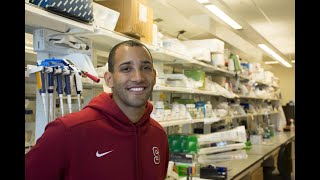
David Cox describes REPAIR, a CRISPR-Cas13 platform for editing RNA in cells where DNA editing fails. The system uses a mutated ADAR enzyme to convert adenosine to inosine at specific sites, achieving 85% on-target edits but initially causing 18,000 off-target changes. A single mutation reduced off-targets to 20, though it lowered on-target efficiency to 40%.
Before we move on, I just want to take a quick second. It can be— I know it can be hard watching a live stream remotely to know if you're by yourself or part of a large community, and we just got news that there's actually 700 people watching this live stream right now. So we're really thrilled that this has been such a great response, and we thank all of you for joining us today. And now I'd like to go ahead and introduce our next speaker, Speaker:Dr. David Cox.
700 members of the audience, no pressure. So, I'd like to thank the organizers for putting together this fantastic event. Today, I'm excited to talk about my graduate work, which is entitled RNA Editing with CRISPR-Cas13. I completed this with Feng Zhang when I was a member of the Harvard MIT MD-PhD program. I'm currently a first-year Stanford internal medicine resident, and I'm concurrently undertaking postdoctoral work with Riju Das. So as everyone here knows, CRISPR systems are bacterial adaptive immune systems that utilize RNA-guided nucleases to defend bacterial and archaeal cells against mobile genetic elements. In the simplest version of the system, you have a single protein DNA nuclease, Cas9, whose activity is directed against a DNA molecule by hybridization through the CRISPR RNA to which Cas9 is attached and the target site. Reconstituting the function of Cas9 in mammalian cells has facilitated genome editing by allowing a simple way to create targeted double-strand breaks that allow for activation of endogenous repair pathways that allow you to change sequence information near the break site. One goal of genome editing is to directly reverse causal genetic mutations in order to treat disease. In order to do this, it requires the homology-directed repair pathway most of the time, which is only active during the S and G2 phase of the cell cycle. So it was restricted to mitotically active cells. This means that for cells that are slowly dividing or are post-mitotic,, it's very challenging to execute genome editing therapy. And this would include hepatocytes, cells in your liver, neurons, and then also cells like cardiomyocytes. So as an MD-PhD, I was interested in extending our ability to carry out therapeutic genome editing in post-mitotic cells and tissues. The idea that I and others in the field came to was using cellular deaminases, that directly convert one base to another and do not rely on endogenous partners, so would be less likely to be subject to the cell-state restriction of homology-directed repair. There are the cytidine deaminases that convert cytidine to uridine and the adenosine deaminases, like ADAR, which I'll talk more about, which convert adenosine to inosine, which is treated by the cell as guanosine. One thing that you'll probably notice is that these enzymes are only capable of reversing very specific mutations. So, the cytidine deaminases can only reverse a T to C mutation, and the adenosine deaminases can only reverse a G to A mutation. In order to get something like ADAR to work, you may notice that it interacts with double-stranded RNA. So, we thought if we were to ultimately carry out genome editing therapy with ADAR, we need a way to actually recruit it to transcripts. So, for that, we'd ultimately need a programmable RNA binding protein, which would be covalently linked to a deaminase enzyme like ADAR in order to get it to a specific transcript where it could change an adenosine to an inosine to ultimately mediate therapy. You'll notice that I use the term genome editing. That's not truly what we're doing here. Now we're reversing mutations, but at the transcript level. But if you're fixing a coding mutation, we figured that that would still be useful. And we were most interested in ADAR because G-to-A mutations are much more likely to cause human disease. So this is how ADAR works. It has an N-terminal double-stranded RNA binding domain and then a C-terminal deaminase domain that's responsible for, of course, deaminating adenosines. But it has this very cool mechanism by which it preferentially deaminates certain adenosines. So if an adenosine is mispaired with a cytidine, that allows for much higher rates of adenosine deamination. So we thought we could take advantage take advantage of this in our goal of building an RNA editing machine. In order to recruit ADAR2-specific transcripts, we needed a programmable RNA binding protein. And for this, we ended up utilizing Cas13B, which at the time was a novel RNA-guided RNase. That's a CRISPR enzyme that we discovered through a novel computational search that only relied on the presence of the CRISPR architecture to find new Cas genes. So, we showed in an earlier study that basically you could reconstitute the activity of Cas13b in vitro to cleave individual RNA molecules, and all it required is the Cas13b protein and then the CRISPR RNA shown in this in vitro cleavage assay here. We also identified the catalytic residues that were responsible for RNA cleavage, which are found within the heptin domains. And if you mutate those residues, you can abrogate cleavage, and shown in this in vitro gel that you see in the center of the screen.. But importantly, if you do a gel shift assay with those same point mutants in the HEPN domains, it does not affect the binding strength to an RNA target. So, for our purposes, this means that Cas13b has the potential to serve as a programmable RNA binding protein that you could use to ultimately recruit ADR to transcripts. So, we thought we'd put it all together like this. We'd have dCas13B, which is a catalytically inactive version of Cas13B, that would be covalently linked to the deaminase domain of the ADR enzyme. We'd recruit that to a specific transcript using a guide RNA. And because you control the sequence of the guide RNA, you could program in that cytosine to pick out a specific adenosine to deaminate. Having the guide RNA would also serve to make that part of the transcript where you want targeting to happen duplexed so that ADAR can ultimately carry out its functions since it works on double-stranded RNA. If this all works, you get conversion of a target adenosine to inosine, which is treated by the cell as guanosine. Since everything in the CRISPR field must have an acronym, we named our system RNA Editing for Programmable A-to-I Replacement, also known as REPAIR. When we transfected this system into mammalian cells and we measured sequencing, and we measured editing rates by RNA sequencing, we were very happy to see that the targeted edit that we wanted to happen was occurring at very high rates, about 85%. But in an RNA sequencing experiment, there's more information than that. So, we looked at other adenosines within the target transcript, and we could see off-target edits there. So, that wasn't great. And then we looked throughout the whole rest of the transcriptome, and we could see many other off-targets, up to 18,000. So, this is not something that would really be useful in a therapeutic context or as a research tool. We, however, had some information from where all these off-targets were coming from. Based off the sequences, we could see that it was probably related to the ADR deaminase domain binding to transcripts independent of Cas13B. So, what we thought we could do is we could maybe mutate some of the RNA-binding residues present in the ADAR deaminase domain, which would decrease the ability of ADAR to independently bind to these off-target sites, but wouldn't really affect the on-target editing quite as much since you have Cas13B tethering it to the on-target site. So, the RNA-binding residues of ADAR we knew because of a recent crystal structure from Peter Beale's group at UC Davis, and you can see them here. However, to screen through all these mutations, it's not practical to do an RNA sequencing experiment for every mutation that you'd like to try. So, what we ended up doing is taking advantage of a phenomenon that we noticed from some earlier experiments that we had done. When we use repair to correct a broken luciferase gene, what we noticed is in the on-target condition, you get very high rates of correction. But then if you have a non-targeting guide, you get some level of correction that's greater than what you get if you have a construct that completely lacks the Cas13-Adar fusion. So, we thought this might be reflective of maybe a little bit of off-target editing and that we could basically use this as a proxy to screen through the many different mutations that we wanted to test out. So, we incorporated this basically to screen constructs in the form of something called the specificity score. And when we went through all these different mutations and basically picked out the ones we thought would be the best for RNA sequencing, we ultimately found the T375G mutation, which you can see in this kind of center-right part of your screen. And this is what it looks like when you actually incorporate that mutation. So, on the left, we have our original construct, 18,000 off-targets. And on the right, we have what happens when you introduce the T375G mutation. So, you go from an on-target rate of about 85% down to 40%. So, you're sacrificing on-target editing efficiency by about 50%. But then in terms of the off-targets, you go from 18,000 down to about 20 off-targets. So, proportionally, that's a much greater increase in specificity. And 40% editing of a transcript, I think, would be useful in many different therapeutic contexts. So we thought that overall it was a fair trade-off. So I think what I've hopefully have convinced you of today in this talk is that we developed a way to do programmable RNA editing of adenosine to idosine, which is treated by the cells guanosine in mammalian cells. So you could theoretically use this to reverse G to A mutations. We think that this may overcome the limitations of editing in post-mitotic cells, which was our original rationale for doing this work, and there's some unpublished data to that effect. I think overall this will complement many DNA editing technologies. And Cas13B, which we use to recruit ADAR to transcripts, could also be used to recruit other RNA-modifying domains to transcripts inside of mammalian cells to investigate their function or possibly for therapeutic purposes. There's a few things that could be done to kind of improve and extend this work. The first is to develop a version of the system that has high specificity but doesn't sacrifice any on-target editing activity. That may not be possible, but through exploration of other mutations, we might find something that would work. And then of course, we'd like to show that this would be therapeutically efficacious in an animal model disease, preferentially a genetic disease that mostly affects post-mitotic cells and tissues, to show the benefit that we think is really the advantage of this system. I'll just mention that this is a sliver of the genome editing field, which moves incredibly fast. Jennifer Doudna and Emmanuelle Charpentier recently were awarded the Nobel Prize for their work on Cas9 and its, you know, its effects on genome editing. And there have been so many new technologies that have been developed. It's been quite exciting, and it's a wonderful field to be a part of. In the future, I'm interested in doing structure-guided design of genome editing machines using cryo-electron microscopy, and then also observing how they behave inside of cells using cryo-electron tomography. I'm also interested in developing genome editing therapies that can fix many different mutations that occur within the same gene. And with that, I'd like to thank my graduate mentor Feng Zheng, my current postdoctoral mentor Vijay Das, and David Baker, with whom I did a little mini postdoc.
Thank you.
More from Joshua







Scientist Stories: Hans Waterham, The value of phenotypic assays in peroxisomal disorders




Scientist Stories: Joel Zlotogora, Genetic carrier screening programs for reproductive purposes