Scientist Stories: David MacMillan, Development of Asymmetric Organocatalysis & Metallaphotoredox
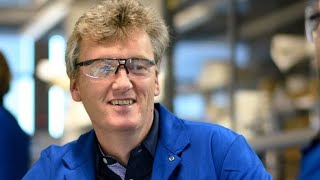
Nobel laureate David MacMillan traces his path from working-class Scotland to discovering asymmetric organocatalysis, which uses cheap organic molecules instead of metals as catalysts. His phenylalanine-derived catalyst achieved over 90% enantiomeric excess in the first organocatalytic Diels-Alder reaction. He later merged organocatalysis with photoredox chemistry to harness visible light, opening applications in pharmaceuticals and fragrances.
Questions this video answers
MacMillan explains that understanding the electronic properties (LUMO‑lowering, HOMO‑raising) of the catalyst relative to the substrates allows rational design; once you have a reasonable electronic picture, catalyst selection becomes more predictable.
He sees AI as useful for optimization and for formulating new questions, but stresses that AI can only do what humans ask; the exciting part is using AI to generate novel reaction ideas based on planetary resources.
He realized physics wasn’t his passion; after sampling many fields, organic chemistry resonated with him, and he advises following one’s instinctual excitement.
No; organocatalysis is powerful for many reactions but not all. Both metal and biocatalysis remain essential; the goal is to expand the toolbox rather than replace existing methods.
He suggests it may have seemed too obvious to others; they recognized a striking similarity and pursued an experiment that was “too easy not to try.”
Chapters
Thank you, Prof. Michelle, and thank you, Prof. Mulakaia. Please now welcome Sir David Macmillan, who will talk about the development of asymmetric organocatalysis and metallophotoredox. The Q&A session will be moderated by Prof. Sergei Kozlov. Sir David, please.
Thank you. Good morning.
Hopefully there's my slides.
It's great to be here to see this very enthusiastic, diverse audience.
It's a great chance for me to actually get this, to be here to be part of this conference for the first time.
Before I begin, I was going to start off by telling you a little bit about me, who I am. I know this is an audience that comes from a lot of different backgrounds. As you might be able to tell from my accent, I'm from Scotland.
Here's a map of where Scotland is, and I hope this is not insulting to you, but most people in America have no idea where Scotland is. So I always like to sort of show this on a map.
This is exactly where we are. For those of you who don't know where Scotland is, there's a really easy mnemonic. There's a really easy way to remember it.
It's always on top of England.
Okay, so that's really, really, really simple. However, where am I from? I'm from just outside of Glasgow, this tiny steelworking town. My father was a steelworker, my mother was a maid. And this is where I grew up, and this is the home in which I grew up. And I wanted to show this because I think this is also true of a lot of places in Singapore. I grew up in what's called a council house. A council house is where you rent the house from the government. And that's exactly where we grew up. And while we were working class and grew up in working class, we were an extremely happy family. So I always tell people we were working class, but we were very wealthy, wealthy people because we really enjoyed ourselves every single day. I love this photograph because you can tell it's easily the 1970s because of the wallpaper and the curtains are pretty, pretty unique. All right, now I was born in 1968, and you might ask yourself why I would show you these photographs. But after I won the Nobel Prize, the Nobel Foundation contacted me and said, "Can you send us photographs of you as a baby?" And I was very confused by this, and I said, "Why? Why would I do this?" They said, "We want to put them on our website." I'm like, "OK." So, I didn't have any photographs of me as a baby, so I contacted my sister back in Scotland, and she sent me these. These are now on the Nobel Prize website. And I think this is the greatest practical joke of all time, because I'm pretty sure that's not me. I'm pretty sure that's my sister, actually, who's very proud of the fact that she's now on the Nobel Prize website. OK, so when I was about 12 years old, my brother decided to do a pretty remarkable thing, and he decided he wanted to go to university, to college. This was very controversial in my family because no one had ever— we didn't know anyone who'd ever gone to university before. But he decided he wanted to go, and the day he graduated, he actually got a job that paid more money than my father, who was a steelworker. So immediately, I was told I had also to go to university so that I could make as much money as my father. So the decision to go to university wasn't really my own. To be honest. It was really those of my parents. But I was very fortunate that my brother decided to do this. Now, he received a bachelor's degree in physics, so I was told I had to go to university to do physics, and off I went to Glasgow to do that. But after about 6 months, I realized I really didn't like physics, and I wasn't very good at it. So I decided I had to make a change, and I decided to move over to chemistry. I really fell in love with organic chemistry, which I'm, I'm going to tell you about today. And this is actually my graduating class. It was an amazing experience for me because going to university, I got to meet so many different people from so many different backgrounds. And as much as an education in science, it was an education in sociology and meeting people, which was one of the most important things about going to college. So after doing this, I decided I had to go off and do a PhD. I was in love with the United States because I watched NFL, and I watched a lot of independent movies, and I liked a lot of groups that came from America. It really wasn't anything to do with the science, it was everything to do with moving to America. So I decided to use my degree as a passport to move to the States. Now, I applied to 19 different universities in America, I wrote to 19 different people, and only one person responded. And it was basically this gentleman I'll show you here. This is Hal Moore. And it was very fortunate that he did, because he said to me, "You cannot get a PhD in America simply by sending a letter." He said, "You have to fill out an application form." And that's exactly what I did. And I always love to tell this story about how much fortune there is along in everyone's lives as you move through your academic career. And this was very good fortune for me that he took the time to respond to me and actually send me this application form. So off I went to California, and that's where I began my PhD in 1990. OK, I'm going to come back to this later in my talk. That was me in a Jacuzzi, by the way. I thought I'd taken that slide out. But anyway, it doesn't really matter. But 2021 is when I received the Nobel Prize. And I received the Nobel Prize along with Ben List. And since receiving it, I've been asked an awful lot of questions. But one of the, probably the number one question I've been asked is, asymmetric organocatalysis, what on earth does this actually mean? So what I thought I'd do for you today is sort of break this down into its individual components. First of all, what is catalysis? I think most people here probably know what catalysis is. But one of my favorite ways to talk about this with either high school students or undergraduate students is to first of all point out that every single thing in this room, Every material, every substance, every single thing in my office, which is shown here, is made from a chemical reaction. And here are just some of those materials, and it's flashing through those different chemical reactions. And if I focus in on one of them, which is my coffee cup, which is shown right here, and if you look at the— this is the chemical reaction to make caffeine, the key constituent in my coffee. And as it happens, most chemical reactions require energy. Most of them are not spontaneous. And the way that we teach this to incoming chemistry students is we point out, we use these energy diagrams. And again, I don't try to make this too technical for people, but I always point out the way to think about these energy diagrams is imagine every night when you're walking home, you have to walk over a large hill that would require a lot of energy. If, however, somehow you're able to build a tunnel through that hill, that would make it much easier to actually get home every night. And that's exactly what catalysis does for chemical reactions. It actually makes reactions easier, faster, and probably more important, it actually allows chemical reactions to happen that were previously impossible, which obviously has very large implications. Now, if you're wondering, what is the impact of catalysis on the world? A variety of good ways to sort of demonstrate this. I'm going to show this with, first of all, just one chemical reaction. This is basically the population of the Earth over the last 2,000 years, and you can see it's pretty stable until the beginning of the 20th century. There's an inflection point, and it takes off to over 8 billion people. As it happens, you couldn't have 8 billion people on this planet without one catalytic reaction. The conversion of nitrogen over to ammonia. Why is that? Well, the reason is we need ammonia to make food, and without this catalytic reaction, you simply couldn't have 8 billion people. One of my favorite statistics associated with this is the fact that if you think about your body right now, you think about all the protein, the DNA, tissues, your organs, and all those nitrogen atoms that are in your body right now, 50% of them actually come from a factory in Germany. That's an amazing statistic from one catalytic reaction. Okay, now, 90% of industrial-scale chemical reactions use catalysis. 35% of the world's GDP is based upon catalysis. And as we think about solutions to the problems that we're going to face on Earth over the next few decades, that number is only going to increase. I'll just flash through some other ways in which catalysis is important for society here. I'm not going to go through them all. But I hope you can agree that catalysis is critical for societal impact. Okay. So that's catalysis. Next question, what about asymmetric? What does asymmetric mean? Well, this, as it happens, is really easy to explain to people who don't do this type of chemistry. For example, look at your hands and ask yourself, are your hands identical? To each other. They kinda look like they're identical, but it turns out they're not. They're not because they're mirror images of each other that are not superimposable on each other. How can I prove that to you? Well, for example, if I was to take the glove from my left hand, we know that it will nicely fit on your left hand. But if you take that same glove and try and put it on your right hand, it doesn't work. The right-hand glove does not recognize the left hand, and vice versa. Okay, now why is that important? Why do we care about mirror images? Well, the same phenomenon happens with organic molecules. So these are two molecules that are mirror images, but you cannot superimpose them on each other. And one of the most interesting aspects of this, if you go into a lab and try and differentiate these molecules, it's actually very difficult. Involves pretty expensive instrumentation. This would take about 20 to 25 minutes of time just to tell those molecules apart. However, if I was to take— this is my daughter, Emma, when she was 3 years old, back when she was a really nice person. And basically, even as a 3-year-old, she could even tell these molecules apart instantly simply by smelling them. So why is that? Why is it your body can tell them apart instantly? Well, it's because your body is made up— with effectively one mirror image and not the other mirror image. And as much as the way that your right-hand glove can recognize your right hand, but it can't recognize your left hand, your body recognizes these molecules in different ways. So as that happens, that has lots of really interesting implications. First and foremost of which is the pharmaceutical industry. As you might expect, it becomes really important to be able to make one mirror image of a drug molecule but not the other one. The other one is undesirable. It can be dangerous. It can be toxic. They can give you side effects. So how are we going to make this one mirror image? Well, we're going to take effectively catalysis. And so now this becomes known as asymmetric catalysis to make one without making the other one. OK, so far so good. Next question becomes, what does organo mean? OK, so I'm going to take you now back to 1996. And if you ask yourself, how could we perform asymmetric catalysis in 1996? There was two ways you could do it. The first way was to use biocatalysis, to use the enzymes of life, or from animals, or from humans to do this. And the second way was human-made. And this was based upon using metals which had been designed for the purpose to allow you to make one mirror image and not make the other one. So why 1996? Well, 1996 is when I finished my PhD working for this fantastic gentleman, Larry Overman. And upon completing my PhD at Irvine, I actually moved back across America to Harvard. And I went to join the labs of Professor Dave Evans. Dave, who unfortunately passed away last year, was— is a genius of our field. He's one of the, I would say, foundational scientists of the field of organic chemistry. And one of the things he absolutely was is a master in this area of asymmetric catalysis using metals. And here are some of the metals that Dave and his group worked on. And I joined his lab to learn about doing exactly this. And it was a, a really fantastic time. However, during that time, every single day I'd be involved with this contraption. So most of you probably know what this is. This is a glove box. It's a glovebox that has a different environment in the inside from our normal outside environment. Why is this? Well, it's because many metals are not suitable or could not be stable in our outside environment, so you have to keep them under argon or nitrogen for them to be stable. And after 2 years of working in this glovebox 8 hours a day, I started to ask the following question: Why are we spending so much time in a glovebox every day? This just seems unnatural as chemists that we have to do this. So with this in mind, you can actually look at a typical catalyst that would be used at that time, and even visually you can see you can break it right down the middle, and it's two— what looks like two different parts. On the right-hand side is the metal centre. And metals, in certain cases, but not all, but in certain cases, can be expensive, they can be toxic, they can be difficult to work with, and there's also sustainability issues. For example, right now, We only have enough palladium on our planet to last 90 years, which is also a really sort of scary number. At the same time, if you look at the left-hand side, this is the organic molecules. These are inexpensive, they're safe, they're sustainable, they're broadly available, and after you use them, they go right back into the life cycle, return back to us in a relatively rapid time frame. And as such, we can ask ourselves, what if we only use the organic part as the catalyst? And this eventually became known as organocatalysis. Okay, so 1998, I landed a job as an assistant professor over at Berkeley. And this is actually one of the first photographs I ever took of my group.
I, I love this photograph.
It's 10 past 10 on a Friday night, and you can see this young group in their first year, working hard, trying to make a difference, trying to have an impact. And you may ask yourself, well, what did we want to work on? Well, we decided we wanted to work on organocatalysis. Because we started to realize that this idea of using these types of catalysis would have all these advantages. They should be able to be available from nature's building blocks. They should not be sensitive to air and water, the same way we're not sensitive to air and water. They should be inexpensive. They're broadly available. You wouldn't have to work in these contraptions of these glove boxes. And they should be sustainable, right? They should be non-toxic. They should be recyclable.. And all of these things seem like sort of great aspects to this, but this was not the reason why I was mainly interested in doing this. The main reason was the concept, could we actually develop a way of using these organic catalysis or organic catalysts, not to perform one transformation or one chemical reaction, but to perform hundreds? Now, this was a pretty grandiose idea because at the time, I had absolutely no idea how to do that. Zero. So that was just wishful thinking at the time. However, in my first year, I was fortunate to have great graduate students. This is one of them, Tristan Lambert, who's now a professor at Cornell. And he actually came up to me one day and said, what is the mechanism of reductive amination? It's a pretty simple mechanism. As a young first-year professor, I ran to the board to explain this to him. And I said, you take an aldehyde, you take an amine, it reversibly forms an iminium ion.. And it's only when you trap the hydride, it's possible when it has this electronic configuration. It's basically activated to do that. And it was right there, right then, I had this sort of quintessential eureka moment. Because I said, wait a minute, if you think about this, if you take an alpha-beta unsaturated aldehyde and amine, that should reversibly form an iminium ion. And that looks awfully like a field of catalysis that uses metals. So if I show that in a slightly more conventional format, in this top case, using metals for what's called LUMO-lowering catalysis has been used for literally hundreds of reactions. The bottom case has been used for basically zero at that time. But if these are simultaneous equations, that means you should be able to use this organic catalyst to effectively perform, hopefully, hundreds of reactions. So at that moment, we decided we had to test this, and we had to pick a chemical reaction to test it with. And we decided to focus on the Diels-Alder reaction. Why the Diels-Alder? Well, Diels-Alder deservedly won the Nobel Prize in the 1950s for allowing you to take relatively simple starting materials, and with great predictability, make relatively complex molecules you could use for drugs, for materials, etc. So this looked like a great benchmark reaction to employ. And this notebook page is exactly the first time we actually ever performed this. Those are the two start materials. Those are organic catalysts over the arrow. And if I scroll through this and go to the bottom, the result here, I hope you can see that, it says not racemic. Not racemic. What does that mean? Not racemic means it makes one mirror image in preference to the other one. So this was extraordinarily exciting. I remember basically leaving the lab, going into my office, closing the door, closing the blinds, and then I jumped up and down for about 5 minutes. And I called up my wife at the time and said, "You won't believe this, but I think we're going to get tenure." And at the time, tenure was an incredibly important thing to an assistant professor. It was probably the number one thing we were thinking about, even more than the reaction itself. But when my feet got back to the ground, I realized that this number, this meant 48% ee. This meant a 48% excess of one mirror image over the other one. And if the chemistry community was going to take this seriously, this number had to be about 90%. So we're faced with a dilemma. Would we publish this, or would we go for the gusto and try and get a catalyst that would give us that 90% number? We decided to do the latter. And eventually, we came upon this catalyst. And I really love telling this part of the story. Because this catalyst is based upon phenylalanine, a building block of life, which is combined with acetone. Acetone is paint stripper. So you can see how inexpensive and available this catalyst would actually be. But more importantly, when we actually first employed it, you can see the transformation now gets to this 90% EE number. So that was really, again, very exciting. Okay, so at this stage, you have to publish this paper, you have to announce it to the world.. And as a young assistant professor at the time, I always sort of get a chuckle when I sort of look at this first paper.
Because you can see this sort of excitement that we have in this paper.
The first thing is we came up with a name for this area. We called it organocatalysis. And you may ask yourself, well, what's in a name? Is a name important? I can tell you that naming things or vocabulary around science is extraordinarily important. So for example, Jean Jacob Berzelius, who was a Swedish scientist, chemist. He actually came up with the term catalysis as well as protein, polymer, isomer, organic, inorganic. He named all of these things. And the importance of naming things for the field, the vocabulary, has carried forward into the modern era. Directed evolution, machine learning, AI, nanotechnology, organocatalysis. These are all words that help you define fields and in many ways actually help you draw in other scientists. But more importantly, in this first paper, we introduced the concept of a generic activation mode. And you might wonder, what is a generic activation mode? But that's just simply a technical way of saying this should work for hundreds of reactions instead of one reaction. Now the problem with that statement and putting it in our first paper, we'd actually only performed one reaction. We hadn't actually performed any more, so this was a little bit of a bold statement to begin with. And when we went off to test it, we went bang, bang, and it stopped. We got 3 reactions. We told the world we were going to do hundreds. We got 3 reactions. So again, this was a pretty scary moment. We had to go back and think about the catalyst involved. And when we did so, I was really fortunate to have 2 fantastic young graduate students by the name of Joel Austin and Chris Borges, who basically performed what I would call precision molecular engineering. What I mean by that is they effectively took away 2 carbons here and introduced 4 carbons there in a slightly different shape. And they stated that they felt this should be a general catalyst, meaning it should work for many reactions. Now, I call this precision engineering. And whenever I give talks to non-scientists, I always try and sort of convey what does this mean to another way of looking at the world. And the way I always do this, because I'm a big football fan, I always say this is very similar to, for example, precision athleticism, which gives amazing outcomes. And this is Zlatan Ibrahimović, a very famous superstar football player. And I always do this by showing this following goal. So this is this goal. He does this overhead kick. It's incredibly precise. Just a fantastic goal. Just an amazing goal. Okay, now many people have criticized me. I actually put this in my Nobel lecture. And many people criticized me and said, yeah, 'You only put this in because this goal was scored against England.' And I think that's actually really, really unfair. But let's watch it again. All right, so this is actually an amazing goal if you think about it. And actually last year Zlatan Ibrahimović gave me a uniform that he signed for me, so it turns out it was fantastic. But the bigger point here is, can you actually use this precision engineering to have an impact? And so this was our original catalyst. It gave us 3 reactions. When we move now to the second-generation catalyst, it literally led to hundreds of reactions which were now successful. And in fact, Jorgensen and Hayashi came along, and they were able to show that using this other catalyst, you could expand this even further, which was really, really wonderful to see. OK, so what different aspects of this become important? Well, one of the things that we realized What we had performed here was a thing called iminium catalysis. There was another area called enamine catalysis, which Ben List, the co-recipient, received the prize for. And we started to think, was, is there ways that you could start to combine these types of catalysis together? You might ask yourself, why would you want to do that? Why would you want to have two different catalysts going on at the same time? But you realize that nature does this all the time. Nature has these biocatalytic cascades that also are beautifully sequenced together. To generate complexity from incredibly simple starting materials. So we said, well, enzymes are organic molecules. Maybe we can take these small organic molecules and do exactly the same thing. So this was the idea. Could we take these relatively simple starting materials, and could we now start to sequence them in multiple catalytic reactions? And the hope here is that we're going to generate a much more complex molecule than that that we actually began with. And when we did it, it turns out it worked. And it worked beautifully. And it became an area in and of itself called cascade catalysis. And so whereas many years ago, you'd typically see one catalytic reaction in any given chemical reactions, now you see ones that have 5 or 6 different catalytic reactions all going on in a reaction vessel. Nature's known how to do this for forever. But we are now, as a community, figuring out how to do this to increase efficiency. In this case, we actually used this to make strychnine. This was the fastest known synthesis of strychnine, which you probably know as rat poison. You probably wonder, why did we want to make rat poison? Well, strychnine for organic chemists is a very famous benchmark which people use to sort of evaluate their technologies in terms of how quickly you can make it. And this was the fastest known asymmetric synthesis of it. So what other reactivity can you get? From organocatalysis. And what we've been able to do, we're very excited to do, was to actually start to think about, could we come up with other types of catalysis to merge this with? And one that was really exciting to us was, could you actually start to take the principles of harnessing basically solar energy? So using visible light. Inorganic chemists over the last 5 decades have really done a phenomenal job in thinking about how to capture solar energy to try and power the planet. And they've developed many catalysts that allow you to capture that energy. And along the way, have delivered some really fantastic fundamental concepts. And we started to think, could we take those concepts and now move them into organic chemistry? Now, with the idea of thinking about, can you accelerate the production of drugs or materials and so on and so forth? And this led to the development of photoredox catalysis in organic chemistry.. And in and of itself has really became an area which is as large as organocatalysis. And also makes for some really pretty videos along the way, as you can see here. So, but we were really fortunate because this field of organocatalysis which began really led, at least in our lab, to the development of photoredox catalysis, which was something, again, which is really valuable, we felt, and important to be able to see. Okay. So, the other major question we're often asked are, what are the applications of this type of organocatalysis? I'll show you 3 that we pretty much thought of early on. I'll show you one we didn't actually see coming. The first one is for flavors and fragrances. And you might wonder, fragrances, does anyone really care about fragrances? But if you think about the volume of fragrance that's actually produced on the planet Earth every single day, is absolutely enormous. And if you can change the way that you go about making those, that can actually have a reasonable impact. So Firmenich, which is a Swiss company, they actually worked with us towards the idea of, could we use this to make a perfume they make called Lily of the Valley? Previously, this had been made on 6 chemical steps, and we could now actually make it in 1 chemical step, now from using basically biomass,, and combining organocatalysis with this photocatalysis to do it in one chemical step. And in fact, Firmenich now in Northern India make a variety of rose perfumes which on very, I think it's 400 to 800 ton scale, using organocatalysis as well. One other way that people have sort of thought about, I'd say one prominent way that people have now really used this though has been for the pharmaceutical industry. The pharmaceutical industry has heavily adopted organocatalysis, not just for discovery of new drugs, but actually for the manufacture of them. This is talcedipant. I think it's 5% of the world's population basically suffers from migraine. And what was exciting about this was Merck actually were able to make this single mirror image by using exactly the technology which I talked about at the beginning of my talk. About 2 months ago, I was over at Merck, and they actually showed me that they've now a new cancer treatment that's coming online, which actually uses 2 organocatalysis processes in combination with 2 biocatalysis concepts to drive the production of that molecule. Which was really beautiful to see these various branches of asymmetric catalysis coming together to actually make some of these, some of these molecules.. Okay, now the, the part we did not see coming, however, was this idea of democratizing catalysis. What does that mean? Well, it basically means that organocatalysis is extraordinarily inexpensive. It's very, very cheap based upon the materials you actually use to make it. And as a result of which, it's now basically used to teach asymmetric catalysis all over the world, as well as allows you to drive research in all continents around the world. And one of my favorite parts of this is it turns out it allows you to do asymmetric catalysis regardless of the resources that you basically have available to you. And people often ask me, what do you think is going to be the next big thing in organocatalysis? And I always say, I actually don't know. But one thing is it won't be based upon who has the most funding, the most money. —will be based upon who has the best ideas. And for someone like myself, that really aligns well with my values. And that's why I was really proud of the fact it's been able to achieve this way, or allow people to start thinking about asymmetric catalysis in this context. So what does the future hold for organocatalysis? Well, I think one aspect of this, which is very important, we're obviously moving towards 8 billion people. We have now reached 8 billion people. We're going to keep increasing.. And we have to think about even adopting other ways of continuing to achieve sustainable catalysis. And these are things such as organocatalysis, biocatalysis, photocatalysis, electrocatalysis. But while I started out telling you that we really wanted to avoid metals, there's also a big chapter of this that's going to involve using base metals. Metals that are widely available. And can we actually teach those to effectively function the way that precious metals do? To. So that's going to be very critical for our planet as well. All right, so I'll finish off there. Oh, I just realized that I think someone's launched the wrong talk. See if I can exit out here and get to the—
yeah.
Fortunately, I have the talk here. And I basically just want to finish off, but I think it's an important point I want to finish with. I want to finish by thanking my family. I think we're all scientists, we do this because of our families. This is us dancing on the— basically on the Harbour Bridge in Sydney, down in Australia. And one of the things that I've learned in academia, academia is amazing because it lets you work with fantastic people, allows you to work on your own ideas. But it also allows all of us to travel the world and get to connect with each other, which is obviously what we're doing today. So I wanted to sort of point out to the audience, and this is beyond the talk, but academia really is a fantastic profession. And I hope that people sort of understand how important it is that we continue to get people like yourself to be part of it. I also want to point out that after I received the Nobel Prize, we took the award money and we created a foundation. And it was a foundation to basically give all the money to charitable causes that will allow underprivileged students to get to college. This is something that's very close to my own heart, but it's also something I think is really important right now, that we do care about people who don't have opportunities. What you do with your opportunities— Thank you very much. I was actually just going to say, what you do with your opportunities. Everyone knows it's up to you what you do with your opportunities. Opportunities, but getting opportunities is the hardest part. And then finally, I just wanted to say, getting the opportunity to talk to people like yourself. And one of the things about the Nobel Prize that's been amazing for me at least is, and through Zoom you can talk to people all over the world, and I've been able to talk to lots of different high school students over the last year and a half, and that's been utterly fantastic. But one group I got to talk to, and I think all the Nobels were involved with this, was the idea that the Ukrainian ambassador to the US contacted me and said, would I talk to displaced Ukrainian students? And I said yes, but I realized I really couldn't imagine or identify with what these people were going through. So I was extraordinarily nervous to sort of give this talk. But when I talked to them, the thing that absolutely blew me away, it was completely profound, was the fact that how excited they were about science and talking to me and how jazzed they were. And for myself, imagining what they were going through, the fact that they were so excited about science is one of the sort of most, to me, heartwarming things I could ever, ever imagine. So I don't know if my talk had any impact on them, but it had a massive, massive impact on me. So I hope I can answer some of your questions at the end of this, and I just want to finish off by thanking you very much.
Thanks a lot. May we now invite Prof.
Kozlov to moderate the Q&A session. So thank you for a very inspiring talk, Professor MacMillan. So now we have time for a few questions. And I see there is a gentleman there.
So maybe you could start with the first question. Yes. Good morning, sir. Thank you very much for your wonderful talk. I'm also doing organic synthesis when I was doing my PhD. What makes organocatalysis very fascinating to me is that the catalysis itself looks like a substrate. Yes, because they have functional groups that could also somewhat interfere with the reaction. So when you're trying to develop organo— or trying to choose organocatalyst, what makes a good candidate for, let's say, how do you choose which type of organic catalyst you're using, especially if the structure becomes more complex?
Yeah, it's a very good question. One of the parts about this which was really eye-opening to me, and if I refer you back to the part where we did this cascade catalysis, and where you can now have 4 or 5 different catalysts in the same vessel. When we first started out, we thought that would actually be almost impossible, because we assumed all of these things would simply all interact with the same things. But obviously chemistry is far more complex than that.
And when we actually tested it, they didn't.
So you started to build up this picture of the electronics involved and what was actually going to be LUMO lowering, HOMO raising. So you realize it's all like biology, based on equilibria that's going on. And as long as you can control the electronics, it actually turns out to be far more straightforward than you would have ever imagined. So as long as you have a reasonable appreciation for the electronics of your catalyst, versus each other and the other molecules you're working with, it's actually much more predictable and much more straightforward to design at the beginning.
Follow-up question. Would you say a computational type of development, or let's say AI, or with the machine learning in trying to model the molecule with electron density would be the somewhat future of this field?
Yeah, I mean, potentially. I mean, I think we're at this inflection point with AI where we now think it's going to solve all of the world's problems tomorrow and we don't have to do any thinking. I think that AI is going to be extraordinarily important. Right now, AI, the way it's being used in chemistry, the way most of it's used, is for optimization, which is really important. But personally, I don't find that as intellectually interesting. But one of the things I do think which is really interesting with AI is, can AI help you ask questions?
Can it—
if you think about it, AI can only do what humans ask it to do. But if you can actually think about using ways for AI to question what are the reactions we should be trying to invent based upon the resources we have on the planet right now, I think that's a more interesting question. And then either through human invention or AI development, you could start to address some of those problems. So I think for me, that's where I see more excitement around AI. And I've talked to Demi at DeepMind about this, and there's a lot of interest in moving forward with how do you think about the questions as much as you think about the solutions.
Thank you very much. Thank you. This was a very important question and a great answer, of course. So I see there is another question from the audience, so please go ahead.
Thank you for very interesting presentation. My name is Joshua Elkington from Thailand. So just a question from your bachelor, because at first you entered to the physics and you moved to the chemistry. What is the inspiration or motivation that pushed you to study about the organic chemistry?
Yeah, you know, I think everyone has different experiences in this regard.
For me, and this is one part I always try to tell people, is You have to find your own passion in life. So when I started doing physics, I realized that I really— while it's an incredibly interesting area, it wasn't really good for me. I wasn't enjoying it, and I don't think my brain is abstract enough to actually be successful in physics. But my brother did, and he loved it. But I realized I was doing it because my brother did it. And so along the way, I sort of figured out I had to find what I like. So I think it was really important to sort of sample lots of things and try lots of things. And then find the part that to you goes, wow, that's cool. I really like this. And for me, that was organic chemistry. So even other parts of chemistry I wasn't particularly good at or excited about, but organic made an awful lot of sense to me. And I think that for me was a lesson in life that when you find those sort of passions, it's good to sort of go in those directions if you can, if you're afforded those those chances. So ultimately, the take-home for me was like just finding what you're excited about and following that instinct is really, really important.
Thank you very much. Thank you. This was a nice question. And before we go to the next question, let me ask one question asked online.
So the question is, do you think organic catalysts will mostly replace metal-based catalysts in the future?
No, not at all.
So this is a question you get all the time. And I think sometimes as humans, maybe not as scientists, but we sort of get into these binary situations of yes, no, yes, no. And can we replace everything with one thing? Or can we replace— and so the question is, is organocatalysis better than metal catalysis, better than biocatalysis? And what you realize along the way is what you're doing is you're sort of developing really, hopefully, valuable tools. For being able to address almost any problem. So from my perspective, organocatalysis is extraordinarily useful for a whole range of chemical reactions. There's a whole range of chemical reactions it's just not useful for. And those are ones that metals will be uniquely valuable at doing. So I think what we have to do is be able to understand and be comfortable with building up areas that are useful and continuing to think about new areas of catalysis. As well. If you think about all the societal issues that we're facing as we move forward, those will require not just new catalysts but new areas of catalysis if we're going to be successful. You don't want to sort of sit or rest on our laurels of what we have right now.
We have to actually think about new forms of reactivity. Oh, thank you. That's very important. Okay, so maybe we can proceed with the next question from the audience, please.
Thank you for a very clear and engaging talk. You've described an eureka moment in your career where you were able to spot the similarity between organic compounds and metal-based catalysts. My question is, what do you think made you spot that similarity, and what prevented other scientists in the field from spotting that?
Yeah, I mean, I think that's a question a lot of Nobel winners get asked, actually. What made you see something that other people didn't see? And we're exactly the wrong people to ask because we don't know why we saw it. We saw what we saw. And I think it was along the way, probably my guess is it was, in our case, it was something that maybe other people thought was too obvious, that it was too simple. Maybe this is, or if that would work, someone would have found it by now sort of thing. At least from our perspective, we looked at it and thought that looks so unbelievably similar that we had to examine that really quickly. I mean, it would be crazy not to. And I always say in my group, it's an experiment that's too easy not to try. And so you have to do it. But knowing why no one or other people didn't do it is a tough question because obviously we were able to spot it.
Thank you. And we have another question asked online about the impact of scientific work. So the question is, did you deliberately work on your science communication skills, or are they a product of experience and personality? And maybe you can connect, comment on the importance of scientific communication.
Yeah, I mean, it's kind of funny, you know, a lot of people say to me a lot of the time, you're, you're decent with scientific communication, and that's helpful. It's kind of funny, I actually look at young people nowadays, and young people are spectacular at communication. When I watch my group and I watch probably the vast majority of people in this room give talks, they're amazing. And it's clearly become the case that you have to be good at— your science has to be good, but given all the noise which is out there of people talking about the chatter about what they're doing, you have to have good scientific communication skills if people are going to hear what you're doing. It's one thing to do something that's valuable. It's another thing for people to actually know about it and care about it. And I think communication skills becomes really important. But I do think this age group which is in front of me and the group I work with, the communication aspects of it have really been elevated enormously. I do think it's important. I think to be able to take an audience along is really very critical.
I grew up in Scotland.
And Scotland, your entertainment would be you'd go down the pub and you'd drink beer and you'd tell each other jokes. That's what you do. And so you become from each other's form of entertainment. So you have to learn to be able to communicate with each other. That's what you do. You have to take the audience with you to a certain extent. So yeah, I think it's a function of where I grew up as much as anything.
Oh, thank you for this answer.
And oh, we have another question from the audience. Please go ahead. Hi, this is Zainab and I'm from UCSF University. I would like to ask us as young scientists, sometimes during our research We find a method and we expect a good result from this method, and then after implementing it, we face failure or we face shortage of results. So what I want to ask is, through your study or experience, you were expecting hundreds, more than hundreds reactions, right? And then at a certain point, you only got 3. So I want to know How did you face this situation or this point of your life as a researcher or as a scientist?
Thank you. I think I faced it with panic more than anything. I think I was very scared at that moment when everything stopped working. I think, you know, for researchers though, I mean, that actually is the number one question that I get asked. I'm not sure about other folks in the audience, but that's the number one question. How do you deal deal with failure. And I think as scientists, we all deal with failure. And we're not great at talking about failure, but we all know we all sort of have to work our way through it. I'm a big fan of this very cliché statement that failure is just another word for experience. You learn from failure. You learn the things which do things, and you build up concepts and ideas from the failures. You start to realize how more intricate and nuanced things are. And from that information, you build. So failure is important. Number one, it's important because it teaches you lots of things. It's also important because when you have success, you need the failure to really enjoy the success as well. But ultimately, I think all of us sort of believe in, you know, this idea of science. We can get to exciting new things. That's why we're all here, right? And so even when you're dealing with that failure or that lack of success, If you believe that this concept should work and there has to be a way to make it work, I think that in ourselves provides motivation to just keep driving forward, keep driving forward.
I think that's what pushes all of us. Thank you.
Thank you.
And I think this was a very inspirational Q&A session. Thank you so much for your time.
Yeah, let's thank the speaker again.
More from Joshua







Scientist Stories: Hans Waterham, The value of phenotypic assays in peroxisomal disorders




Scientist Stories: Joel Zlotogora, Genetic carrier screening programs for reproductive purposes