Scientist Stories: David MacMillan, Progress with Science
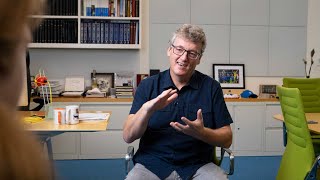
Nobel laureate David MacMillan discusses the art of being a scientist, from the visibility of winning the prize to his core love of hands-on chemistry. He spent 17 years developing an alcohol-alcohol coupling reaction for building complex molecules, and now focuses on catalytic CO₂ mineralization as crucial for addressing climate change.
Chapters
Good morning, everybody. My name is Adam Smith, and it's my very great pleasure to be your moderator for this morning's discussion about the art of being a scientist. As you know, you'll be meeting David MacMillan, Maybrit Moser, and Serge Haroche, listening to some of their lessons from their lives in science, but also discussing with them what it takes to be a scientist. And I'd like to Thank you all, particularly for being here. It is absolutely marvelous to see this huge audience of young scientists. It's a, it's a joy to be here with you. The morning will be divided into two parts. First, you're going to meet the laureates individually. We'll have a conversation with David Macmillan, then Maybrit Moser, then Serge Haroche, and then I'm going to bring all three up on stage for a big discussion about the responsibilities of being a scientist and perhaps the qualities that you need to be a successful scientist, whatever a successful scientist is, and we'll also discuss that. So to start, I'd like to invite David McMillan to join me on stage, please. Please welcome him. David, you were awarded your Nobel Prize in 2021. You're the most recent of our laureates. It's all quite fresh. You were awarded during the pandemic when things were a little odd, and you weren't perhaps asked to move away quite as much as you are now. But you run an extremely active research lab. You've got, what, 45 people in the lab? How's it been? How's it been these first 3 years?
How's it been? It's been Crazy. It's been crazy. To win a Nobel Prize is crazy. It's one day you're a chemist, you work in your lab, no one really cares. And then I remember I tried to have a Zoom call with my friends the evening before I found out I won. No one wanted to have a Zoom call. And then the next day, everyone in the world wanted to talk to me. It was the strangest, strangest thing. So it's been incredible, amazing, surreal. But I think at the end of the day, it feels honestly like an incredible privilege because you get to meet so many people, you get to have the chance to talk about what other people are doing in their science, and people want to talk to you. So it's been incredibly fun. But at the same time, you know, you still are asked to go around and talk to people about, for example, the value of science. Around the world. And you suddenly realize you're also on some level, you're asked to take on a responsibility to be an ambassador to a certain stage, which is something I've learned to take very, very seriously. But the last thing I've found, and it took me maybe 1 year to realize this, deep down inside, I'm a scientist, I'm a chemist, I love doing chemistry. And so getting back to what I do first and foremost, Being in the lab, doing great science, being excited about hopefully having an impact, that's been the number one thing. So if anything, it sort of taught me also what I truly, truly love about what I do, even before I won the Nobel Prize.
That's nice. It's reminded you. Yeah. And I suppose, yeah, doing great science is all about knowing what your priorities should be and sticking to the goal.
Right. Yeah.
Do you find that it has interfered with research?
Yeah. I mean, as you mentioned, I have a group of 45 people, and here I am in Brazil enjoying Rio de Janeiro and enjoying São Paulo and having fantastic caipirinhas. And so yeah, it interferes, but it interferes in a very, very positive way, right? Because the vast majority of things you're asked to do is to broaden or explain what it is that you're doing to people, or what it is, the science you're doing. So although it interferes, you learn how to be that and live with that. So it's very exciting. So if I'm in lab and I'm doing some really things which are fun, that's great. But when it's sometimes you face adversity, then you can go and have a trip to Brazil and it's really wonderful. So yeah, there's nice interferences as well.
We have this sort of conversation with laureates all around the world in front of audiences of young scientists, and today we've called it The Art of Being a Scientist. Sometimes we call the session How to Make a Scientific Impact. What would— how would you— if we, if we take that phrase scientific impact, how would you define scientific impact?
Yeah, that's a tough one. Scientific impact, there's various ways you can have an impact. The first way is fundamental, fundamental research. You might do something that no one seems to care about, and then 20 years later, it's incredibly important to everything that's going on around the world. And, you know, in chemistry, we have many, many examples of that. But there's other impact where I tell people, I tell people in my group that they can invent a reaction on a Monday, and by Friday, people in pharmaceutical companies are using that chemical reaction.. And when they realize that's happening, they get very excited because they suddenly realize this small world that they think they're in actually reaches out to this much, much larger world, and people really do care about what it is that we're doing. So impact is really important in my opinion, whether it takes a small amount of time or a long amount of time. But ultimately, having an impact, I do think, is important for science. It's the part that reminds us why curiosity and learning and thinking actually impacts us all as a society. It has that impact.
And of course, you were awarded your Nobel Prize for the impact of asymmetric organocatalysis on the world in general. But when you were undertaking the research, when you were going down that path, what impact did you have in mind? How did you think of what you were trying to get done?
What did I think I was trying to get done? Well, I'd just become an assistant professor at Berkeley in the US. I'm Scottish, so I was in America. And when you become an assistant professor in America, you get 6 years to get tenure. And if you don't get tenure, you lose your job. So the impact I was hoping for would— I would get to keep my job. That was my first impact that I really cared about. But ultimately, what I was thinking about was more— I was looking at the way we were doing all the things that we were doing. And asking myself, okay, the way that chemistry works in this one area, everyone does it this way, does it make sense? And some of it made sense, but some of it seemed sort of strange to me that we were doing it in this bizarre way. So I started to question, is there other ways to do it? Is there other ways you can think about it? And that's when we started to have ideas about going in this completely different direction. So when it worked, the impact was I was happy, I was satisfied, I'd convinced myself that we could possibly go in a different direction. Did I think that the world would jump on to that direction? Not necessarily immediately, but fortunately, that's exactly what happened. We were very fortunate, very lucky. You have to be lucky as well. And through being fortunate and everyone sort of jumped onto that area, it grew and grew and grew, and just the excitement kept going with it.
I mean, so for all the young people in the audience who are thinking about how to choose their questions, choose the direction. What you've just described is this balance between stepping back and thinking, what are people doing wrong, what's missing, and the extreme focus of just saying, okay, now I need to— I've chosen the question, I need to pursue it. How do you get that balance right?
It's really, really hard, especially when you're a young person. Uh, you know, I, I sometimes say this, and I can say it now because I'm a Nobel Prize winner, but sometimes, you know, it's incredibly important to have funding agencies for all of science. But sometimes funding agencies themselves are great, but sometimes reviewers for funding are difficult because reviewers are often looking for things that make sense based upon what we already know. And sometimes young people want to go in a completely different direction that makes no sense compared to what we've already known. And unfortunately, it's difficult to get funding to do that. That's the, that's the problem. And so we end up doing the things which make sense instead of the things which are more unusual or higher risk. And that's the real balance, I think, for a young person. They have to try and sort of walk that where they can make sure they have the resources to do everything they have to do, but also have this component of what they're doing which is definitely high risk or definitely different enough so that they feel if this works, they'll be really excited about it. And by extrapolation, everyone around them should be really excited about it too.
That phrase, they should be really excited about it, is that the test of a good high-risk project, that it's just you want to do it?
Yeah, I mean, I think we were talking about this the other day, and my internal guide for this is about every 5 to 10 years, I have an idea and I think, wow, that's really cool. That's really cool. And people will say, well, what does that mean, it's really cool? And I say, I don't know. I don't know. It's just, it's cool. I just can feel it. It seems really cool. So at the beginning, you're always trying to, it's all about you subconsciously or consciously sort of feel this feeling that you inside yourself are like, I am really excited about this. This is gonna be something. If it works, I'm just gonna be so happy that it works. And it's number one, it's kind of for you. It's kind of this internal thing that you care about. But if you care that much about it and you have that feeling about it, typically it's the case that everyone around you, when they see that idea, is going to feel the same way. So it's a really nice internal metric. Is it cool or is it not cool?
Is it cool? That's a good take-home message. During today's sessions, I really want to bring in lots of comments and questions from the audience. It would be really nice if those comments are short. So it can be a question, comment, whatever you like, but keep it short. It can be in Portuguese or English, as you wish. We have devices to translate here. And I'd love to start now. If anybody would like to ask a question of David, we have another 9 minutes or so of David on stage. Feel free. You don't have to, but if there's anybody— there's a hand up there. Is there a microphone that could reach you quickly? As I say, let's keep it all moving, so keep it quick and short. Go ahead, please. Just tell us who you are very quickly and then—
Good morning, it's a pleasure to be here and to ask the question. My name is Rafael. I do maths here in University of São Paulo, and I would like to ask if you ever thought about giving up and how do you overcome it, you know?
Everywhere we go in the world, that question comes up right at the beginning.
Yeah, no, it's, it's, it really, I always tell people also, you know, after I won the Nobel Prize, the number one question you get is, how do you deal with failure? I mean, it's a weird question to ask someone who just won a Nobel Prize. How do you deal with failure? But it's what you do. As we know, as scientists, we deal with failure much more than we deal with success. And so the question of giving up There are those days you're like, why am I doing this? This is like hitting my head against the wall constantly and getting no reward. But then there's those days when it works. There's those days when it works, right? My favorite thing in the world, you know, when a student and, you know, you've been working on a project for a while, it's just not working, and then a student will walk into your office, usually in chemistry with an NMR, and say, "Can I show you something?" And when a student says, "Can I show you something?" it usually is not something bad, it's usually something very good. And when that happens, and I'm getting sort of goosebumps even talking about it, it's the most amazing feeling in the world, because you suddenly realize that this piece of knowledge that was unknown to the world on a Tuesday is now going to be known forever on a Wednesday. And that's the most— I just— that to me is one of the most stimulating things about science, is how we're continually contributing. Everyone in this room who does science is continually contributing to what society is going to benefit from. So while there's certainly days you think about giving up, there's those amazing days where you're just like— you feel on top of the world just because you've been part of this process of giving new knowledge to the world.
It's wonderful. But when you don't have a lab and you're all on your own and your NMRs just keep coming out wrong, how do you get over that feeling that it's just never going to work?
It's funny, when I was at Berkeley, we bought this very expensive piece of equipment for my group when we first started. And every day I would go to this piece of equipment to see the result, and every day it failed, failed, failed, failed, failed for 6 months. And one day I walked in, a piece of equipment, there was the— took out the thing, and there was one peak, and something was working. It was working. And I ran around my lab and said, whose is this? And it turns out it wasn't from my lab. Someone from a different lab had borrowed the machine. And it was that moment of like, oh my goodness, is we ever going to succeed? But you realize you just have to go back, and you have to keep going— a piece of paper or a a blackboard or a chalkboard, and you just have to keep your enthusiasm for, you know, at the end of the day, you're going to get there. Going back to the failure question, we fail much more than we ever succeed. We know that, we accept that. We're amazing at dealing with failure. That's what scientists do. But at the end of the day, we know if we keep going, if we keep going, we will reach, we will definitely reach somewhere that will be valuable.
Thank you, Rafael. It's such an important question.
Thank you.
Do we have another one? Oh, there's one just here. Sorry, I know I can't see everybody, so I apologize if I'm getting it wrong, but there's a lady just here with her hand up. Quickly get her. Sorry, I'll try and get everyone.
Thank you. Oh, hello. My name is Flora. I also study here in University of São Paulo. I study chemistry. And well, you talked about like the coolness factor of an idea. And I would really like to ask like a simple question. What is the coolest idea or reaction that you've worked on or researched? Like, I'm just curious.
I'll try and give an answer which hopefully won't be too technical. But we've worked on a lot of different things. And there's lots of things that I love. And all the things you work on are like your children. You love them all equally. However, we recently published a paper last month on a chemical reaction that took us 17 years to solve. And I've been talking about this reaction for 17 years to the point all of my colleagues, all of my students are so bored listening to me talk about this one chemical reaction. But we finally solved it, and we published it, and the response from the community was fantastic. And it was such an amazingly satisfying thing thing, not just because of the response, but because it was one of those things that you always wanted and you think will be valuable. And now you see all these people actually in pharmaceutical and agrochemical who are already using that chemical reaction. So for me, that's something which was just— it was because it was so hard fought for along the way, it was something I thought was extremely cool.
But for Flora the chemist's benefit, you better say what the reaction actually was.
So what it is, around the world, there's all these molecules that exist. They're feedstocks, they're widely available, you're not using up biodiversity by using them, and they're called alcohols. And not just the alcohol you drink, other alcohols. And they're so abundant, but nobody really knows how to remove the oxygens and get them to couple with each other. But if you can get them to do that, you will dramatically accelerate, for example, how you can find new molecules for medicines. And it's such a crazy reaction, no one in the world was even really thinking about it, never mind working on it. And we've been working on it for a long time, and we finally, finally got there. So now you can make all these new molecules really, really quickly by taking these alcohols, and they only react with each other, which is the other super cool thing about the whole thing.
And what would be, in case anybody's listening, the coolest reaction to do in the world, in your opinion?
The coolest reaction— well, I don't know if it would be the coolest reaction to do in the world. It would be probably the most important reaction to do in the world right now is mineralization of CO2. I always tell people we're one catalytic reaction away from solving climate change. And there's an enormous number of alkali metals which exist in our world, and they slowly absorb CO2 to become carbonates. That's the way the world basically— one of the ways that it removes CO2 from our atmosphere. But it takes a long time. It takes hundreds, if not thousands of years. And if you can accelerate that process through catalysis, right now, it would easily be the world's most important chemical reaction. And a lot of people are thinking about it and trying to do it, and I'm optimistic it's going to work, but it is the most important reaction.
Any ideas in the back of your head? Not that you should say them if you have them, but—
Yeah, yeah. I mean, the way that you're going to be able to do that, it's going to be based around— there's two different approaches. You could potentially use a biocatalysis way of doing it, but you also could do this using using different types of abundant metal catalysis to do that, which is quite ironic because it's the opposite of what I got the Nobel Prize for. But it would be an absolutely fantastic chemical reaction.
But what it also shows, you talking about it, is that you need to keep this perspective on your science. You know, again, it's, it's the broad view and the narrow view, and somehow doing that. Right. It's been an absolute pleasure to talk to you. It is ridiculous to have 3 different laureates to talk to on stage. I mean, one, one is just wonderful, 3 is so much. It's fantastic. Thank you very much, David. We'll meet you again in a few minutes.
More from Joshua







Scientist Stories: Hans Waterham, The value of phenotypic assays in peroxisomal disorders




Scientist Stories: Joel Zlotogora, Genetic carrier screening programs for reproductive purposes