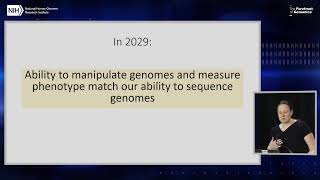
In this talk, Emma Farley outlines the current state of genomics, emphasizing that after 15 years of sequencing the human genome we have amassed massive sequence data and a suite of functional assays (RNA‑seq, ChIP‑seq, Hi‑C, single‑cell methods) that annotate genes, regulatory elements, and chromatin states. Despite these advances, she argues we still lack a mechanistic understanding of how genomic parts generate cellular function and how specific variants cause disease. Farley identifies three critical challenges: (1) decoding how the genome encodes function, especially linking enhancers to target genes; (2) moving from association to pinpointing causal variants across diverse genetic backgrounds; and (3) expanding genomic diversity by sequencing under‑represented populations. To bridge the gap, she advocates a paradigm shift from merely reading genomes to writing and manipulating them at scale, leveraging CRISPR‑Cas technologies, massive functional screens, organoids, and model‑organism biobanks. She makes three concrete 2029 predictions: (a) a consortium‑level effort will have systematically mutated every gene and regulatory element, including previously inaccessible satellite regions, across multiple cellular contexts; (b) systematic functional testing will become standard for all disease‑associated variants, enabling reliable identification of causal variants; and (c) the first synthetic human chromosome (or full genome) will be built, providing a switchable platform to interrogate any annotated element. Farley stresses the need for standardized, biologically relevant assays, open‑access tools and data, and creative model‑system choices, envisioning future therapeutic genome‑editing trials that both treat patients and generate functional insight. The talk concludes with a call to the community to develop the technologies, infrastructure, and collaborative frameworks required to read and write genomes at massive scale.
Chapters
So, hello, everybody. I'm really delighted to be here to talk to you about my favorite topic, which is how genotype relates to phenotype. And I'm going to tell you about my thoughts of where we currently are, what the gaps are in really realizing genotype to phenotype, and also where I see the future forefront of genomics. So it's been 15 years since we sequenced the human genome, and really what we did It was we. We read all of the base pairs in a human genome. So we were reading the genome. And trying to read the genome allowed us to develop really amazing sequencing technologies that revolutionized our understanding of the genome. Now, 15 years on, we have hundreds of thousands of whole genome sequences. And we've been able to modify this reading or sequence technology to annotate parts of the genome. So RNA-seq is really reading the transcripts in a genome. ChIP-seq is reading the parts of the DNA that are protected by proteins bound to the DNA. Hi-C is reading the pieces of DNA that are near to each other in space. And single-cell technologies have advanced this further, and they really allow us to look at things not just in bulk, but also at single-cell resolution. So these are the technologies that we have available to us, and what have they allowed us to do? So I would say in 2019, we've described the parts of the genome. So we know the genes, regulatory elements, and the organization of the genome, and we've managed to annotate the genome with the chromatin state of the genome where transcription factors are binding. But even with this list of parts and some notes about what these parts— what these parts are, and even with some notes about what these parts have going on around them, we still don't understand how these parts lead to a functional genome. So how do we get particular cell types from this sequence information? And then in terms of taking this further and trying to understand how the genome not only encodes normal function, but how changes in this affect phenotype, we've used a vast array of techniques to accumulate sequence variation and associate this with phenotype. But really pinpointing disease variants is still a challenge, and we have all of these associations, but few diseases with a causal variant are known, and even fewer actionable therapeutics. So how do we get from genotype to phenotype? I see 3 key areas. The first is we need to understand how the genome encodes function. What are all the genes in the genome doing? What are all the regulatory elements? I study enhancers, and I couldn't tell you how many enhancers are in the human genome. And also, beyond that, which regulatory elements regulate what? Which enhancers link to which genes. And it's just shocking how little we know at the moment about this. The second thing we need to do is we need to go from association and the collection of variants to finding causal variants. So if we look at a region of the genome where we think there's an association, we see an array of potential variants that are having an impact, and somewhere hidden in these inert variants are causal variants. How are we going to get to these causal variants? And this is easiest in diseases where actually there is a single causal variant. How are we going to work out what's going on in different genomic backgrounds, different genetic populations, and then beyond that, going to much more complex situations? How do we work out which variants are causing what phenotype when you have variants in different elements across the genome all contributing. And finally, the other thing I think we need to do is increase our understanding of genomics across the global population. So we need to sequence diverse genomes. And I think this last thing is the simplest to execute. We really just need to read more genomes from diverse populations. But I think if we want to understand how genomes encode function, and where the causal variants are, we need to take a new approach. And we really need to be reading genomes and manipulating genomes rather than just— we need to be writing genomes, sorry, and manipulating genomes rather than just reading them. And so, in my dream world, in 2029, we'll be able to manipulate genomes and measure phenotypes with the same ability that we can sequence genomes. So we'll go from just reading to reading and writing with equal ability. So how do we get there? So at the moment in 2019, we're generating sequence data at massive scale to analyze genomes, ChIP-seq, RNA-seq. We really need to be doing functional testing at the same scale to work out what regulatory elements truly regulatory elements. We need to be manipulating genomes at scale, manipulating millions, if not billions, of variants. And we need to be assaying the phenotypic impact at scale, which is going to be, I think, really challenging. We need to think how we're going to harness technologies to work out how changes in sequence are impacting phenotype. And new ways of doing that with automating image analysis and also combining that with sequencing. And everything needs to be done at scale, compatible with what we're sequencing, and also in the right context. And then at the moment in 2019, we're finding associations using a variety of methods. We need to get to identifying causal variants. I think we need to use the functional approaches again to do this, and we need— and once we can identify causal variants, we can really get to actionable therapeutics. And so in terms of implementing this plan, what are the specifics of what I predict for 2029? So I've tried to come up with 3 predictions. So in terms of understanding the human genome, I think we will have mutated every gene in the genome. I think we will have deleted, silenced, activated, and mutated all annotated regulatory elements. I think we need, like, a consortium-level approach to this, and we need to harness the abilities of all of the different CRISPR-Cas9 technologies. I know this sounds very ambitious, but if you look at what we've done with CRISPR so far, it's been amazing progress. We also need to work out the bits of the genome that we're missing. So can we sequence the satellites? Can we study other regions of the genome that have been elusive? And in order for this to be truly biologically informative, we need to do this in an array of human cell lines, organoids, and model organisms. In 2029, I hope we have a systematic way to identify causal variants. I hope it will be standard to, once you've identified variation associated with a particular disease, to actually functionally test all of the variants that you've got. Both alone, individual regions, but also combinations of different regions of variation and how they have a role in causing changes in genome function and cellular phenotype. And I think we need to do this in different genetic backgrounds. Again, it needs to be biologically relevant in array of human cells, organoids, and model organisms. I also think by 2029, somebody will have synthesized the first human genome— the first human chromosome. And you may think, why would we want to do that? But if you think about it, trying to read the genome really revolutionized our ability not only to just sequence the genome, but also to study it. And that's got us this far. And now we're using genome editing to manipulate genomes. If we take the next step, which would be to try and synthesize genomes, This will lead to another revolution in molecular biology, allowing us to feed back into our ability to functionally understand genomes and also try and understand how causal variants impact function. And I think as a community, we need to decide if this is something that we want to do. So, for example, could you build a chromosome in which every ENCODE-annotated element can be switched out at ease. So you could switch out a gene for a different gene variant, some elusive element we don't yet understand, some transposable element, dark matter for another dark matter variant. And you could do this not only just for one single location, but if every spot was switchable, you'd be able to start asking questions about diseases where there's many variants all playing a role, and you'd be able to look at variation in multiple enhancer locations, multiple gene locations at the same time. And I think much like when we were trying to sequence genomes and reading genomes, it seemed almost impossible at the time when we started, and now look where we are. I think trying to synthesize genomes and all the technologies that will develop will be really powerful in moving us past this hurdle, which is there's 3 billion bases, there's 9 billion people. How the hell do we work out what all of these base pairs are doing and how they encode us and what mistakes cause disease? And so obviously genomics is the combination of molecular biology and technology, but it's only informative in the right context. And we really need to be thinking about things in a biologically informative manner. And this really requires careful consideration. And I would argue we have to be more inventive about the types of model organisms we're using. We need to think, what's the bottleneck? What are we trying to solve? And what model organism solves that question? I also think we need to be creative and think, how can we use humans to study these questions? I imagine in the next 10 years, we will be doing— there will be trials where genome editing is going on in patients. How can we use somatic variation within these patients to better understand the genome and how sequence variation impacts function. And then I think we need to be using organoids and also tissue culture banks. And this is really a challenge. So how do we share all of these tools more effectively, not only the tools to manipulate genomes, but functional biobanks? Biobanks of model organisms with regions that we can manipulate, biobanks of cell lines, IPS lines, both natural variation and synthetic variation. And so I think at the minute we need more functional insight before we can really predict how changes in sequence affect function. But ideally, with enough data, we should be able to find principles that can help us go beyond a disease-by-disease model of genomics and that we can predict what types of mutations and enhancers are most likely to have a phenotypic impact. If we have a gene with various different SNPs, can we predict the severity of the phenotype? And it's going to be interesting to see how much data do we need to get to a place where we have really accurate prediction on this. And so, in conclusion, My hope for 2020 is that we need to address 3 key questions. How does the genome encode function? What are the causal variants? And we also need to increase genome diversity. And I think to achieve all of these goals, well, we can read genomes to increase diversity, but to address these first 2 questions about function and causal variants, we need to be writing and manipulating genomes at massive scale. And that requires us reading— to reading and writing at massive scale. And this requires us to develop novel technologies and to harness the ones we currently have to better use. And we need to do this within a biologically relevant context. We have to have standardized approach, and we need accessibility of tools and data to the entire community. And we have to think really carefully as well about phenotypic methods. And so, yeah, this is my vision for 2020. Thank you for listening to me.